
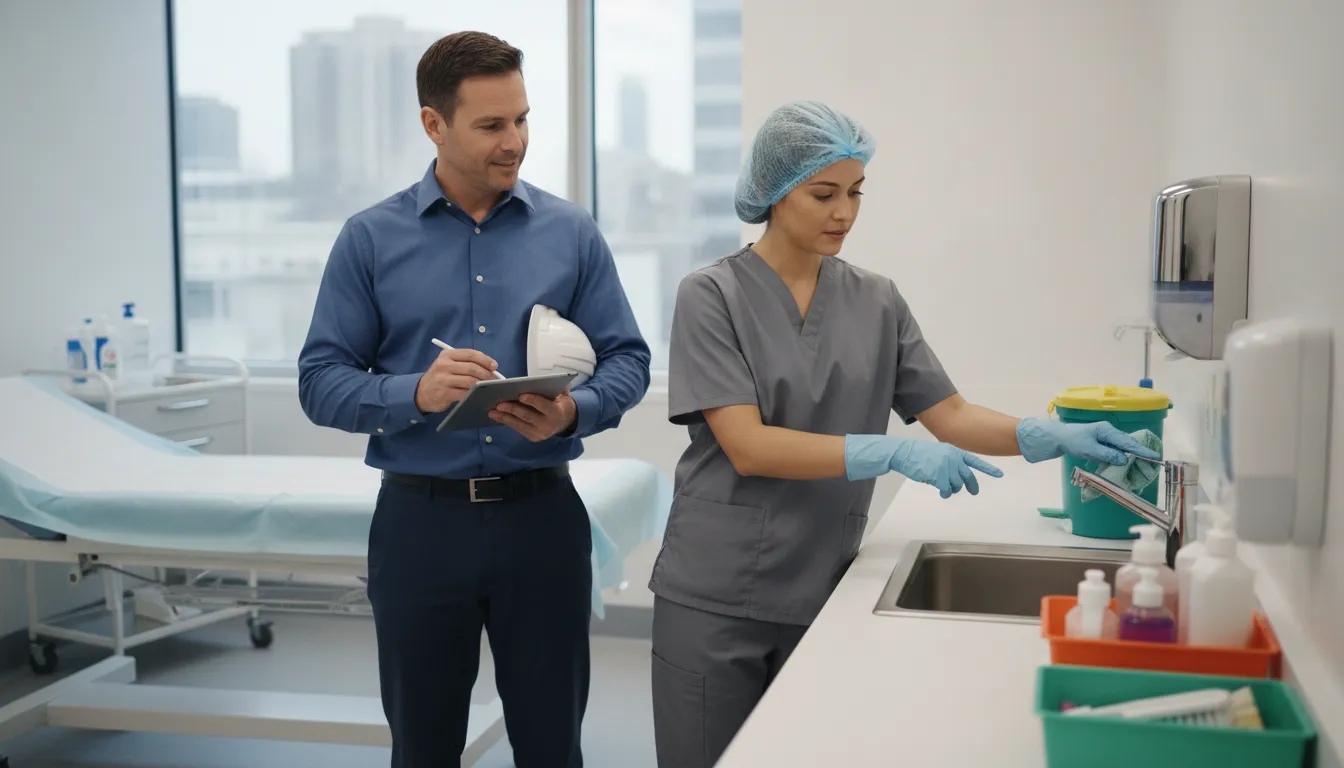
Choosing a healthcare cleaning provider is not simply a matter of comparing service lists. A medical office needs a program that accounts for patient-facing surfaces, clinical workflows, staff safety, documentation, and the level of oversight your facility can demonstrate. The right comparison focuses on how a provider trains personnel, applies setting-specific procedures, verifies completed work, and responds when conditions change.
Request a facility-specific healthcare cleaning discussion with Foreman Pro Cleaning
The best healthcare cleaning companies are not defined by broad promises alone. They can explain their infection-prevention procedures, show how staff are trained and supervised, document inspections and corrective action. And tailor the scope to your facility’s patient population, surfaces, schedule, and risk considerations.
For buyers in Maryland, D.C., and Virginia, this framework creates a more useful conversation with every vendor, including Foreman Pro Cleaning. It also helps separate a generic janitorial proposal from an accountable environmental-services program. Start by asking what evidence supports each provider’s claims and how the proposed work will fit your facility’s actual operations.
What Should You Look For in the Best Healthcare Cleaning Companies?
The strongest healthcare cleaning providers can explain how their work fits your facility’s infection-prevention program, not simply list tasks performed after hours. A useful comparison starts with the framework published by the Centers for Disease Control and Prevention. Its six core components include integrating environmental services into the safety culture, training personnel, selecting appropriate technologies, standardizing setting-specific protocols, monitoring performance, and providing feedback.
Use those components to structure conversations with prospective providers. Ask whether an environmental services representative can participate in defined oversight and explain who owns decisions, inspections, reporting, and corrective action. The CDC recommends multidisciplinary participation that may include leadership, quality, nursing, facilities, infection prevention, and EVS. A provider should therefore be prepared to communicate with the people who understand both patient-care risk and facility operations.
Does the provider assess your actual facility and patient flow?
A healthcare cleaning plan should reflect the spaces, surfaces, equipment, patient population, and schedule at your location. CDC core components address noncritical surfaces that contact intact skin, including examples such as beds. Handrails, and over-bed tables, as well as general housekeeping surfaces such as floors, walls, and tables. The guidance is intended for acute-care hospitals, but outpatient and long-term-care facilities can apply it with additional consideration for their patient populations.
That means a credible proposal should distinguish exam rooms, treatment areas, waiting spaces, restrooms, offices, and other zones instead of applying one generic checklist everywhere. For a medical practice, review the provider’s medical office cleaning services scope alongside your room use, turnover patterns, access restrictions, and sensitive equipment. Ask which surfaces receive routine attention, which require disinfection, and how the plan changes when your operations change.
Can the provider show how quality is measured?
Look for a defined process rather than a promise that a supervisor will occasionally look around. The CDC recommends monitoring both the effectiveness of and adherence to cleaning and disinfection protocols, then providing feedback to staff and stakeholders. Ask to see examples of inspection records, issue escalation, corrective-action documentation, and recurring performance reviews. Also clarify how responsibilities are assigned to EVS personnel and management, because accountability should not disappear when a concern crosses departments.
Finally, evaluate whether the company can connect its products, equipment, training, and procedures to your documented requirements. Foreman Pro Cleaning uses customized healthcare programs, procedure-based execution, supervisor inspection, and digital logging. Those details matter because the best choice is the provider that can make its standards visible, repeatable, and accountable in your specific environment.
How Can You Verify Healthcare Cleaning Training and Safety Practices?
A provider’s training claim matters only when you can see how it is taught, observed, documented, and reinforced. Ask to review the training framework before awarding work, then ask how supervisors confirm that technicians follow it in patient-care areas. The CDC says healthcare cleaning education should address facility cleaning and disinfection policies, correct practices observed by a trainer, transmission, infection control, and patient safety. Review the CDC healthcare infection-control framework when comparing a vendor’s program with recognized guidance.
What should observed training include?
Look for more than an orientation or product demonstration. A meaningful evaluation should show that technicians can follow the facility’s standard operating procedures. Use the assigned disinfectant correctly, protect clean areas from cross-contamination, and recognize when a task requires escalation. Ask whether a supervisor observes work in a representative exam room, treatment area, restroom, and other spaces in your scope. Ask how the observation is recorded, what happens when a step is missed, and when retraining is required.
Foreman Pro Cleaning’s healthcare programs include Bloodborne Pathogen Certified Technicians, medical-grade disinfectants, HEPA-filtered vacuums, and compliance documentation. Its operating framework includes safety training and standards implementation, procedure-based execution, supervisor inspection, and quality reporting. A buyer should request the actual documentation that supports any provider’s stated process, rather than treating a sales summary as proof.
How are PPE and bloodborne-pathogen risks addressed?
Ask the provider to explain PPE selection by task and anticipated exposure. CDC guidance says workers should be educated in the proper selection and use of PPE. With protection appropriate to potential exposure through the respiratory system, skin, or the eyes, nose, and mouth. The exact PPE depends on the infectious or chemical agent and the expected duration of exposure. CDC disinfection and sterilization recommendations also state that workers should be informed about possible health effects and the areas and tasks where exposure may occur.
Useful questions include: Which tasks are covered by bloodborne-pathogen procedures? How are sharps, spills, contaminated materials, and exposure incidents escalated? Where are exposure-control instructions maintained? How does the employer document required training, PPE availability, and incident follow-up? The answers should identify ownership and communication, not simply repeat the words “OSHA compliant.”
How can a buyer test whether safety practices are operational?
During a walkthrough, ask to see a sample training record, observation checklist, escalation contact, and corrective-action example with sensitive information removed. Confirm who communicates exposure concerns to facility leadership and how changes to the scope reach frontline staff. For a regional medical practice, a provider’s medical office cleaning services should be shaped around the facility’s patient flow, surfaces, procedures, and risk profile. Specific evidence makes it easier to distinguish a trained, accountable team from a generic promise.
What Infection-Prevention Protocols Should a Provider Explain?
A credible provider should explain how its infection-prevention program changes with the facility, patient population, surfaces, equipment, and workflow. A generic promise to disinfect every area is not a protocol. Ask to review the setting-specific standard operating procedures (SOPs), including who performs each task, which product is used, how the surface is prepared, and how completion is documented.
The CDC identifies standardized, setting-specific cleaning and disinfection protocols as a core component of a clean healthcare environment. It also recommends selecting appropriate cleaning and disinfection technologies and products, then monitoring adherence and effectiveness. Buyers can review the CDC framework when evaluating commercial cleaning services for a healthcare setting.
How are products and contact times documented?
Product selection should be tied to the surface and the task, not to a vague claim that a chemical is medical grade. Ask the provider to identify the product used for each relevant area and show the applicable label instructions, including required wet contact time. The SOP should explain how staff keep the surface visibly wet for that interval. What happens when a surface cannot tolerate the product, and how workers prevent incompatible chemicals from being combined.
This documentation matters because CDC disinfection recommendations are organized around scientific evidence, rationale, applicability, and federal regulations. The agency also notes that recommendations are evidence-based where possible, while some rely on infection-control or engineering principles and experience. A strong provider can distinguish a facility policy, a product-label requirement, and a CDC recommendation rather than presenting all three as interchangeable rules. See the CDC disinfection and sterilization recommendations and its environmental infection-control guidance for the underlying framework.
Which surfaces belong in the high-touch scope?
The scope should name high-touch surfaces rather than treating them as an implied part of routine housekeeping. CDC examples of noncritical surfaces that contact intact skin include beds, handrails, and over-bed tables. General housekeeping surfaces include floors, walls, and tables. In an outpatient setting, the practical scope may also need to address check-in surfaces, waiting-area seating, exam-room contact points, restroom fixtures, treatment areas, and shared equipment. Ask how the provider maps those touchpoints, assigns frequencies, and records completion.
Finally, do not assume an acute-care hospital protocol transfers unchanged to a clinic, dental office, urgent care center, or outpatient treatment site. The CDC states that its core components are intended for acute-care hospitals, but outpatient and long-term-care facilities can apply them with additional considerations, including patient population. That distinction should appear in the proposal and SOPs. A facility-specific plan should account for patient flow, operating hours, sensitive areas, and the difference between routine environmental cleaning and a specialized response. Foreman Pro Cleaning uses assessment and tailored planning to define that scope before execution, rather than relying on a one-size-fits-all checklist.
How Do Documentation and Quality Assurance Separate Providers?
A credible healthcare cleaning proposal should make quality visible after the crew leaves. Look for records that connect the agreed scope to observed work, documented training, inspection results, corrective action, and accountable ownership. This matters because the CDC recommends monitoring both the effectiveness of and adherence to cleaning and disinfection protocols, then providing feedback to staff and stakeholders.
Ask to see a sample, with confidential details removed, rather than accepting a promise that inspections occur. The document should identify the area or task reviewed, the date, the reviewer, the result, and the response when performance falls short. It should also distinguish routine housekeeping surfaces from patient-care touchpoints and show how the plan fits your facility’s actual use.
| Area to evaluate | Weak evidence | Stronger evidence |
|---|---|---|
| Scope | Generic task list with no rooms, surfaces, frequencies, or exclusions. | Facility-specific scope identifying patient-care areas, high-touch points, general surfaces, and service frequencies. |
| Training | Attendance claim without curriculum, observation, or renewal records. | Training records covering policies, correct-practice observation, transmission, patient safety, and PPE. |
| Inspections | Verbal assurance that a supervisor checks the work. | Dated inspection logs showing criteria, findings, reviewer, and follow-up status. |
| Corrective action | Problems are handled informally with no owner or completion date. | Each variance has a documented action, responsible person, due date, and verification of resolution. |
| Reporting | Invoices or completion notes that do not show quality results. | Regular reports summarize trends, exceptions, feedback, and adjustments for facility stakeholders. |
| Ownership | No clear escalation path between the cleaner, supervisor, and facility contact. | Named operational ownership and a defined reporting structure for environmental services. |
The CDC also recommends a defined management structure with multidisciplinary oversight, clear responsibilities, and evaluation using environmental monitoring and cleaning-monitoring data. Those principles make documentation more than paperwork. They create a feedback loop that lets a practice administrator or infection-prevention leader identify patterns and adjust the program.
When reviewing medical office cleaning services, ask how records are stored, who reviews them, how quickly issues are escalated, and whether your team receives usable summaries. Foreman Pro Cleaning describes its healthcare operations around tailored planning, procedure-based execution, supervisor inspection, and digital logging. Request examples that show how those steps would apply to your facility, rather than relying on a generic checklist.
How Should Staffing, Communication, and Scheduling Be Evaluated?
A cleaning proposal can look complete while leaving the daily chain of responsibility unclear. Ask who owns the account, who supervises the assigned team, and who can make a timely decision when access changes. A room turns over late, or a clinical priority interrupts the normal schedule. A named supervisor should be more than a contact on a proposal. That person should have defined authority to inspect work, document issues, coordinate corrections, and communicate with your practice or facility lead.
This structure should connect the cleaning team with the people responsible for operations and infection prevention. The CDC recommends a defined management structure with multidisciplinary participation and oversight, along with clear reporting and accountability for environmental services personnel. It also recommends defining program responsibilities and evaluating effectiveness through appropriate surveillance, environmental monitoring, and cleaning-monitoring data. CDC guidance on healthcare environmental cleaning provides a useful benchmark for these questions.
Can the staffing plan follow patient flow?
Review the proposed staffing pattern against the facility’s real operating day. Ask how the provider will handle reception and waiting areas, exam-room turnover, restrooms, treatment spaces, staff work areas, and any sensitive rooms. Then clarify access windows. Will service occur before opening, during a defined after-hours period, between patient blocks, or through a combination of scheduled windows? A credible plan accounts for patient schedules, staff workflows, occupancy, security procedures, and restricted access instead of assuming that every area is available at the same time.
Ask whether the same trained team is expected to return consistently, how absences are covered, and how a substitute receives the facility’s procedures before working independently. Staffing continuity matters because handoffs can affect room priorities, product use, documentation, and communication with staff.
What happens when the schedule or service changes?
Require a documented escalation path. It should identify the first contact, the supervisor, the account manager or operations lead, response expectations, and the method used to record the resolution. Ask how the provider handles missed access, urgent cleaning needs, patient-care changes, supply concerns, or a reported deficiency. The answer should describe a process, not simply promise responsiveness.
Finally, establish a routine review cadence before signing. CDC guidance calls for regular review of practices and quality measures, plus feedback to staff and stakeholders. Agree on what will be reviewed, such as inspection findings, recurring access problems, schedule changes, corrective actions, and open requests. Foreman Pro Cleaning’s medical office cleaning services can be evaluated using the same practical questions: who is accountable, how work is verified, and how the program adapts to the facility’s operating reality.
Which Facility-Specific Questions Should You Ask Before Signing?
A proposal should reflect how your facility actually operates, not just its square footage. Before selecting a provider, use a walkthrough to test whether the team can translate patient flow, clinical risk, staffing, and documentation requirements into a practical scope of work. CDC guidance notes that healthcare cleaning frameworks can be applied to outpatient settings with additional consideration for the patient population. So the right questions will vary between a dental practice, pediatric clinic, laboratory, urgent care center, and medical office.
- What type of facility and patient population will the plan cover? Ask the provider to identify every included area, from exam and treatment rooms to waiting areas, administrative spaces, laboratories, or procedure areas. Confirm whether the proposed procedures account for the age, condition, mobility, or vulnerability of the patients you serve. The CDC identifies outpatient settings as requiring special patient-population considerations when applying healthcare cleaning components: review the CDC framework.
- Which high-touch and general housekeeping surfaces are included? Request a room-by-room scope that names reception surfaces, chairs, door hardware, handrails, exam surfaces, restrooms, floors, tables, and other frequently contacted areas. The scope should distinguish noncritical surfaces that contact intact skin from equipment or areas requiring separate clinical protocols.
- Which products, tools, and contact times will be used? Ask for product names, intended applications, safety data, dilution instructions, and the required wet contact time. Confirm whether the provider uses medical-grade disinfectants, appropriate equipment, and HEPA-filtered vacuums where the facility’s surfaces and procedures warrant them. Do not accept a generic statement that an area will be sanitized.
- Who will perform the work, and how are they trained? Ask whether assigned personnel receive healthcare-specific training, PPE instruction, bloodborne-pathogen safety training, and observed practice review. Confirm whether a supervisor or named account lead is responsible for onboarding, coverage, and performance follow-up.
- How will cleaning align with access, staffing, and patient schedules? Discuss operating hours, treatment turnover, after-hours entry, restricted rooms, keys or badges, alarm procedures, and interruptions to patient care. Ask how absences are covered and how the provider communicates schedule changes.
- What documentation and escalation process will we receive? Request sample logs, inspection records, training documentation, corrective-action records, and reporting cadence. Clarify who receives deficiencies, how urgent concerns are escalated, and when the plan is reviewed. A facility-specific program should support accountability through defined responsibilities, monitoring, and feedback rather than relying on verbal assurances.
- Where does healthcare cleaning end and specialized environmental work begin? If your site includes a laboratory, imaging area, isolation space, or data center, ask which procedures are included and which require a separate scope, training pathway, or specialist. Foreman Pro Cleaning can discuss medical-office cleaning services in the context of your facility’s actual layout and operating requirements.
Why Should the Proposal Match Your Facility’s Risk and Scope?
The strongest proposal is not necessarily the longest or least expensive. It is the one that accurately reflects how your facility operates, who uses each space, and which surfaces, workflows, and risks require documented attention. A medical office, outpatient clinic, laboratory, and critical environment may all need disciplined cleaning, but they do not have identical operating conditions or service boundaries.
For medical offices and outpatient settings, the scope should account for patient population, exam and treatment areas, waiting rooms, restrooms, floors, handrails, tables, and other noncritical surfaces. The CDC notes that its core components address surfaces that contact intact skin, and that outpatient facilities can apply the framework with additional consideration for their patient populations. Read the CDC guidance on healthcare environmental cleaning before accepting broad language such as “healthcare-grade” without a defined work plan.
A sound proposal should show how responsibilities are assigned, how environmental services connects with facility leadership and infection prevention, and how the program will be monitored. The CDC recommends defined management structures, clear accountability for EVS personnel, regular review of practices and quality measures, and evaluation using cleaning-monitoring and environmental data. Those principles translate into practical buyer questions: Who owns the account? What gets inspected? How are missed tasks escalated? What documentation will the facility receive?
How Does Critical-Environment Scope Differ From Medical-Office Cleaning?
Critical-environment cleaning should not be treated as an upgraded version of routine medical-office service. Data centers, laboratories, cleanrooms, and other sensitive environments may require different access controls, work sequencing, equipment requirements, contamination-control procedures, and reporting. Buyers evaluating those conditions should review the provider’s critical environment cleaning capabilities separately from its medical office cleaning services.
Foreman Pro Cleaning develops proposals after walkthrough and discovery, considering layout, complexity, foot traffic, frequency, environment type, compliance requirements, and specialized protocols or equipment. Its healthcare offering includes Bloodborne Pathogen Certified Technicians, medical-grade disinfectants, HEPA-filtered vacuums, and compliance documentation, with a four-phase approach covering assessment, preparation, the cleaning program, and presentation. That level of detail lets a buyer compare a defined service plan rather than a generic list of tasks.
Request a facility-specific cleaning assessment from Foreman Pro Cleaning
Frequently Asked Questions
How can you compare the best healthcare cleaning companies fairly?
Use the same questions for every provider. Ask about healthcare-specific training, facility assessment, setting-specific procedures, supervision, inspection records, corrective action, communication, insurance, and documented scope. The strongest proposal explains how those elements fit your patient population, surfaces, schedule, and operational risks instead of relying on broad claims.
What healthcare cleaning training should a provider be able to document?
Request records showing instruction in cleaning and disinfection policies, infection-control fundamentals, patient safety, bloodborne-pathogen precautions, and appropriate personal protective equipment. CDC guidance also emphasizes observing correct practices, not simply completing a classroom module. Ask who verifies competency and how retraining is handled when procedures change or an inspection identifies a deficiency. CDC guidance
How do I know whether a cleaning plan fits my medical facility?
Start with a walkthrough that maps exam rooms, waiting areas, restrooms, administrative areas, treatment spaces, equipment, high-touch surfaces, storage, and access restrictions. Then confirm frequency, products, contact-time procedures, after-hours access, and boundaries around clinical or specialized areas. CDC notes that outpatient facilities can apply core environmental-cleaning components with additional consideration for their patient population. CDC guidance
What quality-assurance records should a healthcare cleaning provider share?
Ask for a sample service log, inspection or audit format, issue-escalation process, corrective-action record, and reporting cadence. A useful system identifies what was reviewed, who reviewed it, what required attention, and how resolution was confirmed. CDC recommends monitoring adherence and effectiveness, maintaining clear accountability for environmental-services personnel, and providing feedback to staff and stakeholders. CDC guidance
How Can You Start Comparing Healthcare Cleaning Providers?
The right provider should be able to explain its healthcare-specific training, infection-prevention procedures, documentation, staffing model, quality checks, communication process, and facility scope in clear terms. A walkthrough can turn those questions into a practical service plan that reflects your patient areas, operating schedule, access controls, and reporting needs.
Foreman Pro Cleaning serves healthcare and commercial facilities across Maryland, Washington, D.C., and Virginia with customized cleaning programs designed around each facility’s requirements. Bring your evaluation criteria to the conversation and ask for a scope that your team can review.
Contact Foreman Pro Cleaning to discuss your facility-specific healthcare cleaning needs.
