
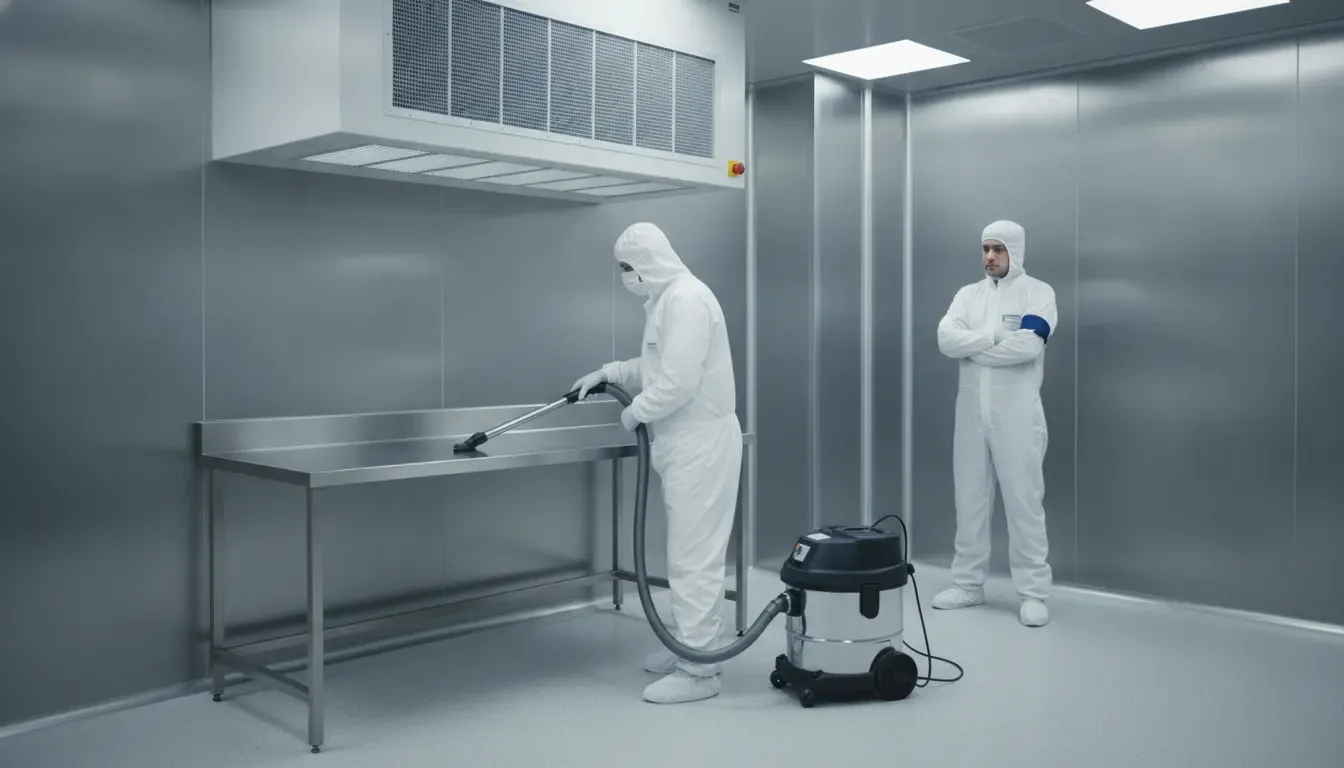
Cleanroom cleaning services should do more than make a controlled space look presentable. They should help facility managers protect a defined process by aligning room classification, contamination risks, personnel movement, approved materials, written procedures, and service records. That is why the right program begins with a facility assessment, not a generic checklist.
Request a cleanroom cleaning services assessment from Foreman Pro Cleaning
This guide explains what facility managers should expect before, during, and after specialized cleanroom cleaning. It also clarifies how cleanroom work differs from laboratory cleaning, how standards inform the scope, and which questions belong in a proposal or statement of work.
What should cleanroom cleaning services protect?
A cleanroom program should protect the conditions that allow a process, product, research activity, or sensitive operation to perform as intended. Airborne particles are one part of that concern. The facility may also need to control residues, surface contamination, material transfer, personnel movement, static, moisture, or the disturbance created by the cleaning activity itself.
ISO 14644-1:2015 classifies air cleanliness by the concentration of airborne particles within specified particle-size ranges. It does not prescribe one universal cleaning routine for every room. Instead, the classification gives the facility a technical reference that should be considered alongside process requirements, room design, airflow, equipment, and site procedures.
That distinction matters when a facility manager evaluates a proposal. A provider should be able to explain how its work supports the broader contamination-control strategy without claiming that cleaning alone creates or guarantees a room classification. Classification, filtration, airflow, maintenance, operations, personnel behavior, and monitoring all contribute to performance.
How does classification shape the cleaning plan?
The cleanroom classification is a starting point for planning the level of control, but it is not the entire scope. Managers should identify the classification of each relevant room or zone, the state in which it is classified, and the process that the room supports. A room operated at rest may have different expectations from a room operating during production or active work.
What is the difference between classification and cleaning?
Classification describes measured air cleanliness by particle concentration. Cleaning is an operational activity intended to control or remove contamination from defined surfaces and areas. The cleaning plan should be designed to support the room’s operating requirements, while testing and monitoring should be handled through the facility’s authorized verification program.
The ISO 14644-2:2015 monitoring standard specifies minimum requirements for a monitoring plan related to air cleanliness by particle concentration. A cleaning contractor may contribute service records, observations, and exception reports, but the facility owner or qualified process team must define which tests, limits, investigations, and release decisions apply.
How should zones and flows be mapped?
A practical scope separates classified rooms, airlocks, gowning areas, material staging, corridors, support rooms, and other adjacent spaces. It should show how personnel and supplies enter, where tools are staged, which route the technician follows, and how used materials leave. The plan should also identify transition points where movement could introduce or redistribute particles.
Managers should expect the provider to ask for room drawings, access rules, gowning requirements, production windows, restricted areas, and existing standard operating procedures. Those questions are signs of responsible planning, not unnecessary complexity.
Which process risks should facility managers identify?
Before service begins, facility managers should identify what the cleanroom is protecting and what could be disrupted by cleaning. The risk review should be specific to the facility rather than based only on square footage or service frequency.
- Product or process exposure: Identify whether work occurs during production, between batches, during shutdown, or only after authorized clearance.
- Particle sensitivity: Note the room classification, critical surfaces, airflow pattern, and activities that could disturb settled particles.
- Residue and chemical risk: List substances, residues, disinfectants, or process materials that require special boundaries or escalation.
- Equipment sensitivity: Define which exterior surfaces may be cleaned, which equipment must remain untouched, and who can authorize access.
- Material compatibility: Identify surfaces, coatings, seals, flooring, fixtures, and other materials that could be damaged by an unsuitable product.
- Access and safety: Document gowning, entry, lockout, restricted areas, waste boundaries, and emergency contacts.
- Change events: Account for maintenance, construction, spills, new equipment, process changes, or unusual traffic that could require a revised scope.
A strong cleanroom cleaning services proposal turns these risks into a defined work boundary. It should state what the cleaning team will do, what it will not do, what the facility must prepare, and how exceptions will be handled.
What personnel controls should be in the scope?
People are part of the contamination-control plan. The service scope should explain how technicians are trained for the environment, what authorization is required, how gowning is performed, how supplies are introduced, and how personnel move between rooms or zones.
ISO 14644-5:2025 describes an operations control program that includes personnel management, entry and exit of personnel and materials, cleaning, maintenance, and monitoring. Its listed operational topics also include gowning and training. For a facility manager, the practical implication is that a cleaning provider should fit into the site’s existing operating controls rather than arrive with an isolated routine.
What happens before service begins?
Pre-service coordination may include a walkthrough, document review, security or access approval, gowning orientation, hazard communication, and a responsibility matrix. The facility should identify who clears work areas, who moves or secures materials, who authorizes equipment access, and who reviews exceptions.
Technicians should have a clear escalation path for a blocked doorway, damaged surface, unknown residue, active process, missing supply, or condition that differs from the approved procedure. Stopping and reporting an unexpected condition is safer than improvising inside a controlled space.
Foreman Pro Cleaning positions its critical-environment work around specialized training, customized plans, and leadership experience in IT operations and facilities management. Its critical environment cleaning overview describes the planning approach used for sensitive facilities across Maryland, Washington D.C., and Virginia.
How should validated procedures govern the work?
Cleaning should be performed against an approved, repeatable procedure. The procedure may identify the work sequence, room or zone boundaries, approved tools, cleaning agents, contact or dwell requirements where applicable, change controls, and completion criteria. It should be written so that a supervisor can determine whether the work followed the intended method.
In regulated sterile-drug settings, the FDA guidance on sterile drug products produced by aseptic processing addresses critical areas, personnel training and monitoring, environmental monitoring, written programs, and disinfection efficacy. The exact regulatory requirements that apply depend on the facility and process. A cleaning provider should therefore work from the customer’s approved procedures and regulatory responsibilities rather than present one method as universally sufficient.
What should a repeatable procedure include?
- The room, zone, or surface boundary covered by the task
- Required entry controls, gowning, and personal protective equipment
- Approved equipment, tools, wipes, and cleaning agents
- Cleaning sequence and direction of work
- Restrictions around process equipment, samples, utilities, and sensitive surfaces
- Required frequency, event triggers, and periodic detail work
- Completion checks, supervisor review, and exception escalation
- Rules for revising the procedure when the facility or process changes
Validation and qualification are facility-specific responsibilities. A provider can execute a defined procedure and supply records, but it should not imply that a service visit substitutes for the customer’s process validation, environmental monitoring, or release decision.
Talk with Foreman Pro Cleaning about a documented cleanroom service scope
Which materials and equipment are compatible?
Material compatibility should be confirmed before work starts. The correct product or tool depends on the surface, room requirements, process residues, facility approval, and the risk of leaving particles or chemical residue behind. A cleaning provider should not substitute a familiar product simply because it is commonly used in ordinary commercial areas.
The ISO 14644-5 abstract specifically excludes detailed requirements for equipment and materials associated with individual processes and products, as well as cleaning-agent compatibility with cleanroom materials. That limitation is useful guidance for procurement: the facility must communicate its approved materials and constraints, and the service plan must respect them.
Equipment selection should also reflect the room and the task. Depending on the approved procedure, a scope may address dedicated tools, low-shedding wipes, controlled vacuuming, damp methods, surface-specific tools, tool segregation, and the movement of supplies. Equipment should be maintained and inspected so that cleaning does not introduce a new source of contamination.
Facility managers should ask for the proposed equipment list and confirmation that technicians understand what may be used in each zone. If a provider cannot explain how it prevents cross-use between areas, the proposal needs more detail before approval.
What documentation should managers expect?
Documentation turns a service visit into an auditable operational activity. The exact record set should be defined by the facility, but a useful cleanroom cleaning services program commonly records:
| Planning layer | What the reference addresses | What managers should expect in a service conversation |
|---|---|---|
| ISO 14644-1:2015 | Classification of air cleanliness by airborne particle concentration, using specified particle-size ranges | A scope that identifies the relevant room classification and avoids treating every controlled space as the same |
| ISO 14644-2:2015 | Minimum requirements for a monitoring plan related to air cleanliness by particle concentration | Clear separation between cleaning records and the facility’s authorized monitoring and release program |
| ISO 14644-5:2025 | Operations control program covering personnel, material movement, cleaning, maintenance, and monitoring | Defined entry, gowning, training, work sequence, material transfer, and exception controls |
| FDA aseptic processing guidance | Guidance for sterile-drug facilities covering critical areas, training, monitoring, written programs, and disinfection efficacy | A procedure-based scope that is coordinated with the customer’s regulatory and quality systems |
At the service level, managers may also request room and zone identification, date and time, technician or supervisor sign-off, tasks completed, approved products used, skipped tasks, access issues, observed damage, and corrective-action follow-up. These records help the facility identify repeated scope gaps and decide when a procedure or schedule needs review.
Foreman Pro’s critical-environment operating model includes a tailored plan, specialized execution, supervisor quality assurance, a post-delivery report, and program assessment. Those elements can help facility managers connect recurring cleaning to ongoing operational oversight.
How do cleanroom and laboratory cleaning differ?
Cleanroom cleaning and laboratory cleaning should remain distinct service concepts. A cleanroom program is anchored in the requirements of a classified or otherwise controlled environment. Laboratory cleaning is anchored in the work performed in the laboratory, including chemicals, biological materials, equipment, experiments, waste boundaries, and laboratory-specific safety procedures.
A laboratory may contain a cleanroom, but not every laboratory is a cleanroom. A cleanroom may also support manufacturing, electronics, medical-device, or other technical work that is not a laboratory. The service provider should use the correct label and build the scope around the actual operation.
Foreman Pro’s laboratory cleaning service is a separate reference point for facilities where laboratory workflows and hazards drive the plan. Keeping the two scopes distinct helps prevent a generic laboratory checklist from being presented as a cleanroom protocol, or a particle-focused cleanroom routine from overlooking laboratory hazards.
When should facility managers request a cleanroom cleaning assessment?
Request an assessment when a facility is commissioning a new room, changing a process, reviewing a contractor, expanding into a new area, responding to recurring monitoring concerns, or replacing an informal cleaning routine with a documented program. An assessment is also useful after construction, equipment installation, maintenance, a spill, or a significant change in traffic or access.
Before the walkthrough, gather room classifications, floor plans, operating schedules, approved procedures, material restrictions, monitoring responsibilities, access requirements, and any recent findings. The more specific the inputs, the more useful the proposed scope will be.
For facilities in Maryland, Washington D.C., and Virginia, Foreman Pro Cleaning can evaluate the relationship between the environment, the work schedule, the surfaces, and the required controls. A customized plan is more useful than a rate based only on square footage because it shows what the team will do and how the work will be managed.
What questions should managers ask before selecting a provider?
- How do you assess room classification, process risk, and facility-specific restrictions?
- What training and supervision do technicians receive for critical environments?
- How do you control entry, gowning, material transfer, and movement between zones?
- Which tools, equipment, wipes, and cleaning agents are proposed, and who approves them?
- How are equipment boundaries, samples, waste, and unknown conditions handled?
- What procedure governs the work, and how are revisions approved?
- What records will the facility receive after each service?
- How are skipped tasks, access problems, damage, and corrective actions reported?
- How will the cleaning schedule change when the process, occupancy, or room requirements change?
A credible provider should answer these questions with a site-specific plan. Vague references to deep cleaning, routine service, or compliance are not enough without defined methods, boundaries, responsibilities, and records.
What are common cleanroom cleaning services questions?
Does cleaning alone keep a cleanroom within classification?
No. Cleaning supports the contamination-control strategy, but room performance also depends on design, filtration, airflow, maintenance, personnel practices, material movement, process controls, and monitoring. Facility owners should define how cleaning fits into the complete program.
Should a provider clean during active production?
That depends on the room, process, approved procedure, and facility authorization. Some work may be scheduled during a defined window, while other tasks may require shutdown, clearance, or a specific operating state. The service scope should state the permitted timing instead of assuming access.
Are cleanroom cleaning services the same as laboratory cleaning?
No. The two services can overlap in training and contamination awareness, but their scopes are driven by different conditions. Cleanroom work centers on the controlled environment and its operating requirements, while laboratory work must account for the activities, hazards, equipment, and materials handled in the laboratory.
What should be documented after a service visit?
At minimum, the facility should define the rooms or zones serviced, completed tasks, approved materials used, date and time, technician or supervisor sign-off, exceptions, and follow-up actions. Additional records may be required by the facility’s quality or regulatory program.
Request a facility-specific cleanroom cleaning services plan from Foreman Pro Cleaning
Cleanroom cleaning is most effective when it is planned as part of the facility’s operating system. Classification, process risk, personnel controls, compatible materials, validated procedures, and documentation should work together. Foreman Pro Cleaning serves critical environments across Maryland, Washington D.C., and Virginia with customized planning and trained support for sensitive facilities.
