
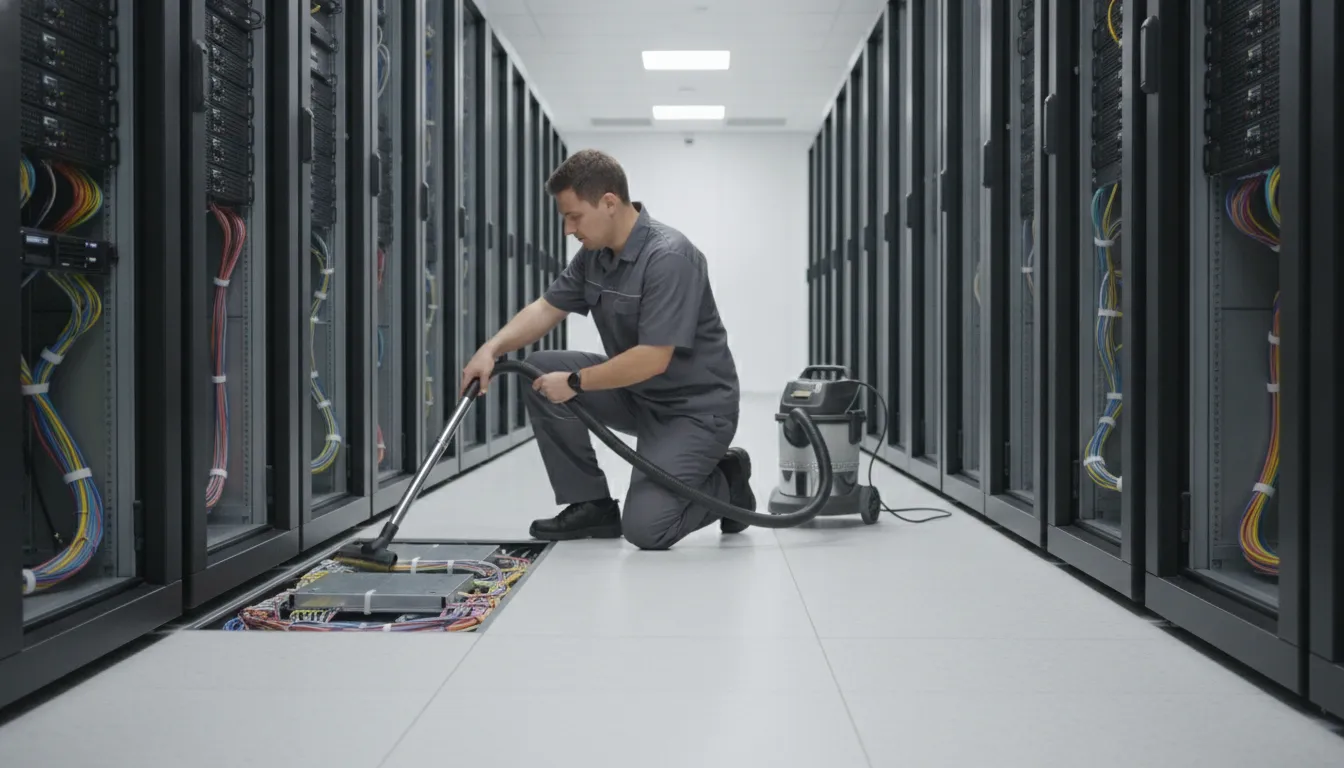
Choosing among data center cleaning companies is not the same as hiring a general commercial cleaning provider. The right specialist must understand contamination control, electrostatic discharge (ESD) risk, raised-floor airflow, restricted access, and the operational discipline required around live infrastructure. This guide gives data center operators a practical way to compare providers before a proposal becomes a service interruption.
Request a data center cleaning assessment from Foreman Pro Cleaning.
What makes a data center cleaning company a true specialist?
A true specialist can explain how its people, equipment, materials, documentation, and scheduling protect the facility as a connected operating environment. It does not reduce the conversation to appearance. It starts with the building’s airflow, equipment layout, access rules, maintenance windows, contamination history, and incident-response expectations.
Look for evidence in six areas:
- Contamination control: A defined approach to particulate removal, filtration, material handling, and work sequencing.
- ESD-safe methods: Clear controls for static-sensitive areas, approved tools and materials, grounding practices, and equipment boundaries.
- Raised-floor knowledge: A process for panels, pedestals, stringers, subfloor plenums, cables, and airflow paths.
- Security discipline: Technicians who can work within escort, badge, sign-in, photography, and restricted-zone requirements.
- Audit-ready reporting: Service records that identify the work area, date, scope, observations, exceptions, and follow-up items.
- Operational continuity: A plan for working around change windows, live systems, tenants, emergency priorities, and facility personnel.
Ask each provider to show the process behind these claims. A polished proposal is useful, but a walkthrough, sample report, technician training outline, and escalation plan reveal much more about readiness.
How should you evaluate contamination control?
Contamination control is the foundation of data center cleaning. A provider should be able to connect cleaning actions to the facility’s particulate, gaseous, airflow, and equipment-protection goals, rather than treating every surface as if it were an ordinary office. ASHRAE guidance on data center gaseous and particulate contamination emphasizes controlling airborne contaminants and maintaining an environment suitable for extended equipment operation.
During evaluation, ask for specifics about:
- HEPA-filtered vacuuming and how collected material is contained.
- Microfiber or other low-lint methods for cabinets, doors, grilles, and adjacent surfaces.
- The order of work, including high surfaces, equipment exteriors, floor areas, and waste removal.
- How the team prevents resuspension, cross-contamination, and movement of material between zones.
- How the provider documents visible particulate, corrosion indicators, moisture, damaged flooring, or blocked airflow.
Do not accept a generic statement that the team uses specialized equipment. Ask which equipment is used for which surface, how filters are maintained, and how the supervisor verifies the work. The strongest data center cleaning companies can describe what they will not do, such as introducing unapproved moisture near energized equipment or moving customer assets without authorization.
What should an ESD-safe cleaning method include?
An ESD-safe method is a controlled work practice, not a label on a vacuum. The provider should explain how technicians control static generation, select materials, protect equipment boundaries, and coordinate with the facility’s own ESD program. The final method should be approved for the specific environment and never assumed from a standard office-cleaning procedure.
Use these questions in the technical review:
- Which tools, cloths, vacuums, floor-care materials, and personal protective items are approved for the environment?
- How are technicians trained to recognize static-sensitive areas and avoid unsafe contact with racks, cables, power distribution, and controls?
- How are maintenance-only outlets, cord routing, and equipment clearances handled?
- Who authorizes work near live systems, and what happens when the technician finds an unsafe condition?
- How are materials stored, labeled, and transported into and out of secure areas?
Foreman Pro’s data center cleaning service describes static-safe protocols, cabinet and rack cleaning, and cleaning support for server and communications rooms. During a site review, use those service categories as prompts, then ask the provider to map each one to your facility’s written requirements.
Talk with Foreman Pro Cleaning about a facility-specific critical-environment plan.
How should a provider handle raised floors and plenums?
Raised-floor work deserves its own evaluation because the subfloor plenum is part of the facility’s airflow system. A qualified provider should plan panel access, cable and pedestal protection, zone sequencing, HEPA vacuuming, panel replacement, and a final inspection. The scope should also identify what is excluded, such as electrical or mechanical work outside the cleaning team’s authorization.
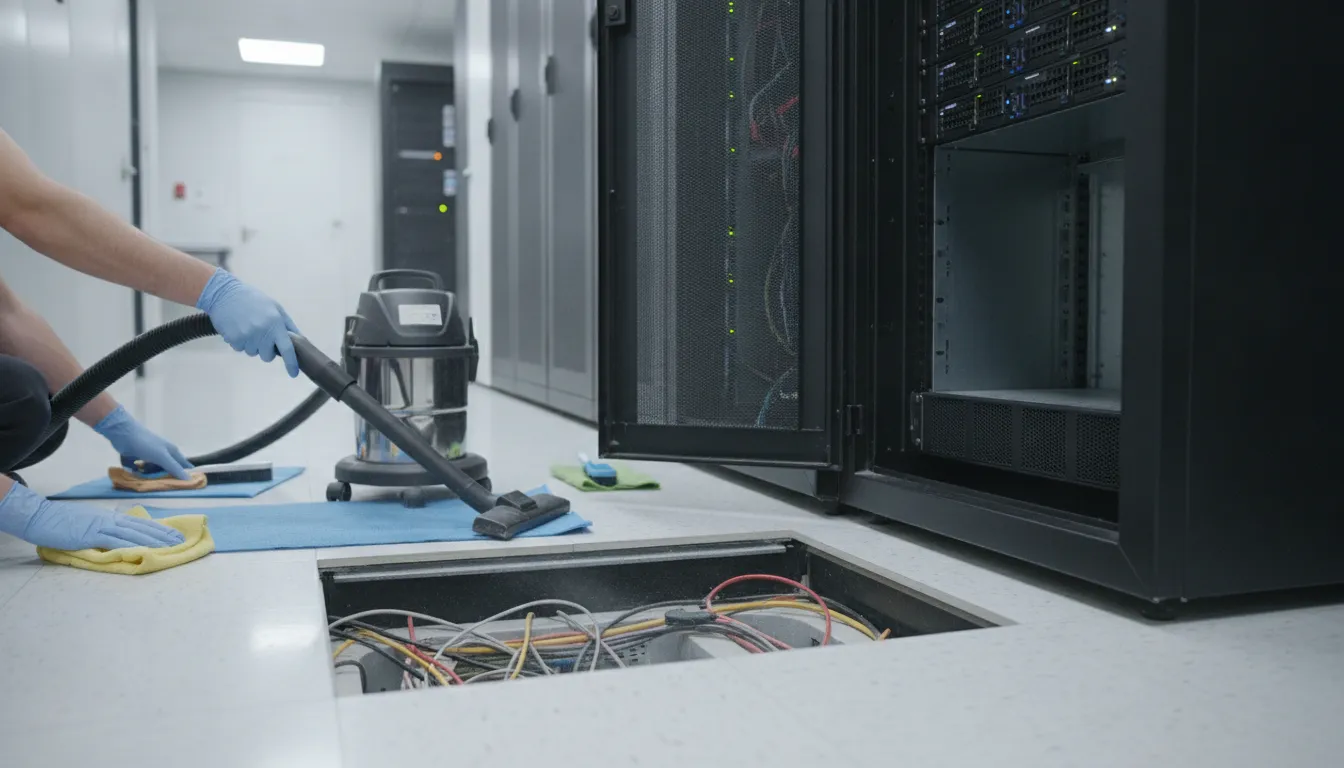
Ask whether the provider can distinguish between:
- Subfloor and plenum cleaning: Removing accumulated particulate without disturbing cables, supports, or airflow patterns.
- Top-floor care: Maintaining the walking surface with materials compatible with the facility’s ESD and flooring requirements.
- Cabinet and rack exteriors: Removing deposits without pushing material into equipment openings.
- CRAC and air-handler surfaces: Cleaning accessible grilles, returns, and surrounding areas without changing system settings.
Foreman Pro’s raised-floor cleaning service provides a useful example of a scope that includes subfloor areas, access-floor systems, server rooms, and critical-environment procedures. Your provider’s proposal should be equally specific about the areas, sequence, controls, and acceptance criteria.
Which documentation and access controls matter?
Cleaning work inside a data center becomes part of the facility’s operational record. Documentation should make it possible to confirm who entered, what area was serviced, which exceptions were found, and what needs a facilities or IT decision. Access control should be equally specific. GSA physical and environmental protection guidance aligns facility controls with NIST frameworks and illustrates why contractor activity must fit the site’s security and environmental procedures.
Request a sample redacted report and check whether it includes:
- Facility, room, zone, and service date.
- Technicians, supervisor, escort, or access record as required by the site.
- Planned scope and completed scope, including areas not accessed.
- Equipment or floor observations, photographs only when authorized, and exception notes.
- Materials or methods used when that information is needed for auditability.
- Corrective-action recommendations, owner, priority, and follow-up status.
Also ask how the provider handles keys, badges, visitor logs, sensitive information, after-hours access, and an unexpected alarm or incident. NIST storage infrastructure guidance treats physical security, authorization, change management, recovery, and incident response as connected controls. A cleaning partner should fit into that operating model rather than create a separate informal process.
How can you compare data center cleaning companies without choosing on price alone?
The most useful comparison is evidence-based. Score each provider against the same questions, then investigate gaps before comparing the final price. A lower proposal can become expensive if it leaves the facility to supply supervision, rewrite procedures, manage access exceptions, or correct incomplete work.
| Evaluation area | Evidence from a strong specialist | Question to ask before selection |
|---|---|---|
| Contamination control | Defined filtration, low-lint materials, zone sequencing, containment, and supervisor inspection. The approach is consistent with the contamination-control principles in ASHRAE’s data center guidance. | How do you prevent resuspension and document conditions that could affect equipment? |
| ESD-safe methods | Written method statements, approved materials, equipment boundaries, technician training, and a stop-work path for unsafe conditions. | Which parts of your method change for our ESD flooring, racks, and live systems? |
| Raised-floor protocols | Panel and cable protection, plenum cleaning sequence, HEPA vacuuming, controlled replacement, and final inspection. | Who authorizes panel access, and how do you record areas that could not be reached? |
| Documentation | Service reports with scope, zones, exceptions, observations, corrective actions, and supervisor sign-off. | Can we review a redacted report before signing? |
| Access and security | Background and site training as required, badge and escort compliance, restricted-zone rules, and incident escalation. | How are access changes, lost badges, alarms, and unauthorized requests handled? |
| Training and continuity | Critical-environment SOPs, site orientation, maintenance-window coordination, backup coverage, and an escalation contact. | What happens if our window changes or a critical event pauses the work? |
How should continuity and scheduling be tested?
A data center cleaning plan should fit the facility’s operating rhythm. The provider should be able to schedule work during approved maintenance windows, overnight periods, weekends, or other lower-risk times without treating timing as an afterthought. The plan should identify a supervisor, escalation contact, stop-work triggers, rescheduling process, and response expectations for an urgent contamination or recovery need.
Before award, walk through one realistic scenario: a scheduled raised-floor service is underway when IT begins an unplanned change. Ask who pauses the work, who confirms the area is safe, how panels and tools are secured, and how the team records the incomplete scope. Then ask how the provider handles a water event, construction dust, equipment relocation, or a request to clean a new room quickly.
The provider should also explain how it maintains consistency across recurring visits. A repeatable checklist, supervisor review, digital service log, and post-delivery report are more useful than a promise that the same person will always appear. The goal is predictable execution even when the facility, shift, or technician changes.
Why does critical-environment training change the outcome?
Training changes the outcome because data center cleaning requires situational judgment. Technicians must understand the difference between a safe accessible surface and a boundary that belongs to IT, electrical, mechanical, or security personnel. They must recognize when a panel, cable, air path, material, or schedule creates risk and know when to stop and escalate.
Foreman Pro Cleaning positions its critical-environment work around proprietary training, IT operations knowledge, facilities-management experience, supervisor inspections, and documented service delivery. Its critical environment cleaning program covers data centers, server rooms, network rooms, command centers, and related facilities across Maryland, Washington D.C., and Virginia. That combination is relevant for DMV operators who need a cleaning partner to understand both the physical facility and the operational consequences of a mistake.
Ask to see the training path, not just the word “trained” in a proposal. A useful answer covers new-hire orientation, site-specific access rules, critical-environment SOPs, equipment and material handling, incident response, supervisor sign-off, and refresher training. It should also explain how the company evaluates work after the technician leaves the room.
What questions should you ask before signing?
Use this short checklist in your final provider interviews:
- Which data center, server-room, colocation, or network-room environments have you serviced?
- What written contamination-control and ESD-safe procedures will apply to our site?
- What exactly is included for raised floors, subfloor plenums, racks, cabinets, CRAC surfaces, and adjacent rooms?
- Which areas require customer authorization, escort, shutdown, or a separate trade?
- What training and supervision will each technician receive before entering our facility?
- What report will we receive, and how are exceptions and corrective actions tracked?
- How do you coordinate with our maintenance windows and change-management process?
- Who can stop work, and who can authorize a safe restart?
- What is the escalation path for an alarm, spill, contamination event, damaged floor, or access issue?
- Can we review references, sample documentation, insurance details, and the service agreement before approval?
Answers should be specific to the site. If every provider receives the same generic checklist regardless of room layout, flooring, access model, airflow strategy, and operational schedule, the evaluation has not gone far enough.
Contact Foreman Pro Cleaning to compare a customized data center cleaning plan for your facility.
What are common questions about data center cleaning companies?
How often should a data center be professionally cleaned?
There is no responsible single interval for every facility. Frequency should reflect contamination history, construction activity, traffic, airflow, flooring, equipment density, maintenance windows, and the site’s risk tolerance. A qualified provider should begin with a walkthrough and recommend a documented schedule that can be reassessed.
Can a general commercial cleaning company clean a data center?
A general provider may be able to support non-critical adjacent areas, but work inside a data center requires additional controls. Confirm experience with ESD-safe methods, raised floors, restricted access, low-lint materials, equipment boundaries, supervisor inspection, and operational continuity before assigning the scope.
What should be included in a data center cleaning proposal?
The proposal should define rooms and zones, surfaces, raised-floor and plenum scope, methods, materials, equipment, access requirements, schedule, supervision, reporting, exclusions, escalation, and acceptance criteria. It should also identify the customer decisions needed before work begins.
Why is raised-floor cleaning important in a data center?
Raised-floor systems can contain airflow paths, cables, pedestals, and accumulated particulate. Cleaning must be controlled so the work removes material without disturbing infrastructure or changing the facility’s operating conditions. The provider should explain panel access, cable protection, filtration, sequencing, and final inspection.
How do I compare data center cleaning companies in Maryland, D.C., or Virginia?
Compare documented technical methods, critical-environment training, access discipline, reporting, supervisor coverage, response capability, and site-specific planning. Price matters, but it should be evaluated after confirming that every provider is quoting the same rooms, controls, schedule, and acceptance standard.
