
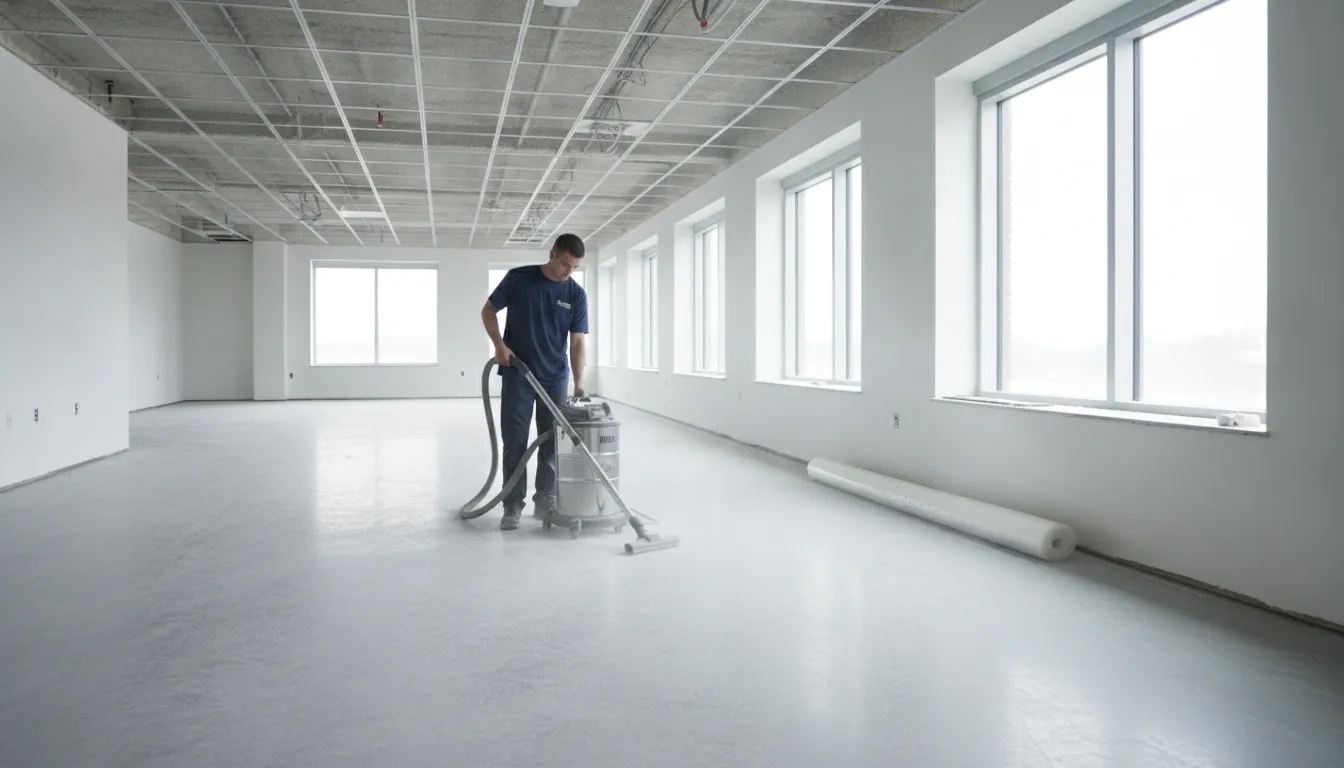
A post construction cleaning scope of work lists the phases, surfaces, exclusions, and acceptance checks. The GC, the owner, and the crew all price against that list. Without that document, “final clean” means debris to one bidder and a presentation-ready floor to another. Foreman Pro Cleaning writes the scope after a walkthrough of the commercial space, then prices only what the document names.
Request a post-construction cleaning quote
Commercial clean-up services are where a project team starts. This page is only the written scope that locks the work before anyone is on site. What rough, final, and touch-up cleaning cover sits on the post construction cleaning guide. Project teams across Maryland, Washington, D.C., and Virginia use the scope when the punch list is closing and the certificate of occupancy is already on the calendar.
What Should a Post Construction Cleaning Scope of Work Name?
A usable scope names the building, the party who owns the document, the phases that are in, and the conditions that are out. It is a contract exhibit, not a brochure. Foreman Pro Cleaning treats it as the record the crew, the superintendent, and the owner’s representative can hold up during a walk.
Put these fields at the top, before any task list:
- Project name, address, and the floors or suites in the clean. A Columbia office build-out and a Newport News clinic do not share a scope.
- The party who issues the scope: general contractor, construction manager, or owner. Name who can add work after the walkthrough.
- The date of the site walk and the people who attended. A scope written from drawings alone misses protection left on floors and stickers left on glass.
- The target handover date and whether the building will be empty, partially occupied, or already running systems.
- The acceptance standard: a joint punch walk, a written deficiency list, and a return visit only for items on that list.
Foreman Pro Cleaning is family-owned, licensed, bonded, and insured, with offices in Annapolis, Washington, D.C., and Yorktown. Justin Foreman, co-founder, came out of construction management, so the scope is written the way a superintendent already reads a trade package: inclusions, exclusions, and a sequence. The crew does not invent a second scope on the day of the clean.
Who Writes the Post Construction Cleaning Scope of Work?
The general contractor should own the scope, because the GC owns the schedule and the other trades still in the building. The cleaning firm should draft the task lines from the walkthrough, and the owner or facilities lead should confirm what “ready” means for the first occupants. If only one of those three writes it, the other two will argue about it at handover.
On Foreman Pro projects the sequence is fixed. A project manager walks the space with the superintendent. The walk records square footage by floor type, the finishes that cannot take a wet method, remaining protection, and any area still held by another trade. The written scope goes back to the GC before a price. A quote that arrives without that document is a guess, and guesses are what produce change orders the week of move-in.
Occupied work needs its own line. If staff are already in part of an Arlington or Bethesda building, name the work zone and the hours. Also name the debris path so it does not cross a live corridor. That coordination is separate from the task list. It is also why a scope copied from the last job fails: the last job was empty.
Which Phase Lines Belong in the Scope?
Phase names only help if each phase has tasks, an endpoint, and a handoff. Foreman Pro Cleaning uses three phases on commercial post-construction work. The scope should list them as separate line items so a GC can authorize phase one while phase three waits for dust to settle.
| Scope line. | In the document. | Endpoint the GC can accept. | Typical exclusion. |
|---|---|---|---|
| Phase 1, preparation. | Large debris, boxes, wrapping, stickers and tags, heavy high dusting, and bulk floor particles. | Floors are clear of construction waste and of protection the GC has released. | Hauling the GC’s own dumpsters were priced to take. |
| Phase 2, detail clean. | Top-down dusting, ledges, fixtures, restrooms, kitchenettes, a HEPA vacuum of carpet, and a hard-floor machine clean per the manufacturer. | Surfaces are wiped once from the ceiling line down to the floor. | Floor finish work such as strip and wax, unless it is added as its own line. |
| Phase 3, presentation. | A second dusting after overnight settle, a second HEPA vacuum, and a damp mop or auto-scrub of hard floors. | A joint walk with a written deficiency list. | A standing janitorial program after occupancy. |
Phase 1 is preparation: boxes, wrapping, stickers, tags, and the heavy soil on high surfaces. Phase 2 is the detail clean, top to bottom, including restrooms and kitchenettes. Carpet gets a detailed HEPA vacuum. Hard floors are machine cleaned, dust mopped, or damp mopped according to the finish manufacturer, not according to whatever pad is on the truck. Phase 3 waits for dust to settle, often overnight, then repeats the dusting, the vacuum, and the hard-floor pass. The building is ready for business only after that third pass.
Keep floor-finish work out of these three lines. Hard floor cleaning such as strip and refinish, and commercial carpet cleaning beyond the construction vacuum, are separate scopes. Folding them into “final clean” is how a VCT floor gets priced twice or not at all.
How Should Dust Control Be Written into the Scope?
Construction dust is the line that separates a real scope from a janitorial task list. Drywall sanding, concrete cutting, and masonry leave respirable particles that a household vacuum puts back into the air. The scope should name the control, not the brand of machine.
OSHA’s construction silica rule, 29 CFR 1926.1153, sets the permissible exposure limit for respirable crystalline silica at 50 micrograms per cubic meter as an 8-hour time-weighted average. The same section bars dry sweeping or dry brushing where that work could add to silica exposure. Wet sweeping, HEPA-filtered vacuuming, or another lower-exposure method is required when it is feasible. It also bars compressed air for cleaning clothing or surfaces unless the air is captured by ventilation or no alternative exists. OSHA defines a HEPA filter as at least 99.97 percent efficient at 0.3 micrometers.
Write that into the scope as three plain rules. Fine particulate is lifted with a HEPA-filtered vacuum, not a dry broom. Compressed air is not a cleaning method on this project. Wet methods are used only where the finish manufacturer allows them. Foreman Pro Cleaning runs HEPA-filtered vacuums on commercial and critical-environment work, including post-construction cleans in data centers. The scope then matches a method the crew already uses.
If the project is a server room or a raised-floor space, do not bury that work in the office scope. Data center cleaning has its own access rules, ESD controls, and subfloor sequence. A scope that says “clean the IT room the same as the offices” is the scope that puts the wrong vacuum under a live rack.
What Should the Scope Exclude on Purpose?
Exclusions protect the price. A scope that only lists inclusions invites every leftover trade task onto the cleaning invoice. Name the outs in the same document, in the same font, not in a footnote.
- Other trades’ punch work: paint touch-up, caulk, device covers, and missing trim stay with the trade that owns them.
- Debris the GC has already contracted a hauler to remove, including roll-off dumpsters and pallet disposal.
- Exterior grounds, scaffolding, and roof surfaces, unless a separate exterior line is added.
- Window film removal and high-rise glass that needs a suspended scaffold or a lift the GC has not provided.
- Floor protection that is still holding an active trade. The scope should say who pulls protection and when.
- Ongoing janitorial after the certificate of occupancy. That is a different contract, usually an office cleaning program with its own frequency.
Foreman Pro Cleaning will add floor care, carpet extraction, or window work when the walkthrough shows they belong. They go in as their own lines with their own acceptance, not as a silent part of phase 3. The post-construction cleaning checklist is the field tool the crew uses once the scope is signed. It does not replace the exclusions.
How Does the Walkthrough Lock the Scope Before a Quote?
The walkthrough is the moment the scope stops being a template. Foreman Pro Cleaning does not price a commercial clean from a square-foot number emailed over. The project manager needs to see the finishes, the dust load, and what is still in the way.
On the walk, record four things and attach them to the scope:
- Area by finish: carpet, VCT, polished concrete, tile, and any floor still under protection. Each finish gets the method the manufacturer allows.
- Height and access: open ceiling, ladder work, lifts the GC will provide, and rooms the crew cannot enter yet.
- Systems that are already live: HVAC running, furniture installed, or a partial tenant. Live systems change both the sequence and the hours.
- The handover path: who walks at the end, how deficiencies are written, and how many return visits the base scope includes. One return for listed items is normal. Open-ended “until the owner is happy” is not a scope.
That record is what Annapolis, Washington, D.C., and Yorktown crews take to the building. The same three-hub coverage is why a scope for a Baltimore suite and a scope for a Hampton Roads clinic should not be copied from each other. The method is the same. The building is not.
Once the GC accepts the document, the quote matches the lines and nothing else. Added suites, a slipped trade, or a request to clean before the dust has settled becomes a written change, not a favor at the end of the shift. Teams who want the underlying service described first can read that service page and then bring this scope to the walkthrough.
How Should Acceptance Be Written So the Clean Can Close?
A scope that never says how the job ends stays open. Foreman Pro Cleaning closes a commercial post-construction clean on a joint walk, not on a text message that says the space looks good. The acceptance block belongs in the scope, next to the phase lines, before anyone talks about price.
Write the close in five lines the superintendent can initial:
- Who walks: the GC superintendent and the Foreman Pro project lead. The owner joins when the owner is the accepting party.
- When the walk happens: after phase 3, under the permanent lighting the occupants will use. A walk under temporary lamps hides film on glass.
- How deficiencies are recorded: one written list, item and room, issued the same day. Verbal punch items do not exist after the walk.
- What the base scope includes: one return visit for items on that list. Items that belong to another trade are marked and sent back to the GC.
- What starts the close: the signed list, not the day the crew arrived. Open items stay open only if they are written.
This is the same discipline Foreman Pro uses on a critical-environment closeout, scaled to a commercial suite. The crew does not leave a building in Annapolis, Washington, D.C., or Yorktown with the acceptance standard still verbal. A second return is a change order with hours and a date. So is standby while a painter finishes. It is not absorbed into phase 3.
Tie the acceptance block to the field checklist only after the scope is signed. The checklist tells the technician what to touch in each room. The scope tells the GC what done means. Mixing the two is how a missed outlet cover becomes a cleaning deficiency, and a missed windowsill becomes nobody’s item.
Which Project Facts Change the Scope from Job to Job?
The three-phase structure stays. The facts inside it do not. A scope copied from the last handover fails as soon as the building type, the schedule, or the remaining trades change. These are the facts Foreman Pro Cleaning rewrites on every commercial scope in Maryland, Washington, D.C., and Virginia.
Building type comes first. An office build-out in Bethesda is mostly carpet, glass, and a kitchenette. A clinic in Newport News adds restrooms that have to be disinfected to a healthcare standard, not just wiped. A data hall in Ashburn is not in this scope at all. It goes to the critical-environment program, with access control and a subfloor sequence. Putting those rooms in the office scope is how the wrong method shows up under a live cabinet.
Schedule pressure comes second. If the certificate of occupancy is inside a week and drywall sanding is still underway, phase 2 cannot start. The scope should say the crew will not detail-clean a floor that is still producing dust. Waiting overnight before phase 3 is a line in the document, not a courtesy the superintendent can waive because furniture arrives the next morning.
Remaining trades come third. Protection on the floor, stickers on the glass, and boxes in the electrical room each need an owner. The scope names who pulls them and the date they must be gone. Foreman Pro will remove stickers and tags as part of phase 1. It will not pull another trade’s floor protection while that trade is still working, because the next person on the floor will put the dust right back.
Partial occupancy comes last, and it changes the hours more than the tasks. A live lobby in Washington, D.C. means debris leaves by a service corridor, not through the front door during the morning arrival. A vacant shell in Yorktown can run a day shift. The scope states the shift. It also states whether HVAC will recirculate or shut down. A running air handler during phase 2 pulls the dust the crew just lifted.
None of these facts are a price. They are the reason two bids for the same square footage should not match. When the walkthrough captures them, the quote Foreman Pro sends is a price for this building’s scope. The GC can compare it with another bidder’s document line by line.
Frequently Asked Questions: What Should Buyers Ask?
What is a post construction cleaning scope of work?
It is the written exhibit that lists the phases, surfaces, exclusions, and acceptance checks for a commercial clean after construction. The general contractor, the owner, and the cleaning firm all price and walk against that same document. It is not a room checklist and it is not a price list.
Who should approve the scope before cleaning starts?
The general contractor should approve it, because the GC controls the other trades and the schedule. The owner’s representative should confirm the acceptance standard. The cleaning firm should draft the task lines from a site walk rather than from drawings alone.
Does the scope include strip and wax or carpet extraction?
Not unless those tasks are written as their own lines. A standard three-phase construction clean covers debris, detail dusting, HEPA vacuuming, and a manufacturer-approved hard-floor wash. Strip and refinish, and extraction beyond the construction vacuum, are separate floor-care scopes.
Why does the scope ban dry sweeping?
Where respirable crystalline silica may be present, OSHA’s construction rule restricts dry sweeping and dry brushing if that work could add to employee exposure. A HEPA vacuum, a wet method, or another lower-exposure method has to be used when it is feasible. A scope that specifies HEPA vacuuming keeps the crew off a broom that puts the dust back in the air.
Can one scope cover an occupied floor and an empty floor?
It can, but the occupied floor needs its own hours, work zone, and debris path. Copying the empty-floor lines onto a live suite is how a clean crosses a corridor that staff are still using. Split the lines if the conditions are different.
