
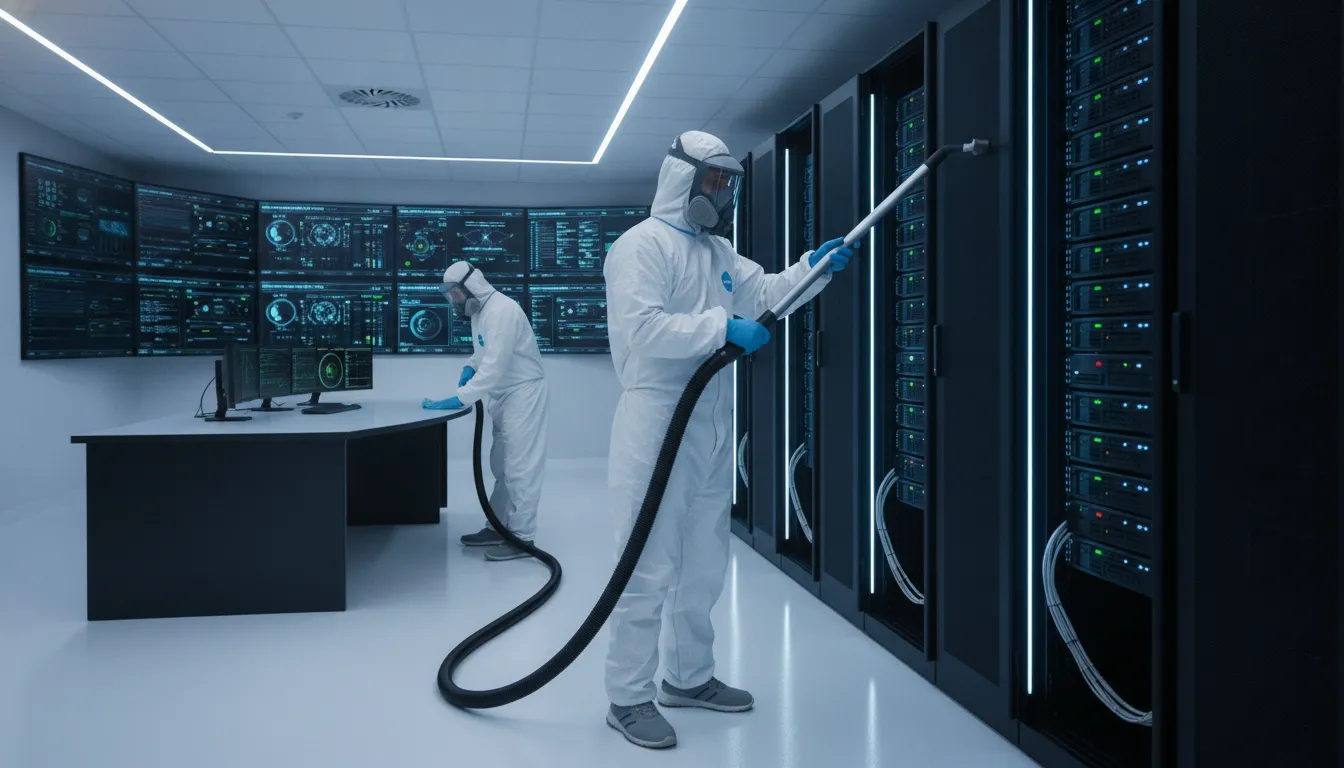
Static discharge from standard janitorial vacuums can permanently destroy terminal equipment in mission-critical command centers.
Specialized commercial cleaning command centers protect mission-critical infrastructure from particulate contamination and electrostatic discharge that standard janitorial services often overlook. While general crews use standard equipment that recirculates microscopic particulates, specialized experts use HEPA-filtered vacuums and ESD-safe protocols to maintain sensitive spaces. These advanced methods prevent equipment overheating and hardware failure in 24/7 facilities like Network Operations Centers and broadcast studios. By following strict ISO 14644-1 standards, Foreman Pro Cleaning teams remove conductive debris and zinc whiskers from raised floor plenums without disrupting live operations. Choosing a provider with deep IT operations experience ensures that cleaning chemicals do not leave residues on terminal equipment or interfere with sensitive electronics. This technical approach reduces the risk of costly downtime and extends the life of critical systems in utility control rooms and emergency operations centers.
Maintaining these complex spaces needs an understanding of hardware sensitivity and contamination control that general cleaning crews simply do not have. Many facility managers struggle to find where standard maintenance falls short until equipment begins to fail. Understanding what makes command center cleaning different from standard janitorial services is the first step in building a resilient maintenance program.
What Makes Command Center Cleaning Different from Standard Janitorial Services?
Standard janitorial crews clean offices, hallways, and restrooms. These spaces need general upkeep but do not house sensitive terminal equipment. Command centers and NOCs require a much higher level of care. The difference comes down to training, equipment, and protocols.
| Factor | Standard Janitorial Services | Specialized Commercial Cleaning for Command Centers |
|---|---|---|
| Staff training | General cleaning methods | CET-certified critical environment training |
| Vacuum equipment | Standard consumer-grade vacuums that recirculate particulates | HEPA-filtered vacuums that capture 99.97% of microscopic contaminants |
| ESD awareness | No electrostatic discharge protocols | Anti-static tools and grounding procedures |
| Chemicals used | General cleaning agents that may leave harmful residues | EPA-registered disinfectants compatible with sensitive electronics |
| Scheduling flexibility | Fixed daytime or after-hours slots | 24/7 maintenance window coordination |
| Quality reporting | Minimal or no documentation | Post-delivery QA reports with supervisor sign-off |
| Industry standards | General OSHA compliance | ISO 14644-1, NFPA 75, ESD Association standards |
ISO 14644-1 cleanroom classifications matter even in spaces that are not certified cleanrooms. Command centers benefit from the same rigor because airborne particulates can settle on circuit boards and cause intermittent failures. HEPA-filtered vacuums extract these contaminants instead of pushing them deeper into the environment.
Foreman Pro Cleaning brings more than 30 years of combined IT operations experience to every command center project. This background means our teams understand the real cost of particle contamination, cable management disruption, and static discharge. We treat every surface with methods designed for sensitive equipment, not general commercial spaces.
What Risks Do Untrained Janitorial Staff Pose to Sensitive Command Center Equipment?
Deploying untrained janitorial staff in a command center creates several specific risks that can damage equipment and disrupt operations. Facility managers need to understand these dangers before they cause expensive failures.
Electrostatic Discharge Damage
Standard cleaning tools generate static electricity. When janitorial staff wipe down server racks or vacuum near open equipment bays, a sudden discharge can destroy microchips and circuit boards. Even a small static shock can cause latent damage that leads to premature hardware failure. The ESD Association reports that electrostatic discharge can permanently damage sensitive electronic components, leading to costly unplanned replacements and system downtime.
Zinc Whisker Contamination
Many raised floor tiles in command centers contain zinc. Over time, standard cleaning can disturb these tiles and cause microscopic zinc whiskers to break free. These conductive particles can float through the subfloor plenum and land on circuit boards, creating short circuits and equipment fires. Specialized zinc whisker mitigation strategies are essential for any facility with raised access flooring.
Particulate Recirculation
Conventional vacuums lack HEPA filtration. They capture large debris but recirculate fine particulates back into the air. Over months and years, these microscopic contaminants accumulate inside server cabinets, cooling units, and ventilation systems. This buildup causes equipment to overheat, reduces energy efficiency, and shortens the lifespan of expensive hardware.
Chemical Residue
General cleaning chemicals may leave residues that attract more dust or interfere with sensitive electronics. Harsh solvents can damage plastic housings, screen coatings, and cable insulation. Specialized command center cleaning uses only compatible, low-residue agents that are safe for continuous use around live equipment.
Cable Management Disruption
Untrained cleaners may accidentally move or disconnect cables while vacuuming or dusting. Poor cable management restricts airflow through server racks, causing hot spots and equipment failures. Foreman Pro technicians understand cable routing and work around existing infrastructure without causing disruptions.
How Does Foreman Pro Cleaning’s Critical Environment Expertise Protect Network Operations Centers?
Network Operations Centers (NOCs) and mission-critical command centers require more than basic janitorial care. These facilities house sensitive equipment that drives 24/7 operations across Maryland, Virginia, and Washington D.C. At Foreman Pro Cleaning, our critical environment expertise is built on a deep understanding of IT infrastructure. Our leadership team brings more than 30 years of combined IT operations experience to every project. This technical background allows us to protect your uptime while maintaining a spotless, professional environment.
What makes our IT operations background a key advantage?
Our founder, Wes Foreman, spent over 17 years in corporate IT operations before starting Foreman Pro Cleaning. This experience means we do not just see a room of computers; we see a network that must stay live. We understand the risks of equipment overheating due to microscopic particulates. Because we know how these systems work, we use specialized protocols to prevent damage. We have cleaned millions of square feet of critical space with a 98% customer retention rate, showing our commitment to reliability in high-stakes settings.
How does our six-step critical environment process work?
We use a structured critical environment cleaning program to ensure total site protection. This six-step process starts with an expert consultation to find your specific facility needs. We then create a custom program that outlines our strategic cleaning plan. During the cleaning phase, our trained technicians use expert precision to remove contaminants. A Critical Environment Supervisor then performs a quality check with detailed checklists. We provide a post-delivery report with findings and finish with a program assessment to set long-term maintenance goals.
Which specialized tools do we use to protect your NOC?
We use advanced technology to manage particulates without causing static discharge. Standard vacuums can push dust back into the air, but we use HEPA-filtered equipment to capture microscopic debris. Our teams use advanced microfiber technology that traps soils without scratching delicate surfaces. To protect sensitive circuit boards, we follow strict anti-static protocols and use Electrostatic Dissipative flooring care. These tools meet industry standards for contamination control in command center cleaning services.
Our technicians go through our proprietary Critical Environment Training program. This program ensures every team member knows how to work around live systems without causing a disruption. By using hospital-grade disinfectants and EPA-registered solutions, we keep your NOC safe for both your gear and your staff. We focus on continuous particulate management so your command center stays ready for any emergency or operational need.
Which Facility Types Require Specialized Commercial Cleaning Command Centers Protocols?
Different command center environments have unique contamination vulnerabilities. Each facility type below benefits from specialized cleaning protocols designed for its specific operational demands.
Network Operations Centers
NOCs manage and monitor network traffic 24 hours a day. These facilities contain rows of servers, network switches, and monitoring stations. Dust accumulation on networking equipment can cause overheating and packet loss. Specialized cleaning protects uptime by removing contaminants from raised floors, cable trays, and equipment interiors.
Emergency Operations Centers
EOCs coordinate crisis response for natural disasters, security incidents, and public health emergencies. These centers must remain fully operational at all times. Cleaning during live operations requires ESD-safe protocols and minimal disruption to critical communications equipment.
Security Operations Centers
SOCs monitor security threats across digital and physical infrastructure. These centers handle sensitive data streams and classified information. Cleaning staff must follow strict confidentiality protocols and access procedures. Foreman Pro teams are trained to work in secure environments without compromising operational security.
Broadcast Studios and Control Rooms
Television and radio broadcast studios house master control rooms, production control rooms, and edit suites. Audio and video equipment is highly sensitive to dust, static, and chemical residues. Ingesting particulates into broadcast equipment can degrade signal quality and cause expensive equipment damage.
Traffic Management and Utility Control Rooms
Traffic management centers and power utility control rooms oversee critical infrastructure networks. These 24/7 facilities require cleaning that does not interfere with real-time monitoring and control systems. Specialized technicians understand the importance of working around live displays, control panels, and communication arrays.
Data Center Control Rooms
Control rooms connected to enterprise data centers need the same rigor as the server floor itself. Technicians use anti-static tools, HEPA vacuums, and low-residue cleaning agents to protect monitoring equipment and operator workstations. Regular commercial cleaning command centers protocols prevent particulate migration from the control room into adjacent server spaces.
How Often Should Mission-Critical Command Centers Be Professionally Cleaned?
Cleaning frequency for command centers depends on facility type, foot traffic, and operational sensitivity. Following the right schedule prevents contamination buildup while respecting operational constraints.
- Quarterly deep cleaning for raised floor plenums. The subfloor space beneath raised access floors accumulates dust, debris, and zinc whiskers over time. A thorough HEPA vacuum of the entire plenum every three months prevents contaminant circulation through the cooling system. This cleaning must happen during scheduled maintenance windows to avoid disrupting operations.
- Monthly surface cleaning for NOC workstations. Consoles, monitors, and work surfaces in active command centers should receive monthly cleaning using ESD-safe wipes and low-residue solutions. Frequent touch-point cleaning reduces contaminant transfer between operators and equipment.
- Weekly touch-point cleaning for high-traffic command centers. Facilities with multiple shifts and high personnel turnover benefit from weekly cleaning of door handles, shared keyboards, and common surfaces. This schedule maintains a hygienic environment for staff working in close quarters.
- Annual comprehensive assessment. A yearly evaluation of the entire facility, including equipment interiors, cable management, and HVAC systems, helps identify emerging contamination issues before they cause failures. Foreman Pro provides a detailed QA report with observations and maintenance recommendations.
- Custom scheduling aligned to maintenance windows. Every command center operates on a unique schedule. Foreman Pro coordinates cleaning during after-hours, overnight, weekend, or planned maintenance windows to avoid any operational disruption. Our teams can also respond to emergency cleaning needs within 24 hours.
Frequently Asked Questions
What is the difference between standard janitorial services and command center cleaning?
Standard janitorial services use general cleaning methods and equipment designed for offices and common areas. Command center cleaning requires specialized training, HEPA-filtered vacuums, anti-static tools, and protocols that protect sensitive electronic equipment from electrostatic discharge and particulate contamination.
How often should a command center be professionally cleaned?
Most command centers benefit from quarterly deep cleaning of raised floor plenums, monthly surface cleaning of workstations, and weekly touch-point cleaning for high-traffic areas. An annual comprehensive assessment helps identify emerging issues before they cause equipment failures.
Can untrained cleaning staff cause damage to NOC equipment?
Yes. Untrained staff can cause electrostatic discharge damage, disturb zinc whiskers in raised floors, recirculate particulates through standard vacuums. Leave chemical residues on sensitive equipment, or disrupt cable management leading to overheating and system failures.
What certifications should a command center cleaning company have?
A qualified command center cleaning provider should have critical environment training programs, knowledge of ISO 14644-1 cleanroom standards, ESD-safe protocols, and experience with HEPA-filtered equipment. Foreman Pro Cleaning offers proprietary Critical Environment Training with continual certification requirements.
Does Foreman Pro Cleaning serve command centers in the Washington D.C. area?
Yes. Foreman Pro Cleaning serves command centers and critical environments across Maryland, Washington D.C., and Virginia. Including the Ashburn data center corridor, Northern Virginia technology hubs, Baltimore metro, and Hampton Roads through three regional office locations.
Ready to Protect Your Command Center with Professional Cleaning Services?
Standard janitorial services are not equipped to handle the unique demands of mission-critical command centers. From electrostatic discharge risks to particulate contamination and zinc whisker mitigation, the threats to your sensitive equipment are real and costly. Foreman Pro Cleaning brings more than 30 years of IT operations experience, HEPA-filtered equipment, and proprietary critical environment training to every project.
Contact us today at (888) 360-1608 or visit our contact page to schedule a free facility assessment and consultation. Let our expert team show you how specialized commercial cleaning command centers services can protect your uptime and extend the life of your critical infrastructure.
