
Selecting a critical environment cleaning partner demands more than a review of their service menu. The difference between a qualified provider and an inadequately trained crew comes down to verifiable certifications. A legitimate critical environment cleaning certification signals that a provider has mastered contamination control protocols. It shows they understand ISO 14644 cleanroom classifications. It also proves they train personnel in industry-specific safety standards. This guide walks through the credentials that matter most for data centers, laboratories, and medical facilities.
Schedule a free consultation with Foreman Pro Cleaning to discuss your facility’s certification requirements and cleaning protocols.
What Certifications Define a Qualified Critical Environment Cleaning Partner?
A qualified partner holds credentials at both the organizational and personnel levels. Facility standards such as ISO 14644-1 define cleanroom classes from ISO Class 1 through ISO Class 9. These classes are based on maximum airborne particulate concentration limits per cubic meter of air. Personnel certifications like CHESP verify that individual technicians have the hands-on experience to execute contamination control protocols correctly. A provider that invests in both facility-level compliance and individual certification demonstrates a systematic commitment to quality. General janitorial services cannot match this depth of verification.
Beyond these baseline credentials, a truly qualified partner maintains certification across multiple regulatory domains. The National Sanitation Foundation provides accreditation for biosafety cabinet field certifiers under NSF/ANSI 49. This standard applies directly to laboratory environments where containment integrity is critical. Organizations like ANSI and ASHRAE publish guidelines that govern air quality and environmental control in sensitive spaces. When a cleaning provider references these standards voluntarily, they demonstrate genuine familiarity with the regulatory ecosystem governing your facility.
ISO 14644 cleanroom classification standards
ISO 14644-1 establishes the international framework for classifying cleanrooms by allowable particulate counts. An ISO Class 5 cleanroom permits no more than 3,520 particles at 0.5 microns per cubic meter. An ISO Class 8 environment allows up to 3,520,000 particles at the same size threshold. Cleaning protocols escalate in rigor with each classification level. An ISO Class 5 environment requires HEPA or ULPA filtration. It also requires validated microfiber technology and documented particulate-count verification after every cleaning cycle. A partner that cites ISO 14644 compliance understands these graduated requirements. They can adapt their methodology to match your specific classification. A cleaning protocol designed for an ISO Class 8 environment will fail the stricter requirements of an ISO Class 5 space. Certified partners make these distinctions instinctively.
Personnel-level credentials: CHESP, CET, and CVI training
The CHESP certification from the American Hospital Association requires three to five years of healthcare environmental services experience. It also requires a comprehensive examination covering infection prevention, regulatory compliance, and emergency preparedness. CET programs focus on specialized techniques for sensitive environments. These include proper dilution ratios for hospital-grade disinfectants and contact-time compliance for pathogen elimination. CVI training prepares technicians to document cleaning verification through digital reporting systems. A partner whose technicians hold these credentials brings verified competence rather than on-the-job guesswork.
Why Does Certification Matter for Data Center Cleaning?
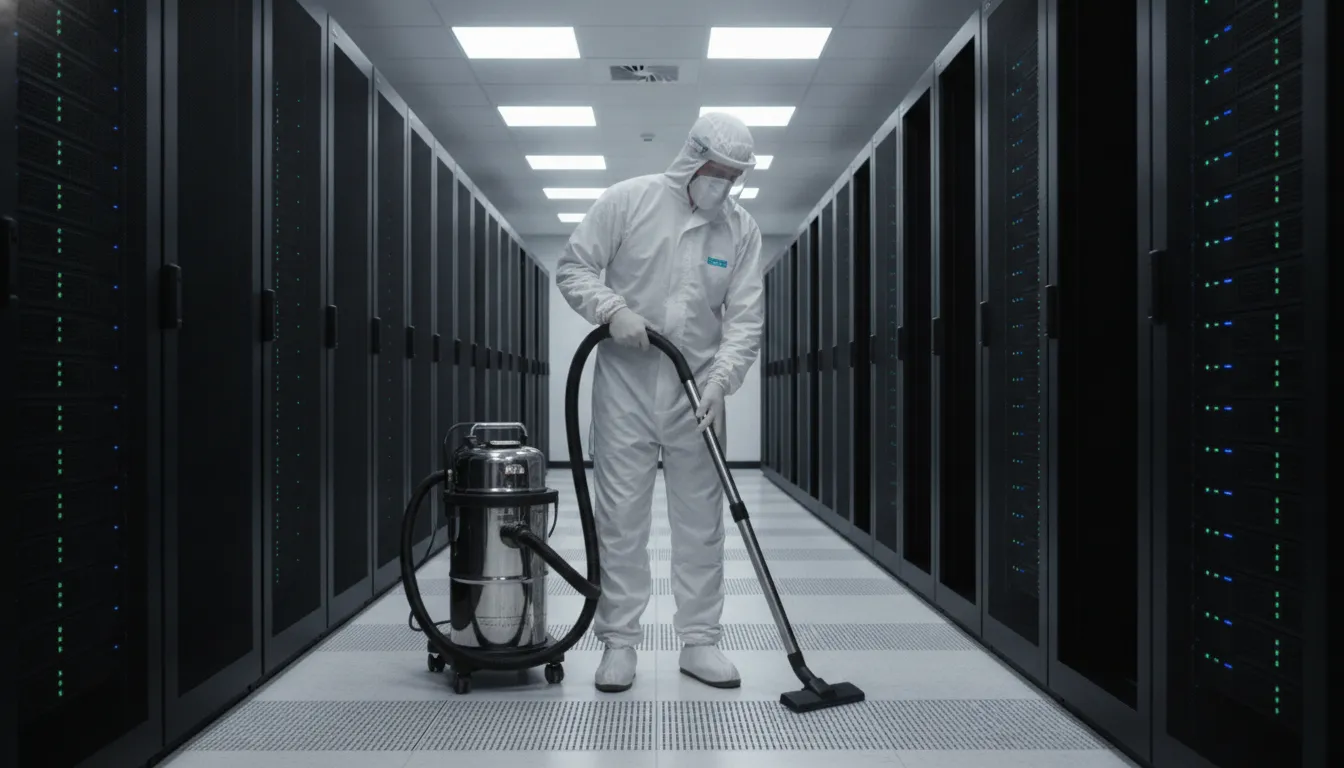
Data center cleaning differs fundamentally from commercial office cleaning. The contaminants that threaten server operations are invisible to the naked eye but carry measurable operational risk. Microscopic particulates settling on circuit boards create thermal insulation that raises operating temperatures by 2 to 5 degrees Celsius. This accelerates electromigration and component failure rates. Zinc whiskers from galvanized raised-floor tiles can bridge electrical contacts and cause intermittent short circuits. A cleaning team with documented data center cleaning expertise understands these risks.
The financial implications of inadequate cleaning are substantial. A single hour of unplanned data center downtime costs an average of $8,000 to $12,000 for small-to-medium operations. Enterprise facilities face even higher losses. Dust-induced thermal events represent one of the most common preventable causes of unplanned downtime. By insisting on a partner with verifiable certification, facility managers directly reduce their operational risk exposure. The cost of certification verification is negligible compared to the cost of a single preventable equipment failure.
- ESD-safe methods: Technicians use anti-static tools and conductive footwear to prevent electrostatic discharge that damages sensitive server components.
- HEPA filtration: Vacuums must capture 99.97% of particulates at 0.3 microns to prevent contaminant recirculation into server intake vents.
- Subfloor plenum protocol: Raised-floor cleaning requires sequential tile removal and HEPA vacuuming of all subfloor surfaces. Careful replacement maintains airflow dynamics.
- Zinc whisker mitigation: Specialized vacuum attachments prevent disturbing zinc deposits on galvanized floor tiles.
- Tool segregation: Teams use separate inventories of mops, cloths, and vacuums that never enter non-critical areas. This simple procedural boundary eliminates an entire category of cross-contamination risk.
Call 888-360-1608 to speak with a critical environment cleaning specialist about your facility’s certification requirements.
Which Training Standards Apply to Medical and Laboratory Environments?
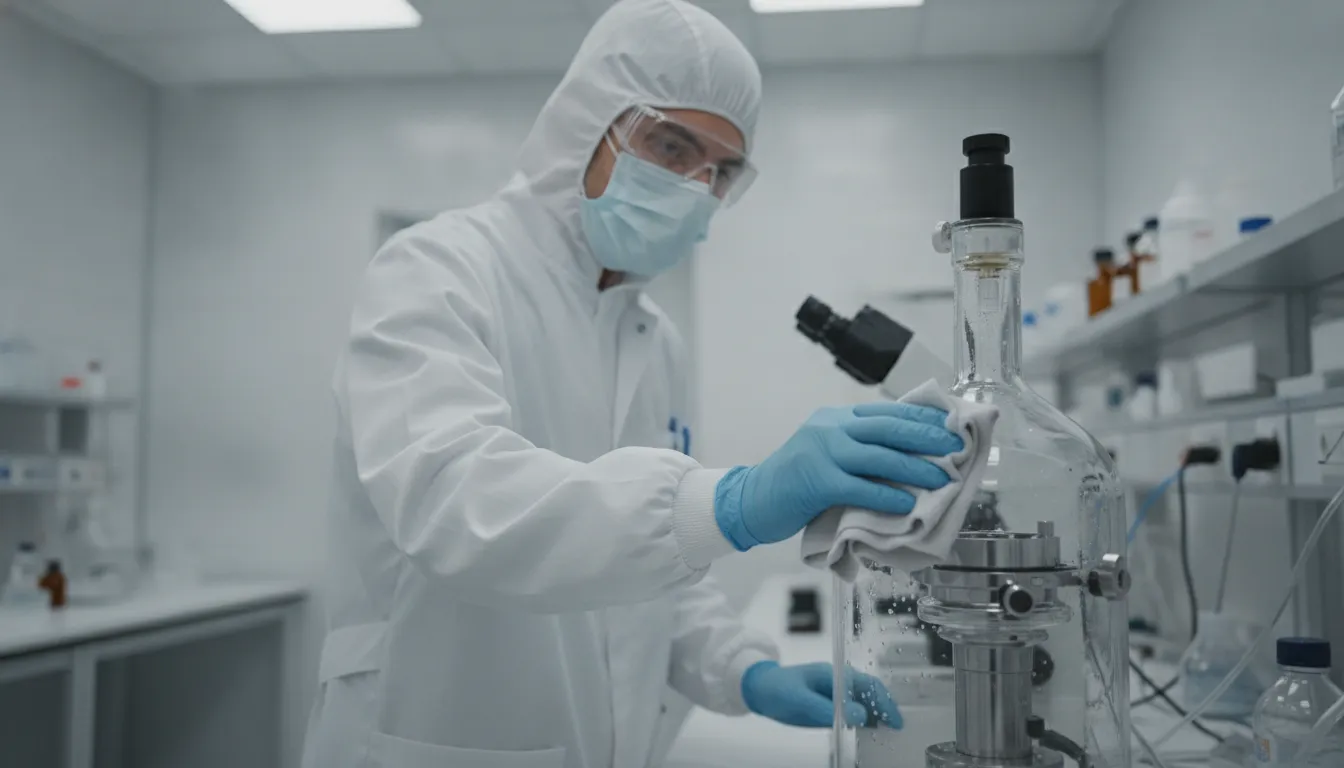
Medical and laboratory cleaning carries regulatory weight that commercial cleaning does not. OSHA mandates Bloodborne Pathogen training under 29 CFR 1910.1030 for any personnel who may encounter infectious materials. This training covers exposure control plans, universal precautions, PPE selection, and post-exposure procedures. It must be renewed annually. The CDC and AORN publish evidence-based guidelines for disinfection protocols in surgical and examination suites. These guidelines address everything from surface disinfection frequencies to sterilization validation methods. A certified cleaning partner must demonstrate documented compliance with these regulations as a baseline requirement for healthcare facility access.
| Credential | Governing Body | Facility Type | Key Requirement |
|---|---|---|---|
| Bloodborne Pathogen Training | OSHA (29 CFR 1910.1030) | Medical, Laboratory | Annual certification on exposure control |
| CHESP | AHA / ASHE | Healthcare facilities | 3-5 years experience plus examination |
| NSF/ANSI 49 | NSF International | Biosafety laboratories | Biosafety cabinet field certification |
| USP <797> | U.S. Pharmacopeia | Sterile compounding areas | Cleanroom contamination control standards |
| AORN Guidelines | AORN | Surgical suites | Perioperative disinfection and sterilization |
How Can You Verify a Cleaning Partner’s Certifications?
Verification protects your facility against unsubstantiated claims. A provider that cannot produce current certificates or training records may not hold the credentials they market. Three verification steps apply across facility types.
- Request current certificates with expiration dates. Certification is time-limited. A certificate issued more than 12 months prior without renewal evidence may be expired. Ask for ISO 14644 compliance documentation and current CHESP or CET certificates for technicians assigned to your site.
- Audit training continuity and assessment records. Request evidence of quarterly or annual refresher training. Include course titles, dates, and skills-assessment scores. Look for structured programs with documented pass-fail criteria rather than self-study modules.
- Inspect quality control documentation from past engagements. A certified partner should maintain particulate-count logs, equipment calibration records, and post-cleaning inspection reports. Ask to review sample documentation before signing a contract.
How Does Foreman Pro Cleaning’s Training Program Ensure Compliance?
Foreman Pro Cleaning’s training program builds on leadership experience spanning 30 years of combined IT operations and facilities management. This operational foundation gives our training content a practical edge that classroom-only programs lack. Every technician completes a structured certification path. They begin with general contamination control principles and advance to environment-specific protocols. The program includes hands-on supervised cleaning sessions, written examinations, and documented proficiency assessments.
Proprietary training modules cover ESD-safe cleaning methods, HEPA vacuum operation, chemical handling protocols, PPE donning and doffing sequences, and incident reporting procedures. Each module concludes with a practical skills demonstration graded against internal Standard Operating Procedures. Technicians repeat this certification cycle annually. They must also pass random unannounced quality audits to maintain active status. This rigorous approach ensures consistent protocol application on every engagement.
Tool segregation is a core component of contamination control protocols. Transporting cleaning tools between facility zones is one of the most common cross-contamination pathways. Certified teams maintain separate color-coded inventories of mops, cloths, buckets, and vacuums designated exclusively for critical areas. These tools never enter restrooms or general office spaces.
Chemical application discipline represents another dimension of certified practice. Hospital-grade disinfectants carry labeled contact times ranging from 30 seconds to 10 minutes. Spraying a surface and immediately wiping it dry does not achieve disinfection. The chemical must remain wet for the full labeled dwell time. Certified technicians understand this distinction and follow documented application protocols.
Documentation is the third pillar of certified cleaning accountability. Every cleaning cycle should generate verifiable records: which surfaces were cleaned, what chemicals were applied, what contact times were observed, and what post-cleaning particulate counts were measured. A provider with genuine critical environment cleaning certification treats documentation as a standard deliverable, not an optional extra.
For further guidance, explore our overview of what to look for in a critical environment cleaning company and our critical environment cleaning services page. Both cover our certification-backed approach in detail.
What Are Common Questions About Critical Environment Cleaning Certification?
What is a critical environment cleaning certification?
A critical environment cleaning certification is a formal credential that shows a provider has the technical knowledge to clean sensitive spaces such as data centers, cleanrooms, laboratories, and healthcare facilities. Certifications may apply to the facility itself through ISO 14644 classification, to the company through NSF accreditation, or to individual technicians through programs such as CHESP, CET, and CVI.
How do I verify a cleaning company’s certifications?
Request current certificates with expiration dates, audit records of ongoing technician training, and samples of quality control documentation including particulate-count logs. Legitimate providers make these records available for client review without hesitation.
What certifications are required for data center cleaning?
Data center cleaning requires documented training in ESD-safe protocols, HEPA filtration methods, raised-floor cleaning procedures, and zinc whisker mitigation. Providers should demonstrate adherence to ISO 14644 cleanroom standards and TIA-942 data center guidelines.
Does Foreman Pro Cleaning provide certification documentation for client audits?
Yes. Foreman Pro Cleaning maintains current certification records for all technicians. We make quality control documentation, including particulate-count verification reports, available for client review. Contact our team to request documentation specific to your facility’s requirements.
Call 888-360-1608 now or schedule a consultation online to discuss your critical environment cleaning certification needs with the Foreman Pro Cleaning team. Our certified technicians serve data centers, laboratories, medical facilities, and cleanrooms across Maryland, Washington D.C., and Virginia. We bring documented compliance and proven contamination control protocols to every engagement.
