
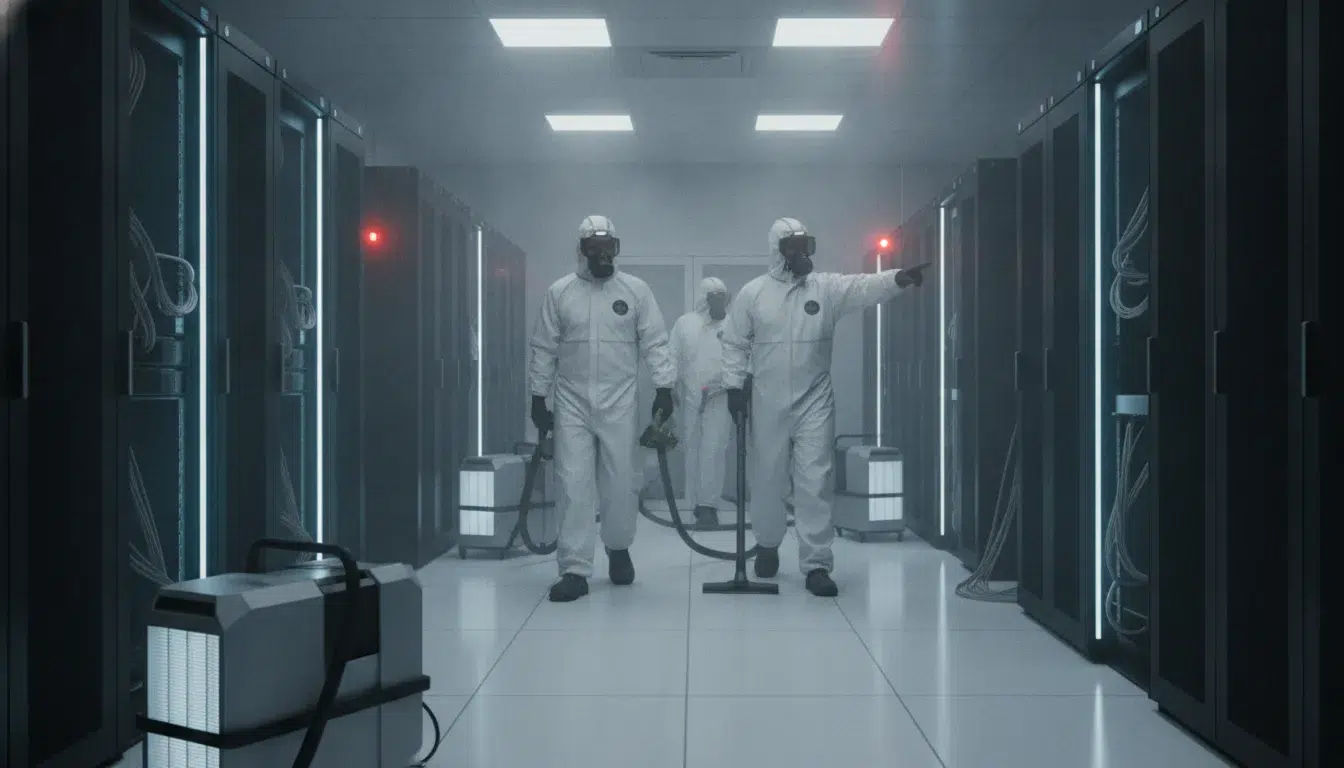
A contamination breach in a data center is not a housekeeping problem. It is a threat to uptime, equipment reliability, and operational continuity. When construction debris, ceiling particulate, or airborne contaminants infiltrate a controlled environment, the response window is measured in minutes, not hours.
Emergency data center cleaning is a contamination-control discipline that protects mission-critical hardware from particulate-induced failures. When debris enters a controlled environment, the protocol demands immediate zone isolation, HEPA-filtered vacuum extraction, ESD-safe surface care, and HVAC management to prevent secondary spread across server infrastructure.
Contact Foreman Pro Cleaning for emergency data center cleaning services in Maryland, Washington D.C., and Virginia. 24/7 response available. Delaying containment allows contamination to settle into server fans, power supplies, and circuit boards, where it accelerates thermal stress and creates short-circuit risks. The following sections outline the assessment priorities, common mistakes, and specialized protocols required to restore environmental integrity.
Immediate Response Steps for Data Center Contamination Events
A confirmed contamination breach demands fast, methodical action. The priority is containment before remediation. Every second that airborne particles circulate increases the radius of contamination across your server infrastructure.
Isolate the Affected Zone
Identify the contamination source and establish a physical perimeter. Restrict all foot traffic through the affected area. Foot-borne particulate tracked from a contaminated zone to clean zones is one of the fastest vectors for secondary spread. Use temporary barriers, signage, or plastic sheeting to seal the space.
Simultaneously, assess your HVAC and CRAC units. Cooling systems can become distribution networks for airborne debris within minutes. The CDC notes that HVAC infrastructure frequently serves as an entry and dispersal pathway for hazardous particulate. If contamination reached the air handling system, shut down or isolate the affected zone’s airflow to prevent rack-to-rack propagation.
Engage Specialized Response Resources
Once the zone is secured, contact a certified critical environment cleaning provider. Standard janitorial crews lack the training, tools, and protocols to work safely around live IT infrastructure. The objective is zero-downtime remediation that does not introduce secondary risks such as electrostatic discharge or moisture intrusion.
- Isolate and restrict. Halt all foot traffic in the contamination zone and seal the perimeter. This prevents cross-zone migration of debris.
- Deploy expert responders. Activate emergency data center cleaning protocols. Certified technicians arrive with ESD-safe, HEPA-filtered equipment rated for critical environments.
- Use correct extraction tools. Consumer-grade vacuums recirculate sub-micron particles and generate static discharge. Only ESD-safe HEPA vacuums rated for 99.97% particle retention at 0.3 microns are acceptable.
- Follow a top-down cleaning sequence. Start at the overhead cable trays and ceiling grid, work through rack tops and side panels, then address raised floors and the sub-floor plenum. This sequence prevents recontamination of cleaned surfaces.
- Inspect and document air handler status. Replace filters and verify that CRAC units are not recirculating contaminated air. Post-remediation air quality testing confirms the environment meets ISO 14644-1 standards where applicable.
Validate Environmental Recovery
Post-remediation verification is non-negotiable. Visual inspection alone cannot detect sub-micron particulate or zinc whisker debris. Professional teams perform particle count testing and surface contact analysis to confirm the space meets operational thresholds. In Maryland, D.C., and Virginia, facilities subject to regulatory oversight often require documented proof of environmental restoration. A comprehensive server room cleaning protocol includes this verification step to close the incident loop.
What NOT to Do During a Data Center Contamination Event
The instinct to restore order quickly often leads to counterproductive actions that worsen the damage. Understanding what to avoid is as important as knowing the correct protocol. The wrong cleaning method can convert a contained event into a facility-wide failure.
Avoid Consumer-Grade Vacuums and Brushes
Standard shop vacuums and household vacuum cleaners lack HEPA filtration and ESD protection. They capture visible debris while recirculating fine particulate into the airstream, where it settles into server power supplies and fan assemblies. ESD-safe HEPA vacuums rated for 99.97% particle retention are the only acceptable tools for data center contamination recovery. Foreman Pro Cleaning uses HEPA-filtered, ESD-safe extraction systems as standard equipment on every response.
Never Use Compressed Air on Server Racks
Canned air or compressed gas simply relocates contamination. It drives particulate deeper into disk drive enclosures, network port cavities, and power supply vents. The U.S. CDC recommends capturing contaminants at the source through properly rated filtration rather than redistributing them through air movement. In a data center environment, microfiber capture and HEPA vacuum extraction are the only safe removal methods.
Restrict Untrained Personnel from Cleaning
Standard custodial staff frequently use wet mops, spray cleaners, and chemical agents that are incompatible with live electronics. Water and electronics create short-circuit hazards. Cleaning agents can corrode connector pins and leave conductive residues on circuit boards. Additionally, untrained personnel who lift raised floor tiles risk disturbing zinc whiskers, microscopic metal filaments that cause intermittent short circuits when they land on exposed circuitry.
Common Mistakes vs. Correct Responses
| Action | Common Mistake | Correct Response |
|---|---|---|
| Vacuuming | Using a standard shop vacuum or household vacuum cleaner | Use only ESD-safe, HEPA-filtered vacuum systems certified for critical environments |
| Dust removal | Blowing debris off racks with compressed air | Capture particulate at the source using anti-static microfiber cloths designed for electronics |
| Floor tile access | Lifting raised floor tiles without contamination awareness training | Leave sub-floor access to zinc-whisker-trained critical environment technicians |
| Cleaning crew selection | Having standard janitorial staff clean the server room | Dispatch certified data center cleaning technicians with ESD and ISO compliance training |
How Does HVAC and Air Filtration Affect Contamination Spread?
Cooling infrastructure in a data center serves two roles: thermal regulation and air movement. During a contamination event, that second role becomes a liability. CRAC units and air handlers can transform a localized dust release into facility-wide contamination within minutes.
Air Handling Units as Distribution Pathways
The CDC has documented that HVAC systems serve as primary pathways for hazardous particulate dispersal in commercial facilities. In a data center, a CRAC unit located near the contamination source pulls debris into its return grille, passes it through the cooling coil, and discharges it across the entire cold-aisle containment zone. Fans, blowers, and ductwork become reservoirs that shed debris long after the visible contamination appears controlled.
Facility operators in Maryland and Virginia report that post-construction dust events are the most common trigger for this scenario. Construction debris from adjacent build-outs or ceiling plenum disturbances introduces fine silica dust and gypsum particles that bypass standard MERV-8 filtration and circulate until they settle on server components.
Filtration as a Containment Strategy
High-MERV or HEPA-grade filtration is the primary engineered control for airborne contamination. During an event, upgrading to MERV-13 or higher filters on CRAC units reduces the recirculation load and captures finer particulate. The CDC identifies air filtration as a primary engineering control for building safety. Post-event filter replacement should be mandatory. Even filters that appear clean may be loaded with sub-micron debris that restricts airflow and forces cooling units to work harder, creating thermal risk for downstream racks.
Airflow Management During Active Remediation
When contamination is confirmed, isolate the affected zone by adjusting or disabling the local CRAC unit’s supply airflow. Use portable HEPA air scrubbers to create negative pressure within the sealed zone, preventing particulate migration to adjacent white space. After remediation, the entire air handling path, including ductwork, coils, and condensate pans, requires inspection and cleaning before normal operations resume. A structured data center maintenance cleaning program includes these HVAC checks as standard intervals to prevent small events from escalating.
Specialized Cleaning Protocols for Sensitive IT Equipment
Emergency data center cleaning cannot be performed with general-purpose tools or generic procedures. The protocols used must account for ESD sensitivity, particulate retention standards, and the operational requirement that equipment remains live throughout remediation.
ESD-Safe and HEPA-Rated Equipment Requirements
Electrostatic discharge at levels imperceptible to humans can destroy semiconductor junctions on server motherboards and memory modules. All cleaning equipment used in a data center must be certified ESD-safe, with conductive hoses, grounded wands, and anti-static collection bags. HEPA filtration rated for 99.97% retention at 0.3 microns is the minimum standard, consistent with CDC guidance on airborne particulate control in sensitive environments.
Rack-Level Cleaning Methodology
Server racks require surface-level contamination removal without disturbing active components. Technicians use specialized microfiber cloths with anti-static treatments to wipe rack rails, cabinet tops, and side panels. Cable bundles are gently lifted to access trapped debris beneath. The cleaning sequence always proceeds from the highest point in the rack downward to prevent debris cascading onto already-cleaned surfaces. Raised floor tiles receive anti-static treatment to maintain ESD flooring performance. Facilities that schedule quarterly cleaning cycles significantly reduce the accumulation that turns minor spills into emergency events.
Post-Cleaning Verification and ISO Compliance
A professional remediation concludes with documented verification. Particle count readings, surface contamination swabs, and photographic evidence establish that the environment meets operational standards. Facilities operating under ISO 14644-1 classification or other regulatory frameworks require this documentation for audit compliance. Foreman Pro Cleaning provides written reports with every data center maintenance cleaning engagement, creating a verifiable chain of environmental quality data.
What Are Zinc Whiskers and Other Hidden Threats?
During an emergency response, the contamination visible on rack surfaces and floor tiles represents only the most obvious threat. Hidden dangers accumulate in spaces that standard cleaning protocols never reach, including the sub-floor plenum, the ceiling plenum, and the surface of overhead cable trays.
Zinc Whiskers in Raised Floor Systems
Zinc whiskers are microscopic, crystalline filaments that grow on zinc-electroplated raised floor tiles, typically in data centers constructed before the mid-2000s. These filaments are approximately 2-10 microns in diameter and up to several millimeters in length. When disturbed by foot traffic, tile removal, or airflow changes, whiskers break free and become airborne. Because they are conductive, a single whisker landing on a circuit board can produce a short circuit that results in intermittent failure or permanent hardware damage. Emergency data center cleaning teams are trained to identify and mitigate zinc whisker risks through controlled sub-floor access and HEPA vacuum extraction at the source.
Sub-Floor Plenum Contamination
The raised floor plenum serves as the primary air distribution pathway in most data centers. If debris accumulates in this space from construction, cable installation, or years of minor contamination events, every CRAC unit cycle pulls that debris across server intakes. The CDC has documented that under-floor air distribution systems can recirculate contaminants throughout a facility. Plenum vacuuming using HEPA-filtered equipment is a standard component of emergency response protocols.
Overhead Debris Reservoirs
Ceiling tiles, cable trays, and overhead conduit surfaces accumulate years of settled dust. When construction occurs nearby or ceiling tiles are moved for cable runs, this legacy debris falls directly onto active server racks. A comprehensive contamination response includes inspection and cleaning of all overhead surfaces to prevent secondary contamination events. Professional server room cleaning protocols account for all six surfaces of the room: walls, floor, ceiling, and every horizontal surface between them.
When to Call Professional Emergency Data Center Cleaning Services
Any confirmed or suspected contamination breach in a controlled environment warrants a professional assessment. The threshold for calling expert responders should be low. The cost of a professional response is minor compared to the cost of a single hour of unplanned downtime in a modern data center.
The Dual-Expertise Requirement
Effective emergency data center cleaning demands a provider that understands both contamination control and IT infrastructure operations. Foreman Pro Cleaning’s leadership brings combined experience in IT operations and facilities management, enabling response teams to navigate live environments without triggering power faults, ESD events, or accidental equipment contact. This dual competence is what distinguishes critical environment specialists from general cleaning contractors.
Proprietary standard operating procedures govern every phase of the response. These protocols address containment sequencing, tool selection, technician movement patterns, and waste handling. They are developed from actual field experience across millions of square feet of critical environment space, not from theoretical guidelines. This operational discipline ensures consistent outcomes regardless of the specific contamination scenario.
Certifications That Matter in Critical Environments
General cleaning staff are not trained to handle live data center environments safely. Technicians responding to contamination events should hold certifications in ESD awareness, hazardous material handling, and ISO cleanroom protocols where applicable. They should arrive with documented training records and a clear understanding of the facility’s specific operational constraints. Foreman Pro Cleaning’s critical environment team completes proprietary training that bridges IT operations knowledge with contamination control methodology.
24/7 Response Capability
Contamination events do not follow business hours. When a ceiling panel gives way at 2 AM or construction dust infiltrates a live environment over a weekend, the response must begin immediately. Leading providers maintain 24/7 dispatch capability so that containment can start within hours, not days. The CDC emphasizes that rapid containment is the single most effective intervention for preventing environmental contamination from escalating. A provider with round-the-clock response capacity gives facility operators the confidence that help is always available when the controlled environment is compromised.
Frequently Asked Questions About Emergency Data Center Cleaning
How often should a data center be cleaned?
Industry best practice recommends professional data center cleaning at least once per year. Facilities that schedule quarterly cleaning cycles significantly reduce particulate accumulation that can turn minor contamination events into emergency situations. Regular cleaning also helps maintain ISO 14644-1 compliance where applicable. Foreman Pro Cleaning recommends quarterly schedules for most critical environments.
Can emergency cleaning be performed without data center downtime?
Yes. Professional critical environment cleaning teams use specialized equipment and protocols specifically designed for zero-downtime remediation. Technicians work around live equipment using ESD-safe tools and HEPA-filtered vacuums that capture particulate without disrupting server operations. The goal is to restore environmental integrity without requiring a shutdown. Foreman Pro Cleaning’s critical environment team specializes in non-disruptive emergency response.
Can a standard vacuum be used to clean a data center?
No. Standard vacuums lack HEPA filtration and ESD protection. They recirculate fine particulate into the airstream and can generate electrostatic discharge that damages sensitive electronics. Only ESD-safe, HEPA-filtered vacuum systems rated for 99.97% particle retention at 0.3 microns should be used in data center environments. Foreman Pro Cleaning uses HEPA-filtered, ESD-safe equipment on every engagement.
Why is HVAC cleaning critical after a data center contamination event?
HVAC and CRAC systems can act as distribution pathways for airborne contaminants. Once particulate enters the air handling system, it can spread to every server rack in the facility. The CDC has documented that HVAC infrastructure frequently serves as a primary dispersal pathway for hazardous particulate. Post-event cleaning of ductwork, coils, and filters is essential to prevent recirculation.
Ready to protect your data center from contamination risks? Contact Foreman Pro Cleaning today for emergency data center cleaning services across Maryland, Washington D.C., and Virginia.
