
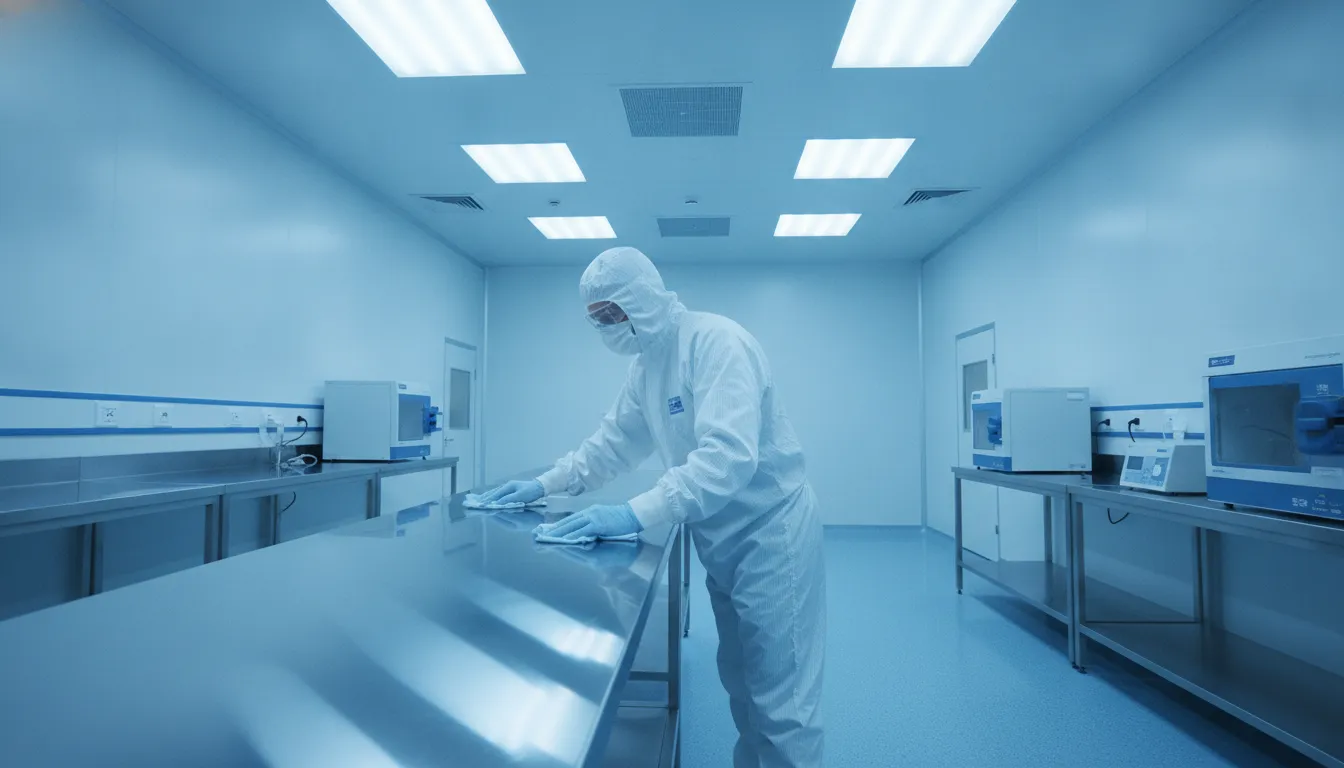
Cleanroom cleaning and laboratory cleaning may happen in similar-looking facilities, but they solve different contamination problems. Cleanroom cleaning protects a classified environment by controlling particles and following procedures tied to the room’s required classification. Laboratory cleaning supports safe, reliable work by addressing the hazards, workflows, surfaces, and equipment found in a specific lab. Facility managers need to understand that distinction before setting scope, frequency, staffing, or documentation requirements.
Need a cleaning scope built around your facility’s actual risks? Request a tailored laboratory and cleanroom cleaning consultation from Foreman Pro Cleaning.
This guide compares cleanroom cleaning vs laboratory cleaning across contamination controls, methods, documentation, training, and purchasing decisions. It is designed to help facility managers ask sharper questions and avoid a generic scope that overlooks critical operational requirements.
Cleanroom cleaning vs laboratory cleaning at a glance
Cleanroom cleaning is driven primarily by the need to maintain controlled particle levels and protect the integrity of a classified space. Laboratory cleaning is driven by the work performed in the lab, including the substances handled, surface types, equipment, and cross-contamination risks. Some laboratories contain cleanrooms, but many do not.
| Decision factor | Cleanroom cleaning | Laboratory cleaning |
|---|---|---|
| Primary objective | Protect the controlled environment and limit particle introduction or redistribution | Support safe, reliable laboratory operations and manage facility-specific contamination risks |
| Scope driver | Room classification, approved procedures, zones, and process requirements | Research or production activities, hazards, equipment, and surface compatibility |
| Entry controls | Often includes defined gowning, material transfer, and movement procedures | Varies by laboratory type, biosafety requirements, and site policy |
| Cleaning method | Controlled sequences intended to prevent particles from being moved back into cleaned areas | Task-specific cleaning and disinfection selected for the room and its activities |
| Documentation | May include zone-based logs, approved materials, sequence records, and exception reporting | May include task logs, room schedules, chemical records, and incident reporting |
| Success measure | Execution against approved procedures while supporting the room’s control strategy | A clean, safe, operational space aligned with laboratory protocols |
The most important purchasing lesson is simple: neither service should be treated as ordinary janitorial work. Both require a scope based on the facility, not a recycled checklist.
What makes cleanroom cleaning different?
Cleanroom cleaning focuses on protecting a deliberately controlled environment. The service plan must account for the room’s classification, airflow strategy, gowning rules. Controlled access, approved tools, and the risk of introducing or redistributing particles during the cleaning process.
ISO 14644-1 establishes a system for classifying air cleanliness by particle concentration. That classification does not, by itself, prescribe every cleaning step. Instead, it gives facility managers and process owners a measurable framework that informs their contamination-control strategy. Cleaning procedures must then align with the room’s use and the organization’s approved operating requirements.
Controlled movement and sequencing matter
A cleanroom technician cannot move casually between zones or use the same technique applied in a conventional workspace. A procedure may define how personnel enter, how supplies are introduced, which surfaces are addressed first, and how used materials leave the room. The sequence is intended to reduce the chance that cleaning activity itself becomes a source of contamination.
Materials must fit the environment
Facility-approved wipes, tools, vacuums, and cleaning agents should be selected for compatibility with the room and its processes. Suitability depends on the facility’s requirements. The correct product for one controlled environment may be inappropriate in another, so the service provider must work from the approved scope rather than make assumptions.
How is laboratory cleaning different?
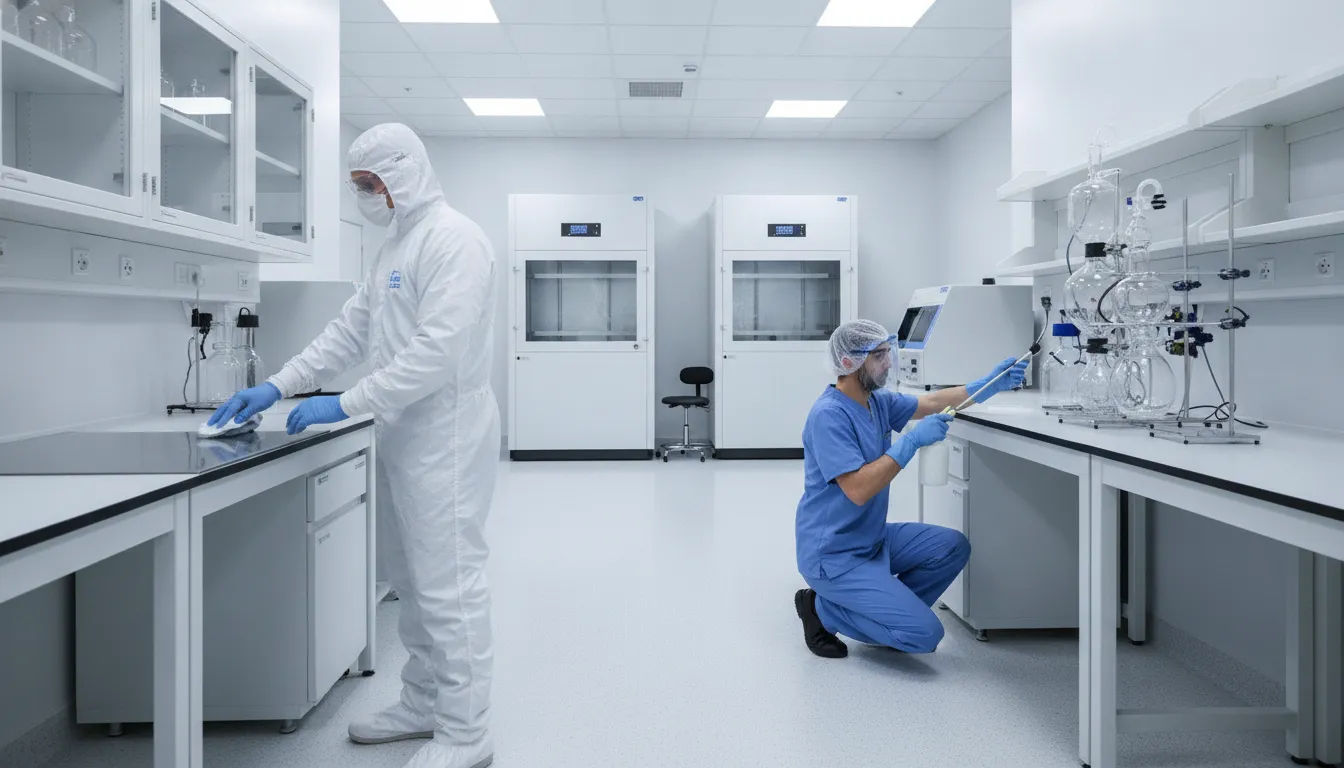
Laboratory cleaning is shaped by what happens inside the lab. A research laboratory, analytical lab, teaching lab, and pharmaceutical facility can have very different risks and operating rules. The cleaning plan must account for the work performed, restricted equipment, approved disinfectants, waste boundaries, and the responsibilities reserved for trained laboratory personnel.
Routine laboratory cleaning can include floors, accessible surfaces, sinks, fixtures, exterior equipment surfaces, and high-touch points. However, the exact boundary must be clearly documented. Cleaning personnel should never be expected to move samples, handle unknown substances, or clean sensitive equipment without authorization and an approved procedure.
Hazard communication is essential
Before service begins, facility management should identify access restrictions, chemical hazards, biological concerns, spill-response boundaries, and areas that require lab staff clearance. The cleaning team needs to know what it may touch, what it must avoid, and who to contact when conditions differ from the approved plan.
Cross-contamination controls vary by workflow
Laboratories often need room-specific or zone-specific tools, defined cleaning paths, and careful handling of reusable equipment. These controls can resemble cleanroom practices, but they are based on laboratory operations rather than particle classification alone. The National Institutes of Health laboratory cleaning guidance also reinforces the importance of disinfectant compatibility, contact time, and coordination with laboratory procedures.
Which contamination controls should facility managers compare?
Facility managers should compare the controls that prevent cleaning work from disrupting the environment. The strongest scopes define entry, tools, work sequence, chemical approval, equipment boundaries, waste handling, documentation, and exception reporting. Vague promises to “deep clean” do not provide enough operational detail.
Use this checklist when comparing cleanroom and laboratory cleaning proposals:
- Access and authorization: Who may enter each room, and what training or clearance is required?
- Gowning and personal protective equipment: What must personnel wear, and where are items donned and removed?
- Approved products: Which wipes, solutions, vacuums, and tools may be used on each surface?
- Tool segregation: Which supplies are dedicated to a room, zone, or contamination type?
- Work sequence: In what order are surfaces and areas cleaned to limit recontamination?
- Equipment boundaries: Which equipment exteriors may be cleaned, and what remains the responsibility of lab staff?
- Waste handling: What may cleaning personnel remove, and what requires specialized handling?
- Exception reporting: How are spills, damaged surfaces, unknown materials, and access issues escalated?
- Verification: What records show that scheduled work was completed according to the approved scope?
These questions help expose the difference between a thoughtful critical-environment plan and a generic cleaning proposal. Foreman Pro Cleaning’s overview of critical environment cleaning services explains why controlled spaces require specialized planning and trained personnel.
How should methods, frequency, and documentation differ?
Methods, frequency, and records should follow the risk and operating requirements of each space. A cleanroom schedule often reflects classified zones, controlled procedures, and production needs. A laboratory schedule often reflects room use, occupancy, experiment cycles, surface risks, and site safety protocols. Neither schedule should be based only on square footage.
Methods should be written, repeatable, and approved
A strong scope translates expectations into repeatable steps. It identifies approved products, surfaces, sequence, tool controls, and completion criteria. For cleanrooms, this may include a defined pattern that limits the redistribution of particles. For laboratories, it may include room-specific disinfection steps and strict restrictions around instruments or active work.
Frequency should reflect risk and use
High-traffic entry points, gowning areas, and frequently touched surfaces may require more attention than low-use zones. Production schedules, experiments, maintenance work, and unexpected events can also change cleaning needs. A useful plan distinguishes routine service from periodic detail work and event-driven response.
Documentation should support oversight
Records create accountability and help facility managers identify recurring access issues or scope gaps. Depending on the environment, useful documentation may include:
- Room, zone, date, and time of service
- Completed tasks and approved products used
- Technician identification or sign-off
- Access restrictions or skipped tasks
- Observed exceptions, damage, or unusual conditions
- Corrective action and supervisor follow-up
Want a documented scope that reflects your rooms, schedules, and operating constraints? Talk with Foreman Pro Cleaning about specialized laboratory cleaning.
What training should a specialized cleaning team have?
A specialized cleaning team needs more than general cleaning experience. Personnel must understand controlled access, contamination pathways, task boundaries, approved procedures, and escalation protocols. Training should be specific to the facility and reinforced through supervision, documented processes, and clear communication with facility stakeholders.
When evaluating providers, ask how technicians are prepared for critical environments. Useful questions include how the company verifies training, communicates site changes, supervises work, and prevents unapproved substitutions. Facility managers should also confirm who owns the cleaning plan and how updates are approved.
Foreman Pro Cleaning combines critical-environment training with leadership experience in IT operations and facilities management. That background supports a practical understanding of how cleaning activity must fit around sensitive operations. The company’s laboratory cleaning service is designed for organizations that need detailed planning, careful execution, and contamination-conscious work.
Define the boundary between cleaning and facility operations
Even a well-trained cleaning provider should have explicit limits. Facility personnel may need to clear benches, secure samples, shut down equipment, or authorize access before cleaning begins. A responsibility matrix can prevent confusion by identifying who prepares the room, who performs each task, and who verifies completion.
How can facility managers choose the right service scope?
Choose the scope by documenting the environment before requesting proposals. Identify room types, classifications, workflows, sensitive assets, approved products, access windows, and recordkeeping expectations. Then evaluate whether each provider can explain how its procedures will protect operations rather than merely list standard cleaning tasks.
A practical selection process includes these steps:
- Map the spaces. Separate classified rooms, general laboratories, support areas, gowning spaces, storage, and corridors.
- Identify risk and ownership. Document contamination concerns, restricted equipment, waste boundaries, and tasks reserved for facility staff.
- Set approved methods. Define acceptable products, tools, cleaning paths, and room-specific procedures.
- Build the schedule. Match routine and periodic work to room use, access windows, and operational events.
- Define records and escalation. Specify required logs, exception reporting, contacts, and corrective-action steps.
- Review performance. Hold regular scope reviews and update procedures when rooms, processes, or risks change.
Facility managers can also use a detailed laboratory cleaning checklist to organize requirements before discussing service. The goal is not to force every room into one template. It is to make sure every task has a reason, an approved method, and a clear owner.
Frequently asked questions about cleanroom and laboratory cleaning
Is every cleanroom a laboratory?
No. A cleanroom is a controlled environment designed to maintain specified particle conditions, while a laboratory is a workspace used for testing, research, analysis, or related technical activities. A laboratory may contain a cleanroom, and a cleanroom may support manufacturing or other work that is not considered laboratory activity.
Can the same cleaning team service both environments?
A provider may service both when its personnel have the required training and follow separate, facility-approved procedures for each space. The provider should not apply one generic method to both. Facility managers should verify tool segregation, entry requirements, task boundaries, and documentation before work begins.
Does cleanroom cleaning guarantee a room will meet its classification?
No. Cleaning supports the facility’s contamination-control strategy, but classification depends on the entire controlled environment, including design, airflow, filtration, operations, maintenance, personnel behavior, and monitoring. Facility owners should define how cleaning fits into their broader control and verification program.
How often should a laboratory or cleanroom be cleaned?
Frequency depends on risk, room use, classification, traffic, process requirements, and facility procedures. A schedule may combine routine tasks, periodic detailed cleaning, and event-driven service. The right cadence should be established with facility stakeholders and reviewed whenever operations change.
Build a cleaning plan around the environment
Cleanroom cleaning vs laboratory cleaning is not a choice between two labels. It is a decision about the controls, procedures, training, and documentation needed to protect a specific operation. Foreman Pro Cleaning develops customized plans for commercial and critical environments across Maryland, Washington D.C., and Virginia.
Request a laboratory and cleanroom cleaning consultation to discuss your facility, service boundaries, and contamination-control priorities.
