
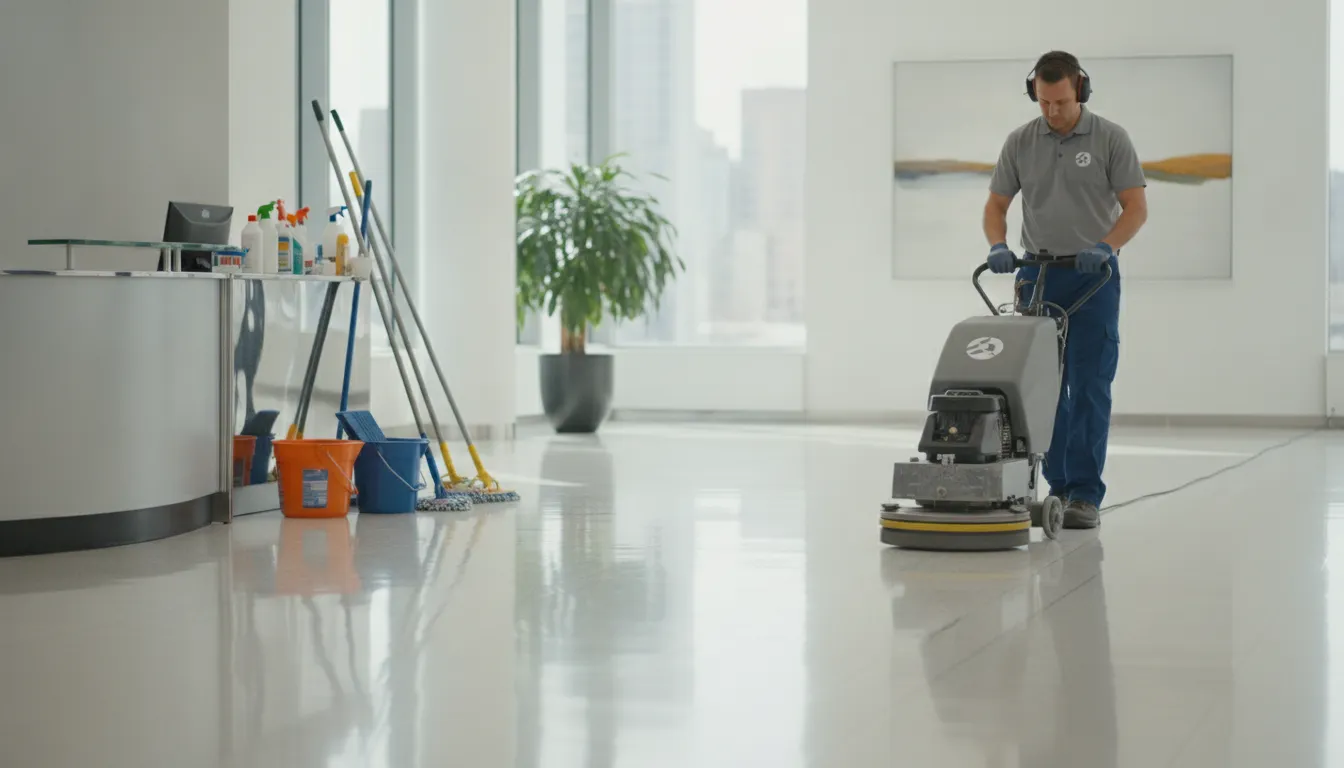
Commercial floor restoration is not priced by appearance alone. The condition of the existing finish, the flooring material, the square footage, and the work required to protect occupants and surrounding operations all affect the scope. A credible estimate should account for labor, floor-care chemicals, finish coats, equipment, site access, and any scheduling requirements. For the service itself, review Foreman Pro’s hard floor cleaning services to see how a custom floor-care program can support the work described in this guide.
The cost to strip and wax commercial floors commonly falls within a broad range. With early 2026 estimates of approximately $1.72 to $2.15 per square foot under favorable conditions, according to Homewyse cost data. Actual pricing may be higher or lower when finish buildup, floor type, minimum service charges, or specialized procedures change the labor requirements.
Request a custom floor care proposal from Foreman Pro Cleaning.
Understanding how those variables shape the estimate helps facility managers compare proposals accurately and identify savings that do not compromise floor protection. The first step is to establish a realistic baseline for the work itself.
What Does It Cost to Strip and Wax Commercial Floors?
The cost to strip and wax commercial floors commonly falls between $0.50 and $3.00 per square foot, depending on the flooring material, condition, access, and scope of work. Vinyl composition tile, or VCT, often falls near $0.50 to $1.50 per square foot. Small projects may also carry a minimum service charge of approximately $250 to $500, even when the measured floor area is limited.
For an additional benchmark, Homewyse estimated the cost to strip and wax a floor at $1.72 to $2.15 per square foot in January 2026. That estimate assumes favorable site conditions and should be treated as a planning reference rather than a universal commercial rate. Review the Homewyse cost estimate and its stated assumptions before comparing it with a proposal.
Why does the same floor-care service have such a wide range?
Square footage is only one part of the calculation. A facility with a large, open VCT area may allow a crew to move efficiently with a 24-inch floor machine. While a smaller building with multiple rooms, corridors, elevators, and occupied work areas can require more labor per square foot. Furniture relocation, restricted access, after-hours scheduling, and protection of adjacent surfaces can also affect the total.
The existing finish is another significant variable. Light wear and a manageable finish layer may require a relatively straightforward removal and application process. Heavy buildup, embedded residue, damaged areas, or inconsistent prior maintenance can require additional preparation, dwell time, machine passes, and finish coats. The correct approach should be determined after assessing the floor rather than by applying a generic rate.
How should facility managers compare floor-care proposals?
Compare what each proposal includes, not only the quoted price per square foot. A complete scope should identify the floor type, approximate area, preparation steps, number of finish coats, labor assumptions, equipment, drying time, and post-service inspection. It should also clarify whether the price includes moving light furnishings, returning them to position, and managing access around occupants or sensitive operations.
Foreman Pro Cleaning develops customized floor-care pricing for commercial facilities across Maryland, Washington, D.C., and Virginia. A site-specific review helps align the work with traffic patterns, operational requirements, and the condition of the finish, so the recommendation supports both appearance and long-term flooring performance.
How Is the Cost per Square Foot Calculated?
A professional estimate starts with the measurable area, then adjusts for the floor surface, finish condition, service scope, labor time, and materials. Square footage provides the baseline, but it does not tell the full story. A heavily worn VCT floor with multiple finish layers may require more preparation than a lightly maintained surface of the same size. Sealed concrete also calls for a different chemical and equipment approach than resilient tile.
| Floor or service type | Planning range | What typically affects the estimate | Recommended planning frequency |
|---|---|---|---|
| VCT strip and refinish | $0.50-$1.50 per sq. ft. | Finish buildup, number of coats, furniture relocation, and edge work | Usually periodic; inspect high-traffic areas throughout the year |
| Sealed concrete floor care | $0.75-$3.50 per sq. ft. | Surface condition, sealer compatibility, stain removal, and polishing requirements | Routine cleaning with restorative service as the surface dictates |
| Full strip and refinish benchmark | $1.72-$2.15 per sq. ft. | Labor, cleaning solution, consumables, equipment, and site access. | Often 1 to 2 times annually in primary entrances and lobbies. |
| Small or access-constrained project | $250-$500 minimum service range. | Minimum labor time, mobilization, setup, and equipment transport. | Schedule by inspection and operational need, not square footage alone. |
The $1.72-$2.15 benchmark reflects a January 2026 estimate published by Homewyse. It is a reference point, not a guaranteed rate for every facility. The same source identifies specialty equipment, including a rotating 2-horsepower, 24-inch floor machine, as a job-related cost. Its estimate also accounts for cleaning solutions, machine consumables, and disposable materials. Those inputs help explain why a quote cannot be calculated by multiplying square footage by a single universal number.
Minimum charges matter most for smaller suites, isolated rooms, and projects requiring a separate mobilization. For larger facilities, production efficiency can reduce the relative effect of setup and equipment costs. While restricted access, occupied areas, security protocols, or phased work can increase labor time. A floor-care assessment should therefore document the surface type, existing finish, usable square footage, access conditions, and desired maintenance frequency before pricing is finalized.
What Factors Drive Strip and Wax Pricing Up or Down?
The cost of a strip-and-wax project reflects the work required to return the floor to a stable, presentable condition, not simply the size of the room. A facility with open, lightly worn flooring may require fewer labor hours than a smaller site with several finish layers, restricted access, or extensive preparation. That is why a responsible quote begins with a site assessment rather than a generic rate card.
- Square footage and usable area that must actually be treated.
- Floor type, ranging from VCT and resilient tile to sealed concrete.
- Existing finish thickness and the level of preparation required.
- Site access, scheduling constraints, and furniture relocation.
- Labor hours, local rates, and specialized equipment and materials.
How Do Labor and Site Conditions Affect the Quote?
Labor is usually the largest variable. Estimates may include minimum service time, so a small project can carry a higher effective cost per square foot than a large, uninterrupted floor. Homewyse identifies a two-hour minimum labor allowance in its cost model. Scheduling, local labor rates, and the availability of trained commercial floor-care technicians also influence the final price, particularly in Maryland, Washington, D.C., and Northern Virginia.
Site conditions can add preparation time. Furniture, fixtures, stored materials, and tenant belongings may need to be relocated or protected before work begins. Tight corridors, multiple rooms, elevators, security checkpoints, and limited after-hours access can slow production. Travel time and mobilization may also affect a quote when the facility is outside a regular service route. These items should be identified in advance so the proposal reflects the actual work instead of producing an unexpected change order.
Why Does Existing Finish Buildup Matter?
Old finish does not always release evenly. Multiple layers, heavily worn traffic lanes, adhesive residue, or embedded soils can require additional solution, dwell time, passes with the floor machine, and rinsing. The underlying floor type matters as well. VCT, resilient tile, sealed concrete, and other surfaces have different tolerances, preparation requirements, and finish specifications. A professional assessment should confirm the flooring material and evaluate whether the existing coating can be safely removed without damaging the substrate.
When Is Specialized Equipment Necessary?
Large or heavily finished areas may require a rotating 2-horsepower, 24-inch floor machine to improve production and achieve consistent results. Homewyse includes this type of specialty equipment, along with stripping solutions, pads, machine consumables, and disposable materials, as job-related cost considerations. Equipment selection should match the floor and the site, not be added indiscriminately.
Foreman Pro Cleaning uses these variables to develop a customized quote based on square footage, floor condition, access, labor requirements, furniture moving, travel, and the equipment needed. The result is a clearer budget and a floor-care plan aligned with the facility’s operating conditions.
How Often Should Commercial Floors Be Stripped and Waxed?
Most commercial floors do not need a complete strip-and-refinish every time they lose their initial gloss. The appropriate interval depends on pedestrian traffic, floor type, finish condition, soil load, and the effectiveness of daily maintenance. A main entrance in a medical facility, office tower, school, or retail property may require a more frequent evaluation than a low-traffic administrative corridor.
For a practical planning baseline, the U.S. Environmental Protection Agency lists stripping and refinishing main entrance and lobby floors at approximately one to two times per year. The same EPA housekeeping guidance lists spray buffing at 52 to 250 times annually. Applying floor finish at 6 to 26 times annually, and scrubbing or polishing at 6 to 12 times annually. These figures are task-frequency ranges, not a universal mandate. They illustrate how commercial floor care relies on frequent restorative work between full strip-and-wax cycles. EPA housekeeping task guidance provides the underlying schedule ranges.
How Does Traffic Affect the Schedule?
High-traffic spaces accumulate more tracked-in soils, moisture, and abrasive particulates. Those conditions can wear through finish at entrances, elevator approaches, reception areas, and primary walkways before the rest of the floor shows comparable deterioration. A facility with sustained foot traffic may need more frequent spray buffing and interim scrubbing. With stripping and refinishing scheduled when the protective finish can no longer be restored effectively.
Lower-traffic areas may remain serviceable for longer periods, particularly when entry mats, prompt spill response, and consistent damp mopping reduce the contaminants reaching the floor. Floor type also matters. Resilient flooring such as VCT may be designed for periodic finish application, while sealed concrete and other hard surfaces may follow a different restorative protocol. The service plan should therefore distinguish between flooring materials rather than assign one annual frequency to the entire building.
Why Do Routine Services Extend the Interval?
Damp mopping removes soils before they become abrasive, while spray buffing helps restore appearance and support the existing finish without removing every layer. Regular scrubbing and polishing can address dullness and surface residue before a full strip becomes necessary. This layered approach protects the finish and helps facility managers schedule major floor work based on condition instead of cosmetic decline alone.
Scheduling also requires an indoor-air-quality review. The EPA has documented elevated airborne particles during certain wet-stripping and high-speed burnishing procedures, especially where resilient flooring may contain asbestos. Confirm flooring history, provide appropriate ventilation and containment, and plan work during low-occupancy periods. A professional assessment can establish whether the current cost to strip and wax commercial floors is justified now or whether interim maintenance is the safer, more efficient choice.
How Does a Maintenance Program Lower Life-Cycle Floor Costs?
The financial value of commercial floor care is measured over the life of the flooring system, not by the price of a single strip-and-wax visit. A customized program protects the finish between restorative services, helping facility managers preserve the appearance and serviceability of resilient flooring while reducing the likelihood of premature replacement. The objective is not to schedule every task at the same frequency. It is to match each procedure to traffic, flooring material, finish condition, and operational requirements.
Routine buffing and damp mopping remove tracked soils and help maintain the protective finish layer before abrasion exposes the underlying surface. The U.S. Environmental Protection Agency’s housekeeping guidance distinguishes frequent routine care from periodic strip-and-refinish work. Listing spray buffing for high-traffic lobby floors at 52 to 250 times per year while recommending strip and refinish approximately one to two times per year. Depending on conditions. Review the EPA housekeeping task guidance for the maintenance-frequency framework.
That cadence matters because finish failure can create a costly decision point. When the protective layer is neglected, abrasion, embedded residue, and traffic patterns can make a surface appear worn even when the underlying flooring remains serviceable. A measured program can use scheduled scrubbing, polishing, and buffing to preserve finish clarity, then reserve full stripping and recoating for areas that inspections show require restorative work. This approach supports better budget forecasting than treating every floor as if it needs the same annual scope.
Inspections should therefore guide the timing of the next project. Foreman Pro Cleaning can evaluate finish levels, traffic patterns, floor type, and operational constraints before recommending a service cycle. That customized assessment helps avoid both extremes: stripping too frequently, which adds unnecessary labor and material costs, or waiting until replacement appears to be the only practical option. For broader planning, compare the commercial cleaning cost per square foot with the projected scope of a floor-care program, and review how recurring janitorial services cost can fit alongside periodic restoration.
Long-term budgeting should also account for safe execution. Floor type and existing conditions affect the appropriate process, equipment, scheduling, and containment measures. A program built around documented inspections and customized intervals gives operations leaders a defensible way to prioritize high-traffic zones. Protect finish life, and plan capital expenditures before deterioration becomes urgent.
Why Partner With Foreman Pro Cleaning for Commercial Floor Care?
Facility managers need floor care that protects the surface, supports a professional environment, and fits the building’s operating requirements. Foreman Pro Cleaning brings a structured approach to commercial floor maintenance across Maryland, Washington DC, and Virginia. Rather than applying the same process to every facility, the team evaluates floor type, finish condition, traffic patterns, access limitations, and scheduling needs before recommending service.
For resilient flooring such as vinyl composition tile (VCT), that may include specialized strip-and-wax work to remove depleted finish and apply new protective layers. Auto-scrubbing supports efficient soil and residue removal across larger areas, while buffing and burnishing help maintain finish clarity between restorative cycles. The appropriate equipment, pad selection, solution, and operating speed depend on the surface and the condition of the existing finish. A site-specific plan helps prevent unnecessary removal of sound finish and avoids treating a periodic restoration as a substitute for routine maintenance.
Execution quality also depends on the people operating the equipment. Foreman Pro Cleaning uses trained and certified staff, including personnel with CET and CVI credentials. To apply documented floor-care procedures with attention to occupant safety, surface protection, and consistent results. Where older resilient flooring or unknown materials are present, the team can account for appropriate precautions and scheduling rather than proceeding without evaluating the site conditions.
Customized planning is particularly valuable when a facility needs to control the commercial floor care and carpet cleaning program as one coordinated scope. It can also complement broader commercial janitorial services, allowing recurring cleaning and periodic floor restoration to support the same facility standards. The result is a maintainable plan based on actual traffic and finish performance, not a generic calendar.
Because square footage, floor material, finish buildup, access, and labor requirements vary, Foreman Pro Cleaning does not rely on a one-size-fits-all rate. A professional assessment clarifies the work required and gives facility leaders a defensible basis for budgeting the cost to strip and wax commercial floors.
Request a custom floor care proposal from Foreman Pro Cleaning.
Frequently Asked Questions
How much does it cost to strip and wax a commercial floor?
Pricing depends on square footage, flooring type, finish buildup, access, and the labor and equipment required. A January 2026 estimate places strip-and-wax work at approximately $1.72 to $2.15 per square foot under stated site conditions. But a commercial proposal should be based on an evaluation rather than a generic rate. Homewyse cost data provides the cited estimate.
How often should commercial floors be stripped and waxed?
Many high-traffic areas require stripping and refinishing approximately once or twice per year, although the appropriate interval depends on traffic volume, flooring material, finish condition, and routine maintenance. The U.S. Environmental Protection Agency lists strip-and-refinish service at one to two times annually for main entrances and lobbies, while routine damp mopping and spray buffing occur more frequently. EPA housekeeping guidance supports these maintenance intervals.
How long does it take to strip and wax 1,000 square feet?
There is no dependable time estimate from square footage alone. The schedule must account for furniture relocation, floor preparation, finish removal, drying time between coats, ventilation, and cure requirements. A relatively open floor with limited finish buildup may be completed more efficiently than a congested or heavily worn area. So the provider should confirm timing after reviewing the site.
What factors influence the cost to strip and wax commercial floors?
The primary factors are floor type, total area, existing finish thickness, contamination and wear, access, working hours, labor requirements, and the need for specialized machines or additional materials. Existing resilient flooring should also be assessed before work begins. The EPA documents airborne particulate concerns during certain burnishing and wet-stripping operations, making material identification, containment, ventilation, and scheduling important considerations when conditions warrant. EPA research details these considerations.
Ready to Protect Your Commercial Floors With a Custom Program?
A defensible floor maintenance budget starts with an accurate scope of work. Foreman Pro Cleaning evaluates your floor type, finish condition, square footage, and operating schedule before recommending a strip-and-wax program. So the estimate reflects the work your facility actually needs rather than a generic rate.
Request a professional assessment and a custom proposal for your building today.
Request a custom floor care proposal from Foreman Pro Cleaning.
Share your building details and a Foreman Pro representative will follow up with a site-specific scope and pricing. Periodic floor restoration, paired with a consistent maintenance schedule. Is one of the most effective ways to protect your flooring investment and extend its useful life across Maryland, Washington DC, and Virginia.
