
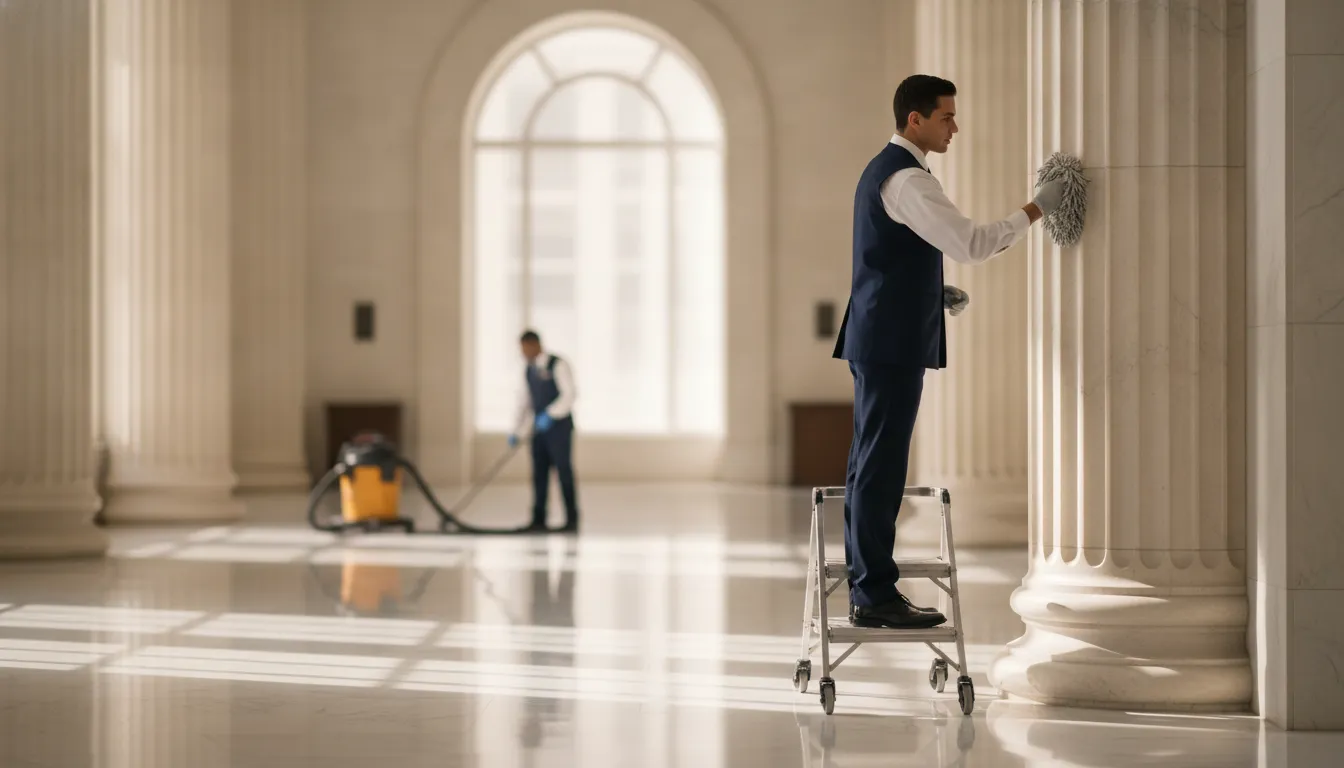
Federal facility managers in Maryland, Washington, D.C., and Virginia are accountable for more than an orderly appearance. Cleaning programs must support occupant safety, operational continuity, documented contract performance, and the requirements attached to the building’s use. That makes the distinction between a generic janitorial checklist and a federal-ready custodial program consequential.
Federal building cleaning standards are the documented custodial, sanitation, product, and service-frequency requirements used to maintain government facilities. The GSA National Custodial Specification establishes the national service standard for custodial services in federal buildings, while OSHA, CDC, and environmentally preferable product requirements add operational controls.
Effective compliance begins with identifying which requirements govern the property, occupants, and security profile, then translating them into measurable tasks, frequencies, records, and vendor qualifications. The governing framework provides that foundation before a facility evaluates specialized controls, staffing, or performance verification.
What Are Federal Building Cleaning Standards?
Federal building cleaning standards establish a documented performance baseline for custodial services, rather than treating every facility as an interchangeable commercial space. The General Services Administration (GSA) National Custodial Specification states that its requirements constitute the national standard of service for custodial and related services provided to federal tenants across service zones. GSA’s National Custodial Specification therefore serves as the primary reference for defining task requirements, service expectations, and property-specific custodial operations.
What Does the National Custodial Specification Cover?
The specification applies across distinct property types, including offices, courthouses, child care centers, land ports of entry, warehouses, airports, and public-facing facilities. Its property-type framework recognizes that occupant patterns, security conditions, surface materials, public access, and operational risks affect the appropriate cleaning program. A courthouse, for example, may require a different sequence of work and access control than a warehouse or a child care center.
For facility managers, this distinction matters during scope development and performance review. A compliant program should translate the applicable specification into defined frequencies, methods, quality controls, documentation, and escalation procedures. Foreman Pro Cleaning approaches federal and government-adjacent environments through that same lens. Aligning the cleaning plan with the building’s use, risk profile, and operational constraints instead of relying on generic task lists.
GSA’s scale reinforces why consistent standards are necessary. The agency manages approximately 8,500 assets totaling about 360 million square feet across the states, Washington, D.C., and U.S. territories. GSA’s organization profile describes the scope of that portfolio, where standardized requirements must still accommodate materially different facilities.
How Are Federal Building Standards Updated?
Federal requirements are maintained through revisions to facilities standards and performance criteria. GSA’s current facilities standards resources identify the 2025 PBS Core Building Standards and the 2024 P100 as mandatory design and performance references for GSA-owned buildings. GSA’s facilities standards page provides the current publications and related submittal materials.
Updates can affect procurement language, documentation, building-performance expectations, and the evidence required from service providers. Facility managers should therefore confirm the edition incorporated into the contract, maintain a controlled copy of applicable specifications. And require vendors to map procedures and quality records to the current requirements. This approach supports defensible inspections and reduces the risk that an otherwise capable custodial program is evaluated against obsolete criteria.
Which Federal Agencies Define Building Cleaning Requirements?
Federal cleaning requirements are distributed across procurement specifications, workplace sanitation rules, public-health guidance, and product standards. Facility managers should treat these sources as complementary controls rather than as a single checklist. The General Services Administration (GSA) establishes the contractual and building-performance framework, while OSHA defines an enforceable workplace sanitation floor. CDC guidance informs routine hygiene practices, and EPA procurement language helps agencies specify lower-impact products without weakening cleaning performance.
The scale of the GSA program demonstrates why documentation matters. GSA Public Buildings Service manages more than 600 custodial contracts covering more than 1,500 government-owned buildings, with annual spending above $400 million, according to its April 2024 announcement: GSA custodial procurement data. The same announcement requires PFAS-free products certified through EPA Safer Choice or applicable Green Seal standards, including GS-37, GS-41, and GS-53. The requirements also direct contractors toward USDA BioPreferred biobased minimums.
| Standard | Governing agency | What it requires | Key data point |
|---|---|---|---|
| GSA National Custodial Specification | GSA PBS | Defines custodial service expectations, task requirements, and property-specific performance criteria for federal facilities. | More than 600 contracts, 1,500+ buildings, and $400M+ annually. (GSA) |
| GSA P100 / PBS Core Building Standards | GSA PBS | Establishes mandatory design and performance criteria for GSA-owned buildings, which affect maintainability and custodial execution. | Applies across a federal portfolio of approximately 8,500 assets and 360 million square feet. (GSA) |
| OSHA 29 CFR 1910.141 | OSHA | Requires clean workplaces, dry floors, controlled waste, potable water, toilet facilities, and vermin control. | Enforceable workplace sanitation standard. (OSHA) |
| CDC facility hygiene guidance | CDC | Directs regular cleaning of high-touch surfaces, cleaning before disinfecting, and increased attention in high-traffic areas. | Examples include door handles, elevator buttons, railings, desks, and restroom fixtures. (CDC) |
| EPA Safer Choice / Green Seal product requirements | EPA and recognized certification bodies | Supports environmentally preferable custodial specifications, including PFAS restrictions and certified product selection. | PFAS-free products and Green Seal GS-37, GS-41, or GS-53 certifications are specified for federal custodial contracts. (EPA) |
For a compliant operating plan, Foreman Pro Cleaning can translate these agency requirements into documented task procedures, product submittals, and quality-control records. That approach helps facility teams distinguish a general service promise from verifiable alignment with federal expectations.
How Often Do Federal Specifications Require Buildings to Be Cleaned?
Federal custodial specifications do not impose one universal calendar for every facility. The GSA National Custodial Specification uses task frequencies that can be adjusted to the building type, occupants, and operating conditions. A federal office with controlled occupancy may require a different service rhythm than a courthouse, child care center, or public-facing facility. The specification also recognizes periodic and bi-weekly task language within the scope of work, allowing the contract to define recurring services without treating every area as identical. Review the GSA National Custodial Specification when developing service frequencies.
What Do Daily and Weekly Task Rhythms Include?
Daily work typically prioritizes occupancy-sensitive conditions: restroom fixtures, waste removal, entry points, spills, floors, and high-touch surfaces such as door handles, elevator buttons, railings, and shared work areas. The CDC recommends regular cleaning of high-touch surfaces and advises increasing frequency in high-traffic spaces. Cleaning should precede disinfection when disinfection is required, because removal of residue and contaminants improves the subsequent process.
Weekly cycles can address lower-frequency surfaces, detailed restroom work, edge and corner attention, interior glass, and areas that accumulate particulate matter between daily services. The schedule should identify the responsible party, verification method, service window, and escalation procedure. A documented commercial cleaning scope of work template helps translate these expectations into auditable tasks rather than vague promises of routine cleaning.
Which Periodic Tasks Belong on a Bi-Weekly or Monthly Cycle?
Periodic specifications commonly assign carpet care, hard-floor maintenance, restroom deep cleaning, high dusting, and other restorative work to bi-weekly, monthly, quarterly, or condition-based cycles. The correct interval depends on traffic, floor finish, contamination risk, and the facility’s performance requirements. Carpet extraction may be scheduled more frequently at entrances during severe weather, while hard-floor maintenance may follow finish condition and traffic patterns instead of an arbitrary date.
Staffing capacity directly affects whether the written frequency is achievable. The APPA custodial framework lists approximately 8,500 square feet per custodian for a Level 1 classroom environment. Compared with approximately 26,500 square feet at Level 3, reflecting materially different appearance and service expectations. APPA custodial level data therefore provides useful context when facility managers evaluate labor plans, inspection scores, and the feasibility of daily versus periodic tasks. Foreman Pro Cleaning can align the schedule, staffing model, and documentation with the conditions documented in the facility scope.
Why Do Secure and Critical Federal Spaces Need Specialized Cleaning?
Secure federal assets require cleaning methods that protect operational continuity, information security, and sensitive equipment. A SCIF, data center, laboratory, or courthouse cannot be serviced safely with a generic checklist designed for an ordinary commercial office. Cleaning activity must be planned around access controls, material compatibility, contamination pathways, static-sensitive systems, and the facility’s documented operating requirements.
How Does Contamination Control Protect Sensitive Federal Assets?
Particulate contamination can accumulate around servers, ventilation pathways, laboratory instrumentation, and electronic components. In data centers and command centers, uncontrolled residue and airborne particulates can interfere with cooling, maintenance, and equipment reliability. Electrostatic discharge presents an additional risk where static-sensitive hardware is present. A qualified team therefore uses controlled movement patterns, appropriate microfiber technology, and HEPA-filtered vacuums rather than transferring contaminants between zones.
Foreman Pro Cleaning applies proprietary critical environment training (CET), contamination control protocols, and ESD risk mitigation to high-stakes environments. These practices support a methodical approach to critical environment cleaning, including data centers, laboratories, and command centers. Facility managers evaluating technical requirements should also review ISO 14644-1 cleanroom classifications when a controlled environment’s particulate limits or classification affect the scope of work.
Why Do Cleared and Trained Personnel Matter?
Access is not the same as qualification. Personnel entering a secure federal space must follow the facility’s escort, identification, tool-control, and documentation procedures. They must also understand which surfaces, enclosures, flooring systems, and equipment may be handled, which areas require restricted access, and how to report an anomaly without disrupting operations. A trained crew can execute the approved sequence consistently and preserve chain-of-custody expectations.
Foreman Pro Cleaning combines critical-environment training with experience informed by IT operations and facilities management. That perspective helps teams recognize when cleaning activity could affect uptime, hardware, or contamination boundaries. The CDC notes that facilities with regulated requirements may need to follow specific rules, reinforcing the need to align procedures with the building’s governing standards instead of relying on a universal routine.
How Can MD, DC, and VA Facility Managers Verify a Vendor Meets Federal Standards?
Verification should be evidence-based, not limited to a capability statement or a general promise of regulatory compliance. For facilities such as a GSA regional office, the Pentagon, NIH campuses, or federal courthouses. The contract file should show how cleaning activities align with the applicable facility standards, security requirements, and performance criteria. The GSA facilities standards provide the starting point for identifying required documentation and organizing submittal matrices.
How Do Audit Trails and Documentation Demonstrate Compliance?
Ask the vendor to provide a controlled documentation set before work begins and to maintain it throughout the contract. At minimum, the audit trail should include:
- Current staff training records, including role-specific instruction in contamination control, restricted-area procedures, and safe chemical handling.
- Verified CVI and CET certification records where the facility includes critical infrastructure, sensitive equipment, or elevated particulate-control requirements.
- Product inventories, manufacturer documentation, and current safety data sheets (SDS) for every chemical brought on site.
- Inspection checklists showing task completion, exceptions, corrective actions, supervisor review, and closeout dates.
Product documentation deserves particular scrutiny. Federal custodial contracts require certified products, including EPA Safer Choice and applicable Green Seal GS-37, GS-41, or GS-53 products, as well as USDA BioPreferred biobased products. These requirements are described in the GSA announcement on federal custodial products. Do not accept an undated product list when the contract requires current certifications.
How Should Managers Build a Compliant Scope of Work?
A compliant scope should translate standards into observable tasks. Define each space by building type, occupancy, security classification, surface, method, frequency, responsible role, acceptance criteria, and required record. Include escalation procedures for missed tasks, contamination events, restricted access, and product substitutions. The scope should also identify which submittals require approval before mobilization and how inspection findings are documented.
Foreman Pro Cleaning uses structured training and contamination control protocols to support this type of traceability across Maryland, Washington D.C., and Virginia. Managers can review government building cleaning services for facility context, then use the commercial cleaning RFP questions resource to test whether proposed documentation is specific enough to audit.
Frequently Asked Questions
What are the GSA P100 standards?
GSA P100, formally the Facilities Standards for the Public Buildings Service, establishes design and performance requirements for GSA-owned facilities. Facility managers should use the current P100 edition with applicable PBS standards and project documentation when translating building requirements into custodial scopes. GSA also publishes related standards and submittal materials through its facilities standards resource.
What does the GSA National Custodial Specification cover?
The GSA National Custodial Specification establishes the national service standard for custodial and related services provided to federal tenants. It applies across property types including offices, courthouses, child care centers, warehouses, airports, land ports of entry, and public-facing facilities. The specification is therefore a framework for a building-specific scope, not a universal checklist applied without regard to occupancy or use. Read the GSA specification.
What are the OSHA cleaning guidelines for workplaces?
OSHA 29 CFR 1910.141 requires workplaces to be maintained in a clean and orderly condition. With dry floors, appropriate waste receptacles, prompt waste removal, vermin control, potable water, and compliant toilet facilities. These requirements establish an enforceable sanitation baseline. A federal facility may also need additional controls from its contract, property type, security program, or operational risk profile. Review OSHA 1910.141.
What are the five APPA cleaning levels?
APPA custodial levels describe progressively different appearance and maintenance outcomes, from Level 1 Orderly Spotlessness through Level 5 Unkempt Neglect. The selected level should match the facility’s mission, occupancy, risk tolerance, and available staffing. Managers should document the desired level in performance criteria and inspection procedures rather than relying on an undefined expectation of cleanliness. See APPA cleaning operations guidance.
How often should federal office high-touch surfaces be cleaned?
There is no single frequency appropriate for every federal office. The GSA specification supports task frequencies tailored to building type and occupants. While CDC guidance recommends regular cleaning of high-touch surfaces such as door handles, elevator buttons, railings, restroom fixtures, and desks. Increase frequency in high-traffic areas and clean surfaces before applying an EPA-registered disinfectant when disinfection is required. Consult CDC facility guidance.
How Can Foreman Pro Cleaning Support Your Facility?
Federal cleaning specifications can require careful alignment between building use, service frequencies, product documentation, and contamination control procedures. Foreman Pro Cleaning can help you identify the appropriate considerations for your facility and develop a practical next step. Schedule a consultation to review your cleaning requirements against applicable federal building standards.
