
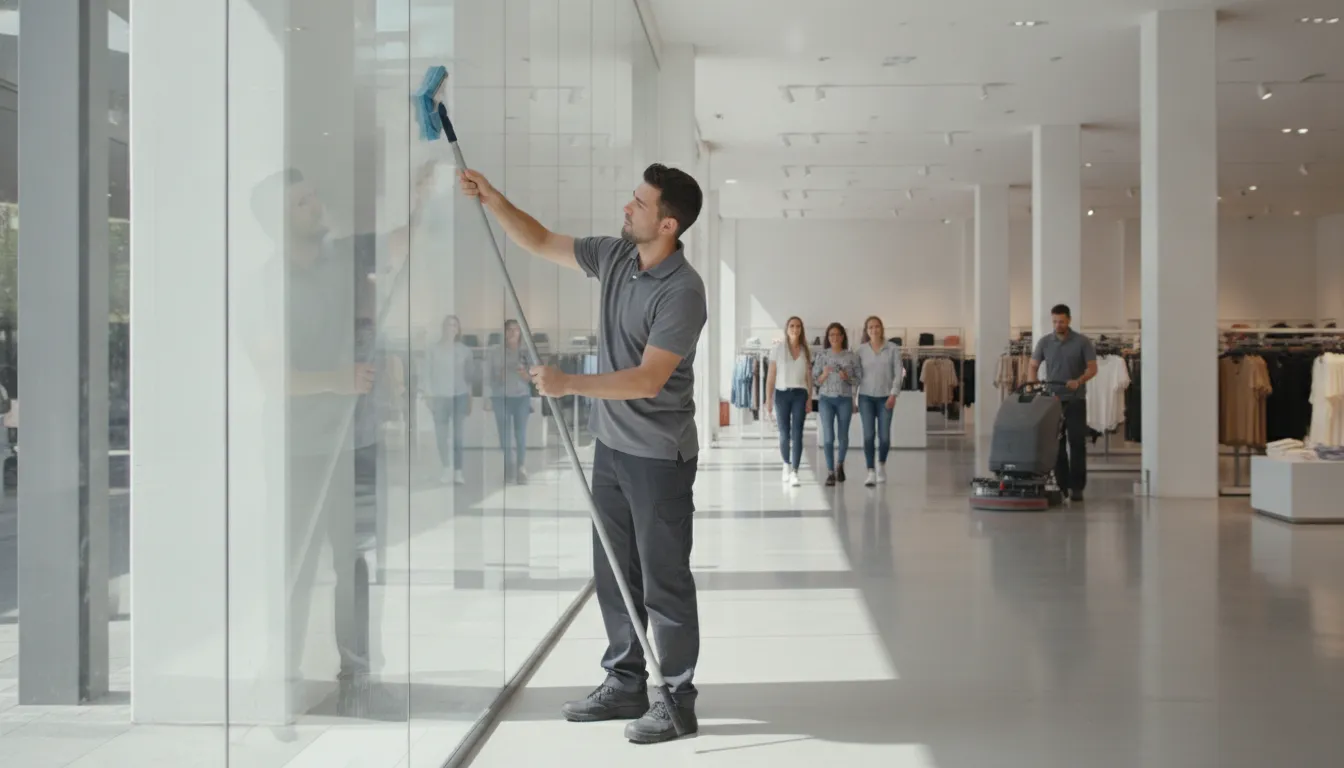
Customers form an opinion of a retail business before they evaluate its merchandise. Smudged entry glass, residue around checkout zones, or neglected fitting rooms can make an otherwise well-managed store appear inattentive.
A professional retail store cleaning service protects brand reputation by maintaining visible presentation, controlling contaminants in high-traffic areas, and supporting a consistent customer experience. That work spans sales floors, fitting rooms, restrooms, and back-of-house spaces.
That consistency has measurable commercial importance. Ipsos research found that 92% of Americans consider business cleanliness important when deciding whether to return. Foreman Pro Cleaning builds site-specific plans around traffic patterns, operating hours, surface requirements, and contamination control protocols. Request a custom retail cleaning plan to establish the right service scope, then consider why cleanliness directly shapes how customers interpret your brand.
Why Does Retail Cleanliness Matter for Your Brand Reputation?
In retail, customers interpret environmental conditions as evidence of how carefully a business manages its products, facilities, and service standards. A consistent cleaning program therefore supports more than appearance. It reinforces confidence at the point of purchase and protects the credibility a brand has built across every location.
How Does Store Condition Influence Customer Trust?
Research conducted by Ipsos for P&G Professional found that 92% of Americans consider business cleanliness an important factor when deciding whether to become repeat customers. That finding makes cleanliness a retention issue, not merely a housekeeping preference. Visible residue, neglected high-touch surfaces, overflowing receptacles, or poorly maintained restrooms can create doubt before an employee has an opportunity to correct the customer experience.
Academic research also indicates that disorderly retail settings can influence consumer behavior in harmful ways, including perceptions associated with contamination and unethical conduct. The study demonstrates why facility condition should be treated as part of the retail environment and brand management process. A disorganized or visibly neglected setting can alter how customers assess the business, even when the underlying products and service are sound.
Foreman Pro Cleaning addresses this risk through contamination control protocols tailored to traffic patterns, surface materials, fitting rooms, point-of-sale areas, and other customer-facing zones. The objective is continuous particulate management and consistent presentation, supported by appropriate methods such as microfiber technology, HEPA-filtered vacuums, and EPA-registered disinfectants where applicable.
Retail operators can review the retail store cleaning service to evaluate a customized scope. For facilities that require more targeted hygiene measures, the discussion of commercial disinfection services provides additional context on risk-based protocols and surface treatment.
What Does a Professional Retail Store Cleaning Service Include?
A professional retail program should address every customer-facing and operational zone, not only the visible sales floor. Foreman Pro Cleaning develops customized plans for each facility, accounting for layout, materials, traffic patterns, operating hours, and the level of contamination control required.
How Are Customer-Facing Areas Maintained?
Storefronts, entry doors, glass, and display-adjacent surfaces require careful cleaning that preserves a polished first impression without streaks or residue. On the sales floor, crews manage tracked-in debris, microscopic particulates, shelving surrounds, aisles, and high-traffic zones with microfiber technology and HEPA-filtered vacuums where appropriate. Floor maintenance is matched to the surface, whether the facility has resilient flooring, tile, polished concrete, or carpet.
Restrooms and fitting rooms receive more than a visual reset. A defined protocol addresses fixtures, partitions, mirrors, floors, dispensers, ventilation grilles, benches, hooks, and other touchpoints. High-touch surfaces, including door handles, cart handles, counter edges, and point-of-sale zones, can be treated with EPA-registered disinfectants according to product-label directions. This supports a documented approach to hygiene rather than informal spot cleaning.
What Belongs in Back-of-House Cleaning?
Stockrooms, receiving areas, employee corridors, break areas, offices, and waste staging zones also belong in the scope. These spaces influence inventory handling, staff experience, and the movement of contaminants into customer areas. Service timing can be coordinated around deliveries, replenishment, opening, and closing procedures to minimize operational disruption.
Foreman Pro Cleaning can document these responsibilities through a commercial cleaning scope of work. Retail operators evaluating a commercial cleaning company should look for clear task ownership, service frequencies, escalation procedures, and quality-review expectations. The result is a facility-specific plan that makes each area measurable and each cleaning decision purposeful.
How Are Storefront and Window Cleaning Protocols Handled?
Storefront glass, entry doors, and display cases establish the retail environment before a customer examines a product. Streaks, fingerprints, adhesive residue, and airborne particulates can obscure merchandise and make a well-managed location appear neglected. Because visual order influences perceptions of hygiene and quality, Foreman Pro Cleaning treats reflective surfaces as part of the customer experience, not as an incidental detail.
What Does Proper Glass Cleaning Require?
A professional storefront window cleaning program begins with a surface assessment. Technicians identify coated glass, mirrors, brushed metal, acrylic, and other materials before selecting compatible solutions. Microfiber technology removes residue without introducing lint, while clean, properly sized applicators limit cross-contamination between surfaces.
Technicians apply solution in controlled amounts rather than saturating frames, thresholds, or electronic door hardware. They then use a properly maintained squeegee with overlapping passes, consistent pressure, and a clean rubber edge. Edges and corners receive a final detail with a dedicated microfiber cloth. This process reduces water marks and streaking while protecting surrounding finishes.
How Are Exterior Areas Maintained Safely?
Exterior protocols extend beyond the glass. Foreman Pro Cleaning can coordinate pressure washing for walkways, entrances, and other hardscape areas when accumulated residue affects appearance or creates a slip concern. Technicians control pressure, overspray, runoff, and pedestrian access to protect storefront materials and maintain safe operations. Scheduling may occur before opening, after closing, or during an approved low-traffic period.
The result is a consistent presentation across windows, doors, displays, and approach areas, supported by a documented scope rather than improvised spot treatment.
How Do You Maintain a Clean Sales Floor During Operating Hours?
A day porter maintains presentation and safety while the store remains open. The role is not limited to visible spot cleaning. It applies contamination control protocols across entrances, aisles, checkout lanes, fitting rooms, and other zones where traffic concentrates microscopic particulates, residue, and debris.
A defined day porter service assigns recurring inspections to a trained professional. The porter monitors high-traffic areas, responds to spills, replenishes restroom supplies, removes debris, and coordinates discreetly with store leadership. Scheduling work around customer movement prevents unnecessary disruption while preserving consistent standards.
How Does Equipment Support Particulate Management?
HEPA-filtered vacuums can capture 99.6% of particles down to 0.3 microns as an equipment capability statement. Used according to manufacturer specifications, this technology supports continuous particulate management on hard floors, carpets, entry mats, and edges where conventional sweeping can redistribute fine contaminants.
Color-coded microfiber cloths help separate cleaning applications and reduce the risk of transferring residue between zones. A documented system can reserve designated cloths for checkout surfaces, fitting-room fixtures, restroom touchpoints, and back-of-house areas. Foreman Pro Cleaning can align those assignments with the facility’s operational requirements.
What Should Spot-Cleaning Routines Include?
Spot-cleaning routines should prioritize spills, tracked moisture, high-touch surfaces, and visible residue without creating hazards for shoppers. Staff should establish a controlled perimeter when a liquid creates a slip risk, use appropriate warning signage, remove the hazard promptly, and verify that the surface is dry before reopening the path.
Inspection logs can record the zone, condition observed, corrective action, and follow-up time. Managers can also review the principles of maintaining hygiene in high-traffic areas when refining routes and inspection intervals. This approach keeps sales-floor maintenance systematic, discreet, and measurable throughout operating hours.
What Restroom Standards Should a Retail Store Enforce?
Retail restrooms are highly visible indicators of operational discipline. A Bradley survey identifies clean restrooms as beneficial to business performance, while a Cintas-commissioned survey reports that restroom conditions influence how Americans perceive a business. Standards should therefore address both hygiene and presentation.
Which surfaces require high-touch disinfection?
Each service should include methodical cleaning and disinfection of door handles, stall latches, faucet controls, flush handles, dispensers, grab bars, baby-changing stations, and other frequently contacted surfaces. Foreman Pro Cleaning uses the application of EPA-registered disinfectants according to product-label directions and site requirements. Cleaning personnel should observe required contact times rather than wiping product away immediately.
How should restocking and inspection be documented?
Consumables must remain available throughout operating hours, including hand soap, paper products, toilet tissue, and liners. A written inspection log should record the attendant or technician, inspection time, observed conditions, corrective action, and supervisor review. High-traffic stores may require checks at opening, during peak periods, and before closing. Lower-traffic locations should still receive documented daily inspections, with frequency adjusted through a site-specific scope of work.
Managers should verify odor control, dry floors, clean mirrors, intact fixtures, functional dispensers, and appropriate waste removal at every inspection. This documented process converts restroom care from an informal expectation into a measurable retail standard.
What Should a Retail Cleaning Checklist Include?
A reliable checklist converts cleaning expectations into observable tasks, assigned frequencies, and documented standards. The intervals below are a practical protocol framework. Adjust them for square footage, operating hours, foot traffic, merchandising changes, and incident response requirements.
| Task | Frequency | Purpose/Standard |
|---|---|---|
| High-touch surfaces, including door handles, POS keypads, and fitting-room rails | Daily; repeat during peak operating periods as needed. | Apply an EPA-registered disinfectant and observe the product label dwell time before wiping. Record each completed service. |
| Restrooms | Daily inspection and disinfection; inspect supplies at least once per shift | Verify fixtures, partitions, floors, dispensers, and odor control. Maintain a signed inspection log for each service round. |
| Sales floor sweeping or HEPA-filtered vacuuming | Daily; increase frequency in entrance and queue zones | Remove tracked-in debris and manage microscopic particulates without disrupting customers or merchandise. |
| Glass, entry doors, and storefront detail | Weekly; address visible marks immediately | Maintain streak-free reflective surfaces and a clear entrance presentation across the primary customer approach. |
| Display, fixture, and shelving dusting | Weekly; spot-check high-touch displays daily | Use microfiber technology to remove residue while protecting merchandise, finishes, and visual presentation. |
| Hard-floor scrubbing and carpet extraction | Monthly or quarterly, based on traffic and flooring type | Schedule restorative floor care before soils become embedded. See the hard floor cleaning service option for surface-specific planning. |
| Seasonal deep cleaning | Quarterly; add pre-opening and post-holiday services when warranted | Complete concealed-area detailing, high-level dust removal, fixture attention, and documented quality review. |
| Carpet extraction | Annually or semi-annually, depending on traffic and appearance | Use a condition-based schedule to protect fibers and preserve customer-facing presentation. Coordinate commercial carpet cleaning with low-traffic periods. |
The checklist should identify who performs each task, which products and equipment are approved, and where completion is recorded. Managers can then distinguish an incomplete service from a surface that requires repair or replacement. Product label directions govern disinfectant application, including required dwell time, while floor-care intervals should reflect actual traffic and material condition. Foreman Pro Cleaning can translate this framework into a documented scope of work for stores across Maryland, Virginia, and Washington, D.C. Review the checklist monthly, compare recurring exceptions, and revise frequencies when queueing, seasonal traffic, or a layout change creates new high-touch zones.
When Should Retailers Schedule Seasonal Deep Cleaning?
Seasonal deep cleaning should follow the retail calendar, not a fixed date. The right timing allows teams to restore heavily used areas, address accumulated residue, and improve presentation without disrupting customers or merchandise. A documented schedule also helps facility managers align cleaning activity with traffic patterns, lease obligations, and planned construction.
Which Seasonal Milestones Require Additional Attention?
- Post-holiday recovery: Schedule intensive floor and fixture care after peak shopping periods, when foot traffic, displays, and product handling have placed additional demands on the space.
- Before a grand opening or remodel reopening: Complete final-detail cleaning after construction, merchandising, and equipment installation. This timing removes construction residue before customers enter.
- Spring and fall refreshes: Use transitional seasons to review the full facility, including storefront surfaces, vents, fitting rooms, stock areas, and high-traffic flooring.
- End of lease: Plan the work early enough to address restoration requirements, flooring conditions, and exterior walkways before the final inspection.
What Should a Seasonal Deep-Cleaning Scope Include?
A complete scope may include hot-water extraction for carpeted areas, machine scrubbing and refinishing for resilient hard floors. Detailed cleaning of fixtures and ventilation grilles, and pressure washing for entrances and walkways. Floor care deserves particular attention because specialized maintenance can materially improve a store’s presentation and preserve surfaces. Review commercial carpet cleaning services when carpet extraction is due.
Foreman Pro Cleaning can build a customized schedule around operating hours, access requirements, and the condition of each retail facility. Its broader commercial cleaning capabilities support coordinated work across sales floors, back-of-house areas, and exterior entry zones. Schedule seasonal work before deterioration becomes visible, and pair it with routine service for continuous particulate management.
How Often Should a Retail Store Be Professionally Cleaned?
The appropriate cadence depends on foot traffic, operating hours, product handling, restroom use, and the visibility of the premises. A high-volume retailer typically needs daily or nightly professional service, while a lower-volume boutique may require fewer scheduled visits. The objective is consistent presentation and hygiene, not occasional recovery after contaminants, residue, or debris become visible.
Use the checklist in the preceding section as the operational baseline, then adjust frequency according to observed customer experience risk:
- High-traffic stores: Schedule service daily or nightly. Add daytime touch-point attention when entrances, fitting rooms, checkout areas, and restrooms experience sustained use. This supports continuous particulate management without disrupting shoppers.
- Moderate-traffic stores: Schedule comprehensive professional cleaning weekly, with daily staff touch-ups for high-contact surfaces, visible spills, fitting rooms, and restroom conditions. Weekly service should still include the recurring floor, fixture, and detail tasks defined in the checklist.
- Boutiques and lower-volume locations: Schedule professional cleaning two or three times per week, supplemented by a monthly detail service for glass. Corners, fixtures, and other areas that routine visits may not fully address.
Retailers should also increase service around promotions, holidays, weather events, remodels, and changes in store hours. Entrance soils and tracked moisture can increase quickly during adverse weather, while seasonal shopping periods can intensify restroom and fitting-room demand. Review the cadence after incidents, customer complaints, or recurring quality-control findings rather than waiting for the next contract cycle.
Foreman Pro Cleaning can build a documented schedule around traffic patterns, cleaning zones, and service windows. Its approach to high-traffic area hygiene helps facility managers coordinate visible maintenance with scheduled professional work, preserving the customer experience while minimizing operational disruption.
What Are the Most Common Retail Store Cleaning Questions?
What are the benefits of a professional retail store cleaning service?
A professional plan protects the customer experience, reinforces brand standards, and gives store teams a consistent operating environment. It can cover sales floors, fitting rooms, restrooms, checkout areas, display fixtures, stockrooms, and high-touch surfaces. Scheduled service also creates documented responsibilities, reducing the risk that essential tasks are missed during busy trading periods.
How does retail store cleanliness impact customer experience?
Clean floors, clear glass, orderly fitting rooms, and well-maintained restrooms communicate operational discipline before an associate speaks with a customer. Visible residue, overflowing waste, unpleasant odors, or neglected high-touch areas can undermine confidence in the merchandise and the retailer. A cleaning schedule should therefore reflect customer traffic, store layout, and the moments when shoppers most notice conditions.
What is included in a typical retail store cleaning service plan?
A plan commonly includes floor maintenance, restroom cleaning, fitting-room detailing, dust removal from fixtures, high-touch surface disinfection, waste handling, and storefront or window care. The exact scope should identify task ownership, service frequency, approved products, equipment requirements, quality checks, and escalation procedures. Foreman Pro Cleaning can align the scope with the retailer’s operating hours and facility requirements.
How often should a retail store be professionally cleaned?
Frequency depends on foot traffic, store size, product handling, restroom usage, weather exposure, and operating hours. High-traffic locations often need daily or nightly service, with additional attention during peak periods. Lower-volume boutiques may use scheduled weekly maintenance with periodic detail work. Restrooms, fitting rooms, entrances, and high-touch points should be assessed separately rather than assigned one universal interval.
What safety measures are used during retail cleaning?
Professional teams use task-appropriate equipment, follow product instructions, place warning controls around wet floors, and coordinate work to limit disruption to shoppers and employees. High-touch surfaces may receive EPA-registered disinfectants selected for the intended use. Floor-care procedures should address slip and trip risks, while managers should receive clear escalation notes for spills, damaged surfaces, or other hazards.
Ready to Request a Customized Retail Store Cleaning Plan?
A tailored plan can align cleaning frequency, surface care, and operating-hour protocols with your facility’s traffic patterns and service priorities. Contact Foreman Pro Cleaning to request a customized retail store cleaning plan for your facility and discuss the appropriate next steps with the team.
