
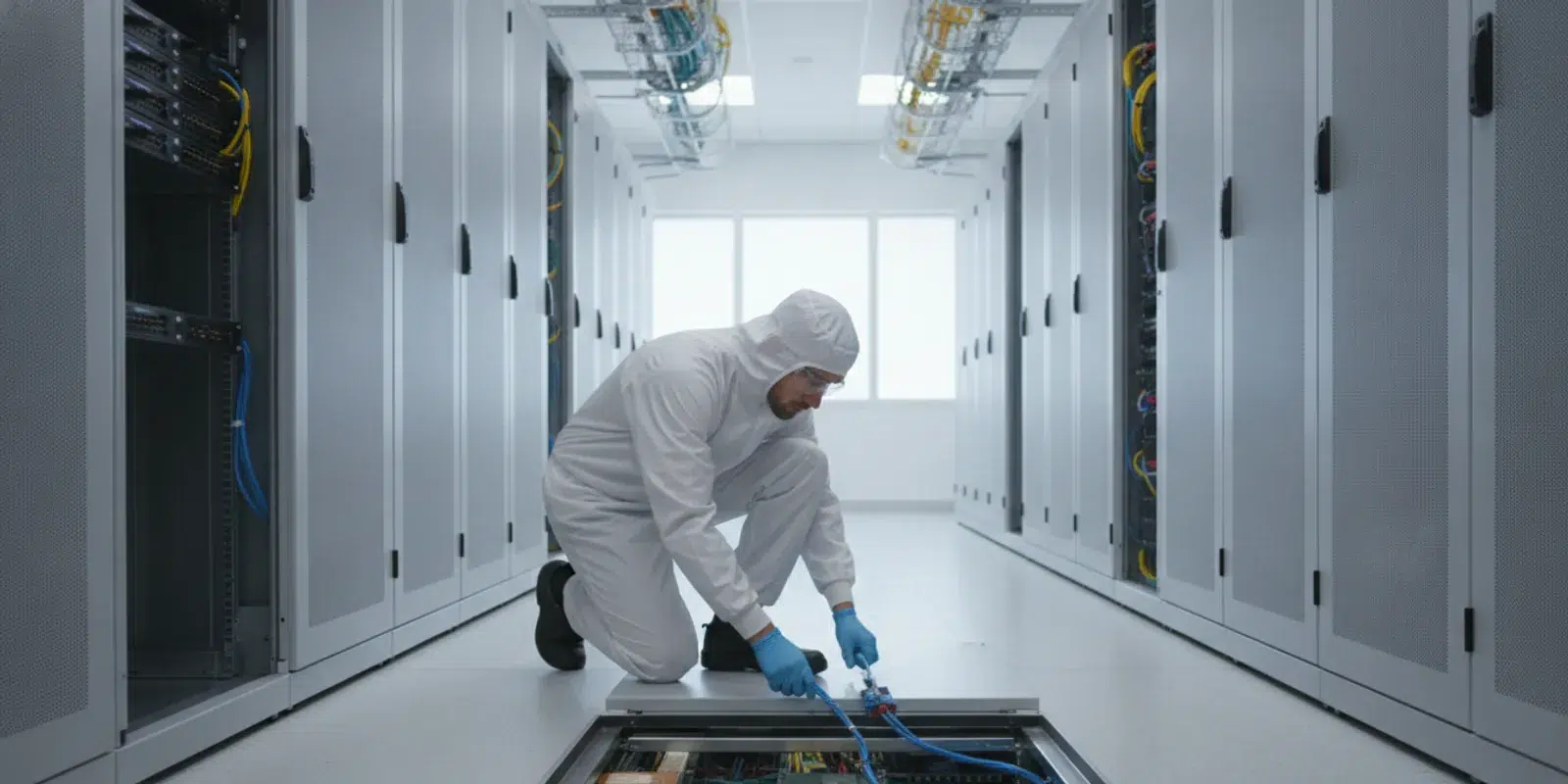
Raised floor contamination can affect more than the visible floor surface. Particles and residues may collect below panels, near cable routes, or around air-handling pathways, where routine observation from the room may not reveal the condition. Data center teams can reduce uncertainty by connecting operational symptoms to a controlled inspection plan, then defining remediation boundaries before work begins.
Discuss a data center cleaning plan
What does raised floor contamination mean in a data center?
A raised-access floor creates a space between the structural slab and removable floor panels. Depending on the facility design, that underfloor area may contain cabling, services, and an air-distribution plenum. Contamination in this zone can include settled particulate, fibers, construction residue, packaging fragments, or material introduced during maintenance. The concern is not simply appearance: particles can be disturbed by foot traffic, maintenance activity, airflow, or panel movement and then migrate into adjacent areas or toward equipment.
Conditions vary from site to site. Some underfloor spaces are used for supply-air distribution; others have different cooling arrangements or airflow paths. A facility’s mechanical drawings, operating procedures, and change records should establish how the floor and plenum function. Do not assume every raised floor has the same airflow purpose. For broader context, see Foreman Pro Cleaning’s guide to what a subfloor plenum is and its overview of data center cleaning services.
How can contaminants move through raised-floor and plenum areas?
Contaminant movement depends on airflow, openings, activity, and the material involved. A particle that settles below a panel may remain undisturbed for a long time. Opening the panel, pulling a cable, moving a cart, or performing construction work can resuspend or displace it. Air movement may then carry suspended material toward perforated tiles, equipment intakes, cable openings, or other pathways. Materials can also travel by contact on footwear, tools, wheels, packaging, or gloves.
Movement is not always airborne. A fiber or fragment may be dragged between zones during maintenance. Work on one section can shift material into a neighboring section if the work boundary, panel handling, and collection method are not controlled. Materials introduced during construction or equipment installation may persist under panels after the visible work is complete. The site’s airflow pattern and maintenance history matter more than a generic assumption about where contaminants will go.
Contact transfer is a recognized contamination pathway in other controlled work settings as well: a study indexed by PubMed reports contamination of healthcare personnel’s skin and clothing during removal of contaminated gloves or gowns. That finding concerns healthcare practices, not data centers, but it illustrates why handling and removal methods belong in a contamination-control plan. Read the study abstract.
Teams evaluating this pathway can use the practical principles in Foreman Pro Cleaning’s data center cleaning tips and server room particle-control guide as starting points, then confirm that any action fits their facility procedures.
Which symptoms make raised floor contamination worth investigating?
A single observation does not prove that contamination below the floor is causing an equipment or cooling problem. Instead, treat signals as prompts to gather evidence and compare them with operating history. Useful triggers include:
- Visible particulate or fibers around panel edges, perforated tiles, cable penetrations, or equipment intakes.
- Residue, fragments, or construction material found when a panel is lifted during authorized work.
- Recent installation, renovation, cable additions, water intrusion, or maintenance that disturbed the underfloor space.
- Repeated particle observations in a particular zone, especially when they coincide with a specific work activity or airflow condition.
- Unexpected changes in airflow observations, pressure relationships, or temperature patterns that facilities staff have already flagged for engineering review.
- Filters, grilles, or nearby surfaces showing a new or unusual accumulation pattern that cannot be explained by routine conditions.
Temperature, pressure, alarm, or cooling issues require facilities and engineering assessment; a cleaning observation is not a diagnosis. Review available building-management data and incident records with the responsible operations staff. If particulate monitoring is part of the site’s program, use the approved method and compare readings only with the relevant baseline and acceptance criteria. Avoid declaring a facility safe or noncompliant based on a visual check alone.
How should teams assess risk before opening floor panels?
Begin with the operational context, not a cleaning task list. Identify the affected room or zone, equipment criticality, current occupancy, maintenance calendar, airflow design, and any restrictions on access. Confirm who has authority to approve panel lifting and whether the area contains sensitive cabling, power distribution, or other infrastructure. Use current drawings and site procedures rather than relying on memory.
Then make a short risk record: what was observed, where and when it occurred, what work preceded it, and what evidence is available. Separate confirmed observations from possible causes. For example, “fibers observed at the panel seam after a cable installation” is more useful than “the plenum is contaminated by cable work” unless that cause has been verified. This discipline helps the team plan a proportionate inspection instead of expanding scope without evidence.
Foreman Pro Cleaning describes its critical-environment work as using HEPA-filtered vacuum equipment, ESD-safe methods, static-dissipative solutions, low-lint wipers, and contamination-control entry protocols. The exact method and materials still need to be matched to the facility’s approved scope and equipment requirements. Teams considering outside support can review critical environment cleaning capabilities and its information on choosing a data center cleaning company.
Which risk signals call for which response?
Use this table to organize decisions, not as a substitute for site-specific thresholds. The facility owner or designated operations lead should set escalation criteria and authorize access.
| Observed signal | What it may indicate | Practical first response |
|---|---|---|
| Light, localized material visible at one opened panel | A limited deposit or recent activity nearby; cause and extent remain unconfirmed | Record location and context, keep the panel opening controlled, and ask the site lead whether to inspect adjacent points. |
| Similar material at multiple panels or zones | A broader source, repeated transfer, or an activity affecting multiple areas | Map observations, review recent work and airflow context, and define a bounded inspection before remediation. |
| Material near intake paths, perforated tiles, or sensitive equipment | Potential route toward equipment or occupied airflow pathways | Escalate to operations and facilities engineering; determine whether additional monitoring or an approved response is needed. |
| Visible liquid, unusual residue, or suspected biological or chemical material | A condition that may need specialist assessment and handling controls | Stop routine handling, restrict access as directed by site procedures, and involve the responsible safety or environmental lead. |
| Concurrent cooling, pressure, or equipment alarms | Possible operational issue; contamination may or may not be related | Follow incident procedures and have engineering investigate system performance independently of cleaning observations. |
Plan a controlled site assessment
How can teams inspect raised floor contamination without disrupting operations?
Inspection should answer a defined question. Avoid lifting panels across a large area simply to “see what is there.” The facility lead can identify representative or priority locations based on symptoms, recent work, airflow paths, and equipment sensitivity. Before entry, agree on the approved access route, work window, panel handling, barriers, protective measures, tool control, and a stop-work contact.
- Review records. Check current floor plans, plenum or cooling information, work orders, construction closeout records, and previous observations. Confirm what is known and where the records are uncertain.
- Set inspection boundaries. Mark the permitted panels and route. State who may open panels and what conditions require work to stop or expand only after approval.
- Capture baseline observations. Record date, time, zone, panel location, visible condition, nearby activity, and relevant operating context. Use facility-approved photographs if allowed.
- Open panels deliberately. Follow local procedures for safe panel lifting and protection of services. Do not rest panels or tools where they may obstruct airflow, damage cabling, or create trip or access hazards.
- Observe and document. Describe material, distribution, and proximity to pathways without guessing at composition or cause. If sampling is warranted, have the designated specialist define the method and interpretation.
- Restore the area. Account for panels and tools, confirm the work area is returned to its approved state, and notify operations of anything that needs follow-up.
For a more detailed view of below-floor considerations, consult the guides to raised floor cleaning in data centers, data center subfloor cleaning, and raised floor cleaning cost factors. These resources can help frame the questions to ask; the facility’s own access and maintenance controls remain decisive.
How should remediation be planned and controlled?
Once the observations justify action, agree on a written scope before work starts. State the affected zones, permitted access, task sequence, collection method, materials allowed, protection requirements, waste handling, and the conditions for stopping. Specify how cable pathways and sensitive equipment will be protected, how panels will be managed, and how the space will be returned to service. The method should be selected for the material and environment, not assumed from a general-purpose floor procedure.
For critical spaces, the plan should also define coordination and evidence. Name the operations contact, establish notification points before and after each work segment, and identify the person who can approve scope changes. Agree on documentation such as area maps, work records, exceptions, material or equipment information, and completion observations. If the facility has particulate limits, ESD requirements, or a documented cleanliness protocol, identify the applicable version and who will verify it. Do not imply that a visual finish alone certifies a technical or regulatory condition.
Work in manageable zones can help operations retain oversight. The sequence should minimize unnecessary panel openings and avoid blocking access or airflow routes. The site team should determine whether work can proceed during normal operations, requires a planned maintenance window, or needs other controls. There is no universal frequency or outage window that suits every data center: operating design, incident history, construction activity, and local risk determine the schedule.
Foreman Pro Cleaning serves commercial and critical environments in Maryland, Washington, D.C., and Virginia. Its background includes IT operations and facilities management, and the company provides specialized data center and server-room cleaning. To discuss an appropriate scope, contact the team through its commercial cleaning contact page or review its service locations. Teams seeking a broader maintenance relationship may also compare scope with commercial janitorial services; routine janitorial work and controlled underfloor remediation should not be treated as interchangeable tasks.
What should verification and follow-up include?
Closeout should show what was done and what remains unresolved. Compare the completed work with the approved boundary. Record zones accessed, activities completed, exceptions, materials used where required, and any conditions that differed from the plan. Confirm that panels, access routes, and surrounding work areas have been restored and that operations has accepted the handoff under site procedures.
Verification must match the question the work was intended to answer. If the objective was removing visible particulate, document the applicable visual inspection and its limits. If the facility requires particle measurements or another acceptance check, use the site’s specified instrument, method, location, and criteria, with qualified personnel interpreting results. Do not claim that an area is contamination-free or that equipment risk has been eliminated when the evidence only supports completion of a defined task.
Keep the record useful for future decisions. Note the original trigger, observations, response, verification, and any recommendation for monitoring or follow-up. Compare later observations with that baseline and consider whether construction, maintenance, or airflow changes preceded a recurrence. Foreman Pro Cleaning’s overview of data center cleaning checklists and data center service planning offers additional prompts for defining responsibilities and documentation.
Request a critical-environment cleaning discussion
What questions do teams ask about raised floor contamination?
Can a raised-floor area appear clean from above while material remains below?
Yes. A surface inspection cannot establish the condition beneath panels. Where there is a credible trigger, review records and plan an authorized, bounded inspection that reflects the facility’s design and access rules.
Does every particle observed below a raised floor require remediation?
No. Record what is present and assess its location, extent, likely pathways, and operational context. The facility’s risk assessment and acceptance requirements should determine whether monitoring, investigation, or removal is appropriate.
How often should a data center inspect underfloor areas?
There is no single schedule for all facilities. Set intervals and event-based inspections according to the site’s design, maintenance and construction activity, prior findings, and documented operating requirements.
Can underfloor inspection happen while the data center is operating?
That decision belongs to the facility operations team. It depends on access controls, airflow and equipment conditions, the scope of panel opening, and the work window. Agree on controls and stop-work authority before inspection or remediation begins.
With a documented trigger, controlled access, and a clear verification plan, teams can investigate raised-floor conditions while keeping operational decisions with the people responsible for the facility.
