
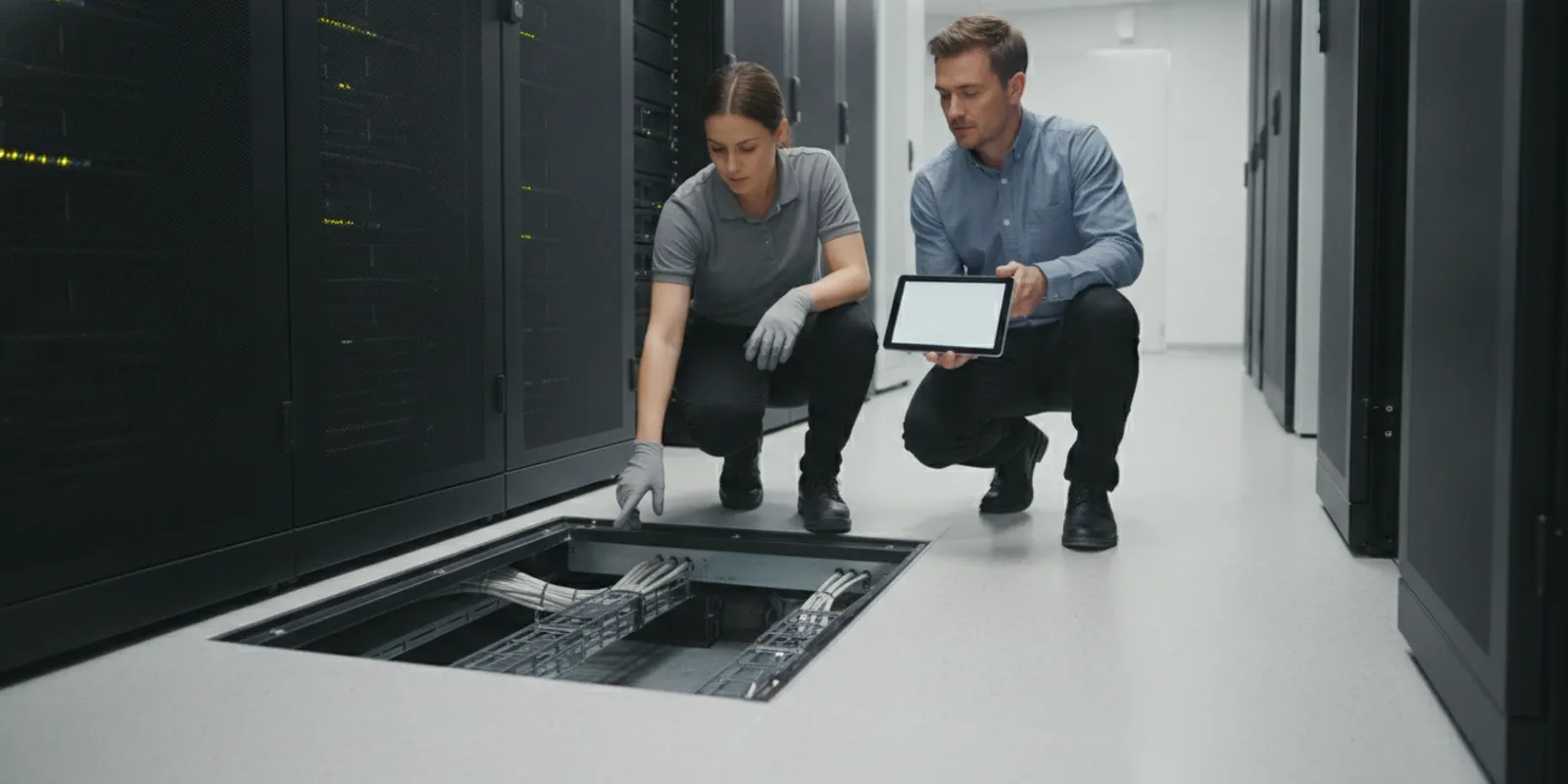
Raised floor cleaning cost depends on more than the square footage beneath an access floor. A data center quote also reflects the floor layout, site conditions, access and security rules, approved work methods, schedule, and closeout records. Because those details vary by facility, a useful estimate is a written, site-specific scope—not a universal price per square foot.
Request a raised floor cleaning assessment
What factors determine raised floor cleaning cost?
Most quotes are built from the amount of work, the time and coordination needed to complete it, and the controls that apply in the operating environment. Each part should be described clearly enough for a facility team to check whether the proposal matches its needs. Ask the provider to state its assumptions rather than treating a lump-sum total as self-explanatory.
| Cost factor | What to verify | How it can affect the quote |
|---|---|---|
| Area and configuration | Included zones, panel layout, obstacles, and boundaries | Changes the amount of work and panel handling |
| Site condition | Observed residue or particulate, past service, and access limitations | May change the planned scope, controls, or time |
| Operating requirements | Security, escorts, approved tools, and equipment protection | Adds coordination and work sequencing requirements |
| Schedule and phasing | Work window, zones released at a time, and interruptions | Affects crew deployment and productive hours |
| Deliverables | Inspection notes, completion records, and approvals | Defines closeout and administrative work |
These are scope variables, not automatic surcharges. For example, a large open area may be straightforward to plan, while a smaller area with restricted entry and multiple handoffs may require more coordination. A walkthrough lets a provider validate the conditions behind its estimate and record what remains outside the proposed work.
How does area and floor layout affect raised floor cleaning cost?
Square footage gives buyers a starting point for estimating work volume, but it does not describe how the area can be reached or serviced. A wide open underfloor zone and a similarly sized zone broken up by equipment rows, cable routes, supports, or restricted panels can require different sequencing. The quote should identify whether its measured area refers to the room footprint, accessible underfloor sections, or another defined boundary.
Ask the provider to mark the included zones on a current plan or otherwise list them by room and aisle. Note areas that are excluded, inaccessible, reserved for another contractor, or subject to separate approval. If plans are outdated, identify known changes before the walkthrough. The provider can then verify panel locations and access conditions instead of carrying an unclear assumption into the price.
Also clarify exactly what panel work is included. Does the proposed scope include lifting and replacing panels, or only cleaning areas that facility personnel make accessible? Are any panels excluded because of load, condition, or infrastructure below them? Who is authorized to approve access, and who will return a panel if an unexpected condition is found? These questions define work and responsibility; they should not be left to an informal understanding on the service date.
For a plain-language explanation of the space below a raised floor, see what a subfloor plenum is and why it matters. Facilities evaluating a broader program can also review critical environment cleaning services to understand the service context.
Which site conditions can change the scope and estimate?
Condition matters because a quote should reflect what a crew is expected to address, not a vague label such as “routine.” Before requesting proposals, describe known maintenance history, visible accumulation, previous construction or repair activity, and any locations that facility staff want assessed. Avoid assuming that every condition can be handled under an ordinary cleaning scope. The provider should observe the site, explain its proposed response, and identify items that require separate review or authorization.
During a walkthrough, ask the provider to distinguish what it observed from what it was told. Record the location of any concern, the access available for inspection, and what could not be verified. If a section is blocked or panels cannot be opened during the visit, the estimate should say whether the price assumes ordinary conditions there or excludes that area pending a later inspection. That distinction helps prevent a disagreement when site conditions differ from the assumptions.
Discuss sensitive infrastructure and the facility’s limits for work near it. Identify cabling routes, equipment clearances, airflow considerations, and concurrent maintenance. Establish whether the cleaning team may move any items; do not assume it may reposition cables, equipment, or facility components. The provider and facility should agree on boundaries and escalation steps before work begins.
Foreman Pro Cleaning provides data center and other critical-environment cleaning services. Its data center resources explain related planning topics, including data center cleaning services, data center cleaning planning, and data center subfloor cleaning. Use site-specific procedures to decide which practices apply to a particular facility.
How do access controls and work windows affect a quote?
A crew working in an operating data center may need advance authorization, security screening, escorts, restricted equipment approval, or coordination with facilities and IT operations. Each condition can shape entry, staging, movement through the work area, and how zones are released. Provide those requirements during quoting, not after a price has been accepted. If approvals are still pending, list them as open items and ask how they affect the proposed schedule.
Describe the service window in practical terms. State whether the provider can work during normal operations, only during a planned maintenance period, or one zone at a time. Explain how much notice is needed to reserve access and who can approve a schedule adjustment. If the work must pause for an operational priority, agree on how the team will secure the open area, communicate the interruption, and resume. These details help make a phased plan and its labor assumptions understandable.
Safety requirements also need to be explicit. Provide the facility’s approved procedures for access, panel handling, electrical safety, and work-area control. The Occupational Safety and Health Administration (OSHA) provides workplace safety and health information at OSHA.gov; facility teams should consult applicable requirements and their own site procedures when defining controls. A general resource is not a substitute for a site-specific hazard review or the facility’s authority over work.
For additional planning context, review how to plan server-room cleaning and server-room dust-control considerations. The facility’s approved procedures govern the actual project.
What should a raised floor cleaning scope include?
A well-defined scope makes the price testable. It lets operations staff, facilities, procurement, and the service provider agree on what will happen and how completion will be recorded. Ask each bidder to address the same items:
- Locations: rooms, zones, approximate area, boundaries, and specific exclusions.
- Access: whether panels are handled by the provider or facility team, limits on panel work, and approval responsibilities.
- Work method: proposed steps and equipment, subject to the floor system and facility approval.
- Protection: how nearby equipment and infrastructure will be protected and what the crew is not authorized to move.
- Coordination: escorts, entry rules, contacts, security requirements, and other contractors working nearby.
- Schedule: service window, sequence by zone, access handoffs, and how pauses or rescheduling are handled.
- Verification: inspection expectations, completion notes, unresolved findings, and who accepts the work.
- Commercial assumptions: included labor and equipment, exclusions, conditions that trigger a scope review, and approval for added work.
Be specific about the expected record. A closeout might need a list of completed zones, exceptions, or items requiring follow-up, but each facility should define what it needs rather than presume a standard package. If photographs, inspection forms, or particular approval signatures are required, state that before pricing. Documentation takes planning, and a provider cannot reliably include an undefined deliverable.
To understand a provider’s approach to data center work, buyers can read questions to ask when choosing a data center cleaning company and Foreman Pro Cleaning’s company background. These resources support evaluation; the written proposal should still define the specific project.
How can buyers compare raised floor cleaning proposals?
Compare scope before comparing totals. Put the proposals beside a shared list of locations, access conditions, methods, safeguards, schedule, and records. Mark each item as included, excluded, assumed, or unresolved. Then ask bidders to explain any difference. A lower total may reflect fewer included zones or less coordination rather than a more efficient plan; a higher total may include deliverables or operating constraints another proposal omits.
| Comparison item | Question for every provider | What to record |
|---|---|---|
| Area | Which rooms and underfloor zones are included? | Zone list, boundaries, and exclusions |
| Access and panels | Who opens panels and approves access? | Responsibilities and limits |
| Controls | What site rules and equipment restrictions are assumed? | Approvals, safeguards, and open items |
| Timing | How is the work sequenced and what window is assumed? | Schedule, handoffs, and contingencies |
| Closeout | What evidence of completion will be provided? | Records, exceptions, and acceptance contact |
| Change handling | What happens if actual conditions differ? | Review, authorization, and revised scope steps |
Consider a hypothetical comparison. Provider A includes two defined zones, an agreed access window, and a closeout list. Provider B gives a smaller total but describes a single “underfloor cleaning” task without listing zones or panel responsibilities. Those offers are not yet comparable. Ask Provider B to clarify boundaries, access, and records; ask Provider A whether any blocked sections are excluded. The point is not to favor a particular quote, but to ensure each price refers to substantially the same work.
If a proposal includes an allowance or a condition-based adjustment, ask what triggers it and who can authorize a change. Define a process: pause affected work, document the condition, notify the named facility contact, and obtain written approval before expanding the scope. This prevents an assumption from turning into an unplanned task and gives procurement a record for reviewing any adjustment.
When should a facility request a raised floor cleaning estimate?
Start early enough to complete the site review, approvals, and schedule coordination before the desired work window. A last-minute request may leave too little time to confirm access, security procedures, equipment restrictions, or stakeholder availability. If a maintenance outage or other facility project is already planned, coordinate the cleaning scope with the teams managing that event rather than assuming a particular date will remain available.
Prepare a short information pack for the walkthrough. Include current floor plans if available, areas of interest, access and escort instructions, approved work procedures, preferred dates, known restrictions, and the documentation your organization expects. Identify the facilities contact who can approve access and an operations or IT contact who can address equipment boundaries. If previous work records exist, share the relevant scope and note what has changed since then. A facility can also use a data center cleaning checklist as a prompt for organizing what needs discussion, then tailor it to the raised-floor project.
How can a facility prepare for a more accurate estimate?
Before the visit, separate confirmed information from items that still need verification. A simple scope sheet can have four columns: zone, known access conditions, work or review requested, and open questions. Add a separate list of facility requirements that apply across the site, such as security approvals, equipment restrictions, required escorts, contact names, and acceptable work windows. This is more useful than sending a plan without explaining which areas matter or what the provider is expected to price.
During the walkthrough, confirm the boundaries in the field. Ask the provider to note any discrepancy between the plan and the actual layout, identify areas it could not inspect, and state how those unknowns are treated in the estimate. Then review the draft scope internally with the people responsible for operations, facilities, procurement, and security. Resolve practical questions—such as which team releases each zone and who accepts completion—before approval. These steps reduce ambiguity; they do not guarantee a particular price, but they make the assumptions behind the quote easier to assess.
Foreman Pro Cleaning serves commercial and critical environments in Maryland, Washington, D.C., and Virginia. Check regional service locations and read the company’s frequently asked questions for additional background. For a provider assessment, have a contact ready to walk through access, the proposed zones, and facility requirements.
Discuss your raised floor cleaning scope
What questions do buyers ask about raised floor cleaning cost?
Can raised floor cleaning cost be estimated by square foot?
Area can help establish the amount of work, but a square-foot figure alone does not explain access, condition, panel responsibilities, operating controls, schedule, or closeout records. Ask for a site-specific scope and confirm what area the estimate uses. If a unit rate is provided, ask which assumptions make it applicable and what falls outside it.
What information helps a provider prepare a useful estimate?
Share the approximate area, current floor plans, zone boundaries, known site conditions, access and escort rules, approved equipment requirements, schedule preferences, and records needed at completion. Identify who can approve access and who answers operations questions. A walkthrough can verify information that drawings and email descriptions cannot settle.
Should the quote include panel lifting and replacement?
It should state clearly whether panel handling is included, limited, or assigned to facility personnel. Confirm which panels may be accessed, who has authority to approve the work, and what happens if a panel or the area below it raises a concern. Do not rely on the phrase “underfloor cleaning” to define these responsibilities.
Why might two bids for the same facility differ?
The proposals may cover different zones, assume different access windows, include different levels of coordination, or promise different closeout records. They may also treat unknown or restricted areas differently. Compare the written assumptions and exclusions line by line, then request revisions if the scopes are not equivalent.
How often should a facility schedule underfloor cleaning?
There is no single interval that fits every data center. Facility stakeholders can consider observed conditions, maintenance history, internal requirements, and operational plans when deciding what schedule is appropriate. A provider can assess the area and describe its observations, while the facility determines the program and timing.
A clear scope makes raised floor cleaning cost easier to understand and helps your team compare providers on equivalent work, safeguards, timing, and records. Request an assessment to discuss the conditions and requirements that apply to your data center.
