
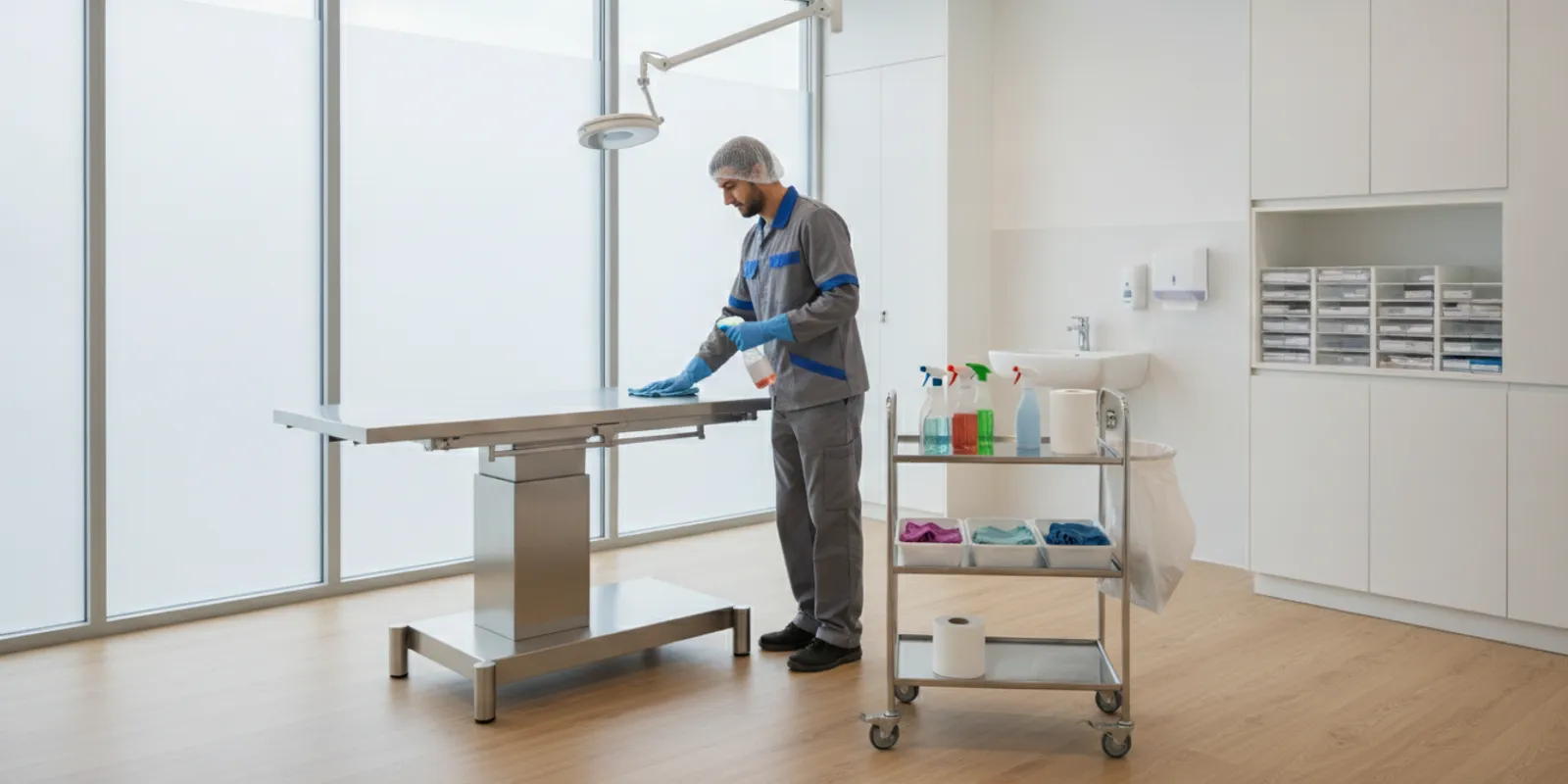
Medical clinic cleaning services work best when room turnover follows patient flow and the clinic’s own infection-prevention procedures. The practical answer is to establish an authorized room-release signal, a room-specific task card, and a clear handoff before the next patient enters. That keeps routine service coordinated without asking cleaning personnel to make clinical decisions.
Discuss a clinic cleaning plan
How should medical clinic cleaning services fit the appointment flow?
Begin with how the clinic operates on a representative day, rather than with a generic list of tasks. Map the patient journey from arrival through examination and departure. Note which rooms turn over frequently, which are used for procedures, where patients wait, where staff prepare supplies, and which shared spaces remain in use throughout the day. Separate room-turnover work from routine upkeep during operating hours and from periodic or after-hours tasks.
Then review the map with clinical leadership. The clinic identifies the procedures, product requirements, room restrictions, and roles that govern each area. A cleaning provider can translate those approved requirements into assigned tasks, access rules, and completion records. It should not classify clinical risk, revise infection-prevention procedures, or substitute a contractor’s routine for the clinic’s approved process.
Define a release point for each room type. For example, clinical staff mark a room as ready for service after patient care is complete; the assigned cleaner follows the task card; and the designated clinic role receives the room back or confirms its next status. The roles can vary by facility, but the transition should be explicit. Without it, a cleaner may have to guess whether a room is vacant, in use, or available for service.
Draw the sequence as a short chain: patient care ends, an authorized person updates the room status, service staff enter under the agreed access rule, assigned tasks are completed, exceptions are reported, and the clinic resumes control. For each transition, identify the person or signal responsible. If an appointment is running late, for example, the system should show whether the room remains occupied or whether another room can be serviced instead. The team should not treat silence as authorization.
Which tasks belong between patient appointments?
Between-visit work must be specific to the clinic’s procedures and the room’s use. A Nevada State Board of Oriental Medicine clinic cleanliness overview describes changing table coverings between every patient visit and disinfecting treatment tables and treatment chairs. This is a focused example for the setting addressed by that board, not a universal protocol for every clinic. Facilities should follow the requirements that apply to their services and jurisdiction. See the board’s clinic cleanliness overview.
A useful task card does more than list surfaces. It states which room it applies to, who can release the room, the approved sequence, the surfaces included, the product and contact-time instructions supplied by the clinic, the required cloth or equipment changes, and the method for recording completion. If instructions differ between an examination room and a treatment room, keep separate cards or make the distinction unmistakable.
Keep the work boundary equally clear. Clinical equipment, medication and specimen areas, sharps, regulated waste, and patient records may require handling by designated clinic personnel. The plan should name what the cleaning assignment excludes, not just what it includes. If an excluded item is left in the work area, staff should know whether to pause and contact a clinic representative or proceed with other assigned tasks.
- Room turnover: Follow the clinic-approved process for designated patient-contact surfaces, room furnishings, and waste handling.
- Shared touchpoints: Specify the doors, counters, switches, and other points included in the schedule; do not leave the scope to interpretation.
- Consumables: Decide whether service staff replenish named items or notify clinic staff when stock is low.
- Unexpected conditions: Set a reporting route for visible contamination, spills, damaged furnishings, blocked access, or a room that cannot be serviced as planned.
A task card should use action words that can be observed and verified. “Prepare room” is too broad if it does not say what preparation means. A better card identifies the approved task sequence and the completion signal. The exact actions still come from clinic leadership, applicable instructions, and product labeling; a contractor should not fill in missing clinical directions by assumption.
Foreman Pro Cleaning provides commercial and critical environment cleaning, including medical office cleaning. A service plan should reflect approved clinic procedures and actual room use instead of promising a one-size-fits-all clinical result. Review medical office cleaning considerations and the scope of commercial cleaning services as background for a facility-specific discussion.
How can clinics coordinate cleaning without disrupting care?
Appointment schedules shift. A visit may run over, a room may be held for follow-up, or a staff member may need a space before the planned service window. Agree on a small set of room statuses that everyone understands, such as occupied, ready for service, in service, and returned to clinic staff. Define who can change a status and how the cleaning team sees the update. A door signal, a shared system, or direct communication may work; what matters is that it is reliable and approved by the clinic.
Plan ordinary work around predictable gaps, but do not make every task depend on the schedule going perfectly. Decide what happens when a room is not released on time. The cleaner might move to a preapproved alternate area, wait for confirmation, or report that the task is deferred. The clinic and provider should agree which choice applies to each situation. They should also decide how deferred work is tracked and when it must be revisited.
Assign a clinic point of contact for routine coordination and identify an escalation contact for time-sensitive issues. Clarify how schedule changes reach service staff, who authorizes room entry, and which areas remain restricted. For a sensitive or continuously operating space, access and timing should be coordinated with the clinic role responsible for that space.
- Use room statuses that distinguish occupancy from release for service.
- Agree on an entry protocol, including knocking, waiting for confirmation, and protecting patient privacy.
- Keep carts and supplies in locations approved by the clinic, away from patient circulation and clinical work.
- Set routine service windows and a separate process for urgent requests or schedule changes.
- Record tasks that are missed, deferred, or blocked, and assign an owner for follow-up.
Consider a simple example: a clinic has three examination rooms and one treatment room, with appointments that do not end at fixed intervals. If one examination room remains occupied, service personnel should not infer that the next room is available. The status process directs them to an authorized room or an approved shared-area task. When the occupied room is later released, the team can complete its specific task card and return its status to the clinic. The example illustrates coordination, not a recommended staffing level or clinical frequency.
Foreman Pro Cleaning’s janitorial service programs can be considered alongside facility-specific scheduling needs. For a mid-process conversation about access and scope, share your clinic’s operating constraints.
What should a clinic cleaning schedule specify?
A schedule is useful when it turns expectations into observable work and ownership. Separate appointment-turnover tasks from shared-area service, closing work, and periodic assignments. For every task, state its location, assigned role, trigger or frequency, access condition, approved method source, and completion record. Clinic leadership should set the frequencies based on room use and applicable requirements; identical service assumptions for every room can miss meaningful differences.
| Planning option or task | What the clinic guidance says | What the schedule should make explicit |
|---|---|---|
| Change a treatment-table covering | The cited Nevada board overview says to change table coverings between every patient visit in its clinic cleanliness guidance. | Which rooms and coverings are in scope, who performs the task, and how completion is recorded. |
| Disinfect a treatment table or chair | The same board overview identifies treatment tables and treatment chairs for disinfection. | Approved product and method, contact-time instructions, access timing, and any clinic verification step. |
| Service a room with different use | The board example does not define every clinic’s room-specific protocol. | Clinic leadership supplies the task card and determines whether its requirements differ by room or service. |
| Handle a room unavailable at the planned time | The cited guidance does not prescribe a scheduling system. | Define the room-status signal, alternate task or wait instruction, escalation contact, and deferred-work record. |
The first two rows report the cited board’s stated examples; they should not be read as rules for every medical practice or jurisdiction. The remaining rows are planning decisions, not claims that the board requires a particular scheduling method. The clinic should supply exact criteria and decide which roles may verify completion. A service record can document assigned work and exceptions, while room release and clinical decisions remain with the appropriate clinic personnel.
Make the schedule practical to use. A compact task card can show a room name or code, a task sequence, the permitted entry condition, where to log completion, and who to call when a condition falls outside scope. If paper and digital records are both used, decide which one is authoritative. Avoid patient-identifying details in cleaning documentation; use the minimum operational information needed to show task status and communicate an exception.
How should responsibilities and documentation be arranged?
Write down the boundary between cleaning and clinical responsibilities before service begins. Specify which party handles patient-care equipment, sharps, regulated waste, medication or specimen areas, and room release. Never assume that a worker is authorized to handle an item simply because it is in a room. If an item blocks an assigned surface, a clear stop-and-report instruction prevents improvisation.
Keep documentation concise enough to complete consistently. A room log or digital record might capture the area, time, assigned task set, completion status, and any exception reported. Decide who reviews the records, how quickly an urgent exception is routed, and how unresolved items are carried to the next shift or service window. A record that notes “not completed—room remained occupied” is more useful operationally than a blank box with no explanation.
Training should cover the clinic’s access rules, privacy expectations, approved task sequence, product instructions, and escalation pathway. Buyers can ask how facility-specific instructions are shared with assigned personnel and how updates are communicated when a protocol or room changes. For specialized environments, confirm the scope and training expectations with the responsible clinic team. Foreman Pro’s company information describes proprietary critical environment training and experience with specialized facilities; the particular scope for a clinic should be confirmed during planning. See critical environment cleaning capabilities and the company’s background.
It can help to test the responsibility matrix against realistic situations. If a spill is found, who is notified, and what work can continue safely under the clinic’s instructions? If a supply is unavailable, who provides an approved substitute or decides to defer the task? If a cleaner finds a room occupied despite a ready signal, what is the immediate next step? Discussing these cases before launch makes reporting expectations concrete without expanding the cleaning role into clinical judgment.
What should buyers compare in medical clinic cleaning services?
Compare the operational detail behind proposals, not just the stated frequency or a broad promise. Ask each provider to describe how the plan fits appointment flow, how access is controlled, how changes in scope are handled, and what completion records are available. Confirm that the service team will work from clinic-approved protocols instead of inventing clinical standards. A clear proposal makes gaps visible before they become disagreements during service.
- Does the proposal distinguish room turnover, routine service, closing work, and periodic tasks?
- Does it identify restricted spaces and name who authorizes entry?
- Are missed tasks, urgent requests, and exceptions addressed through a defined communication route?
- How are facility-specific task instructions given to assigned personnel and kept current?
- Can timing and task assignments be reviewed if appointment volume, room use, or operating hours change?
- What record will the provider supply, and who at the clinic reviews it?
- Does the plan state what is outside the cleaning scope, including clinical equipment and items that need authorized handling?
Ask for a walkthrough with the people who understand both the clinical workflow and the building. Bring a representative appointment day, a room list, existing procedure documents, and known access limits. Walk the proposed service route, identify where supplies may be staged, and check whether patient movement conflicts with the planned tasks. This conversation can show whether a schedule is workable without making claims about a clinical result.
Related references can help buyers prepare focused questions. Review clinic disinfection planning considerations, the guide to dental office cleaning, and urgent care cleaning considerations. These materials provide related context; the clinic’s own approved procedures and applicable requirements govern its service plan.
To assess proposal fit, score each provider against the same operational questions rather than relying on a single headline metric. For example, rate whether room status, task ownership, exceptions, records, and review cadence are clearly documented. A provider that describes a lower frequency in detail may be easier to evaluate than one offering a broad schedule without defining who does what. The clinic still determines whether the proposed plan meets its needs and requirements.
How can a clinic launch and improve the workflow?
Before launch, confirm the room list, task scope, access permissions, clinic contact, escalation route, and record format. Walk through the turnover sequence with relevant staff and service supervisors. Demonstrate how the team signals that a room is ready and how it returns room status after assigned work. Make sure the plan identifies the person who can answer a question when an instruction is unclear.
Use one representative operating day to test the proposed schedule on paper. List the first appointment block, estimated room release points, routine shared-area tasks, and the person who handles late-running visits. Then test three exceptions: a room is still occupied, the next appointment arrives sooner than expected, or an assigned product or supply is unavailable. For each case, identify who communicates the change, which task may be deferred, and how the clinic confirms the room’s status afterward.
A short pilot can reveal whether task cards are readable at the point of work. Have a clinic representative and service supervisor review a card together. Check that task names are unambiguous, the order matches the clinic-approved process, and exception directions lead to a specific contact. If different readers interpret a line differently, revise it before using it across the facility. The purpose is to make the approved process easier to follow, not to change clinical requirements through a service checklist.
During the initial review period, look for recurring patterns rather than treating every delay as an isolated event. Repeated waits may suggest an unclear release signal or service windows that do not match actual operations. Repeatedly deferred tasks may point to access limits, unrealistic timing, or an unresolved scope boundary. Record the issue, assign an owner, agree on a correction, and check whether it resolves the problem at the next review. Changes to clinical protocols should follow the clinic’s authorized process.
For a multi-site organization, do not copy one location’s schedule without review. Room mix, operating hours, patient flow, and access requirements can differ. A shared framework may support consistency, while site-specific task cards and escalation contacts reflect local operations. Review changes when services, rooms, or hours change, so the plan remains connected to actual use.
Foreman Pro Cleaning serves commercial facilities across Maryland, Washington, D.C., and Virginia. To start a practical discussion, share operating hours, room types, expected service windows, and access or documentation needs. You can review service coverage, learn about janitorial programs, or request a clinic service discussion.
Before a plan is finalized, the clinic and provider should confirm in writing what success means operationally: assigned tasks are clear, authorized access is respected, exceptions reach the right contact, and records are reviewed through an agreed process. That shared definition makes later adjustments more specific and keeps the service plan grounded in clinic-approved requirements.
Request a clinic cleaning discussion
What questions do buyers ask about medical clinic cleaning services?
Who decides when a room is ready to clean?
The clinic should designate the person or status system that releases a room to cleaning staff. Service personnel follow that authorization and return the room through the agreed handoff.
Should every examination room have the same turnover checklist?
Not necessarily. Clinic leadership should define room-specific tasks based on its services, equipment, and approved procedures. A shared checklist format can still make those differences clear.
How can cleaning fit a schedule that changes during the day?
Use planned windows for routine work and an agreed method for signaling changes or urgent needs. Identify who can reprioritize tasks and how deferred work is recorded.
What should a cleaning proposal include?
It should describe locations, task scope, timing, access rules, responsibilities, exception reporting, and completion documentation. It should also explain how the plan can be reviewed and adjusted with the clinic.
A coordinated workflow makes room turnover more predictable while leaving clinical procedures and patient-care decisions with the clinic team.
