
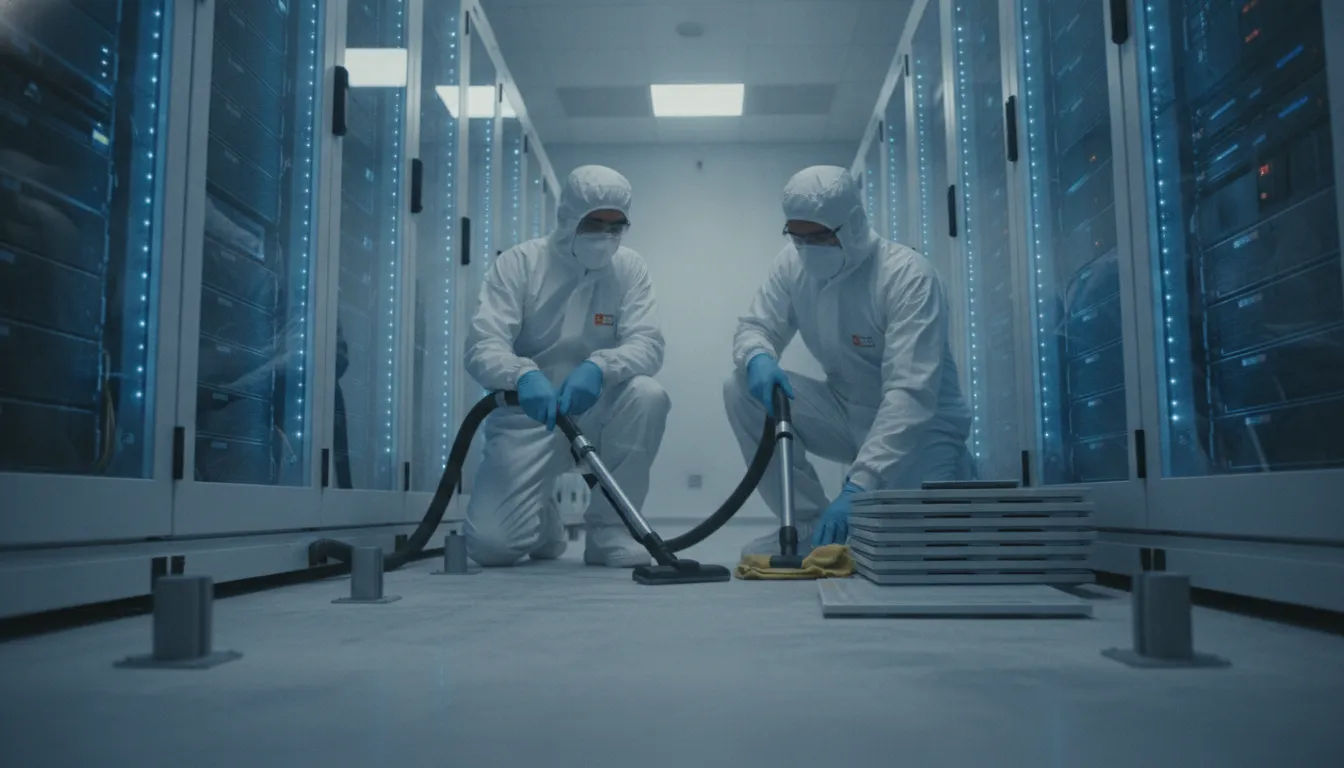
Under a raised data center floor, the space that supports cooling can also become a pathway for contamination. Particulates, debris, and residue in this concealed area may be redistributed by airflow toward sensitive server equipment. Making plenum maintenance part of operational risk management rather than routine janitorial work. For facility and IT leaders, the question is not whether the space is visible, but whether it is controlled.
Understanding what is subfloor plenum starts with its airflow function: it is the space beneath a raised floor that carries conditioned air from computer room air conditioning units toward server intakes. Because contaminants can travel through that same airflow, the area requires deliberate contamination control, including HEPA-filtered vacuuming and anti-static treated equipment.
Contact Foreman Pro Cleaning to schedule a critical-environment cleaning assessment.
Understanding the plenum’s role clarifies why airflow performance, equipment reliability, and cleaning strategy are connected. The raised-floor assembly is not simply an architectural void. It is an active part of the facility’s cooling design, and its construction determines how contaminants move, accumulate, and reach infrastructure.
What Is a Subfloor Plenum in a Data Center?
A subfloor plenum is the controlled space between a structural slab and a raised access floor. In a data center, it functions as an airflow conduit, carrying conditioned air from computer room air conditioning (CRAC) units toward server intake locations through floor-level supply openings. Foreman Pro Cleaning describes this space as part of the facility’s airflow management strategy, not as an unused cavity beneath the room. The raised-floor system distributes cool air to server equipment through the plenum.
This arrangement is an example of underfloor air distribution (UFAD) architecture. In UFAD systems, the underfloor supply plenum occupies the zone below the raised floor and supplies air through outlets integrated into the floor system. UFAD references describe this architecture and its use in data centers and laboratories. The design allows facility teams to manage supply-air paths near the equipment that requires cooling.
How Does a Raised-Floor Anatomy Work?
A raised-floor assembly typically includes several functional layers:
- Structural slab: The permanent floor supporting the raised-floor system and installed infrastructure.
- Pedestals and stringers: The support framework that establishes the plenum height and stabilizes floor panels.
- Access floor panels: Removable panels that provide a serviceable walking surface and accommodate grilles, perforated panels, or other supply outlets.
- Subfloor plenum: The open air pathway below the panels, where conditioned air moves toward server intakes.
Because the same air pathway can transport contaminants toward sensitive equipment, maintenance directly affects reliability. The Environmental Protection Agency recognizes the importance of controlling gaseous and particulate contamination in data center environments to support equipment reliability. EPA research addresses contamination control and electronic equipment reliability. Effective inspection and cleaning therefore protect both the airflow function and the hardware environment.
Why Does Contamination Build Up in the Subfloor Plenum?
A subfloor plenum is part of the data center’s airflow system, not an inert cavity beneath the raised floor. As CRAC units move conditioned air through the plenum toward server intakes, the circulation pattern can repeatedly move particulates and debris through the same pathways. Materials that enter through floor-panel gaps, maintenance activity, cable work, or normal facility operations may settle temporarily, then become airborne again as airflow changes.
Over time, this circular movement creates a contamination pathway between the plenum and the equipment it serves. Accumulated particulates can be carried toward server intakes, contributing to overheating, data corruption, and potential fire risks, according to Foreman Pro’s critical-environment guidance. Maintaining controlled airflow and particulate conditions is therefore an equipment-protection concern, not simply a cosmetic cleaning task.
Standard janitorial routines often focus on accessible occupied surfaces. They may not include the controlled access, raised-floor inspection, or technical hazard recognition required beneath a sensitive floor system. Without specialized training, a crew can overlook contamination around pedestals and stringers, disturb settled particulates, or use equipment that is inappropriate near electrical infrastructure. This is why facility managers should evaluate specialized server room cleaning separately from general janitorial service.
Indoor-air-quality considerations also matter. The CDC notes that mold and dampness in building air systems are associated with respiratory and non-respiratory health problems among workers. CDC guidance on duct cleaning and indoor environmental quality supports investigating visible contamination, moisture, and airflow-system conditions rather than allowing buildup to remain unassessed. In a mission-critical facility, the appropriate response combines documented inspection, contamination control protocols, and cleaning methods designed for the plenum’s airflow and equipment environment.
How Do Subfloor Contaminants Damage Data Center Equipment?
Contaminants in a subfloor plenum can affect equipment through several connected pathways. The raised-floor cavity distributes air toward server intakes, so particulate matter deposited on the plenum floor, pedestals, or stringers can be agitated and carried into the rack airflow. The result is not limited to an appearance or housekeeping issue. It can alter electrical reliability, thermal performance, and the operating life of hardware.
One specialized hazard is the zinc whisker. These conductive filaments can develop on galvanized components used in raised-floor systems. If they become airborne, they may enter electronic equipment and bridge energized surfaces, creating short-circuit conditions. IBM identifies conductive contamination, including zinc whiskers, as a concern for power equipment and electronic systems: IBM’s guidance on conductive contamination.
Gaseous and particulate contamination also contributes to hardware corrosion over time. Corrosion can degrade contacts, connectors, and other conductive surfaces, increasing resistance and creating intermittent faults. The U.S. Environmental Protection Agency’s research reference addresses the importance of controlling contamination in data center environments to support equipment reliability.
The thermal pathway is equally important. Accumulated particulates can obstruct cooling surfaces or travel into server intake filters, reducing the effectiveness of heat removal. When airflow is restricted or distributed unevenly, equipment may operate at elevated temperatures. In severe cases, overheating can contribute to data corruption and fire risk. The NIH Sustainable Data Center Design Guide identifies improper airflow management as a source of hot spots. Maintaining the plenum as a controlled airflow component, rather than treating it as an inaccessible void, is therefore part of contamination control and equipment protection.
Get a data center subfloor plenum cleaning quote from Foreman Pro Cleaning.
What Are the Risks of Leaving a Subfloor Plenum Unclean?
An unclean subfloor plenum creates a contamination pathway between facility airflow and sensitive equipment. The risk is cumulative: particulates can restrict distribution, conductive debris can contact electronics, and gaseous contaminants can accelerate corrosion. The table below connects each exposure to an operational consequence and a control that facility teams can verify.
| Risk | Probable Consequence | Prevention |
|---|---|---|
| Accumulated debris restricting airflow Particulates and debris can collect in circular airflow patterns and travel toward server intakes. | Overheating, equipment failure, data corruption, and potential fire risk. The ASHRAE contamination whitepaper addresses contamination control as part of reliable data-center operation. | Inspect the accessible plenum and remove settled debris with HEPA-filtered vacuuming. Preserve designed airflow paths rather than redistributing contaminants during service. |
| Zinc whisker conduction Conductive filaments can accumulate beneath raised floors and enter equipment airflow paths. | Short circuits and data corruption. Zinc-whisker mitigation is a documented critical-environment hazard requiring deliberate control, not routine surface cleaning. | Use anti-static treated equipment, controlled debris removal, and documented stringer and pedestal decontamination. The customer’s critical-environment guidance identifies zinc-whisker mitigation as a technical requirement. |
| Gaseous and particulate contamination Contaminants remain in the airflow system unless they are identified and removed. | Hardware corrosion and reduced reliability over time. The EPA research record recognizes control of gaseous and particulate contamination as important to equipment reliability. | Establish contamination-control inspections and use cleaning methods appropriate for sensitive electrical systems, including HEPA capture and anti-static precautions. |
| Non-compliance with ISO 14644-1 cleanliness expectations Unmanaged contamination weakens the evidence supporting a controlled facility environment. | An audit or standards gap. Contamination management is a key component of ISO 14644-1 cleaning standards. | Document inspection findings, corrective cleaning, and recurring controls against the facility’s cleanliness requirements. |
| Risk to a 99.999% uptime goal Each uncontrolled contamination pathway adds avoidable operational exposure. | Less reliable mission-critical infrastructure. Contamination control supports the 99.999% uptime objective, but it cannot substitute for engineering, monitoring, or change-control discipline. | Treat plenum cleaning as a documented facilities-management control, coordinated with IT operations and planned around approved maintenance windows. |
These controls work best when cleaning records connect observed conditions to airflow, equipment protection, and follow-up actions. That makes the plenum a managed part of the facility, rather than an inaccessible space addressed only after an incident.
How Often Should a Data Center Subfloor Plenum Be Cleaned?
For most raised-floor data centers, Foreman Pro recommends quarterly cleaning of the subfloor plenum. That interval provides a practical baseline for removing accumulated particulates and debris before they are redistributed through the facility’s airflow system. Regular decontamination also supports equipment protection and the service life of mission-critical IT infrastructure. Foreman Pro’s recommendation is based on the operational risks associated with neglected plenum spaces.
Quarterly scheduling is not a substitute for facility-specific assessment. The appropriate cadence may need to increase when the contamination source density is high, such as during construction, nearby renovations, frequent maintenance activity, or heavy personnel movement. A facility should also review its schedule when inspections identify residue around pedestals, stringers, cable pathways, or supply-air openings.
Airflow load is another important consideration. A plenum carrying substantial conditioned air can distribute loosened particulates across a larger equipment area. Facilities using economized or enhanced cooling that draws in outside air may require closer monitoring because outdoor conditions can influence the contaminant burden entering the airflow path. Uptime requirements matter as well. A high-availability environment should align cleaning with its change-control process, maintenance windows, and contamination-control objectives rather than waiting for visible buildup or an airflow complaint.
Facility and IT leaders can document inspection findings, recent construction, cooling configuration, and operational sensitivity in a maintenance plan. The data center subfloor cleaning frequency procedures provide a useful companion for translating that baseline into a site-specific schedule. For a broader contamination-pathway review, see Foreman Pro’s IT-operations-based cleaning approach.
How Does Foreman Pro Cleaning Keep Subfloor Plenums Contamination-Free?
Foreman Pro Cleaning treats the subfloor plenum as part of the data center’s airflow and contamination-control system, not as an inaccessible storage void. That distinction determines how technicians approach the work. The objective is to remove accumulated particulates and debris without redistributing them through the airflow path or exposing sensitive hardware to static discharge.
The protocol begins with HEPA-filtered vacuuming. High-efficiency particulate air filtration is used to capture fine particles while technicians work through the raised-floor environment. Equipment is also anti-static treated, reducing the risk that cleaning activity introduces an electrostatic event near electronic components. These controls reflect the broader contamination-management principles described in the ASHRAE contamination-control benchmark, which emphasizes controlling particulate and gaseous contaminants to protect data center reliability.
How Are Subfloor Components Decontaminated?
Cleaning is not limited to the visible floor panels. Foreman Pro Cleaning addresses the surfaces and structures that can collect or transfer contaminants, including stringers, pedestals, and other subfloor components. Debris removal is performed as a controlled process, with attention to how particulates may move through the plenum and toward server intakes.
Technicians also account for zinc whisker mitigation. Zinc whiskers can accumulate in subfloor areas and create a short-circuit risk for electronics, so identifying and managing that hazard requires more than routine janitorial methods. The work is performed with contamination-control discipline suited to critical environments, where an apparently minor residue can become an operational concern.
Why Does IT Operations Experience Matter?
Foreman Pro Cleaning brings a rare combination of IT operations and facilities-management expertise to this work. That perspective helps the team understand the contamination pathway end to end, from facility conditions and raised-floor components to airflow movement and equipment exposure. Its IT-operations-based cleaning approach is designed for managers who need cleaning activity aligned with uptime, access controls, and infrastructure protection. For broader planning, review the company’s critical environment data center cleaning service guidance.
Frequently Asked Questions
What does a subfloor plenum look like?
It is the open or compartmentalized space beneath a raised access floor. Pedestals, stringers, cabling, ducts, and other infrastructure may occupy the area. In a data center, the space can function as an airflow path between cooling equipment and server intake locations. So it should be treated as part of the facility’s environmental-control system.
What is the purpose of a subfloor plenum?
Its primary purpose is to distribute conditioned air through the raised-floor system and support consistent airflow toward equipment. When obstructions, accumulated particulates, or displaced floor panels interfere with that path, the facility may experience uneven cooling and localized hot spots.
What qualifies as a plenum space?
A plenum is a space used to handle or distribute air as part of a building’s ventilation or cooling design. In a raised-floor data center, the area beneath the access floor may serve that function. The building’s mechanical design and applicable code requirements determine how the space is classified. So facility teams should confirm its designation with the responsible engineer or authority having jurisdiction.
Should a subfloor plenum be replaced?
Usually, the plenum itself is not a replaceable component. The appropriate response is to identify the source of contamination or airflow disruption, correct damaged or unsuitable components, and restore the space through controlled cleaning. If floor panels, seals, pedestals, or cabling systems are compromised, those items may require repair or replacement.
How is a subfloor plenum cleaned?
Specialized crews use contamination-control procedures, including HEPA-filtered vacuuming, anti-static treated equipment, controlled debris removal, and stringer and pedestal decontamination. A qualified team also assesses zinc whisker risk and coordinates access with IT and facilities personnel so cleaning does not disturb equipment, cabling, or airflow controls.
Ready to Protect Your Critical Environment?
A clean subfloor plenum is the foundation of reliable airflow, efficient cooling, and hardware uptime. Don’t leave contamination control to chance.
Schedule a subfloor plenum cleaning assessment with Foreman Pro Cleaning today.
Foreman Pro Cleaning combines IT operations expertise with facilities management discipline to keep your data center’s subfloor plenum contamination-free and mission-critical equipment running at peak performance.
