
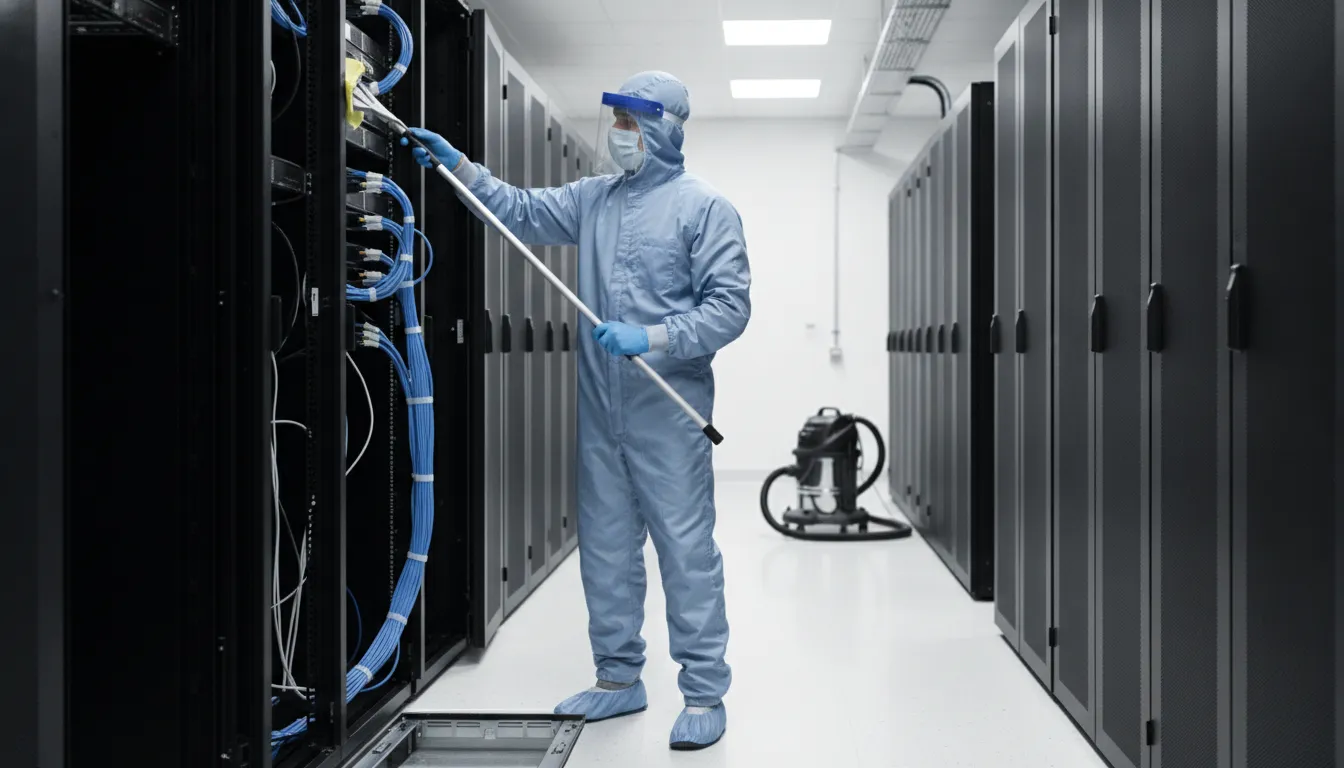
A server room can appear orderly while airborne particulates accumulate inside rack intake vents, cable trays, and under raised flooring. Those contaminants can restrict airflow, increase thermal stress, and compromise sensitive infrastructure long before they are visible during a routine walkthrough.
When protecting critical infrastructure, server room cleaning requires contamination-control procedures rather than ordinary janitorial methods. Standard services may lack the protocols and equipment needed to prevent particulate recirculation, moisture exposure, and electrostatic discharge. Specialized teams use ESD-safe HEPA-filtered vacuums, approved microfiber methods, and controlled floor care to remove contaminants without redistributing them. Industry guidance specifically recommends HEPA filtration, antistatic products, and avoiding dry sweeping or wet methods that could increase risk.
For facility managers and IT leaders, the distinction is operational, not cosmetic. Effective service must account for equipment sensitivity, airflow pathways, access controls, and the consequences of contamination near active systems. The first step is understanding why familiar janitorial tools and workflows are poorly suited to this environment.
What Makes Server Room Cleaning Different from Standard Janitorial Services?
Server rooms are not ordinary commercial spaces. The cleaning objective is not simply visual appearance. It is controlled removal of particulates and residue without introducing moisture, static discharge, or airborne contamination near active infrastructure. Standard janitorial services may be appropriate for offices and common areas. But their tools and procedures are not designed around the operating tolerances of servers, switches, storage arrays, and cable pathways.
Why Can Conventional Janitorial Methods Increase Risk?
Dry brooms can disturb settled particulates and suspend them in the air, where they may migrate toward rack intake vents. Wet mops introduce moisture into a space containing electrical equipment and raised flooring. Creating an unnecessary exposure when floor care is not planned around approved materials and drying controls. Conventional vacuums may also lack HEPA filtration, allowing captured particulates to recirculate through exhaust air rather than removing them from the environment. Research on server-room maintenance identifies the absence of contamination-control protocols as a central reason standard janitorial services are insufficient for sensitive electronics. The documented maintenance guidance specifically recommends HEPA-filtered vacuums, avoidance of water or wet methods around equipment, and approved antistatic products used with microfiber cloths.
These shortcomings are not theoretical. Airborne contaminants can settle on intake surfaces, obstruct ventilation pathways, and contribute to thermal stress over time. A cleaning crew that treats a server room like an office may also move carts, tools. Or personnel through the space without the access discipline and contamination-control sequence required for critical infrastructure. That is why standard janitorial services falling short in high-stakes environments is a broader operational concern, not merely a difference in service quality.
What Does Specialized Server Room Cleaning Include?
Foreman Pro Cleaning uses a controlled methodology built for sensitive infrastructure. Technicians use ESD-safe, HEPA-filtered vacuums with specialized brush attachments to remove particulates from rack intake vents, cable trays, and adjacent surfaces without dispersing contaminants back into the air. The recommended sequence works from higher surfaces downward, so removed material is captured rather than redistributed. Source guidance for ESD-safe HEPA vacuuming identifies these areas and methods as essential elements of server-room maintenance.
Floor care is handled with approved ESD-safe solutions and microfiber technology instead of dry sweeping. Technicians assess the floor type, protect equipment access paths, and maintain a deliberate work sequence around active racks. Foreman Pro Cleaning also applies proprietary CET and CVI training to personnel working in sensitive environments, reinforcing the distinction between routine appearance cleaning and contamination-control protocols. The result is a cleaning process designed to support infrastructure integrity, reduce avoidable exposure, and preserve operational continuity.
What Contaminants Pose the Greatest Risk in Server Environments?
Server equipment is vulnerable to contaminants that appear ordinary in an office but become operational hazards inside a tightly controlled technical environment. The primary concern is not visible accumulation alone. Airborne particulates can migrate through rack intake vents, settle on heat-producing components, and interfere with the airflow required to maintain stable operating temperatures. A disciplined critical environment cleaning program addresses these sources systematically rather than treating the room like a conventional workspace.
How Do Dust and Fibers Restrict Airflow?
Dust, skin particles, dander, and clothing fibers are mobile airborne contaminants that can accumulate on intake grilles, filters, cable trays, and component surfaces. Research on server-room maintenance identifies dust, skin particles, clothing fibers, zinc whiskers from raised flooring, and belt debris from cooling systems as contaminants capable of damaging electronics. The source documentation supports treating these materials as an equipment-protection issue, not a cosmetic housekeeping concern.
When residue restricts rack intake airflow, fans must work harder while less conditioned air reaches internal components. The resulting temperature rise can produce intermittent faults, accelerated component degradation, or shutdowns. Belt debris from cooling systems is particularly important because it can be distributed through the room’s air path. While particulates beneath raised flooring may be drawn upward through gaps or improperly sealed penetrations.
Why Are Zinc Whiskers and Conductive Residue Dangerous?
Zinc whiskers can develop from galvanized steel surfaces used in raised-floor systems. If disturbed, these fine metallic growths may become airborne and migrate toward electronic assemblies. Once deposited, conductive residue can contribute to short circuits or unstable electrical behavior. Other accumulated contaminants can retain moisture or interact with component surfaces, increasing corrosion risk. In critical infrastructure, those failures can progress from a localized fault to corrupted data, unavailable applications, or data loss.
How Does ISO 14644-1 Inform Contamination Control?
ISO 14644-1 provides an international framework for airborne particle cleanliness by defining particle concentration limits for controlled environments. It gives facility and IT leaders a technical basis for evaluating particulate conditions instead of relying solely on visual inspection. Effective server room cleaning should therefore combine documented procedures, appropriate monitoring, and ESD-safe removal methods that capture contaminants without redistributing them through rack intakes.
How Does ESD-Safe Cleaning Protect Sensitive Electronics?
Electrostatic discharge (ESD) is an uncontrolled transfer of electrical charge that can destroy microchips or damage sensitive electronic components without leaving visible evidence. Cleaning activity can create or carry that charge through footwear, clothing, tools, and floor surfaces. In a server room, contamination control therefore has to manage both particulates and the electrical properties of the cleaning process.
Which Vacuum Equipment Prevents Particulate Recirculation?
Technicians should use ESD-safe, HEPA-filtered vacuums fitted with specialized brush attachments. These systems remove accumulated particulates without dispersing them back into the room. The correct sequence is to work from higher surfaces downward, concentrating on rack intake vents, cable trays, equipment exteriors, and other locations where airflow concentrates residue. This protocol is specifically recommended for server room environments because ordinary vacuum equipment may not provide the same ESD control or filtration performance. Industry maintenance guidance identifies ESD-safe HEPA-filtered vacuums as essential for this work.
A broom is an unsuitable substitute. Dry sweeping can aerosolize particulates and move them toward active equipment rather than removing them. A standard vacuum can also lack the grounding, filtration, and accessory controls required around sensitive infrastructure.
How Should Technicians Maintain ESD-Safe Floors?
VCT and raised tile floors require anti-static floor care products applied with a controlled damp-mopping process. Approved ESD-safe solutions trap particulates while reducing the risk of generating a static charge. Dry brooms should never be used in these areas. The documented floor-care approach for server environments replaces dry sweeping with anti-static products and approved ESD-safe solutions. Conventional wet mopping is also inappropriate because excess moisture can migrate beneath raised flooring, reach cable pathways, or create a separate environmental risk.
Which Materials Are Safe for Component-Level Cleaning?
Component-level work calls for approved antistatic cleaning chemicals, 99% isopropyl alcohol where the equipment manufacturer permits its use, and lint-controlled microfiber cloths. Heat-resistant materials should be selected near warm equipment and ventilation paths. Technicians should never improvise with household cleaners, abrasive cloths, or unapproved wet products. Foreman Pro Cleaning applies a documented ESD-safe methodology so cleaning removes residue and contaminants without introducing charge, moisture, fibers, or chemical incompatibility into the server environment.
How Does Server Room Cleaning Differ from Data Center Cleaning?
The distinction is usually scale and governance, not contamination risk. A server room may occupy one protected room, while a data center may span a multi-thousand-square-foot facility with formal environmental controls. Both environments contain sensitive electronics exposed to airborne particulates, fibers, residue, and debris. A smaller footprint can create a false sense of reduced risk, particularly when fewer formal controls are in place.
| Control area | Server room | Full data center |
|---|---|---|
| Scale | Typically a single room supporting localized infrastructure. | Often a multi-thousand-square-foot facility with multiple zones, racks, and support spaces. |
| Protocol formality | ESD-safe methods may be used, but documented controls are often less formal. | Structured contamination-control programs may align with ISO 14644-1 particle-cleanliness principles. Computer-room guidance has also been associated with a Class 500000 cleanroom equivalence. Review the academic source. |
| Frequency | A thorough professional cleaning should occur at least quarterly. The cited maintenance guidance supports a three-month interval. | Monthly cleaning and continuous particulate-management activities are more common because of facility scale and operational exposure. |
| Access controls | Usually limited keycard access, with fewer personnel and zones. | Multi-factor authentication, biometric controls, visitor logging, and segregated access zones may apply. |
| Environmental monitoring | Basic temperature and humidity checks may be available. | Continuous particle-count, temperature, and humidity monitoring supports documented environmental management. |
| Cost impact | Even one room can support systems essential to clinical or business operations. A 2024 Ponemon Institute study reported average healthcare data-center downtime costs of $9,900 per minute. See the reported cost figure. | Outages can affect many systems and tenants simultaneously, multiplying operational, regulatory, and financial consequences. |
| Typical contaminants | Dust, skin particles, clothing fibers, zinc whiskers, and cooling-system debris, generally at lower volume. | The same contaminant categories, distributed across a larger footprint and potentially transported through more airflow pathways. |
That difference makes disciplined server room cleaning arguably more important, not less. Smaller rooms are sometimes treated as secondary spaces even though they face the same contamination mechanisms with fewer formal safeguards. Foreman Pro Cleaning applies ESD-safe methods, HEPA-filtered equipment, and contamination-control procedures suited to the environment. Facility leaders can review professional cleaning protocols before defining a risk-based scope for their server room or data center.
How Often Should a Server Room Be Professionally Cleaned?
A disciplined schedule should combine daily housekeeping controls with a documented professional cleaning cycle. The objective is not merely to remove visible debris. It is to manage microscopic particulates before they accumulate around rack intakes, cable trays, raised floors, and other areas where contamination can affect airflow and equipment reliability.
What Should Be Handled Every Day?
Daily tasks should include removing trash before it becomes a source of fibers or residue, checking entry areas for tracked-in debris, and spot-cleaning visible contamination with approved methods. Staff should not use dry brooms or ordinary vacuums in the room, because those tools can redistribute particulates into the equipment environment. Any unusual residue, construction debris, or evidence of a spill should be documented and escalated rather than treated as routine housekeeping.
When Is a Full Professional Cleaning Due?
As an industry best-practice minimum, schedule a thorough professional cleaning at least once every three months. This quarterly interval provides a baseline for managing invisible particulate accumulation and should be recorded in the facility’s maintenance log. A qualified team can use ESD-safe HEPA-filtered vacuums, microfiber technology. And approved floor-care solutions to address equipment exteriors, rack intake vents, cable pathways, and accessible flooring without dispersing contaminants. For additional schedule guidance, review Foreman Pro’s recommendations for server room cleaning schedules.
Which Conditions Require More Frequent Service?
Quarterly service is a minimum, not a universal prescription. Increase inspection and cleaning frequency when a room is near active construction, receives heavy foot traffic, or is connected to older HVAC equipment that sheds more particulates. Dense equipment layouts can restrict airflow and create more difficult-to-reach accumulation points. A history of overheating events, unusual fan activity, or recurring thermal alarms also warrants a documented review of the cleaning interval and airflow conditions.
How Should Overhead and Subfloor Areas Be Scheduled?
Overhead spaces and subfloor areas may not require the same frequency as occupied floor surfaces, but they must not be ignored. Particles can accumulate invisibly in these locations and later migrate into the active equipment zone. Assign each area a documented inspection and cleaning schedule based on access conditions, particulate load, and facility risk rather than relying on an unspecified occasional service.
After intensive work. Apply the “20 minute rule”: pause for 20 minutes to allow stirred-up particulates to settle before resuming protection activities or returning the room to normal operations. This settling period is part of the contamination-control protocol, not idle time. The documented guidance for server room maintenance supports both the quarterly minimum and this settling procedure.
Why Is Cable Management a Critical Part of Server Room Cleaning?
Cable trays, raceways, and dense bundles collect particulates in places that are difficult to reach without disturbing connected systems. They can also obstruct airflow around racks, creating localized hotspots that increase thermal stress on servers and network equipment. Effective server room cleaning therefore includes cable infrastructure, not merely the exposed floor and equipment exteriors.
Disorganized or overloaded cabling compounds the risk. Restricted airflow can undermine the performance of cooling equipment, while a loose connection may interrupt a critical circuit. Poor routing and unmanaged accumulation of residue can also contribute to fire hazards by restricting inspection access and allowing heat to build around infrastructure. Thermal management must be treated as part of the cleaning plan: CRAC and CRAH units require documented filter replacement. Coil cleaning, refrigerant verification, and airflow-balance records to help prevent thermal runaway from a blocked cold aisle or degraded compressor. These maintenance requirements are documented in critical-environment guidance.
Standard janitorial staff may not recognize the difference between a cable that appears loose and one that is intentionally positioned for strain relief, serviceability, or airflow. Pulling a bundle aside, placing a vacuum nozzle against a connector, or stepping on a cable can dislodge a critical connection. Cleaning teams should coordinate with the facility or IT representative, avoid moving identified cabling, and use ESD-safe tools and attachments around trays, raceways, and rack entrances. Foreman Pro Cleaning’s certified critical environment cleaning providers apply procedures designed for sensitive infrastructure rather than adapting ordinary janitorial methods.
During every deep clean, technicians should vacuum cable trays and raceways with an ESD-safe, HEPA-filtered system, then inspect for blocked pathways, excessive bundle density, and visible damage. Work from the top down so dislodged particulates fall onto surfaces that have not yet been cleaned. This sequence limits recontamination and preserves a controlled path through the room. Any abnormal heat, damaged insulation, or obstructed airflow should be documented and escalated. Do not treat these as routine cleaning issues.
Frequently Asked Questions
How do you clean a server room without damaging equipment?
Begin with an access and equipment-risk review, then use ESD-safe HEPA-filtered vacuums, lint-free microfiber materials, and approved antistatic solutions. Avoid dry sweeping and uncontrolled moisture. Technicians should work systematically from higher surfaces downward while protecting active infrastructure and maintaining required access controls. This approach helps prevent particulate recirculation and electrostatic discharge risks. Technical cleaning guidance supports HEPA filtration, antistatic chemicals, and non-disruptive methods for sensitive environments.
How do you remove particulates from rack vents and cable trays?
Use an ESD-safe HEPA-filtered vacuum with a suitable brush attachment, proceeding from top to bottom and concentrating on rack intake vents, cable trays, and other accumulation points. Do not direct compressed air or use tools that redistribute contaminants into the room. The objective is controlled particulate extraction, not merely moving residue away from visible surfaces.
What solution should be used to clean a server room floor?
Use an approved ESD-safe floor-care solution appropriate for the installed surface, such as VCT or raised-floor tile. Apply it with a controlled damp method that captures particulates, rather than a dry broom that can suspend them. Published server-room maintenance guidance specifically recommends antistatic floor-care products and discourages dry sweeping.
How often should a server room receive professional cleaning?
Schedule a thorough professional cleaning at least once every three months, then adjust the interval for construction activity, building age, foot traffic, filtration performance, and observed particulate accumulation. Daily housekeeping should address waste and visible debris without entering protected areas casually. A documented schedule is more reliable than waiting for contamination to become visible. Industry guidance identifies quarterly thorough cleaning as a baseline.
What is the 20-minute rule in server room cleaning?
The 20-minute rule calls for pausing after approximately 20 minutes of cleaning so disturbed particulates can settle before contamination-control work continues. It is a control measure for limiting airborne redistribution, not a substitute for HEPA extraction, ESD-safe procedures, or appropriate environmental monitoring. The referenced maintenance guidance describes this settling interval as part of the cleaning protocol.
Ready to Schedule Professional Server Room Cleaning?
A specialized cleaning plan helps facility and IT teams manage contaminants around sensitive infrastructure without relying on standard janitorial methods. Foreman Pro Cleaning brings critical-environment expertise, proprietary CET and CVI training. And an understanding of IT operations to server rooms and network rooms across Maryland, Washington, D.C., and Virginia. Schedule a consultation for professional server room cleaning services with the Foreman Pro team.
