
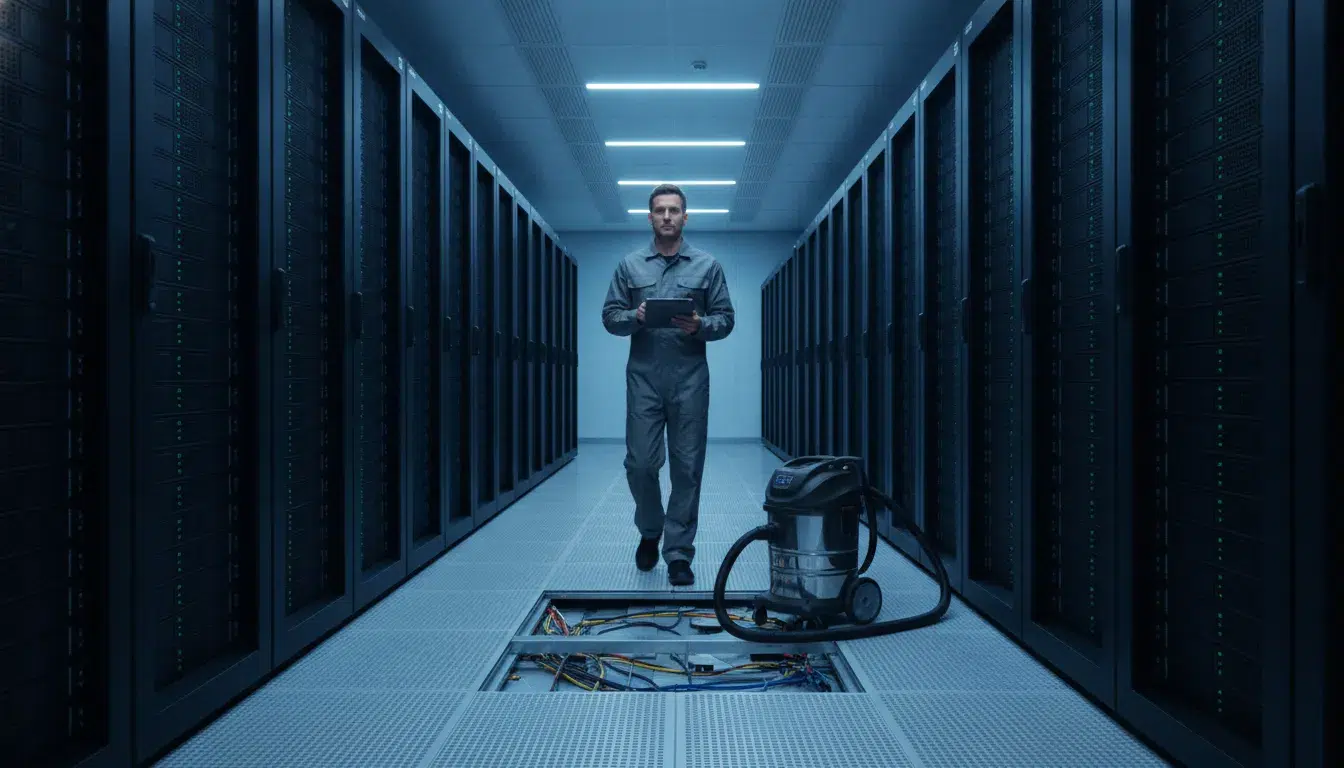
In a data center, a cleaning decision can become an infrastructure decision. Particulates beneath a raised floor, residue near an air intake, or an inappropriate cleaning agent can affect thermal performance, static control, and equipment integrity. The objective is not a visually orderly room. It is a controlled environment that supports uptime.
Critical environment cleaning requires more than proper equipment and protocols. It demands an understanding of what happens when contamination reaches a server or threatens a cleanroom’s ISO classification. Foreman Pro Cleaning brings that perspective through a methodology shaped by direct IT operations and facilities management leadership.
That distinction becomes clear when a general janitorial crew encounters live infrastructure. Without understanding airflow dynamics, static-dissipative requirements, and the operational consequences of disturbing contaminants, routine methods can introduce risk rather than control it. The difference begins with the experience guiding each protocol.
Why Does IT Operations Experience Matter for Critical Environment Cleaning?
In a mission-critical facility, a cleaning decision can become an infrastructure decision. The person directing service must understand more than surface appearance. They must recognize how airflow moves through a data center, where particulates collect, how static discharge can threaten sensitive components. And why a procedure that is acceptable in an office may be inappropriate around live equipment.
Wes Foreman developed that perspective through more than 15 years of IT operations leadership. His experience includes serving as IT Manager and later Director of Network Operations for AVID Medical. Director of Network Operations for Medical Action Industries, and Regional IT Director for Pandora Jewelry. He managed the systems, connectivity, and operational requirements that cleaning crews work around. That experience informs how Foreman Pro Cleaning plans and performs service in data centers, server rooms, network rooms, and other controlled environments. The company’s leadership team brings more than 30 years of combined IT operations experience.
How Does an IT Perspective Change the Cleaning Plan?
An IT operations perspective begins with consequences. A raised-floor data center is not simply a room with racks and a floor to maintain. Its sub-floor plenum supports airflow and can accumulate particulate that later migrates into equipment intakes. Raised-floor pedestals can also develop zinc whiskers, which require deliberate mitigation rather than routine vacuuming. Server intake areas need attention because accumulated residue can restrict airflow and increase thermal stress on hardware.
These conditions affect the sequence, equipment, and controls used during service. Technicians need to work around live systems without disturbing cabling, blocking airflow, or introducing electrostatic risk. They need to distinguish between visible debris and contamination that may be concealed beneath access panels or around cooling infrastructure. The objective is continuous particulate management that protects operational integrity, not a short-term improvement in appearance.
Why Does Understanding the Reason Matter?
Traditional janitorial training can teach a crew to follow a checklist. It does not necessarily explain why a specific vacuum, wiper, cleaning agent, or movement pattern is required in a critical environment. Foreman Pro Cleaning connects each protocol to the infrastructure risk it controls. That makes it easier to adapt service when rack layouts change, construction occurs nearby, cooling patterns shift, or an operations team identifies a new concern.
This approach supports risk-based planning and aligns environmental controls with uptime requirements. It also complements recognized frameworks, including critical environment cleaning services designed around controlled procedures and what constitutes a critical environment. The result is a service methodology built around how the facility functions, not merely how it looks after the crew leaves.
How Does Critical Environment Cleaning Differ From Standard Commercial Cleaning?
Standard commercial cleaning is generally designed for visible soils and routine appearance. That model is not sufficient around servers, laboratory equipment, raised floors, or other sensitive infrastructure. Dry dusting can resuspend particulates, a conventional mop can redistribute contaminated water, and a standard vacuum may recirculate fine particulate rather than capture it. Effective contamination control focuses on continuous particulate management and hardware integrity, not simply visual appearance.
| Control area | Standard commercial cleaning | Critical environment cleaning |
|---|---|---|
| Equipment | Conventional mop-and-bucket systems and general vacuums | HEPA-filtered vacuums, microfiber technology, low-lint wipers, and static-dissipative solutions |
| Chemicals | General-purpose products selected for routine surface cleaning | Controlled cleaning agents, including EPA-registered disinfectants where appropriate, selected for material compatibility and the operating environment |
| Technician training | Standard janitorial orientation and task instruction | Critical Environment Training (CET), CVI preparation, static-control awareness, and equipment-sensitive procedures |
| Documentation | Basic work orders or completion checklists | Validated cleaning documentation, service records, and post-service reporting |
| Quality control | Primarily visual inspection | Visual inspection supplemented by particulate-count verification when the facility protocol requires it |
| Frequency | Predetermined schedule based on occupancy and appearance | Risk-based frequency informed by facility use, contamination sources, and applicable ISO 14644-1 classification |
The distinction is especially important below the finished floor. A qualified team can address raised-floor plenums and pedestals where debris and zinc whiskers may accumulate. While also cleaning around CRAC units without introducing unnecessary residue or airborne particulate. Work sequencing must account for airflow, live equipment, access restrictions, and static-discharge risk.
For healthcare and controlled clinical spaces, the methodology also considers applicable data center cleaning standards and relevant AORN guidance rather than treating every surface as interchangeable. Foreman Pro Cleaning documents the process so facility leaders can review what was serviced, which controls were used, and whether follow-up action is warranted. For organizations evaluating providers, these critical environment cleaning certification requirements offer a useful framework for distinguishing trained contamination-control technicians from a conventional janitorial crew.
What Training Do Critical Environment Cleaning Technicians Need?
Technicians working in a data center, laboratory, command center, or other controlled facility need a substantially different training foundation than standard janitorial personnel. The work involves protecting infrastructure and controlling contaminants while service occurs around sensitive systems. A basic orientation may explain how to operate equipment, but it does not establish the judgment required to work safely around live equipment, restricted zones, or controlled airflow.
Which technical competencies should training cover?
Foreman Pro Cleaning’s Critical Environment Technician (CET) program addresses the operational risks that general janitorial training leaves unresolved. Technicians learn electrostatic discharge awareness, static-safe protocols, proper gowning and entry procedures, biosafety-level considerations, chemical compatibility, and equipment-sensitive cleaning methods. They also learn how contamination control chains work, from preparation and zone entry through particulate removal, controlled product use, and exit procedures.
That training is applied to the facility rather than treated as a generic checklist. A technician must understand how to use HEPA-filtered vacuums and microfiber technology without introducing residue. How to work around cabling and active infrastructure, and how to recognize when a requested task could affect operations. In cleanrooms, procedures must remain consistent with the applicable ISO 14644-1 cleanroom classification requirements. In healthcare environments, the methodology also references AORN guidelines for surgical suites, where environmental control and procedural discipline directly support patient safety.
How are technicians held accountable after initial training?
Foreman Pro’s CET pathway includes CVI, or Critical Space Janitorial, training and proprietary standard operating procedures. Technicians are expected to document service activities, record relevant observations, and complete post-service reporting so facility managers can verify what was performed. Continual SOP sign-off requirements reinforce the correct sequence and keep procedures current as site conditions, equipment, or customer requirements change.
This ongoing accountability distinguishes a qualified critical-environment team from providers whose preparation is limited to a brief introduction before the first shift. Facility managers evaluating critical environment cleaning certification requirements should ask for evidence of role-specific training, controlled-entry procedures, equipment safeguards, documentation standards, and recurring competency verification. Certification matters, but the training system behind each service visit is what protects uptime and maintains contamination control.
What Are the Most Common Contaminants in Data Centers and Critical Environments?
Airborne contamination in a data center is not limited to visible residue. Its source, particle size, electrical behavior, and location determine the operational risk. ISO 14644-1 provides context by classifying controlled environments according to airborne particle concentration at specified particle sizes, including measurements in the submicron range. That framework helps IT managers evaluate contamination as a measurable condition rather than an aesthetic concern.
- Paper dust and packaging fibers: Cardboard cartons, shipping materials, and routine equipment deliveries release cellulose fibers and other particulates. When these materials reach server intakes or heat sinks, they can restrict airflow and contribute to thermal events. Packaging should be staged outside the controlled area whenever possible.
- Zinc whiskers: These conductive filaments can develop on zinc-plated raised-floor pedestals and migrate through the underfloor plenum. If they enter equipment, they may bridge contacts on printed circuit boards and contribute to intermittent or permanent failures. Raised-floor inspections should therefore include the pedestal system and the plenum, not only the visible floor surface.
- Human skin cells and lint: Personnel movement introduces fibers and microscopic biological particulates. Accumulation around intakes, cable pathways, and perforated tiles can interfere with airflow. Static-charged particles may also increase the likelihood of an electrostatic discharge event when they approach sensitive components.
- Construction debris: Nearby renovation or post-construction activity can introduce gypsum residue, concrete particulates, insulation fibers, and other debris. These materials can migrate through air-handling pathways and settle inside equipment, making a documented critical environment cleaning protocol essential before affected spaces return to normal operation.
- Carbon dust: UPS systems, CRAC unit motors, and related mechanical components can generate carbonaceous residue as they operate. In combination with humidity, airborne ionic contaminants can accelerate corrosion on contacts and other vulnerable surfaces.
How Can IT Managers Detect an Increasing Contamination Load?
Two simple observations can identify conditions that warrant a more detailed assessment. A sticky mat at an entry point can reveal the volume and character of particulates carried into the room by footwear and carts. Pre-filter inspection can show whether the air-handling system is capturing an unusual load of fibers, residue, or construction debris. These indicators do not replace particle-count testing, but they provide useful diagnostic evidence for adjusting contamination control protocols.
Foreman Pro Cleaning evaluates these sources in relation to airflow, equipment placement, access patterns, and maintenance activity. That systems-level view supports continuous particulate management and helps protect infrastructure before accumulation becomes a thermal, electrical, or corrosion-related incident.
How Often Should Critical Environments Be Cleaned?
There is no universal calendar for critical environment cleaning. An appropriate interval reflects the facility’s ISO 14644-1 classification, operational profile, personnel movement, adjacent construction, and cooling-system design. A laboratory with controlled gowning requirements does not present the same particulate burden as a data center receiving frequent equipment deliveries. A hospital or command center also requires protocols that account for occupancy, high-touch surfaces, and the consequences of biological contamination.
What Should a Baseline Schedule Include?
For many data center programs, a practical starting point is quarterly service for the raised-floor plenum, semi-annual service around server racks, and quarterly service for communications rooms. These intervals are planning baselines, not substitutes for a site assessment. Cleanrooms should follow a documented schedule tied to their ISO classification and process requirements, while healthcare environments should use risk-based procedures consistent with CDC environmental cleaning guidance.
- Raised-floor plenums: Review particulate accumulation quarterly, with service adjusted for airflow, access, and construction exposure.
- Server racks: Plan semi-annual detailed service, with more frequent inspection where intake filters or pre-filters show elevated loading.
- Communications rooms: Review and service quarterly, particularly in high-traffic areas or rooms with limited filtration.
- Cleanrooms: Align frequency with ISO class, validated process requirements, occupancy, and documented monitoring results.
Why Is Risk More Important Than the Calendar?
Foreman Pro Cleaning treats frequency as a risk-management decision. Particulate observations, sticky-mat condition, pre-filter inspections, foot traffic, nearby construction, and cooling performance should inform revisions to the schedule. Service should also be coordinated with maintenance windows and equipment refresh cycles so technicians can perform controlled work without compromising uptime. The CDC describes environmental cleaning frequency and method as decisions based on transmission risk, a framework that translates well to other high-stakes facilities.
Continuous particulate management is more effective than waiting for visible residue. By combining scheduled HEPA-filtered vacuuming, inspection findings, and documented contamination-control protocols, facility teams can address accumulation before it becomes an equipment or classification concern. Foreman Pro Cleaning can develop a site-specific plan for facilities across Maryland, Washington, D.C., and Virginia.
Frequently Asked Questions
Why is specialized cleaning required for critical environments?
Critical environments contain infrastructure whose reliability can be affected by microscopic particulates, residue, static discharge, and uncontrolled cleaning activity. Specialized service uses contamination control protocols, HEPA-filtered vacuums, microfiber technology, and equipment-sensitive methods rather than standard housekeeping practices. The objective is continuous particulate management that supports hardware integrity and operational continuity.
What does critical environment cleaning involve?
The work may include controlled cleaning around live equipment, raised-floor and subfloor plenum service, particulate removal from server and network rooms, static-dissipative procedures, and documented post-service verification. The appropriate process depends on the facility, airflow design, equipment sensitivity, occupancy, and contamination risks. Cleanroom work may also be aligned with ISO 14644-1 classifications, while healthcare applications may reference AORN guidelines for surgical suites.
How often should critical environments be cleaned?
There is no universal schedule. Frequency should be established through a risk-based assessment of facility type, foot traffic, nearby construction, cooling-system design, particulate observations, and operational requirements. A qualified provider should evaluate the environment and recommend recurring service intervals for areas such as raised-floor plenums. Server racks, and communications rooms instead of applying a generic janitorial calendar.
How does IT operations experience impact cleaning protocols?
IT operations experience connects each service decision to uptime, airflow, equipment access, change windows, and infrastructure risk. A provider with that background can plan work around active systems. Recognize why a cleaning method may affect static control or airflow, and communicate in operational terms with facility and IT teams. Foreman Pro Cleaning applies this perspective to contamination control protocols for data centers, laboratories, command centers, and other high-stakes spaces.
Ready to Schedule a Facility Walkthrough?
A facility walkthrough gives your team an opportunity to discuss operational requirements, contamination-control priorities, and a cleaning plan aligned with your environment. Foreman Pro Cleaning applies IT operations experience to critical spaces where precision and continuity matter. To schedule a walkthrough and discuss a custom cleaning plan, call 888-360-1608.
