
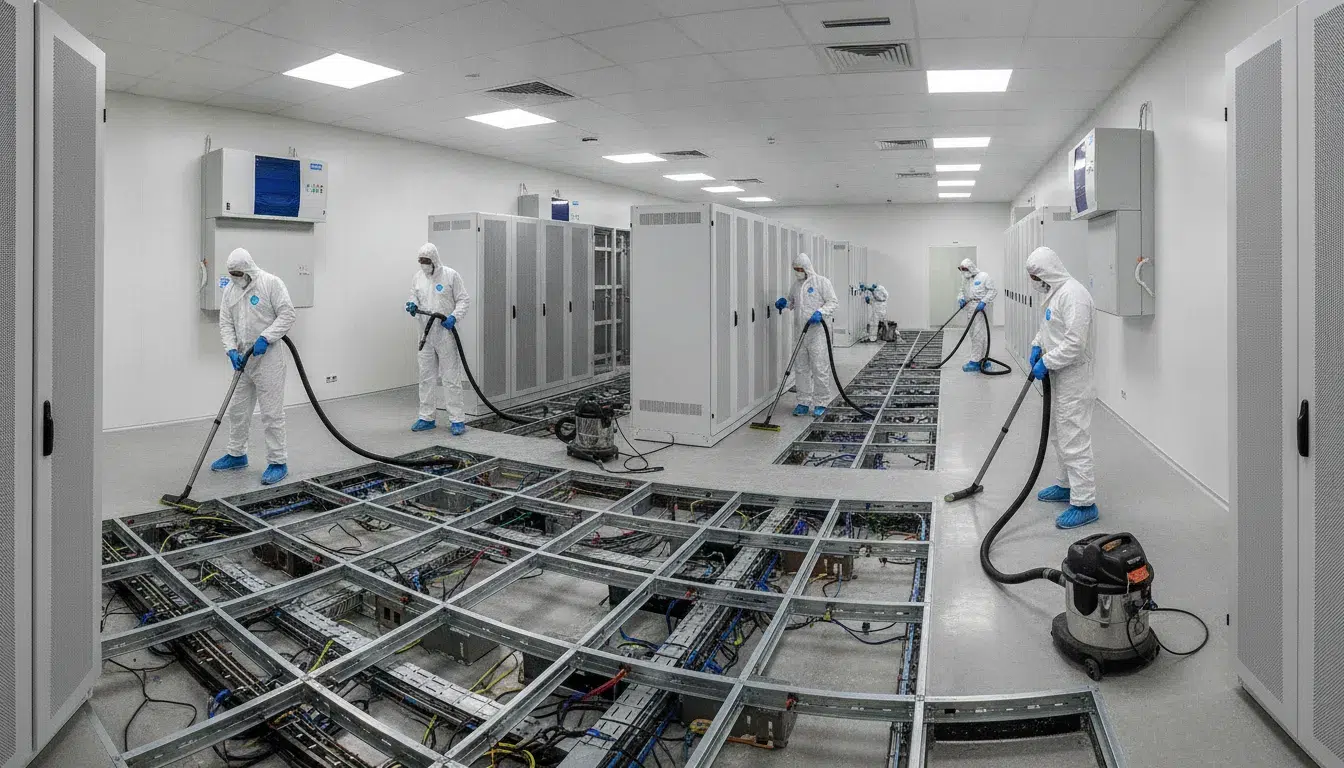
A single stray microscopic particulate can compromise millions of dollars in sensitive server infrastructure before a facility ever goes live. For facility managers and operations directors, coordinating the handover of a newly built facility requires a flawless sequence of environmental controls. True protection for sensitive IT equipment relies on a structured, multi-phase plan executed by certified critical environment cleaning professionals who understand the exact timing of critical path milestones.
Professional data center post-construction cleaning is a highly technical, multi-stage contamination control protocol sequenced to eliminate microscopic particulates before sensitive equipment is energized. Standard construction debris must be managed through proactive maintenance cleaning, followed by a pre-commissioning five-micron deep clean and a final 0.3-micron microscopic decontamination. Each stage must coordinate precisely with engineering handovers and mechanical testing, ensuring compliance with ISO 14644-1 Class 8 air cleanroom standards. Engaging experienced specialists like Foreman Pro Cleaning ensures that construction dust, chemical residues, and airborne contaminants are completely eradicated, safeguarding uptime and protecting complex infrastructure during commissioning.
Failing to plan this sequencing can lead to catastrophic hardware damage, voided warranties, and delayed commissioning timelines. Facility directors must establish a clear understanding of when and how these cleaning phases integrate into the master construction schedule. To align your build schedule with industry-standard contamination control protocols, the first step is to define the baseline strategy behind What Is a Critical Path for Data Center Post-Construction Cleaning?
What Is a Critical Path for Data Center Post-Construction Cleaning?
Building a modern data facility is a complex process. Construction teams must manage heavy tasks like erecting walls and installing vast power systems. But for data center operators, managing microscopic dust is just as vital. Fine dust from drywall, concrete, and metalwork can easily ruin sensitive servers before they even turn on. Treating data center post-construction cleaning as a core part of the build sequence is critical to protect this high-value hardware.
Why Sequencing Matters More Than Cleaning Methods
In a standard build, cleaning is often the last step before handover. For a technical space, however, waiting until the end is a major risk. A critical path maps out exactly when cleaning must occur relative to construction milestones. If you clean too early, subsequent dust-generating work like ceiling trades or cable pulls will recontaminate the space. If you clean too late, fine particulates get trapped inside cooling ducts and server racks, causing long-term damage.
Proper scheduling aligns cleaning phases with milestones like superstructure completion, mechanical rough-ins, dry-in, and equipment installation. According to a case study by Checkmark Pro on the DFW9 project. Managing a complex 18-month build timeline required having a dedicated crew of 15 to 30 technicians on-site starting right from the superstructure phase to manage dust levels (checkmarkpro.com). This continuous presence keeps debris from settling in hard-to-reach areas like sub-floor plenums.
Establishing an ISO-Compliant Timeline
To keep sensitive systems safe, cleaning must meet strict international standards. Experts at Critical Facilities Solutions recommend bringing proactive cleaning technicians on-site as soon as the building shell is watertight (criticalfacilitiessolutions.co.uk). The initial goal during construction is to reach BS EN ISO 14644-1:2015 Level 8, which limits the concentration of microscopic particulates in the air.
Working with certified critical environment cleaning professionals ensures your project moves smoothly through these standards. These specialists understand how to sequence work so that each zone is stabilized before any sensitive air handlers or servers are turned on. This methodical path reduces operational risks, protects hardware warranties, and ensures a seamless handover to your operations team.
How Does Proactive Cleaning During Construction Prevent Contamination?
Traditional data center post-construction cleaning often waits until building is complete. However, waiting until the end of a build allows heavy construction dust to settle deep inside critical areas. To prevent this issue, proactive cleaning manages microscopic particulates progressively from the very start of the fit-out phase.
When should proactive cleaning start?
Proactive cleaning should start as soon as the building structure becomes watertight. At this stage, professional technicians set up on-site containment zones. Under standard guidelines like BS EN ISO 14644-1:2015, the goal during this early construction phase is to maintain a stable Class 8 air quality standard. Having certified critical environment cleaning professionals on-site early ensures that high-level, mid-level, and low-level surfaces are cleaned continuously as the fit-out progresses.
How do teams control dust movement?
To control dust, crews set up strict physical containment zones at every entry point to the server rooms. These zones include sticky mats to catch shoe dust and dedicated overshoe stations. Crews also use physical barriers to isolate areas where active drilling or cutting occurs. These measures protect completed rooms from airborne debris. Mobile elevating work platforms (MEWPs) must also go through full cleaning protocols before they enter sensitive rooms to avoid bringing in grease or outer dust.
How is air quality monitored?
Air quality cannot be left to visual checks alone. Technicians use high-accuracy air particle counters (APCs) to perform daily monitoring of airborne particulates. These measurements are trended over time and shared directly with construction managers. This daily data shows exactly when trade activities cause particle spikes, which allows managers to adjust ventilation or sequence work to protect sensitive infrastructure.
- Establish the watertight boundary: Place trained technicians on-site as soon as the building shell is sealed to begin initial particulate management.
- Set up containment controls: Install sticky adhesive mats, physical barriers, and overshoe stations at all critical entries to stop dust transfer.
- Clean mobile equipment: Clean all mobile elevating work platforms and trade tools completely before they enter clean areas.
- Perform continuous multi-level cleaning: Use HEPA-filtered vacuums and microfiber technology to clean ceilings, walls, and subfloors continuously.
- Monitor air quality daily: Track airborne dust levels with air particle counters and share reports with construction management to manage risks.
By executing these steps, teams manage contamination risks on a continuous basis. This progressive strategy ensures that fine dust does not accumulate in subfloor plenums or cable trays before delicate systems are installed. Protecting these areas early reduces the risk of overheating and equipment failure during later commissioning phases.
When Should the Pre-Commissioning (5-Micron) Clean Occur?
The pre-commissioning cleaning phase represents a critical bridge between rough construction work and the final precision cleaning of your server environment. This transitional clean must be scheduled carefully within your project path to prevent contamination of active systems. It should take place immediately after air handler activation but before sensitive servers, network hardware, and delicate systems are installed. Sequencing this phase correctly is a vital element of the overall data center cleaning lifecycle to ensure project milestones are met safely.
Why Timing the Transitional Phase Matters
During data center construction, activities introduce fine particulate matter, concrete dust, and other debris. If you activate the heating, ventilation, and air conditioning (HVAC) systems or computer room air handlers (CRAH) before a deep clean. These systems will pull floating dust deep into air plenums and ductwork. High-efficiency particulate air (HEPA) filtration is vital for controlling these airborne contaminants, as recommended by the National Institute for Occupational Safety and Health (NIOSH). Running the 5-micron clean at this exact point captures particulates before they settle on newly unboxed server components or get blown through sub-floor cavities.
What Steps Define the 5-Micron Cleaning Path?
To successfully execute this transitional cleaning phase, facility managers should coordinate a structured sequence. Using trained, specialized crews ensures the environment meets strict operational standards before final equipment arrives.
- Activate Air Handling Systems: Turn on all air handling systems and allow the air to circulate to help lift and capture loose, airborne dust.
- Conduct Deep Surface Cleaning: Perform a thorough, top-to-bottom clean of all ceilings, walls, cable trays, sub-floor plenums, and raised floor tiles to a 5-micron level to eliminate heavy construction debris.
- Set Up Contamination Barriers: Deploy anti-static mats, containment controls, and overshoe stations at all entryways to stop workers from bringing new soils into the cleaned zone.
- Inspect and Test Particulate Levels: Conduct detailed visual checks and use particle counters to test the air quality and surface cleanliness across all zones.
- Deliver Environmental Reports: Generate a detailed environmental report that outlines any remaining issues, particle counts, and specific action items to prepare the room for the final turn-over clean.
How Real-World Projects Reach Class 7 Air Quality
The value of structured transitional cleaning is clear in major projects. For example, during the construction of the DFW9 data center in North Texas. An 18-month project with an initial cleaning contract value of $700,000, final cleaning crews faced high standards. The project team aimed to exceed the standard Class 8 target by aiming for ISO 14644 Class 7 cleanliness, as documented by Checkmark’s DFW9 Case Study. Achieving this standard required complete 5-micron cleaning immediately after the air handlers were turned on. Which kept the HVAC units from distributing concrete dust and protected the site during critical testing milestones.
What Does the Final (0.3-Micron) Clean and Verification Process Look Like?
The final phase of data center post-construction cleaning is the most strict. It occurs after all dust-generating trades complete their work but before anyone exposes sensitive systems to the environment. This step targets microscopic particulates down to 0.3 microns in size to meet international cleanroom standards. Proper sequencing prevents contamination from circulating through new systems, which can lead to overheating and equipment failure.
How Do the Three Construction Cleaning Phases Compare?
To achieve a state of operational readiness, a facility must progress through three distinct cleaning stages. Each stage has a specific timing, target particle size, and technical standard. Managing these phases correctly ensures that the data center meets strict contamination control guidelines before handover to operations.
| Cleaning Phase | Timing | Target Particle Size | Standards Applied | Verification Method |
|---|---|---|---|---|
| Maintenance and Proactive | During active building fit-out | Visible debris and coarse dust | ISO 14644-1 Level 8 | Daily particulate tracking and visual walks |
| Pre-Commissioning Clean | Post air handler activation | 5.0 microns and larger | ISO 14644-1 Class 7 or 8 | Air particle counters and bulk wipe checks |
| Final (0.3-Micron) Clean | Before equipment population | 0.3 microns and larger | ISO 14644-1 Class 8 & ASHRAE | Laser particle counts and lab wipe tests |
This phased progression follows the nine-stage construction framework defined by the Institute of Environmental Sciences and Technology under the IEST ISO 14644-5 standard. These nine stages govern everything from early demolition through final classification upgrade. This systematic approach ensures that cleaning teams work from the cleanest areas toward the dirtiest sectors to avoid cross-contamination.
What Specific Verification Methods Are Used for Handover?
A successful final clean is not just about wiping down surfaces. It requires objective, measurable proof of cleanliness. To protect the site investment, certified technicians perform three critical checks to confirm the space is ready for sensitive server racks.
First, teams conduct visual inspections and wipe tests using specialized cleanroom cloths. These tests target hidden areas like cable trays to make sure they are free of debris to allow for proper airflow. Second, technicians use laser air particle counters to measure airborne contamination against ISO benchmarks. Finally, the team documents every zone with photographs, creating a complete verification record that is included in the project closeout package.
Employing certified critical environment cleaning professionals ensures that these strict verification steps are met. Using advanced tools like HEPA-filtered vacuums and microfiber technology helps eliminate static-inducing dust. For more information on how these steps fit into the broader facility plan, you can read about the maintenance cleaning vs post-construction cleaning relationship or explore the complete data center cleaning lifecycle to schedule a long-term plan.
How Do You Document and Hand Off a Clean Data Center?
A successful data center post-construction cleaning project must end with clear proof of work. When you build or renovate these spaces, you need written evidence that the rooms meet strict particulate standards before you install servers. Proper handover requires close tracking of every room, a complete record of results, and careful coordination with other trades. Working with certified experts helps facility managers establish a safe baseline, which simplifies the transition from maintenance cleaning vs post-construction cleaning protocols.
Why Do You Need Zone-Based Inspection Sheets?
Data center projects cover many distinct spaces, which makes a single checklist insufficient. Experienced teams use zone-based inspection sheets that tie directly to specific room names and design drawing numbers. These sheets track contamination levels in the subfloor plenum, the raised floor surface, the cable trays, and the rack spaces. Grouping inspection tasks by physical zone ensures that technicians do not miss hidden areas. It also gives the construction team a clear view of which zones are ready for equipment installation and which still require attention.
What Components Form a Complete Closeout Package?
The closeout package is the official record that proves your facility is clean and safe to operate. This package combines detailed inspection records, high-resolution photographs, and a log of any corrective actions taken during the project. It also includes the final particulate measurement results to prove the space meets cleanroom limits. When you work with Foreman Pro Cleaning, our team delivers this complete packet along with formal acceptance signatures. This documentation provides valuable historical context that supports your long-term data center cleaning lifecycle.
How Do You Align Cleanliness with Commissioning Milestones?
Cleaning activities must align with key facility milestones to ensure the best results. The final particulate sweep should happen after major construction dust settles but before sensitive system testing begins. According to guidelines on data center commissioning, cleaning teams must coordinate their work with functional testing, air balancing, equipment startup, and integrated systems testing. For example, testing the air flow systems can stir up settled dust, which requires another rapid cleanup pass. Securing the space with strict access controls after the final clean is necessary to preserve the verified state and protect the infrastructure.
Frequently Asked Questions
What are the 3 phases of data center construction cleaning?
According to Foreman Pro Cleaning, this specialized work occurs in staged intervals. The process begins with continuous maintenance cleaning to manage coarse debris during fit-out. It moves to a pre-commissioning five-micron clean after air handler startup. Finally, a meticulous zero-point-three-micron clean is completed to meet strict particulate standards before server installation.
Why is post-construction cleaning critical for data centers?
Building activities generate significant dust and debris. If left unmanaged, these fine particulates settle inside electronic systems. According to a Foreman Pro Cleaning guide, microscopic contaminants block airflow, disrupt heat sinks, and cause equipment failure or costly downtime. Professional contamination control is a core technical requirement to protect high-value hardware.
What standards apply to data center post-construction cleaning?
Data center cleaning must meet strict international baselines. Work is completed to align with ISO 14644-1 cleanroom standards and ASHRAE environmental design guidelines. These frameworks govern allowable particulate sizes and airborne counts per cubic meter. This strict compliance ensures the room is safe for high-stakes server operations.
How do you distinguish a builder clean from a critical clean?
A standard builder clean only removes heavy surface trash, dust, and visible debris. In contrast, a critical clean targets microscopic particulates. Specialized teams use microfiber technology and HEPA-filtered vacuums to clean cable pathways, sub-floor plenums, and structural surfaces. This process achieves precise cleanroom-level compliance necessary to safeguard sensitive technology.
How Can You Schedule a Consultation for Your Data Center Post-Construction Cleaning Scope?
Delaying your contamination control protocols can cause costly hardware failures and push back your commissioning timeline. Partnering with certified critical environment cleaning professionals early in the build process helps prevent particulate buildup and secures your operational milestone. Foreman Pro Cleaning provides the precise, protocol-driven solutions you need to protect your facility from microscopic contaminants.
Ready to schedule a consultation for your data center post-construction cleaning scope? Contact us today to speak with our critical environment specialists and book your walk-through.
