
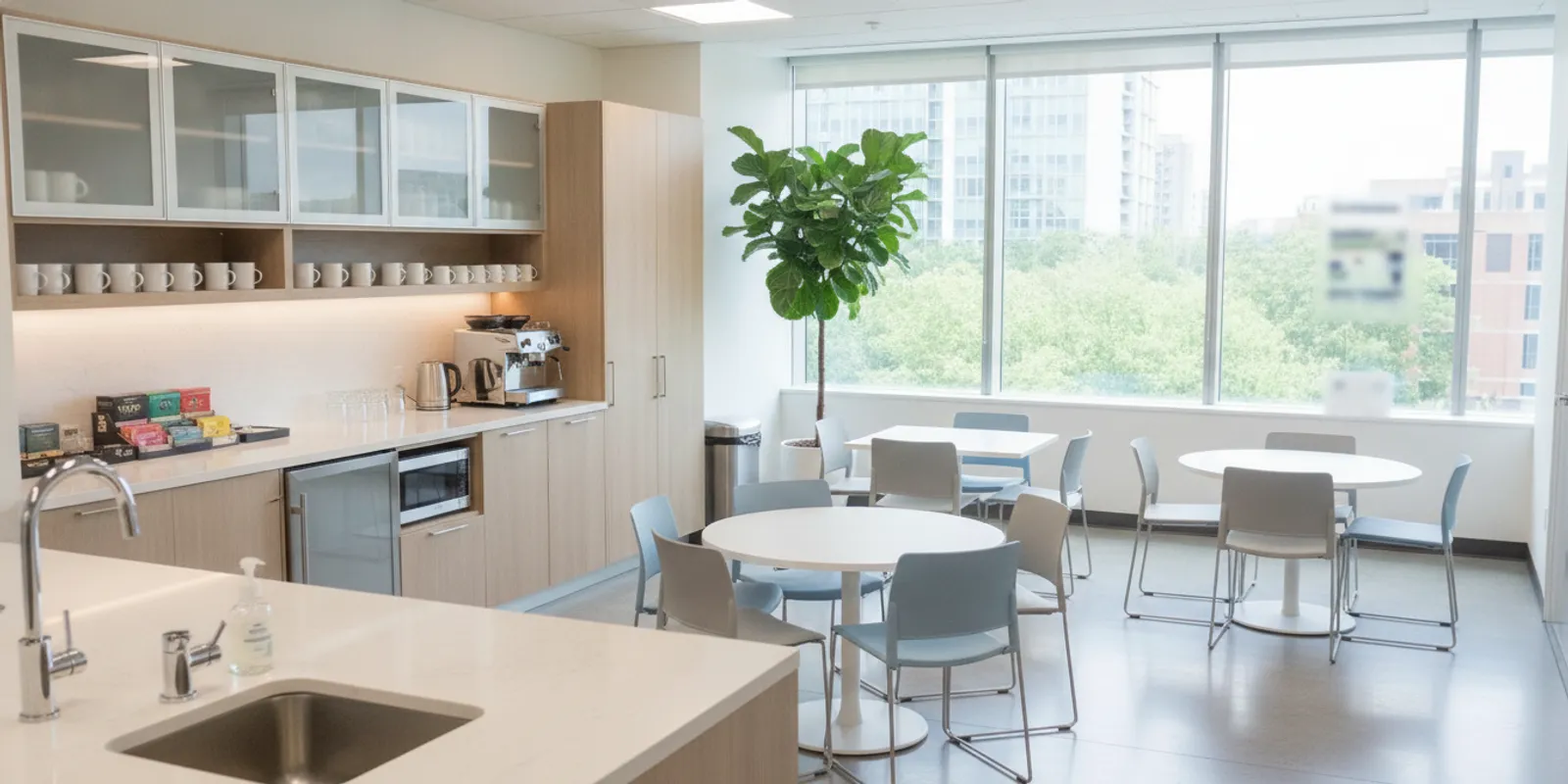
A useful breakroom cleaning plan for offices defines the spaces, touchpoints, task frequency, access, and responsibilities before service begins. It should also account for how employees actually use the room, what surfaces and appliances are present, and which tasks need to happen between scheduled visits. This guide to breakroom cleaning for offices gives facility managers a practical framework for writing a scope that is clear enough to review and flexible enough to adjust.
Discuss a customized breakroom cleaning plan
What should breakroom cleaning for offices cover?
Start by listing every space included in the request. A breakroom might contain a food preparation counter, sink, refrigerator, microwave, vending area, tables, chairs, cabinets, waste and recycling containers, and a floor with a different finish from nearby corridors. A kitchenette in a small suite may need a narrower scope than a shared dining room used by several teams. Naming the spaces and fixtures prevents assumptions about what is or is not included.
Then describe the required result for each surface. For example, specify that counters are wiped, visible residue is removed, the sink and faucet are cleaned, appliance exteriors are wiped, table surfaces are addressed, waste is removed, and the floor is vacuumed or damp mopped as appropriate to its material. If interior appliance cleaning is wanted, define which appliance, what parts, how often, and who removes food or personal items first. Never leave these details to interpretation.
Emory University’s facilities service listing includes daily breakroom tasks such as trash removal, disinfecting sinks and countertops, dusting, damp mopping tile, and vacuuming carpet. This is a useful real-world example of a defined daily task group, not a universal schedule; the right scope for an office depends on room use and the surfaces present. See Emory’s breakroom cleaning description as a reference point when drafting your own task list.
Separate appearance-focused work from sanitation tasks that require a specified product, method, or contact time. Confirm the product is appropriate for the surface and the facility’s safety requirements, and follow its label and applicable site procedures. A general janitorial scope should not imply that it meets a specialized healthcare, laboratory, or regulated-process protocol unless the service and documentation have been specifically designed for that environment.
How can breakroom cleaning for offices be scoped?
Walk the room with the person who owns the facility or service decision. Record the size and layout, the number and type of sinks, counters and appliances, floor materials, nearby waste stations, and any access restrictions. Note if the breakroom connects to a reception area or another shared space, since those areas may need separate scope lines. A quick walkthrough also surfaces constraints such as a locked storage cabinet, limited water access, or a room that is unavailable during meal periods.
Use a room-by-room task list with four fields: location or item, task, frequency, and completion standard. Add a fifth field for ownership when a task is shared between the cleaning provider and employees. For instance, a vendor may wipe the exterior of a refrigerator, while the client sets a process for removing expired food. The scope should state whether inside-appliance work is excluded, scheduled separately, or assigned to a designated employee.
- Surfaces: Identify counters, tables, cabinet fronts, appliance exteriors, handles, and other agreed touchpoints.
- Fixtures: List sink, faucet, backsplash, and any dispenser or vending area that is in scope.
- Floors: State whether the finish calls for vacuuming, sweeping, damp mopping, or periodic floor care.
- Waste: Clarify which bins are emptied, whether liners are replaced, and where collected waste goes.
- Appliances: Distinguish exterior wiping from interior cleaning and spell out who clears contents.
- Exceptions: Define how spills, blocked access, broken fixtures, and supply shortages are reported.
When an organization is considering broader workplace coverage, compare the breakroom scope with its overall commercial janitorial service requirements. This can show whether common areas, nearby corridors, and restrooms belong in the same visit or need a separate schedule. For multiple facility types, the commercial cleaning service overview can help frame the larger scope without treating every room as identical.
Which frequency fits the room’s actual use?
Frequency should follow observed use, not a generic promise that every breakroom needs the same number of visits. Consider how many people use the space, whether meals are prepared there, how quickly waste containers fill, whether staff already manage some tasks, and whether the room serves several shifts. Review the schedule after a change in headcount, occupancy pattern, or room function. A former kitchenette turned into a shared dining area may require different task coverage and timing.
The table below turns those considerations into a starting framework. The daily breakroom task example is drawn from Emory’s published service description; the other cadence suggestions are planning options to test against your site’s use, not a claim that a particular interval is required by a standard.
| Task group | Possible starting frequency | What to define | Planning note |
|---|---|---|---|
| Waste and recycling | Daily on active days, or more often if bins fill sooner | Which bins, liner replacement, collection point, and overflow response | Emory includes daily trash removal in its breakroom example. |
| Sinks and food-contact counters | Daily for routinely used shared rooms; adjust to use and site procedure | Surfaces covered, method, product requirements, and any site-specific precautions | Emory lists daily sink and countertop disinfection. Apply the facility’s own procedures and product instructions. |
| Tables and appliance exteriors | Daily or on scheduled service days, with ownership stated | Tabletops, handles, microwave and refrigerator exteriors; clarify interior work separately | Set a clear boundary between provider tasks and employee responsibilities. |
| Floor care | Routine vacuuming or damp mopping based on finish and use; periodic care as needed | Floor type, method, edges, under movable items, and spill reporting | Emory’s example distinguishes damp mopping tile from carpet vacuuming. |
| Cabinet fronts, walls, and detail work | Periodic, based on visible need and scope | Included surfaces, frequency, access, and whether service is routine or project work | Keep periodic detailing separate from the daily task list so both expectations remain visible. |
Talk through your breakroom service requirements
After the first few weeks, review whether the plan is working. If counters repeatedly need attention before the next visit, assess whether the schedule, task ownership, or employee practices need adjustment. If the room is lightly used and service leaves surfaces untouched, consider a different cadence. Avoid changing frequency based on a single unusual day; look for a recurring pattern and agree on the adjustment with the service contact.
How should employee responsibilities fit the service plan?
A vendor scope cannot resolve every shared-space issue by itself. Establish a simple division of responsibilities. Facility leaders can communicate how employees should label personal food, report a spill, move belongings when needed, and identify a full waste container. The cleaning plan should identify what the service team handles during its visit and what employees or the office coordinator manage between visits.
Be especially precise about food storage and appliance interiors. A cleaning provider should not be expected to decide which food belongs to whom or discard an item without an agreed policy. The client can set a recurring refrigerator-clearout time, post the policy, and name a responsible contact. The service scope can then say whether the provider wipes accessible exterior surfaces only or performs any specifically authorized interior task after the client clears the appliance.
For occupied buildings, timing matters. Coordinate visits with meal periods, room reservations, deliveries, and any security or sign-in process. If daytime attention is important, a day porter service may be worth discussing for ongoing facility support; it is distinct from assuming that a scheduled cleaning visit provides continuous coverage. When the workplace needs a one-time reset in addition to routine tasks, consider whether a separate office deep-cleaning scope is appropriate.
Make exception reporting easy. The plan can name a contact method for blocked access, an overflowing container, a leak, a damaged fixture, or a task that could not be completed. A brief service log can record the date, area, exception, and follow-up owner. Do not ask workers to record personal or sensitive information in a general checklist. Keep records limited to what the facility needs to coordinate work and resolve exceptions.
What should buyers verify about products, training, and documentation?
Ask how the provider will receive and follow the facility’s access, safety, and product requirements. The buyer should identify any restricted products, surface sensitivities, required safety data, storage rules, and site-specific procedures before work starts. Agree on how approved materials are introduced and how a change in product or method is reviewed. The purpose is to make the work predictable and suitable for the room, rather than assuming one approach applies to every facility.
Ask what training applies to the assigned work and how the provider supervises task completion. For an ordinary office breakroom, the relevant questions may concern chemical handling, surface compatibility, access, and service documentation. If the room is part of a healthcare, laboratory, or other controlled environment, ask the facility’s EHS or compliance lead to identify the applicable requirements. Specialized claims should be backed by the appropriate documented procedures, training, and records—not inferred from a general cleaning description.
Foreman Pro Cleaning serves commercial and critical environments in Maryland, Washington, D.C., and Virginia. Its company profile describes proprietary critical-environment training and leadership experience in IT operations and facilities management. A buyer can use a planning discussion to clarify whether a particular breakroom is part of an ordinary office scope or shares requirements with a more controlled facility. Learn more about critical-environment cleaning capabilities if the space is embedded in such an operation.
Request practical documentation rather than broad assurances. Ask for a written room and task list, visit schedule, named escalation path, and a method for recording exceptions or approved scope changes. Clarify who reviews the work, how frequently the plan is checked, and how changes are authorized. If the facility requires particular records, identify them before mobilization and confirm the provider can meet the defined requirement.
Request a breakroom cleaning scope discussion
How can you compare breakroom cleaning proposals?
Compare proposals by matching each one to the same room list and task schedule. A low total is difficult to assess if one proposal includes appliance exteriors and floor care while another excludes them. Ask each provider to state the frequency, service window, included surfaces, exclusions, access assumptions, and process for documenting a missed or blocked task. Keep one-time work separate from recurring service so the difference is clear.
Use these questions during review:
- Does the written scope list every breakroom and the surfaces or fixtures included?
- Are routine tasks and periodic details separated, with a frequency for each?
- Are appliance interiors, refrigerator contents, and employee belongings addressed explicitly?
- Does the schedule reflect occupancy, meal periods, access, and building operations?
- Are product, safety, training, and documentation requirements stated in a way the site can verify?
- Is there a named process for exceptions, scope adjustments, and follow-up?
For a customized proposal, provide the provider with room counts, approximate use patterns, surface types, preferred service windows, access procedures, and any written facility requirements. A site walkthrough can confirm whether the proposed work is realistic and identify adjacent spaces that should be scoped separately. Foreman Pro Cleaning can discuss how breakroom requirements fit a broader Maryland, D.C., and Virginia service plan, or you can review the company’s background and operating approach before contacting the team.
A clear breakroom cleaning plan is specific about tasks, timing, ownership, and verification. Start with what the room contains and how people use it, then document a schedule that can be reviewed as those conditions change. That gives facility teams and service providers a shared basis for consistent work and straightforward follow-up.
What questions do buyers ask about breakroom cleaning for offices?
Should every office breakroom be cleaned every day?
Not necessarily. Daily service can be a useful starting point for heavily used shared rooms, but the right cadence depends on occupancy, food preparation, waste volume, employee responsibilities, and the facility’s own procedures. Review actual use and adjust the written plan when a pattern shows the schedule is not meeting the room’s needs.
Are the inside of appliances and refrigerator cleanouts automatically included?
No. Define these tasks separately. State which appliance interiors are included, how often the work occurs, and who removes food or personal belongings. The client should establish a clear policy for stored food and authorize any disposal or interior work in advance.
What details should a buyer send when requesting a proposal?
Provide a room list, approximate usage, surface and appliance details, desired service window, access procedures, known restrictions, and any required documentation. A walkthrough can resolve unknowns before the final scope is agreed.
Can a general office cleaning plan cover a breakroom in a controlled environment?
It should not be assumed to do so. If the room is part of a healthcare, laboratory, or other controlled operation, have the appropriate facility or compliance lead identify the applicable requirements, then confirm that the scope, training, materials, and records match them.
To discuss a breakroom scope alongside other commercial facility needs, contact Foreman Pro Cleaning with the room details and service priorities you want to review.
A written, use-based plan gives facility leaders and service teams clear expectations to revisit as needs change.
