
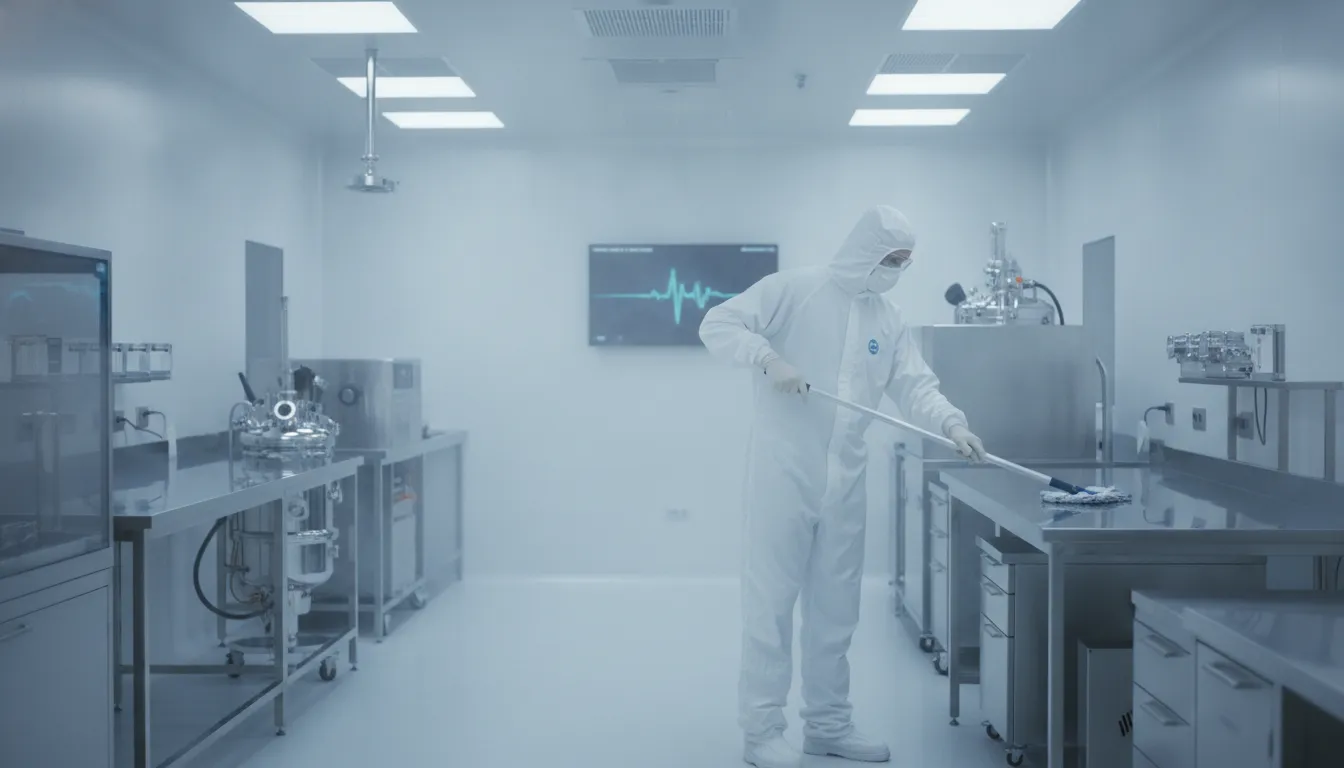
In an FDA-regulated pharmaceutical facility, cleaning is not a cosmetic step performed after production. It is a documented contamination-control activity that protects product quality, equipment integrity, and inspection readiness. Microscopic particulates, residues, and cross-contamination risks must be managed through procedures that can be evaluated, repeated, and defended with evidence.
GMP cleaning applies validated procedures, controlled techniques, and documented verification to reduce contamination risks in pharmaceutical facilities while supporting compliance with FDA current good manufacturing practice requirements.
The FDA identifies contamination or adulteration prevention as the central rationale for requiring clean equipment and expects cleaning processes to demonstrate consistent performance against predetermined specifications. Foreman Pro Cleaning supports critical-environment particulate management with HEPA-filtered vacuum technology and disciplined protocols. Understanding the regulatory purpose of these practices clarifies how cleaning supports pharmaceutical quality assurance.
What Is GMP Cleaning and Why Does It Matter for Pharmaceutical Facilities?
Good Manufacturing Practice (GMP) cleaning is the documented, controlled framework used to maintain pharmaceutical facilities, equipment, and production areas in a condition that protects product quality. For FDA-regulated operations, the framework is grounded in the Current Good Manufacturing Practice regulations in 21 CFR Parts 210 and 211, which the FDA identifies as fundamental to pharmaceutical quality.
This work extends beyond routine sanitation. It encompasses defined cleaning procedures, contamination-control protocols, equipment maintenance, trained personnel, appropriate materials, and records demonstrating that each process was performed as specified. In practice, GMP cleaning and sanitation can account for almost one-third of pharmaceutical production activities, according to an industry overview from GMP SOP. That proportion reflects the operational importance of controlling the environment in which drug products are manufactured.
How Does GMP Cleaning Protect Drug Products?
The central objective is to prevent contaminants, residues, and microorganisms from compromising a product or migrating between manufacturing processes. The FDA explains that validating cleaning processes is necessary to prevent contamination or adulteration of drug products, as documented in its inspection guide for cleaning process validation. A compliant program therefore must be repeatable and supported by evidence, rather than dependent on visual appearance or informal practice.
Effective GMP cleaning also supports inspection readiness. Cleaning methods should reflect the facility’s materials, equipment design, process risks, and contamination pathways. They should establish how particulates and residues are removed, which agents and tools are permitted, and how results are verified and recorded. These controls help facility managers demonstrate that cleaning is part of a systematic quality program, not an isolated service activity.
What Does Critical Environment Expertise Add?
Foreman Pro Cleaning applies critical environment expertise to sensitive facilities, including laboratories and other regulated infrastructure. Its use of critical environment cleaning standards and HEPA-filtered vacuum technology supports particulate management where uncontrolled residue can affect operational integrity. The appropriate approach is tailored to the facility’s contamination risks, access controls, surfaces, and documented procedures. Contact Foreman Pro Cleaning to assess your pharmaceutical facility’s GMP cleaning program.
What Does 21 CFR Part 211 Require for Cleaning and Sanitation?
For pharmaceutical manufacturers, GMP cleaning is not an optional housekeeping activity. It is part of the control framework used to protect product quality, prevent contamination, and support compliance with current good manufacturing practice (CGMP) requirements.
Section 211.67 of Title 21 of the Code of Federal Regulations requires equipment and utensils to be cleaned, maintained, and, where appropriate, sanitized at suitable intervals. The regulation also requires written procedures that define cleaning schedules, methods, materials, and responsibility for execution. These controls apply to production equipment and to associated facilities where residues, particulates, or microorganisms could compromise a drug product.
What does the FDA evaluate during an inspection?
FDA inspection history places particular emphasis on whether cleaning and maintenance controls are effective in practice, not merely whether a written SOP exists. FDA guidance notes that investigators have historically looked for gross insanitation resulting from inadequate equipment cleaning and maintenance or deficient dust-control systems. Such findings can indicate weaknesses in the broader quality system and may raise questions about the reliability of released product.
The regulatory objective is direct: clean equipment reduces the risk of contamination or adulteration. The FDA identifies equipment cleaning as a fundamental element of pharmaceutical quality and explains that cleaning processes must be supported by evidence showing consistent performance. A facility should therefore be able to demonstrate that its procedures are scientifically justified, appropriately implemented, and reviewed when equipment, products, chemicals, or operating conditions change.
How should facilities address cross-contamination risk?
Cleaning controls should begin with a documented risk assessment. The assessment should consider product characteristics, toxicological or potency concerns, equipment design, shared surfaces, hard-to-clean locations, cleaning-agent residues, and the potential movement of contaminants between processing areas. In an FDA Warning Letter discussed by the ECA Academy. The agency required a risk assessment of inspection findings for their potential to cause cross-contamination and affect product quality. This illustrates why an isolated cleaning deviation cannot be evaluated without considering the products, equipment, and processes involved.
Validated procedures, defined acceptance criteria, inspection and testing methods, and complete records provide the evidence needed to show that controls remain effective. Foreman Pro Cleaning approaches critical-environment work through systematic contamination control, including HEPA-filtered vacuum technology for particulate management where appropriate. The service provider does not replace the manufacturer’s quality unit, but disciplined execution can support the facility’s established CGMP procedures and inspection readiness.
Read the FDA’s cleaning validation inspection guidance for the agency’s discussion of equipment cleanliness, contamination prevention, and cleaning-process expectations.
How Are Cleaning Protocols Validated in GMP Environments?
Validation is the evidence-based process that demonstrates a cleaning system can repeatedly control contamination and residue under defined operating conditions. A written procedure alone is not sufficient. The FDA Validation Guide for Cleaning Processes emphasizes that scientific data must show the system consistently meets predetermined specifications.
- Identify contamination risks. Begin with a documented assessment of equipment surfaces, product residues, cleaning agents, and areas where materials may accumulate or transfer between production cycles. The risk assessment should account for difficult-to-access components and the possibility of cross-contamination. The FDA cites a 1988 finished-drug recall in which cross-contamination was believed to result from the reuse of recovered solvents. Illustrating why equipment controls and cleaning procedures must be evaluated together.
- Establish acceptance criteria. Define residue limits before testing begins. Criteria should specify what level of product residue, cleaning-agent residue, or other contaminant is acceptable on relevant equipment surfaces. These predetermined specifications provide the objective standard for deciding whether a procedure is effective, rather than allowing test results to determine the standard after the fact.
- Develop and qualify the cleaning procedure. Select the sequence, chemistry, contact conditions, mechanical action, and rinsing controls needed to address the identified risks. Qualification should be supported by scientific rationale and data showing that the procedure can achieve its acceptance criteria under representative conditions. Equipment design, material compatibility, and the most challenging residue should be considered during this stage.
- Execute the validation protocol. Follow an approved protocol and collect representative samples from locations most likely to retain residue. Swab and rinse sampling can provide complementary evidence. Analytical methods must be appropriate for the residue and validated for their intended use. The FDA specifically asks whether Total Organic Carbon (TOC) can be an acceptable method for detecting residues when evaluating cleaning effectiveness. Where applicable, TOC analysis can supplement targeted methods in assessing residual contamination.
- Document results and maintain ongoing verification. Record sampling locations, methods, analytical results, deviations, and conclusions. Residue quantification on equipment surfaces must be evaluated against the established limits, as the FDA explains in its equipment-cleaning guidance. Continued verification should monitor whether the procedure remains effective as products, equipment, personnel, or operating conditions change. Foreman Pro Cleaning can support contamination-control programs with HEPA-filtered vacuum technology for critical-environment particulate management.
A defensible GMP cleaning program therefore connects risk assessment, measurable limits, qualified procedures, analytical evidence, and continuing oversight. Each element should be traceable in the facility’s controlled documentation.
Which Cleaning Agents Are Approved for GMP Pharmaceutical Facilities?
Approval is not determined by a product label alone. In a GMP environment, the cleaning agent must be compatible with the surface, effective against the relevant contaminant, controlled for residue, and supported by a documented validation protocol. The selected chemistry should also rinse completely away without leaving an odor, film, or other residue that could compromise subsequent production.
The FDA identifies Total Organic Carbon (TOC) as an acceptable method for detecting contaminant residues when evaluating cleaning effectiveness. That makes residue behavior a measurable part of agent selection, not merely a matter of operator preference. FDA guidance on TOC and equipment cleaning also reinforces the need to evaluate residue on equipment surfaces against predetermined limits.
| Agent Type | Primary Application | Residue Profile | Common Validation Method | Frequency of Use |
|---|---|---|---|---|
| Pharmaceutical-grade detergents | Removal of process soils, oils, and product residues from equipment and controlled surfaces | Low-residue formulation; must be demonstrated to rinse completely | Visual inspection, swab or rinse sampling, and TOC where applicable | Routine cleaning after production or as defined by the validated SOP |
| Sterile disinfectants | Reduction of viable microorganisms on qualified cleanroom and laboratory surfaces | Residue depends on formulation; compatibility and post-application residue require verification | Surface compatibility review, microbial monitoring, and documented contact-time verification | Scheduled rotation or application based on the facility’s contamination-control program |
| Sporicidal agents | Targeted control of bacterial and fungal spores during a defined remediation or rotation protocol | May be more chemically aggressive; rinse requirements and material compatibility must be assessed | Challenge or environmental monitoring data, contact-time verification, and residue assessment | Periodic or event-driven use, according to risk assessment and validated procedures |
| Validated rinse agents | Final removal of detergent or disinfectant residues from equipment and process-contact areas | Designed for controlled removal; acceptance limits must be established in the protocol | Rinse sampling, TOC analysis, and comparison with predetermined residue limits | Used when required by the validated cleaning cycle, equipment design, or chemistry |
Foreman Pro Cleaning applies EPA-registered disinfection protocols within a broader contamination-control framework. For pharmaceutical operations, facility leaders can also review Foreman Pro’s pharmaceutical facility cleaning services and confirm that agent selection, application, rinsing, and verification align with site-specific GMP documentation.
What Documentation Is Required for GMP Cleaning Compliance?
In a regulated pharmaceutical facility, a completed cleaning task is not sufficient evidence of control. Documentation must show what was cleaned, how the procedure was performed, which production activity it supported, and whether the result met the approved requirements. These records create a traceable connection between contamination control and product quality.
Which Written Procedures Should Be Maintained?
Each cleaning activity should have a controlled standard operating procedure (SOP) that identifies the equipment or area. Approved cleaning agents, required tools, sequence of work, frequency, responsible personnel, and acceptance criteria. The SOP should also define how residues, contaminants, and unexpected conditions are handled. Procedures must be current, authorized, and available to the personnel performing the work. This supports the FDA’s expectation that equipment be maintained in a clean and orderly manner under 21 CFR 211.67, with the underlying rationale of preventing contamination or adulteration. FDA cleaning validation guidance provides the regulatory context.
How Should Cleaning Records Connect to Production?
Batch or production records should identify the cleaning event associated with the relevant equipment, room, or production run. A complete entry typically records the date and time, location or asset identifier, personnel, procedure version, cleaning agent or material used, inspection result, and reviewer approval. This traceability allows investigators to determine whether equipment was appropriately cleaned before use and whether a potential contamination event affected a defined production period.
What Must Deviation Reports and Audit Trails Show?
Any missed step, failed inspection, out-of-range result, equipment condition, or undocumented interruption should be recorded through a deviation process. The investigation should explain the event, assess potential product or cross-contamination impact, document corrective action, and show final disposition. In an FDA Warning Letter, authorities have required a documented risk assessment addressing the potential for cross-contamination and its effect on product quality. The ECA Academy summary of FDA expectations illustrates why risk assessment records matter during inspection.
Audit trails should preserve who created, changed, reviewed, or approved an electronic record, along with the date, time, and reason for any change. Foreman Pro Cleaning applies systematic contamination control protocols and provides validated cleaning documentation intended to support regulatory audits. Organizations can review their critical environment cleaning standards when evaluating outsourced support.
How Do Facility Design, Zoning, and Airflow Affect GMP Cleaning?
Facility design determines whether GMP cleaning can consistently control microscopic particulates, residue, and cross-contamination. A cleaning program cannot compensate for poorly controlled movement, unsuitable finishes, or airflow that carries contaminants from a lower-control area into a higher-control space. Pharmaceutical facilities should therefore align cleaning procedures with cleanroom classification, room pressure, personnel flow, and material flow.
How Do Cleanroom Classifications Set Cleaning Expectations?
ISO 14644-1 classifications establish allowable airborne particle concentrations, with commonly referenced environments ranging from Class 10 through Class 100,000. The classification affects the level of particulate control, filtration, protective equipment, and cleaning verification required. A Class 100,000 room does not carry the same risk profile as a higher-class cleanroom. So the frequency and method of HEPA-filtered vacuuming, surface cleaning, and post-cleaning inspection must be matched to the room’s classification and process.
Cleanroom distinctions also affect air-exchange expectations. The facility guidance supplied for this program notes that Class 100,000 environments may filter air approximately every 10 minutes. While higher classifications may cycle filtered air every few seconds. These figures should be confirmed against the facility’s validated environmental-control specifications rather than treated as a universal operating rule. Cleaning personnel must understand the specified particle limits before selecting tools, garments, entry procedures, and cleaning sequences.
Why Do Zoning and Airlocks Matter to Contamination Control?
EU GMP Annex 1 uses Grade A, B, C, and D zones to distinguish levels of contamination-control risk. The zoning plan should separate activities by risk and prevent uncontrolled movement between areas. Material airlocks provide a controlled transition for supplies and equipment, while personnel airlocks support gowning, degowning, and staged entry. Cleaning routes should move from lower-risk areas toward higher-control areas, with dedicated or appropriately decontaminated equipment for each zone.
Pressure differentials reinforce that separation by directing airflow away from cleaner spaces or toward designated containment areas, depending on the process design. Doors, pass-throughs, and airlocks must remain consistent with the validated pressure cascade. A cleaning team that leaves doors open, stages supplies in the wrong zone, or carries equipment across incompatible classifications can undermine the facility’s contamination-control strategy.
How Do Airflow and Room Finishes Influence Cleaning Results?
Laminar or unidirectional airflow is designed to move filtered air in a controlled pattern. Whereas turbulent airflow mixes room air and can redistribute particulates if cleaning methods are poorly sequenced. Personnel should work in a way that does not obstruct critical airflow paths. And vacuuming or wiping should avoid driving residue toward exposed product, process equipment, or return-air pathways.
Smooth, non-porous, chemically compatible finishes reduce areas where residue can accumulate and make visual inspection and disinfection more reliable. Foreman Pro Cleaning applies HEPA-filtered vacuum technology for particulate management in sensitive environments. Organizations evaluating pharmaceutical facility cleaning services should require documented procedures that connect the building layout, classification, airflow controls, protective equipment, and cleaning verification into one contamination-control program.
Frequently Asked Questions
What is GMP cleaning?
GMP cleaning is the controlled cleaning of pharmaceutical facilities, equipment, and associated surfaces using documented procedures designed to prevent contamination or adulteration. In FDA-regulated operations, those procedures must be supported by validation evidence showing that they consistently meet predetermined specifications. See the FDA cleaning validation guidance.
What are the three types of cleaning in pharmaceutical facilities?
Facilities commonly distinguish routine cleaning, changeover or product-to-product cleaning, and corrective or deep cleaning. The appropriate method depends on the surface, process residue, contamination risk, equipment design, and required release criteria. A compliant program defines the procedure, responsible personnel, approved agents, acceptance limits, verification method, and required records for each use case.
Why is GMP cleaning important for pharmaceutical facilities?
It reduces the risk that chemical residues, microorganisms, or microscopic particulates compromise product quality. FDA inspection guidance identifies inadequate cleaning and equipment maintenance as potential causes of gross insanitation. While current good manufacturing practice requirements establish cleaning as part of pharmaceutical quality control. Facilities should therefore treat cleaning as a validated contamination-control activity, not a cosmetic service.
What does the GMP cleaning process involve?
The process typically begins with a risk assessment of equipment, rooms, materials, and likely contamination pathways. Trained personnel then follow an approved procedure, use compatible cleaning agents and tools, document each step, and verify results through visual inspection or analytical testing when required. Validation should demonstrate consistent performance, and residue evaluation may be part of the acceptance decision.
Can Total Organic Carbon testing support cleaning verification?
Yes. The FDA identifies Total Organic Carbon, or TOC, as an acceptable method for detecting contaminant residues when evaluating cleaning effectiveness in appropriate circumstances. TOC is not automatically suitable for every process, so the facility must establish scientifically justified sampling plans, limits, and test methods within its validation program. Review the FDA equipment-cleaning questions and answers for regulatory context.
Ready to Schedule a Pharmaceutical Facility Cleaning Assessment?
A focused assessment can help your team align cleaning practices with facility-specific contamination control objectives, documentation expectations, and GMP requirements. Foreman Pro Cleaning can review your pharmaceutical environment and discuss a cleaning approach suited to your operational and compliance priorities. To schedule a pharmaceutical facility cleaning assessment, contact Foreman Pro Cleaning about pharmaceutical facility cleaning services.
