
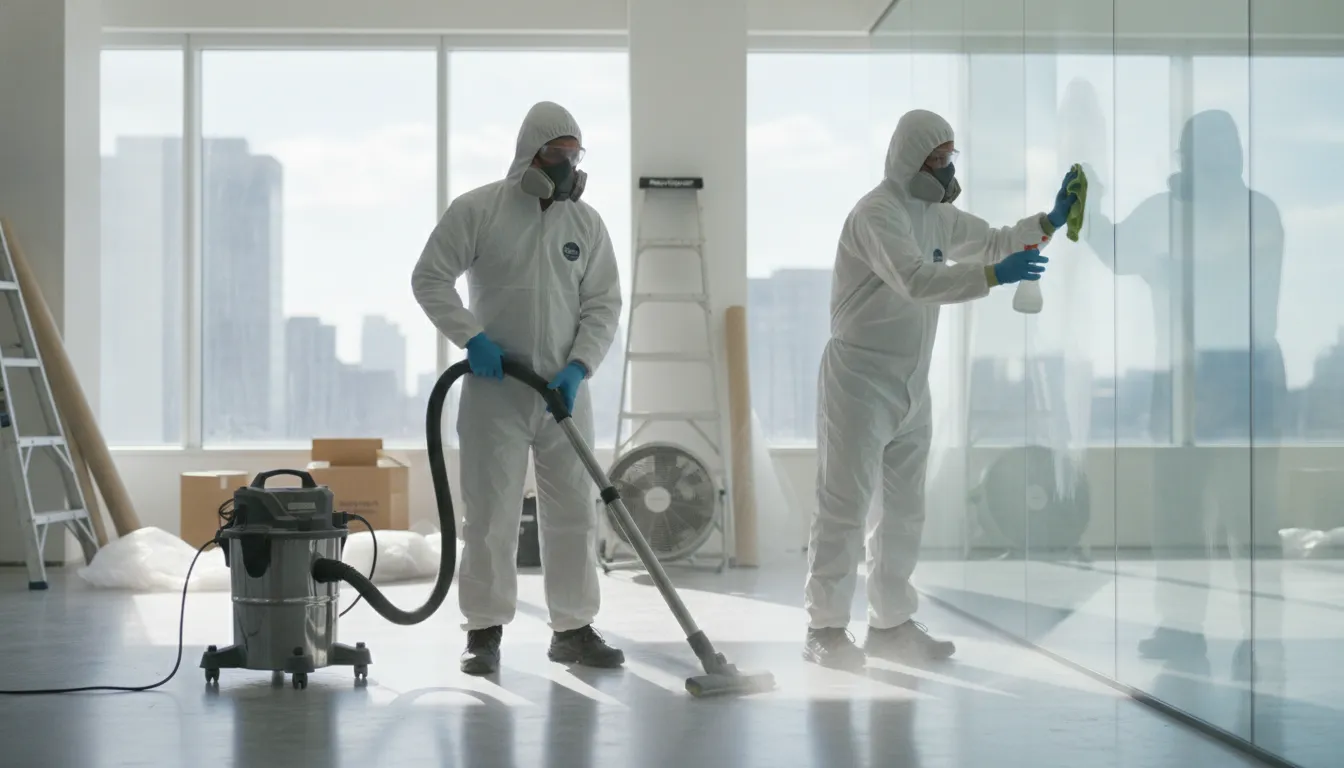
A commercial build-out is not ready for handover when the trades leave. Fine particulate, adhesive residue, packaging, and construction debris can remain on finished surfaces, within floor systems, and around HVAC components. The final cleaning plan must account for the building’s materials, project phase, safety requirements, and occupancy timeline.
Construction cleaning services move a commercial property from active construction to a ready-to-occupy condition through customized debris removal, detailed dusting, hard floor care, surface detailing, and particulate management. The scope should reflect the site, not a generic checklist, particularly when renovations affect medical offices, data centers, laboratories, or other sensitive environments.
Foreman Pro Cleaning develops site-specific protocols for commercial properties across Maryland, Washington, D.C., and Virginia, with rapid deployment during completion phases. That approach helps project managers, property owners, and facility teams coordinate a cleaner handover while protecting new finishes and supporting operational continuity. The first step is understanding what the work includes at each stage of a commercial build-out.
Request a construction cleaning site assessment for your commercial build-out and get a phased cleaning plan matched to your handover timeline.
What Does Construction Cleaning Include for a Commercial Build-Out?
Construction cleaning moves a commercial space from active build-out conditions toward a controlled, ready-for-occupancy environment. The scope is customized to the site, materials, schedule, and handover requirements rather than copied from a generic checklist. Foreman Pro Cleaning plans each phase around the work remaining and the surfaces requiring protection.
How are the cleaning phases structured?
Most commercial projects benefit from three coordinated passes. Rough cleaning addresses larger debris and packaging after major installations. Mid-phase cleaning controls accumulated particulate as trades complete their work. Final cleaning prepares visible surfaces and operational areas for the owner walkthrough, inspection, or tenant move-in.
| Phase | Primary purpose | Typical task scope |
|---|---|---|
| Rough cleaning | Clear the work zone | Remove construction debris, packaging, protective coverings, and larger residual materials. Sort recoverable materials for appropriate recycling or disposal in line with EPA construction and demolition debris guidance. |
| Mid-phase cleaning | Control particulate accumulation | Perform detailed dusting on ledges, millwork, doors, frames, and exposed surfaces. Address HVAC grilles and louvers so construction particulates do not remain in distribution areas. Coordinate hard floor care as finishes are completed. |
| Final cleaning | Prepare for handover | Detail windows, glass, fixtures, trim, floors, and touchpoints. Remove remaining residue, inspect corners and high surfaces, and document items requiring correction before the final walkthrough. |
What areas require the most technical attention?
Fine dust often settles above eye level and inside louvers, returns, grilles, and other air-handling interfaces. Professional post-construction cleaning helps keep HVAC systems free of construction dust and particulates, supporting a more controlled turnover. The cleaning plan should also account for newly installed hard floors, where the correct care method depends on the finish and manufacturer requirements.
Window frames, interior glass, light fixtures, cabinets, hardware, and restroom fixtures need separate detailing because residue can remain after general debris removal. A final walkthrough verifies that visible surfaces, concealed edges, and access areas meet the agreed handover standard. This phased approach gives general contractors, property managers, and facility teams a clear basis for resolving deficiencies before occupancy.
Why Do Commercial Build-Outs in MD, DC & Virginia Need Construction Cleaning Services?
Commercial build-outs create more than visible debris. Cutting, grinding, and drilling concrete or stone can release respirable crystalline silica, a serious health hazard that requires deliberate exposure controls. OSHA’s construction standard, 29 CFR 1926.1153, requires employers to limit worker exposure. The standard applies to construction work, including renovation and build-out activities, unless exposure remains below 25 micrograms per cubic meter of air, according to OSHA’s construction guidance.
Professional construction cleaning services support that safety plan by addressing the residual particulate load after trade work is complete. This is not a substitute for a contractor’s engineering controls, respiratory protection program, or site-specific hazard assessment. It is a specialized cleaning phase that helps remove settled material from floors, ledges, fixtures, and other surfaces before employees, tenants, or visitors occupy the space.
How Does Particulate Management Protect a New Commercial Space?
Fine construction particulates can migrate through a building during sanding, drilling, drywall work, and material handling. Without controlled removal, dust may collect inside HVAC components, spread through return-air pathways, or settle on newly installed finishes. Foreman Pro Cleaning uses customized plans for the site’s conditions, with detailed dusting, hard floor care, debris removal, and contamination-control protocols. Thorough post-construction cleaning helps keep HVAC systems free of construction-related dust and particulates, protecting indoor operations and reducing avoidable maintenance concerns.
The risk is especially significant in medical offices, laboratories, data centers, and other sensitive environments. New equipment and finished surfaces may require controlled methods rather than routine janitorial treatment. Cleaning personnel with critical-environment training can account for access restrictions, surface sensitivity, airflow, and the consequences of introducing contaminants into an operational area.
Why Does Debris Management Affect Safety and Project Readiness?
The scale of construction waste makes disciplined removal essential. The EPA reports that the United States generated about 600 million tons of construction and demolition debris in 2018, more than twice the mass of municipal solid waste generated that year. Commercial teams need a plan for collecting, sorting, recycling where appropriate, and safely disposing of remaining materials.
A controlled site also reduces slip and trip hazards while crews complete punch-list work. In Maryland, Washington, D.C., and Virginia, rapid coordination during the final project phases can help prevent cleaning conditions from becoming an inspection obstacle. A site-specific cleaning plan gives owners and general contractors a clearer path toward final inspection, handover, and occupancy without compromising newly installed surfaces or sensitive equipment.
When Should Building Owners and General Contractors Schedule Construction Cleaning?
Construction cleaning should follow the build-out schedule, not wait until every trade has left the property. A phased plan controls particulates, supports safer movement through the site, and gives the general contractor a cleaner path to inspection and turnover. The right timing depends on project milestones, access, finish installation, and the building owner’s handover requirements. Foreman Pro Cleaning develops construction cleaning services that adapt to phased completion across Maryland, Washington, D.C., and Virginia.
-
Schedule rough or pre-construction cleaning after major installation work. Once framing, mechanical, electrical, and other high-impact work reaches an appropriate milestone, remove larger debris and address accumulated construction residue before subsequent trades complete sensitive surfaces. This phase establishes workable conditions for the remaining build-out. The scope should reflect the site’s actual risks and requirements rather than rely on a one-size-fits-all checklist. A site-specific plan also helps teams identify areas requiring controlled access or additional particulate management.
-
Schedule mid-construction cleaning as the project advances by zone or floor. Mid-phase service is useful when portions of a commercial project reach substantial completion while other areas remain active. Cleaning crews can work behind completed trades, maintaining access routes and reducing the transfer of construction residue into finished spaces. Coordinate each visit with the general contractor’s look-ahead schedule, material deliveries, and trade sign-offs. This approach keeps cleaning aligned with the progress of construction phases, from rough work through final cleaning, as required by the site’s evolving conditions (Foreman Pro Cleaning service guidance).
-
Schedule final construction cleaning before inspection, TCO, and owner turnover. Final service belongs after dusty installation and punch-list work are substantially complete, but before the occupancy date. The team can then perform detailed surface cleaning, hard-floor care, fixture detailing, debris removal. And final presentation work without immediately repeating the process after another trade enters the space. Build in enough time for a walkthrough and corrective pass. Regular construction cleaning helps prevent hazards that could delay final inspections and occupancy (Foreman Pro Cleaning project guidance).
For accelerated completion schedules, involve the cleaning provider before the final phase begins. Rapid deployment may be necessary when inspection dates, tenant move-ins, or owner acceptance deadlines are close. Foreman Pro Cleaning supports construction project completion phases throughout MD, D.C., and Virginia, coordinating the work around the handover rather than treating cleaning as an afterthought.
How Do Construction Cleaning Services Differ from Routine Janitorial Cleaning?
Routine janitorial cleaning maintains an occupied facility through recurring tasks such as waste removal, restroom care, floor maintenance, and surface cleaning. Construction cleaning services address a different operating condition. They transition a commercial build-out or renovation from an active work zone to a controlled, ready-to-occupy environment.
The distinction is not simply the amount of labor involved. Construction work leaves fine particulate, adhesive residue, packaging, joint compound, and material debris across surfaces that routine custodial checklists may not identify or manage correctly. Foreman Pro Cleaning builds a site-specific plan around the project phase, finish materials, access conditions, and contamination risks. That approach supports detailed dusting, hard floor care, and debris removal without treating a complex handover like an ordinary nightly service.
| Consideration | Construction cleaning | Routine janitorial cleaning |
|---|---|---|
| Scope | Detailed particulate removal, debris handling, fixture and finish detailing, hard floor care, and preparation for inspection or handover. | Recurring maintenance of established workspaces, common areas, restrooms, and routine waste streams. |
| Equipment | HEPA-filtered vacuums and specialized tools selected for fine particulate management and sensitive finishes. | Standard vacuums, microfiber systems, floor equipment, and other tools suited to normal facility maintenance. |
| Specialized training | May require construction protocols and CET (Critical Environment Training) for high-stakes or sensitive environments. | Training is generally centered on recurring custodial procedures and facility service standards. |
| Contamination intensity | Variable and often elevated, with fine dust, material residue, and debris requiring targeted controls. | More predictable contamination generated by normal occupancy and daily operations. |
| Timeline | Project-based and milestone-driven, often requiring rapid deployment near inspections, turnover, or occupancy. | Recurring schedule, typically daily, weekly, or otherwise established in a service plan. |
For sensitive facilities, particulate management also protects operational continuity. Foreman Pro Cleaning leverages CET for complex projects where basic custodial service is not sufficient. The company’s customized model reflects the specific construction site rather than relying on a one-size-fits-all checklist.
Project teams evaluating providers can choose a post-construction cleaning company based on scope, controls, training, and handover readiness. When the need is limited to a defined project rather than recurring service, one-off commercial construction cleaning may provide the appropriate structure.
How Much Does Construction Cleaning Cost and What Drives the Price?
Construction cleaning pricing is rarely a simple rate multiplied by square footage. Commercial property managers, general contractors, and facility teams are paying for a defined scope of work. The labor required to complete it, and the risk involved in preparing the space for handover. Commercial facilities often need post-construction cleaning that adheres to tight project timelines, so scheduling and site access can affect the proposal as much as the building size. Foreman Pro Cleaning develops the scope around the actual conditions in the Maryland, Washington, D.C., or Virginia facility.
Which site conditions influence the scope?
Square footage is an important starting point, but it does not describe the entire assignment. A large, open office with completed finishes may require a different labor plan than a smaller medical suite with multiple rooms, fixed equipment, and protected surfaces. The build-out type also matters. New construction, renovation, tenant improvement, and post-installation cleanup can produce different combinations of fine particulate, adhesive residue, packaging, and construction debris.
Building condition is another major variable. A site that has been maintained between project phases may need less restorative work than one where several trades have worked without an interim cleaning plan. The contamination level, access to floors and mechanical areas, elevator availability, water and power access, and finish sensitivity all influence the work sequence. Specialized areas, such as server rooms or laboratories, may require more controlled procedures than ordinary commercial areas.
The cleaning phase also changes the estimate. Rough cleaning may focus on removing larger debris and preparing the site for continued trade work. Intermediate cleaning can address accumulated particulate and help keep completed areas orderly. Final cleaning requires detailed surface work, fixture attention, floor care, and inspection readiness. Because each phase has a different purpose, a single flat description can conceal important differences in labor and deliverables.
How can construction cleaning deliver a measurable return?
A thorough scope can prevent avoidable rework. Removing construction residue before final inspection reduces the chance that finishes, fixtures, or visible surfaces need additional correction after the cleaning crew has left. A clean construction site also supports safer movement by reducing slip and trip hazards, according to the customer’s construction-cleaning guidance. This safety-focused approach helps project teams address conditions before handover.
Particulate control can also protect newly installed HVAC components and finished surfaces from construction-related residue. That matters when the building is moving directly from project completion into occupancy. An organized cleaning plan may help the team complete inspection preparation sooner, identify remaining punch-list issues earlier, and avoid paying for repeated mobilizations.
Why is a site assessment important before pricing?
Professional construction cleaning services are commonly quoted after a site assessment or a detailed review of drawings, photographs, access conditions, and the project schedule. The proposal should identify the areas included, the cleaning phase, the expected deliverables, exclusions, disposal responsibilities, and any special contamination-control requirements. Ask for a phased scope when the project will not reach completion at one time. That approach gives the contractor a clearer basis for staffing and gives the project team a more reliable path from construction activity to final inspection and occupancy.
How Long Does Construction Cleaning Take for a Commercial Space?
There is no reliable single-day estimate for every commercial project. The schedule depends on the building’s square footage, the amount of residual dust and debris. The number of rooms, the finish level, and the condition of the site when cleaners arrive. A 10,000-square-foot office with open floor plates may move faster than a smaller medical or retail space divided into numerous rooms with detailed millwork, glass, flooring, and fixtures.
The type of project also changes the scope. A new build-out may require removal of construction residue throughout a mostly empty space. A renovation can take longer when existing occupants, furnishings, protected areas, or active building systems limit access. Sensitive environments may require more controlled particulate management before equipment or staff can return.
Which project factors affect the timeline?
- Square footage: More floor area generally means more surfaces to vacuum, dust, detail, and inspect. The layout matters as much as the total size.
- Residual material: Drywall dust, adhesive residue, packaging, tracked-in debris, and construction waste each require different handling protocols.
- Rooms and finishes: A space with many offices, restrooms, glass partitions, hard floors, cabinetry, and fixtures needs more detail work than a simple shell.
- Build-out versus renovation: Renovations often require coordination around retained furnishings, occupied areas, utilities, and newly installed materials.
- Access and readiness: Cleaning cannot proceed efficiently while trades are still creating dust, punch-list work is incomplete, or materials block surfaces.
How do rough and final cleaning change the schedule?
Many commercial projects use phased construction cleaning. Rough cleaning addresses larger debris and accessible construction residue while work continues. Mid-phase service can support progressive completion. Final cleaning follows the last major trade activity and focuses on detailed dusting, hard floor care, fixtures, glass, touchpoints, and handover presentation. Foreman Pro Cleaning builds the plan around the site’s actual requirements rather than applying a one-size-fits-all checklist, as its service model explains at Foreman Pro Cleaning.
For a commercial build-out that is genuinely ready for final service, completion is usually measured in days rather than weeks. That expectation still requires a site assessment. A large, heavily impacted building or a renovation with restricted access may need multiple mobilizations, while a prepared 10,000-square-foot space may be completed more quickly. The schedule should be tied to the general contractor’s punch list, inspection dates, certificate-of-occupancy milestones, and planned handover.
Because final construction phases are time-sensitive, rapid deployment can be important across Maryland, Washington, D.C., and Virginia. Foreman Pro Cleaning supports completion-phase work with customized construction cleaning services designed to keep handover timelines visible and achievable. Request a site assessment through the contact page so the scope, crew plan, and target completion window can be matched to the project.
How Do You Prepare a Commercial Site for Final Construction Cleaning?
Final construction cleaning works best when the site is ready for controlled access, detailed particulate management, and a documented closeout review. Building owners and general contractors should treat preparation as part of the handover process, not as a last-minute request for custodial support. Foreman Pro Cleaning builds customized plans around the site’s finishes, equipment, access conditions, and completion schedule rather than relying on a one-size-fits-all checklist. That customized approach supports commercial build-out handover requirements.
Begin by establishing a clear turnover boundary. The construction team should remove tools, unused materials, packaging, loose debris, and personal items from every area scheduled for cleaning. Leaving these items in place can conceal surfaces, restrict floor access, and force the cleaning crew to work around avoidable obstacles. Confirm that trades have completed cutting, drilling, sanding, and installation work before final detailing begins.
What should the site team confirm before cleaners arrive?
- Clear the work areas: Remove tools, ladders, scrap materials, temporary coverings, and personal belongings. Consolidate remaining materials outside the final-cleaning zone.
- Protect completed finishes: Identify newly installed flooring, millwork, glass, fixtures, coatings, and other sensitive surfaces. Keep required protective coverings in place until the cleaning plan confirms their safe removal.
- Secure sensitive equipment: Identify data equipment, controls, laboratory assets, medical devices, and other operational systems. Establish exclusion zones and approved cleaning protocols before work begins.
- Coordinate utilities: Confirm safe access to lighting, water, electrical power, and ventilation. A properly illuminated space allows technicians to identify residue and surface defects during inspection.
- Define access controls: Provide keys, badges, loading instructions, elevator rules, parking details, and an on-site contact. Clarify occupied areas and restricted rooms.
- Prepare the walkthrough list: Mark high-priority areas, including entrances, corridors, restrooms, kitchens, stairwells, glass, flooring transitions, and rooms receiving early occupancy.
- Create a punch list: Record outstanding construction items separately from cleaning items. The cleaning team can then verify completion, document exceptions, and return to defined areas when corrections are finished.
Owners and contractors should schedule a pre-clean walkthrough with the cleaning provider, project superintendent, and facility representative. This review aligns expectations about dust removal, hard floor care, fixture detailing, waste handling, and equipment protection. It also identifies conditions that could prevent safe or efficient work, such as incomplete utilities or active trades.
Preparation cannot replace a thorough final service, but it removes preventable delays. Regular construction cleaning protocols help reduce hazards that can interfere with final inspections and occupancy. A documented, site-specific plan helps move the project toward a cleaner and more predictable handover.
Reach out to Foreman Pro Cleaning for a pre-FAQ construction cleaning walkthrough and schedule final detailing before your occupancy date.
Frequently Asked Questions
What does construction cleaning include?
Construction cleaning typically includes removal of remaining construction debris, detailed dusting, surface detailing, hard floor care, and preparation for final inspection or handover. The scope may also include cleaning fixtures, interior glass, restrooms, and accessible HVAC surfaces that collected construction particulates. A site-specific plan is important because build-outs, renovations, and finished construction leave different materials and cleaning risks.
How should construction cleanup be priced?
Pricing should reflect the square footage, construction phase, surface types, debris volume, contamination level, access conditions, and required completion date. A professional assessment can separate rough, mid-phase, and final cleaning requirements rather than applying one generic rate. The estimate should also identify whether specialized particulate management, hard floor treatment, or repeated mobilizations are necessary.
How long does it take to clean a 10,000-square-foot building?
There is no reliable duration based on square footage alone. A 10,000-square-foot space may require different labor and sequencing depending on the build-out condition, finish quality, debris volume, utilities, and punch-list status. Commercial cleaning is often scheduled in phases, with a final pass after trades leave. Early coordination helps align cleaning with inspection and occupancy deadlines.
When should construction cleaning be scheduled?
Schedule the cleaning plan during project planning, then confirm each mobilization against construction milestones. Rough cleaning can follow major installation work, mid-phase cleaning can control accumulated particulates, and final cleaning should occur after substantial completion and before handover. In Maryland, Washington, D.C., and Virginia, early scheduling also supports rapid deployment during compressed project closeout periods.
Ready to Put Your Commercial Build-Out on a Clean Handover Schedule?
Construction cleaning services are the final project phase that protects your investment, your new finishes, and your timeline. A professional crew removes residual dust, debris, and contaminant risk so your space is inspection-ready and occupant-ready on day one.
Foreman Pro Cleaning builds a customized construction cleaning plan around your site’s scope, finishes, and occupancy date. Whether you are finishing an office build-out, a retail space, a medical facility. Or a critical environment, we align the work with your handover milestones across Maryland, Washington, D.C., and Virginia.
Request a construction cleaning site assessment at Foreman Pro Cleaning and get a cleaning plan matched to your project phase.
