
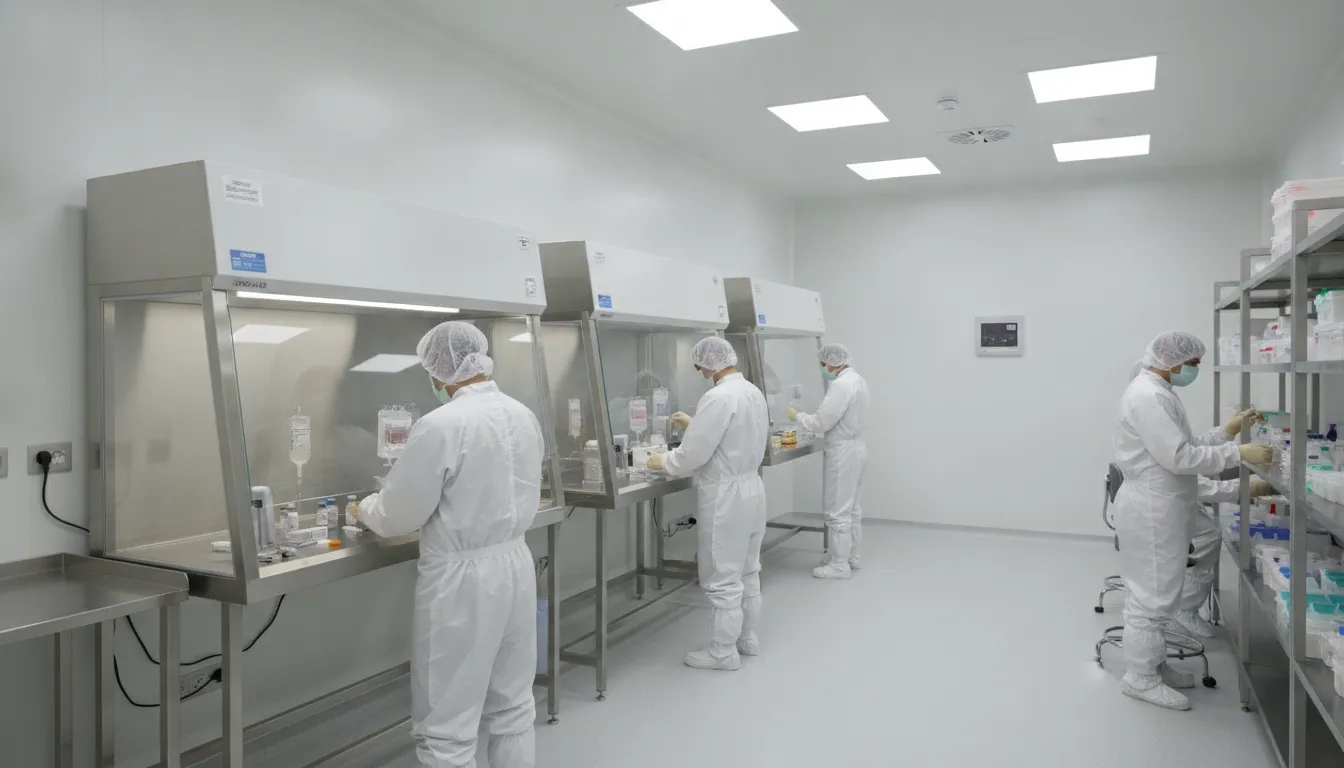
Cleanroom environments for sterile compounding must meet rigorous particulate and microbial control standards to prevent life-threatening contamination. Regulatory oversight makes compliance a critical operational requirement for every pharmacy facility. Schedule a consultation with Foreman Pro Cleaning to evaluate your facility’s compliance with USP 797 cleanroom cleaning requirements and receive a customized maintenance plan.
The USP 797 cleanroom cleaning standard establishes protocols for compounding sterile preparations (CSPs) to prevent patient harm from microscopic particulates and chemical contaminants. Compliance requires maintaining specific ISO 14644-1 classifications, including ISO Class 5 for primary engineering controls and ISO Class 7 for buffer rooms. A compliant program includes daily cleaning of horizontal surfaces with EPA-registered disinfectants, weekly sporicidal agent application, and monthly deep cleaning of walls and ceilings.
Maintaining a compliant facility requires a clear understanding of the regulatory frameworks governing sterile compounding. This guide will walk through the essential requirements for USP 797 cleanroom cleaning programs, from facility design through daily operational protocols.
USP 797 Cleanroom Cleaning: What Are USP 797 and USP 800, and Why Do They Matter for Cleanroom Cleaning?
USP 797 establishes the minimum practice and quality standards for compounded sterile preparations (CSPs) to prevent microbial contamination. While USP 800 governs the safe handling of hazardous drugs to protect pharmacy personnel. Both chapters dictate cleanroom cleaning protocols, air quality classifications, and personnel hygiene requirements.
The United States Pharmacopeia (USP) sets enforceable standards that state boards of pharmacy incorporate into their regulations. USP 797, first published in 2004 and revised periodically, focuses exclusively on sterile compounding environments. USP 800, added in 2016, addresses hazardous drug handling. Together, they form the regulatory backbone for pharmacy cleanroom operations across the United States.
USP 797 classifies compounded preparations into three categories based on environmental controls and beyond-use dates: Category 1 (lowest risk. Shortest BUD), Category 2 (controlled environment, extended BUD), and Category 3 (requiring sterility testing). Each category demands progressively stricter adherence to cleanroom cleaning protocols and air quality standards. The CDC’s environmental infection control guidelines reinforce these requirements for healthcare settings.
Regulatory impact: Facilities that fail USP 797 compliance audits face potential fines, license suspension, or closure orders from state boards of pharmacy. This makes adherence to prescribed cleanroom cleaning schedules and contamination control protocols a non-negotiable operational requirement. Foreman Pro Cleaning brings specialized expertise in pharmaceutical cleanroom cleaning services developed through proprietary critical environment training programs.
ISO 14644-1 classification provides the quantitative framework for cleanroom air quality. An ISO Class 5 environment, required for the primary compounding zone, permits no more than 3,520 microscopic particulates (0.5 microns and larger) per cubic meter of air. Most compounding pharmacies maintain an ISO Class 5 zone housed within an ISO Class 7 buffer room, surrounded by an ISO Class 8 ante-room.
How Should a USP 797 Cleanroom Be Designed for Compliance?
USP 797 cleanroom design requires three distinct ISO-classified zones: the ISO Class 5 primary engineering control (PEC) surrounded by an ISO Class 7 buffer room with an ISO Class 8 ante-room. Each with specific air handling requirements, pressure differentials, and material flow protocols.
What Are the ISO Classification Zones?
USP 797 mandates a graduated cleanroom architecture with three concentric zones. The innermost zone is the Primary Engineering Control (PEC). An ISO Class 5 environment that houses the laminar airflow workbench (LAFW) or biological safety cabinet (BSC) where sterile compounding occurs. The PEC must be positioned within an ISO Class 7 buffer room that maintains positive air pressure relative to adjacent spaces. An ISO Class 8 ante-room serves as the transitional zone between the uncontrolled environment and the buffer room.
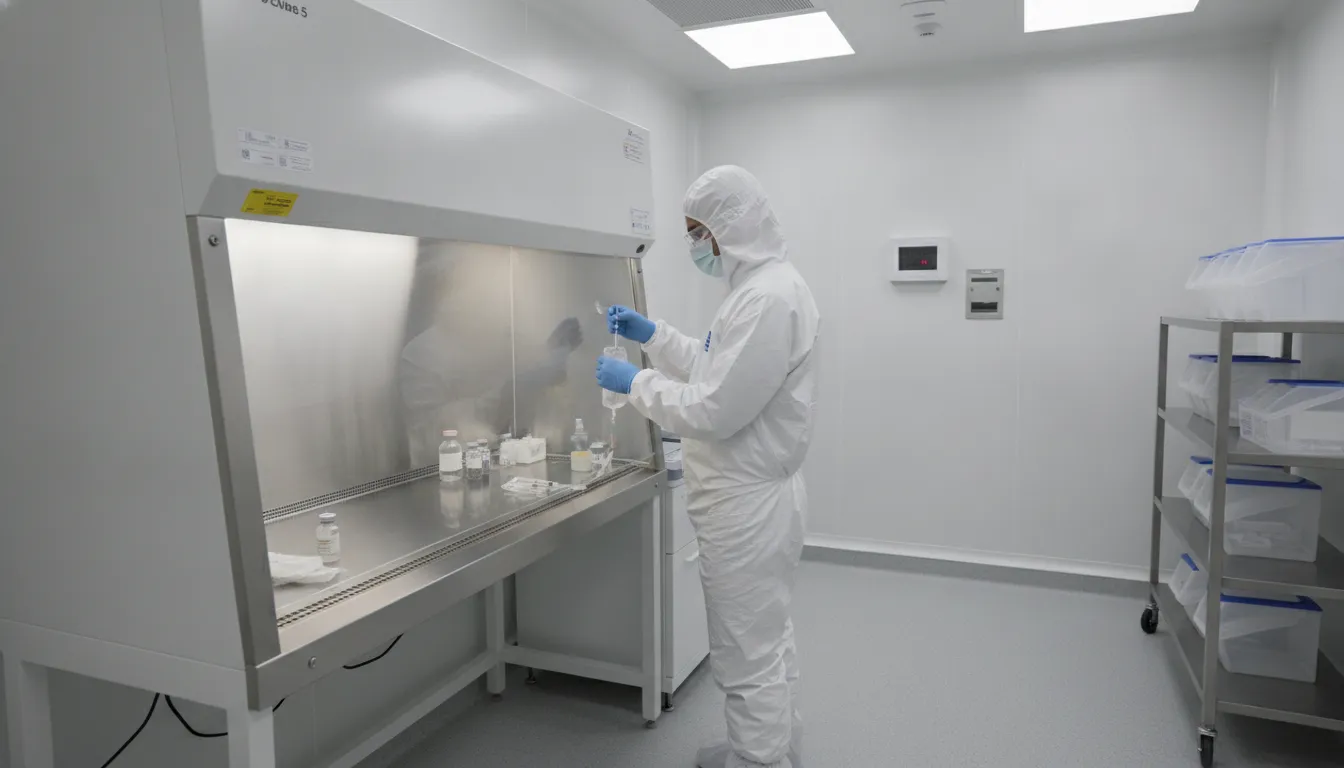
| ISO Class | Maximum Particles (per cubic meter) at 0.5 microns | Primary Function |
|---|---|---|
| ISO Class 5 | 3,520 | Primary Compounding Zone (PEC) |
| ISO Class 7 | 352,000 | Buffer Room |
| ISO Class 8 | 3,520,000 | Ante-Room and Staging Area |
How Do Ante-Rooms and Buffer Rooms Function?
The ante-room serves as the hygiene and gowning transition zone where personnel perform hand hygiene, don sterile garb, and stage supplies. It must maintain ISO Class 8 air quality with HEPA-filtered supply air. The buffer room, maintained at ISO Class 7, houses the PEC and must sustain positive pressure relative to both the ante-room and general pharmacy areas. Pressure differentials of 0.02 to 0.05 inches of water gauge are standard for maintaining proper airflow direction. These specifications align with ISO 14644-1 cleanroom cleaning protocols used by professional cleanroom maintenance providers.
Why Is Personnel and Material Flow Critical?
Cleanroom design must enforce unidirectional traffic patterns. Personnel enter through the ante-room, complete garbing, and proceed into the buffer room. Materials enter through a separate pass-through chamber that allows surface decontamination before introduction to the clean zone. Waste exits through designated pathways that do not intersect with clean material flow. Facilities handling hazardous drugs must maintain physically separate areas with negative air pressure per USP 800 requirements, often requiring dedicated containment primary engineering controls (C-PECs).
What Is the Required Cleaning and Disinfection Schedule Under USP 797?
USP 797 mandates a three-tier cleaning schedule: daily disinfection of horizontal surfaces with EPA-registered disinfectants. Weekly application of sporicidal agents, and monthly deep cleaning of walls, ceilings, and shelving. Each tier requires specific documentation including product name, lot number, contact time, and technician initials.
Which Tasks Must Be Done Every Day?
Daily cleaning targets all horizontal surfaces within the buffer room and ante-room, including counters, work surfaces, carts, and floors. Personnel must apply an EPA-registered disinfectant with the specified wet-contact time to achieve a minimum 6-log reduction in microbial contaminants. The interior of the PEC must be cleaned after each compounding session or at minimum daily using sterile 70% isopropyl alcohol (IPA) on all work surfaces. Microfiber technology is preferred for wipe-down tasks as it captures microscopic particulates without leaving lint or residue that could compromise sterility.
For facilities requiring comprehensive compliance support, professional cleanroom cleaning services ensure that every daily task meets the rigorous standards of USP 797. Contact Foreman Pro Cleaning to schedule an assessment of your current cleaning protocols.
When Are Weekly and Monthly Deep Cleans Needed?
USP 797 mandates weekly application of a sporicidal agent to all surfaces. Bacterial spores, including Bacillus and Clostridium species, exhibit resistance to standard disinfectants and require chemical agents such as peracetic acid or bleach-based solutions for eradication. Facilities must maintain a rotating disinfectant program that alternates between broad-spectrum agents and sporicides to prevent microbial resistance. The EPA maintains a list of registered disinfectants that meet healthcare-grade requirements for sterile compounding environments.
Monthly deep cleaning addresses vertical surfaces, ceilings, shelving, and equipment exteriors throughout the buffer room and ante-room. This comprehensive cleaning requires HEPA-filtered vacuums, validated disinfectant application, and extended contact times to ensure complete microbial kill across all surfaces. Many pharmacy facilities engage specialized cleanroom cleaning providers for monthly deep cleaning to maintain consistent compliance without diverting pharmacy staff from patient care responsibilities.
How Should You Document Compliance and Monitoring?
Documentation is the cornerstone of USP 797 compliance verification. Every cleaning event must be recorded in a log specifying the product name, EPA registration number. Lot number, expiration date, dilution ratio (when applicable), application method, wet-contact time, technician initials, and any observations. State boards of pharmacy routinely inspect these logs during compliance audits.
Environmental monitoring programs complement cleaning documentation. Surface sampling, viable air particle counts, and glove fingertip sampling provide quantitative evidence that contamination control protocols are effective. ISO 14644-1 recertification must be performed by an accredited third party at least every six months or after any significant facility modification. All monitoring records must be retained for a minimum of three years per USP guidelines.
Which Disinfectants and Cleaning Agents Comply With USP 797 Standards?
USP 797 requires facilities to maintain a rotating program of EPA-registered disinfectants, detergent cleaners, and sporicidal agents. The standard mandates at minimum one broad-spectrum disinfectant and one sporicidal agent used on a rotating schedule to prevent microbial resistance.
What Categories of Agents Are Required for Cleanrooms?
USP 797 identifies several chemical categories for cleanroom cleaning. Detergent cleaners remove organic and inorganic soils from surfaces without necessarily achieving microbial kill. Sanitizers provide a 3-log reduction in microbial contaminants. EPA-registered disinfectants, required for daily cleaning, achieve a 6-log reduction against specified test organisms. Sporicidal agents, used on a weekly basis, demonstrate efficacy against bacterial endospores. Sterile 70% IPA serves as the standard for gloved-hand disinfection and PEC surface sanitization between compounding sessions, as documented in published research on alcohol-based hand rub efficacy.
How Does a Rotating Disinfectant Program Work?
A compliant rotating disinfectant program alternates between two or more disinfectants with different mechanisms of action. Common pairings include quaternary ammonium compounds for daily use with peracetic acid or sodium hypochlorite for weekly sporicidal application. The rotation prevents microbial adaptation to any single chemical class. Foreman Pro Cleaning applies these agents through electrostatic disinfection services that ensure complete coverage of all infrastructure surfaces, including hard-to-reach vertical planes and equipment undersides.
Why Is Sporicidal Rotation Necessary for Sterility?
Bacterial spores represent the most resilient form of microbial life, capable of surviving extended periods in dormant states. Standard disinfectants that effectively kill vegetative bacteria may have limited activity against spores. USP 797’s requirement for weekly sporicidal application addresses this gap, ensuring that spore-forming organisms cannot establish a presence in the cleanroom. Proper sporicide application requires meticulous attention to concentration, contact time, and surface compatibility to maintain both efficacy and equipment integrity.
What Garbing and Hygiene Procedures Do USP 797 Guidelines Require?
Personnel represent the primary source of contamination in sterile compounding environments. USP 797 requires a standardized garbing sequence beginning with personal item removal, antimicrobial hand wash of at least 30 seconds. Application of hair and face covers, shoe covers, gown, sterile gloves, and final IPA glove wipe.
How Should Staff Prepare Before Entering the Ante-Room?
All personal items that can harbor or shed microscopic particulates must be removed before entering the ante-room. This includes jewelry, watches, nail polish, artificial nails, makeup, and personal electronic devices. Eyeglasses must be cleaned with a validated disinfectant. Staff must then perform a surgical-style hand wash using antimicrobial soap, scrubbing hands and forearms to the elbows for a minimum of 30 seconds with warm water. Hands must be dried using low-lint towels before proceeding to garbing. These standards parallel those used in biotechnology and laboratory cleanroom environments.
What Is the Correct Order for Garbing?
USP 797 prescribes a strict head-to-toe garbing sequence designed to minimize contamination introduction:
- Remove personal items. Jewelry, nail polish, makeup, and personal electronics. Wipe down eyewear with validated cleaning solution.
- Perform antimicrobial hand wash. Scrub hands and forearms to elbows for at least 30 seconds using antimicrobial soap and warm water.
- Don hair cover and face mask. Ensure all hair is contained, including facial hair, using a beard cover if necessary.
- Apply shoe covers. Don low-lint shoe covers before crossing into the cleanroom zone.
- Put on cleanroom gown. Select a non-shedding, fitted gown that fully covers personal attire.
- Apply alcohol-based hand rub and sterile gloves. Allow hand rub to dry completely before gloving.
- Wipe sterile gloves with 70% IPA. Perform this final disinfection immediately before beginning compounding activities.
How Do You Handle Materials Entering the Cleanroom?
All materials entering the cleanroom must undergo surface decontamination. Supplies are staged in the ante-room, where each item is wiped with an EPA-registered disinfectant and allowed the specified wet-contact time before transfer into the buffer room. Pass-through chambers minimize air exchange between zones during material transfer. Waste removal follows a unidirectional path that prevents cross-contamination between soiled and clean materials. Foreman Pro Cleaning provides comprehensive biotech and laboratory cleaning services that incorporate these material management protocols.
What Are the Key Differences Between USP 800 and USP 797?
USP 797 protects patients through sterile compounding standards, while USP 800 protects pharmacy staff through hazardous drug handling requirements. The critical operational difference lies in room pressure: USP 797 cleanrooms use positive pressure to protect the product, while USP 800 areas use negative pressure to protect personnel.
Patient Safety versus Staff Protection
USP 797 focuses exclusively on preventing patient harm from contaminated sterile preparations. Every requirement, from ISO classification to garbing sequences, centers on maintaining the sterility of compounded products. USP 800 addresses an entirely different risk vector: occupational exposure to hazardous drugs. It establishes protocols for receiving, storing, mixing, administering, and disposing of hazardous drugs to protect pharmacy staff from toxic exposure.
Air Pressure and Engineering Controls
The directional airflow requirements mark the most significant operational divergence between the two standards. USP 797 cleanrooms maintain positive air pressure, pushing contaminants away from the sterile compounding zone and protecting the product from environmental contamination. USP 800 requires negative air pressure for hazardous drug handling areas, containing toxic particles and vapors within the designated space. Facilities that compound both sterile and hazardous preparations must maintain physically separate areas, often with dedicated HVAC systems, to satisfy both standards simultaneously.
| Parameter | USP 797 | USP 800 |
|---|---|---|
| Primary goal | Patient safety (sterile products) | Staff safety (hazardous drug handling) |
| Room pressure | Positive (protects product) | Negative (contains hazards) |
| Compounding equipment | LAFW or BSC | C-PEC with venting |
| ISO classification | ISO Class 5 (PEC) | ISO Class 7 (containment area) |
Frequently Asked Questions About USP 797 Cleanroom Cleaning
What is the difference between USP 797 and USP 800 in terms of cleaning requirements?
USP 797 governs sterile compounding environments and requires positive air pressure cleanrooms with ISO Class 5 PECs, daily disinfectant application, weekly sporicidal cleaning, and rigorous personnel garbing protocols. USP 800 addresses hazardous drug handling areas that require negative air pressure containment and separate cleaning protocols to prevent cross-contamination between sterile and hazardous zones.
How often should a sporicidal agent be used in a USP 797 cleanroom?
USP 797 mandates weekly application of a sporicidal agent to all surfaces within the buffer room and ante-room. This schedule targets bacterial spores that standard disinfectants may not eliminate. The sporicidal agent should be rotated with the primary disinfectant to prevent microbial resistance.
What ISO class is required for a pharmacy cleanroom under USP 797?
USP 797 requires an ISO Class 5 environment for the primary engineering control where sterile compounding occurs. Housed within an ISO Class 7 buffer room, with an ISO Class 8 ante-room for gowning and staging. Each classification has specific maximum particle limits defined by ISO 14644-1.
Can a single facility comply with both USP 797 and USP 800?
Yes, but the facility must maintain physically separate areas for sterile compounding (USP 797) and hazardous drug handling (USP 800). With independent HVAC systems to maintain the required positive and negative air pressure differentials respectively. Cross-contamination between zones must be prevented through dedicated equipment, separate material flow paths, and distinct cleaning protocols.
What documentation is required for USP 797 cleanroom cleaning compliance?
Every cleaning event must be documented with product name, EPA registration number, lot number, expiration date, dilution ratio, application method, wet-contact time, technician initials, and observations. Environmental monitoring records, ISO recertification results, and personnel training documentation must be retained for at least three years.
How Can Foreman Pro Cleaning Support Your USP Compliance Program?
Maintaining USP 797 cleanroom cleaning compliance requires specialized expertise in sterile environment protocols, EPA-registered disinfectant application, ISO classification maintenance, and comprehensive documentation. Foreman Pro Cleaning brings proprietary critical environment training and extensive experience across pharmaceutical, biotechnology, and healthcare facilities throughout Maryland, Washington D.C., and Virginia.
Schedule a comprehensive cleanroom compliance assessment with Foreman Pro Cleaning today. Our team will evaluate your current cleaning protocols, ISO classification status. And documentation practices to identify gaps and develop a customized maintenance plan that meets USP 797 and USP 800 requirements. Contact us online or call to speak with a critical environment cleaning specialist.
