
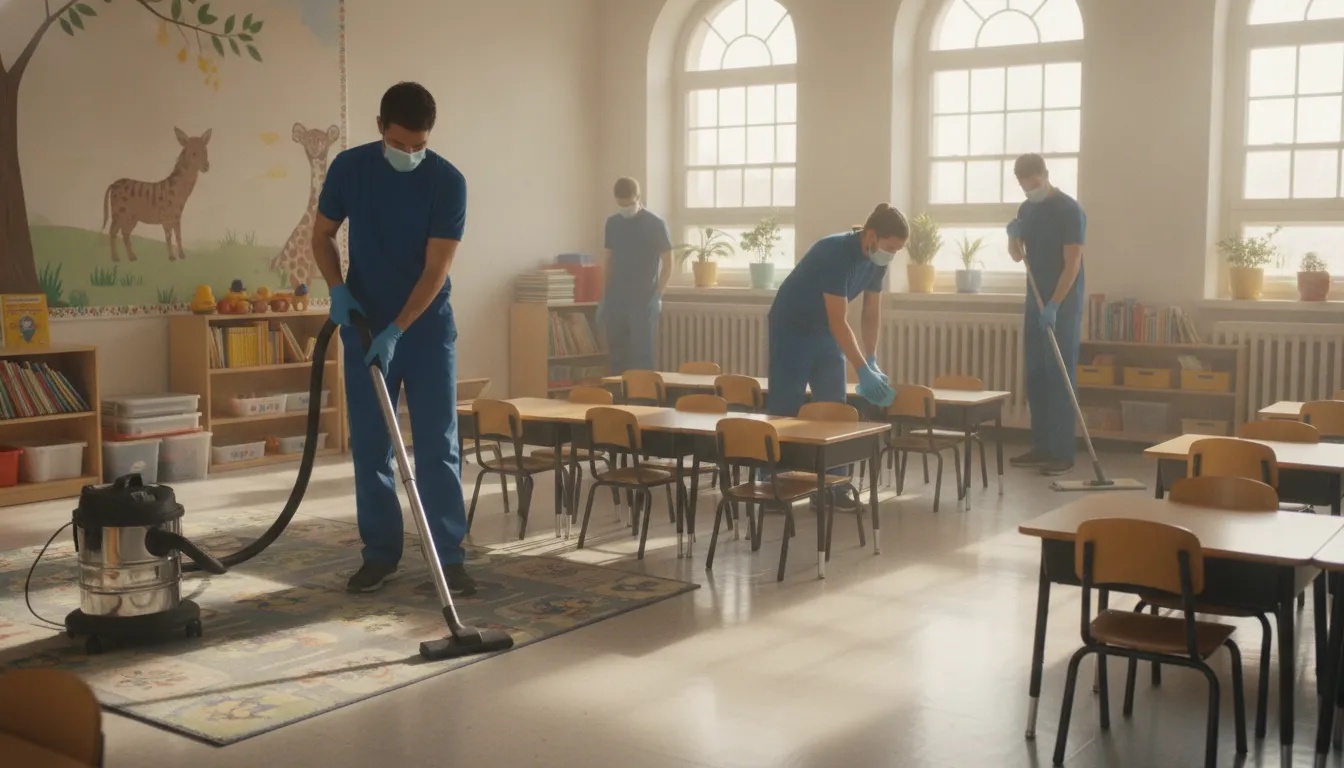
In an educational facility, cleanliness is an operational standard, not a cosmetic preference. Classrooms, laboratories, athletic areas, restrooms, and shared corridors experience different traffic patterns, contamination risks, and maintenance demands throughout the academic day. A reliable program must protect student and staff wellbeing while preserving floors, fixtures, furnishings, and building systems.
Professional cleaning services for schools should combine structured cleaning and disinfection plans, trained personnel, facility-specific schedules, and documented quality controls. Foreman Pro Cleaning develops customized programs for K-12 schools and higher education facilities across Maryland. Washington D.C., and Virginia, using contamination control protocols designed around each campus’s operational requirements. The CDC identifies careful planning as integral to reducing exposure risks in schools.
The right approach begins by translating recognized health guidance and facility standards into practical procedures for each educational environment. Understanding those requirements helps administrators evaluate service providers, set measurable expectations, and determine where daily attention must be most rigorous.
What Cleaning Standards Apply to K-12 and Higher Education Facilities?
Educational cleaning programs must do more than improve appearance. They should define who performs each task, which products and methods are approved, how high-touch areas are addressed, and how results are documented. The CDC recommends that schools develop, implement, and maintain a structured cleaning and disinfection plan, rather than relying on informal or inconsistent practices. CDC school cleaning guidance also frames cleaning and disinfection as part of reducing exposure to harmful viruses in educational settings.
CDC hygiene guidance adds operational detail. A sound program should address hand hygiene, the creation of an educational-environment hygiene plan, and the selection, use, and storage of cleaning products and disinfectants. CDC guidance for clean hands and spaces provides the foundation for training custodial teams and coordinating expectations with school leadership, teachers, students, and caregivers.
How Do OSHA Requirements Shape Custodial Procedures?
OSHA requirements influence how educational facilities protect the people who handle cleaning chemicals and respond to potentially infectious materials. Hazard Communication requirements call for chemical labels, safety data sheets, and employee training. OSHA’s Hazard Communication Standard should be reflected in product storage, dilution, personal protective equipment, and documented training. Where staff may encounter blood or other potentially infectious materials, the OSHA Bloodborne Pathogens Standard provides additional requirements for exposure control and safe work practices.
Which Industry Practices Should Schools Evaluate?
Beyond regulatory obligations, administrators should evaluate whether a provider can support consistent execution across classrooms, laboratories, athletic spaces, cafeterias, offices, and common areas. Foreman Pro Cleaning approaches school programs through facility-specific planning, documented procedures, appropriate product selection, and contamination control protocols. In Maryland, Washington D.C., and Virginia, that approach can be aligned with each campus’s occupancy patterns, risk profile, operating schedule, and reporting expectations.
A practical compliance review should confirm that the provider can:
- Maintain a written plan with assigned responsibilities, service frequencies, and revision procedures.
- Train personnel on hand hygiene, chemical handling, product storage, and applicable exposure controls.
- Use methods suited to the space, including microfiber technology and HEPA-filtered vacuums where airborne contaminants require careful management.
- Document completed work and escalate conditions that require corrective action.
This combination of CDC guidance, OSHA controls, and documented facility procedures gives schools a defensible framework for selecting and managing cleaning services for schools.
What Are the High-Risk Cleaning Zones in School Facilities?
Every school facility contains areas with different exposure patterns, material requirements, and operational constraints. A classroom requires consistent particulate control, while a cafeteria demands disciplined attention to food-contact surfaces and waste handling. Effective cleaning services for schools therefore begin with a zone-based plan rather than a single routine applied throughout the building.
- Classrooms: Desks, tables, door hardware, light switches, shared instructional surfaces, and technology touch points require systematic cleaning and high-touch area disinfection. HEPA-filtered vacuums and microfiber technology help Foreman Pro Cleaning manage microscopic particulates while limiting their redistribution in occupied learning environments. Foreman Pro Cleaning develops customized plans around each facility’s surfaces, traffic patterns, and operating schedule.
- Restrooms: Cleaning must address fixtures, partitions, floors, dispensers, and frequently contacted hardware. Restocking soap, paper towels, tissue, and other essential supplies is part of maintaining a functional hygiene environment, not an administrative afterthought.
- Cafeterias: Food-service areas need cleaning protocols appropriate for tables, serving areas, floors, waste receptacles, and adjacent touch points. The plan should distinguish food-contact surfaces from general surfaces and coordinate work with meal periods to avoid disrupting operations.
- Gyms: Large floor areas, bleachers, equipment, entry doors, and shared activity surfaces accumulate perspiration, residue, and particulates. Floor-care methods should match the surface material, while shared equipment and touch points require consistent attention between scheduled activities.
- Locker rooms: Moisture, dense occupancy, benches, lockers, showers, drains, and handles create a demanding environment. Cleaning should combine surface disinfection, floor care, odor control, and inspection for conditions that can compromise safety or facility longevity.
- Administrative offices: Reception counters, conference tables, keyboards, phones, door handles, and shared workstations require a discreet schedule that protects staff productivity while addressing high-touch surfaces. Private offices and records areas may also require access coordination.
- Drinking fountains: These fixtures and their touch points require daily cleaning and disinfection, according to the University of Northern Iowa’s cleaning frequency guide. The guide identifies drinking fountain cleaning and disinfection as a daily task, reflecting the potential for repeated contact throughout the school day.
A customized plan should document the required method, frequency, responsible team, and verification standard for each zone. This approach allows facility managers to prioritize high-touch surfaces, specialized floor care, and continuous particulate management without treating every room as though it has the same risk profile.
How Do K-12 Cleaning Requirements Differ from University Needs?
Educational facilities share core contamination-control objectives, but their operating profiles demand different service designs. K-12 environments concentrate younger students in classrooms, cafeterias, buses, and activity areas, while universities combine expansive academic buildings with residential, research, clinical, and laboratory spaces. A responsible scope therefore accounts for occupancy patterns, surface-contact frequency, regulatory requirements, and the consequences of disrupting instruction or research.
| Operational consideration | K-12 schools | Colleges and universities |
|---|---|---|
| Primary exposure profile | Younger students share classrooms, restrooms, cafeterias, playground equipment, and other high-contact surfaces. The program places greater emphasis on frequent touch-point cleaning and contamination control during the instructional day. | Students, faculty, staff, visitors, and residents move through varied buildings and schedules. Programs must coordinate cleaning across lecture halls, residence facilities, athletic spaces, offices, and public circulation routes. |
| Staffing and service requirements | District or state requirements may establish custodial staffing ratios, documentation expectations, or service standards. The final scope should be reconciled with the applicable jurisdiction and district policy. | Larger square footage and decentralized facilities require zone-based staffing, service-level tracking, and coordination with campus operations, events, and scheduled closures. |
| Specialized spaces | Science rooms, nurse offices, kitchens, gyms, and early-childhood areas require procedures suited to their materials, equipment, and occupant vulnerability. | Research laboratories, technical workspaces, studios, clinical areas, and controlled environments may require specialized training, restricted access, and documented procedures that differ from general custodial work. |
| Operating schedule | Service is often organized around school-day transitions, after-hours cleaning, athletic programming, and seasonal breaks. | Many campuses operate continuously, with evening classes, residence halls, research programs, athletics, and events requiring coverage beyond a conventional business schedule. |
Why does specialized training matter in both settings?
Cleaning personnel need more than a product list and a route schedule. Foreman Pro Cleaning provides specialized training for sensitive environments so teams can follow contamination control protocols, select appropriate methods, protect occupants, and document completed work. This distinction is particularly important where laboratory materials, clinical operations, or child-focused spaces introduce different safety considerations.
How should the program protect long-term facility performance?
Short-term appearance is only one measure of success. A comprehensive plan supports long-term facility maintenance and health compliance by combining recurring cleaning, high-touch surface attention, floor care, inspection, and corrective action. Foreman Pro’s commercial cleaning services can be structured for educational facilities throughout Maryland, Washington, D.C., and Virginia.
Across both sectors, continuous particulate management is more reliable than casual methods. HEPA-filtered vacuums and microfiber technology can help minimize airborne contaminants when applied within a documented, facility-specific plan. The right approach preserves learning, research, and operational continuity without treating every building as if it had the same risk profile.
How Often Should Schools Schedule Cleaning by Area?
A reliable custodial schedule should match the traffic, contact frequency, and operational demands of each school zone. Daily service is the baseline for occupied educational facilities, while meal periods, athletic activities, and visible contamination require responsive cleaning between scheduled visits.
| Area | Minimum frequency | Core tasks |
|---|---|---|
| Classrooms | Daily | Remove waste, vacuum or mop floors, spot-clean surfaces, and address high-touch points. Daily waste removal, floor care, and spot cleaning are reflected in the University of Cincinnati facilities schedule. |
| Restrooms | Daily, with checks during occupancy | Clean and disinfect fixtures, floors, and touch points; restock soap, paper towels, tissue, and sanitizer daily, as specified by the University of Cincinnati cleaning tasks sheet. |
| Cafeterias | Daily and after each meal | Clean tables, seating, floors, service areas, and touch points after each meal period, then complete end-of-day floor care and waste removal. |
| Gyms and locker rooms | Daily, plus after high-use events | Disinfect touch points and shared-use surfaces, clean floors, service showers and restrooms, and remove moisture-related residue. |
| Administrative offices | Daily | Remove waste, maintain floors, and clean commonly touched doors, counters, and shared equipment surfaces. |
| Hallways, stairs, and drinking fountains | Daily | Sweep and mop corridors and stair landings, disinfect railings and door hardware, and clean drinking fountains. The University of Northern Iowa frequency guide specifies daily touch-point disinfection, wet mopping, and fountain cleaning. |
Schools should also schedule a summer deep-cleaning program when classrooms, cafeterias, athletic areas, and administrative spaces are less occupied. This is the appropriate window for restorative floor care, high-level dust removal, detailed fixture cleaning, furniture extraction, and inspection of areas that daily service cannot fully access. Foreman Pro Cleaning can help facility leaders coordinate recurring service with a documented summer scope. Use our summer school cleaning checklist to organize priorities before the next academic term.
What Sets Professional Cleaning Services for Schools Apart?
Educational facilities need more than a checklist of visible tasks. They need a documented, repeatable approach that protects students and staff, supports facility operations, and gives administrators confidence that cleaning standards are being met. Professional school cleaning services provide the staffing, supervision, equipment, and accountability required to maintain that standard across classrooms, restrooms, cafeterias, athletic spaces, and administrative areas.
How Do Professional Teams Improve Infection Control?
Cleaning and disinfection are most effective when they follow a structured plan that is developed, implemented, maintained, and revised as conditions change. The CDC school cleaning guidance identifies this planning cycle as a core part of reducing exposure to harmful viruses in educational settings. Trained professionals can map high-touch surfaces, sequence work to limit cross-contamination, select appropriate products, and document completed services.
Foreman Pro Cleaning applies specialized equipment and methods to support this process. HEPA-filtered vacuums and microfiber technology help minimize airborne contaminants, while customized plans address high-touch area disinfection and facility-specific floor care needs. These practices are particularly valuable in schools where daily occupancy, shared surfaces, and varied room uses create changing contamination-control demands.
How Do Customized Plans Reduce Operational and Liability Risks?
A generic scope of work can overlook the difference between an elementary classroom, a science laboratory, a gymnasium, and a high-traffic entrance. A customized plan assigns appropriate frequencies, methods, products, and quality checks to each zone. It also creates a clearer record of what was required and what was completed. Helping facility managers maintain audit-ready documentation and respond more effectively to health and safety concerns.
Professional oversight reduces reliance on inconsistent individual habits. Supervisors can verify service delivery, identify recurring deficiencies, and adjust the plan when enrollment, schedules, construction, or seasonal illness changes facility demands. This long-term approach supports cleanliness and compliance rather than treating cleaning as an occasional response.
Why Does Staff Training Matter in Schools?
Equipment is only effective when cleaning personnel understand how to use it. Foreman Pro Cleaning trains teams for sensitive environments and emphasizes contamination control protocols, precise chemical handling, microfiber application, and continuous particulate management. With more than 15 years of experience serving organizations in Maryland, Washington, D.C., and Virginia, Foreman Pro brings the operational discipline needed for dependable results without disrupting instruction.
For administrators comparing providers, the meaningful distinction is not simply whether a company offers routine custodial work. It is whether the provider can build a measurable plan around the facility, train its people to execute that plan, and maintain consistent standards over time.
Frequently Asked Questions
How often should school common areas be cleaned?
Hallways, entryways, cafeterias, and restrooms generally require daily service, with additional attention during high-traffic periods. A practical schedule includes waste removal, floor care, restroom restocking, and disinfection of high-touch points such as door hardware, railings, and push plates. The frequency should be adjusted for enrollment, occupancy, events, and the facility’s documented risk profile.
What cleaning protocols should schools follow?
Schools should maintain a structured plan that covers development, implementation, ongoing maintenance, and revision, as recommended by the CDC. The plan should define product selection and storage, task ownership, contact times, high-touch disinfection, spill response, and quality verification. Staff training should also address hand hygiene and the proper use of cleaning products and disinfectants, consistent with CDC hygiene guidance.
How much do cleaning services for schools cost?
Pricing depends on square footage, building configuration, occupancy, service frequency, staffing requirements, floor surfaces, restrooms, athletic areas, and specialized spaces. A provider should inspect the campus and develop a written scope rather than quote from square footage alone. Foreman Pro Cleaning can structure a customized plan around instructional schedules, high-touch zones, floor care, and required quality controls.
What should a school cleaning plan include for restrooms and drinking fountains?
The scope should include daily cleaning, disinfection of touch points, waste removal, and restocking of soap, paper products, and other essential supplies. Drinking fountains should also be cleaned and disinfected daily, including their touch points, according to this university cleaning frequency guide. Supervisors should document completion and address deficiencies promptly.
Why is specialized cleaning important for educational facilities?
Educational facilities combine high occupancy, frequent surface contact, varied room functions, and active daily operations. Specialized teams can apply contamination control protocols without disrupting instruction, while using equipment and methods suited to classrooms, laboratories, athletic spaces, and administrative areas. The objective is a consistent, auditable maintenance program that supports health, safety, and long-term facility performance.
Schedule a Customized Cleaning Plan for Your Educational Facility
Foreman Pro Cleaning can help your school or university align daily cleaning, floor care, and contamination control protocols with the needs of each facility zone. A customized plan gives administrators a practical framework for maintaining classrooms, restrooms, common areas, and specialized spaces with consistent service expectations. To discuss your facility’s priorities and schedule a customized cleaning plan, contact Foreman Pro Cleaning.
