
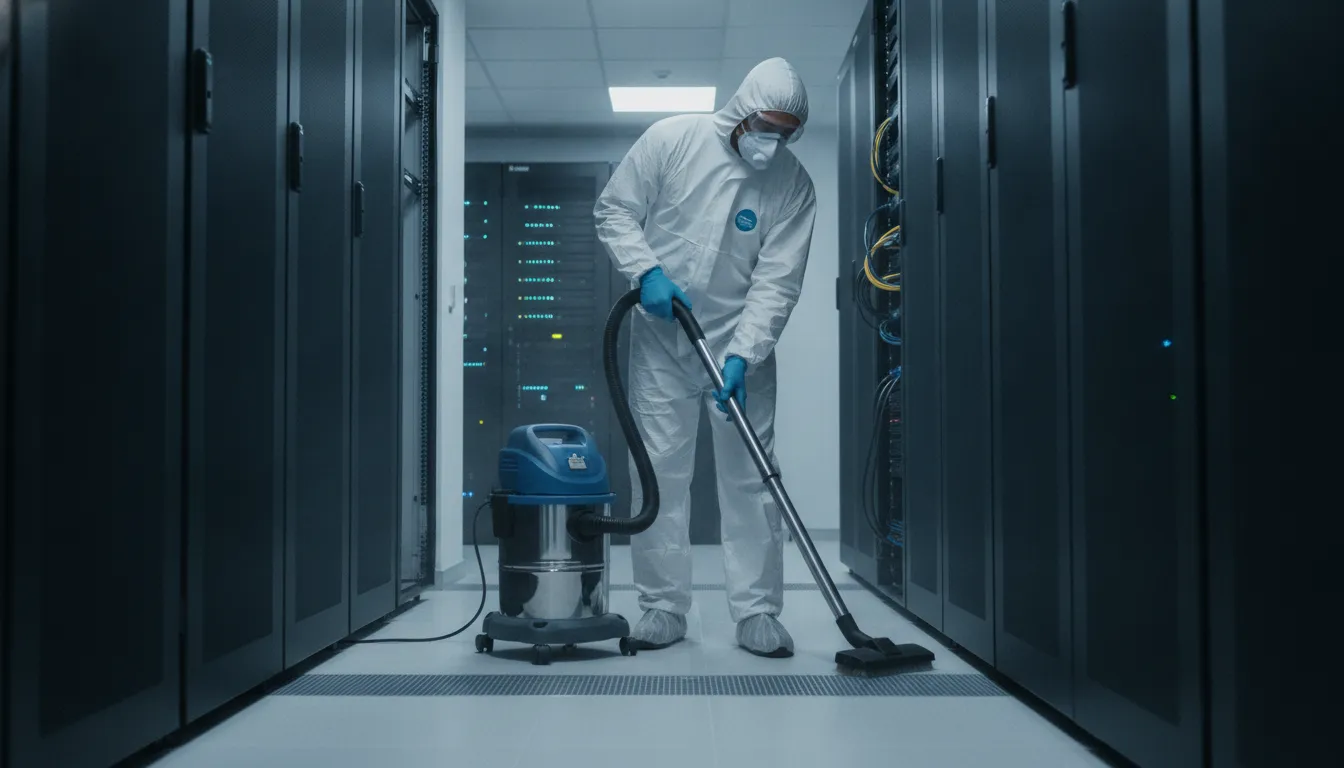
In a server room, laboratory, command center, or other sensitive facility, cleaning affects more than appearance. Particles, residues, static, and uncontrolled movement can interfere with equipment, research, or mission-critical operations. Facility managers in Maryland, Washington D.C., and Virginia need a defined process. A standard room-by-room routine may not address those risks.
Discuss your facility’s controlled environment cleaning requirements with Foreman Pro Cleaning.
Controlled environment cleaning combines contamination-control planning, compatible equipment and cleaning agents, documented verification, and personnel trained to follow site-specific standard operating procedures. The objective is to protect the facility’s processes and infrastructure, not simply make surfaces look presentable.
Foreman Pro Cleaning applies proprietary Critical Environment Training and structured procedures for work in sensitive zones. The right approach begins by identifying what the environment must protect, then matching cleaning controls to those risks. The framework below helps facility managers evaluate the difference between routine service and a controlled program.
What Does Controlled Environment Cleaning Protect?
Short answer: It protects the process, infrastructure, products, research, and operational continuity that depend on a controlled space. The cleaning method should follow the facility’s risk profile and cleanliness objectives.
A controlled environment is a space where conditions such as airborne particles, temperature, humidity, airflow, lighting, or access are managed to support a specific process. The category can include data centers, server rooms, laboratories, broadcast studios, command centers, and cleanrooms. The facility manager’s starting point is defining the critical environment according to the work performed there, the assets present, and the consequences of contamination.
Cleanrooms are a stricter subset of controlled environments. They use defined cleanliness classifications and more demanding particle-control requirements. A server room or command center may need disciplined contamination control without being operated as a classified cleanroom. A cleanroom, in contrast, requires procedures aligned with its specified cleanliness level and process controls. Calling every sensitive room a cleanroom can create the wrong expectations. Ignoring contamination risk because a room is not classified can be just as problematic.
Particle risk is not limited to what personnel can see. ISO 14644-1:2015 provides a framework for classifying air cleanliness by particle concentration in cleanrooms and associated controlled environments. ISO 14644-1:2015 does not turn every controlled space into a cleanroom, but it reinforces why particle behavior and movement belong in the planning discussion.
Process risk matters as well. A cleaning activity can disturb settled particles, move residue between zones, introduce incompatible materials, or interfere with work when performed at the wrong time. ISO 14644-13:2026 addresses cleaning surfaces in cleanrooms and associated controlled environments to achieve defined levels of particle and chemical cleanliness. Its scope supports a practical principle: surface cleaning should be tied to a defined objective rather than treated as an interchangeable routine.
Facility managers should also plan for evidence that the environment remains under control. ISO 14644-2:2015 describes monitoring as a way to provide evidence of cleanroom performance through air and surface cleanliness checks. The monitoring standard helps connect the cleaning procedure to the condition the facility needs to maintain.
How Does Controlled Environment Cleaning Differ From Routine Janitorial Work?
Short answer: Routine janitorial service generally supports appearance, hygiene, order, and occupant comfort. Controlled environment cleaning is designed around contamination risk, process requirements, equipment sensitivity, access controls, and documented verification.
The distinction is not simply how often a space is serviced. It is the level of operational risk the cleaning process must control. A general routine can be appropriate for ordinary occupied areas. It may be insufficient in a space where particles, static, residue, chemical compatibility, or uncontrolled movement could affect a sensitive operation.
| Operational factor | Routine janitorial service | Controlled environment cleaning |
|---|---|---|
| Primary objective | Maintain appearance, hygiene, and everyday usability. | Manage contamination and protect sensitive processes, surfaces, and infrastructure. |
| Scope and frequency | Often follows occupancy, visible needs, and a standard schedule. | Follows process requirements, risk, activity, and the required cleanliness objective. |
| Sequence | Uses a practical room-by-room workflow. | Uses a defined sequence and zone boundaries to reduce transfer between areas. |
| Tools and agents | Uses products selected for ordinary surfaces. | Uses dedicated or controlled tools and agents compatible with the environment. |
| Access and personnel | Uses ordinary visitor and vendor procedures. | Requires authorized personnel who follow entry, movement, and area-specific protocols. |
| Records and verification | May document completion or routine service issues. | Records the work, materials, timing, personnel, observations, and verification activity. |
For example, cleaning in a data center must address particulate accumulation while minimizing static and avoiding interference with live systems. Laboratory work may require awareness of biological hazards, chemical handling, equipment restrictions, and established decontamination procedures. The correct method depends on the site and its operating documents, not on a generic label.
A provider evaluating a sensitive facility should be able to explain how its work fits the owner’s engineering controls, access requirements, SOPs, maintenance windows, and reporting process. Foreman Pro Cleaning brings experience in both IT operations and facilities management to this evaluation.
How Should Facility Managers Plan Contamination Control?
Short answer: Begin with the process and assets that must be protected, then define zones, entry controls, cleaning sequences, approved materials, scheduling, documentation, and corrective actions. The plan should be specific enough for trained personnel to execute consistently.
Which risks should the plan identify?
Identify particle, biological, chemical, static, and cross-contamination risks by room and activity. Consider what is being protected, how sensitive the process is, what materials are present, and what could happen if cleaning introduces residue or particles. In a server room, the plan may prioritize particulate removal and static-charge minimization. In a laboratory, it may also address biological safety, chemical compatibility, equipment protection, and restricted access.
How should zones and movement be controlled?
Divide the facility into practical zones based on cleanliness requirements, process sensitivity, and movement patterns. Define entry and exit routes, staging locations, transition points, and the tools approved for each area. Equipment assigned to a controlled space should remain isolated for that environment when the SOP requires it. The zone map gives supervisors a clear basis for contractor instructions and reduces the risk of moving material from a less controlled area into a more sensitive one.
When should the work be scheduled?
Coordinate cleaning with production, laboratory, IT, security, and facilities teams. When operations allow, schedule the work during a maintenance window or lower-activity period. Account for material transfers, alarms, restricted access, active experiments, equipment servicing, and any condition that could make cleaning unsafe or ineffective. Frequency should follow the facility’s process requirements and required cleanliness objective rather than an arbitrary calendar alone.
What should the SOP contain?
Each area-specific SOP should identify the approved sequence, surfaces, tools, agents, personal protective requirements, entry controls, waste handling, documentation fields, and escalation path. It should state when personnel must pause and contact a supervisor. Contractor onboarding and supervision belong in the operating plan, not in an informal handoff.
How should the plan handle deviations?
Define who reviews observations, who authorizes corrective action, and how the team verifies that the response worked. A missed step, unexpected residue, access limitation, or failed validation result should trigger a controlled review of the SOP, schedule, training, or zone boundary. This feedback loop keeps the program useful as processes and equipment change.
Which Equipment and Cleaning Agents Belong in Sensitive Areas?
Short answer: Use tools and agents selected for the zone, surface, airflow conditions, and process risks. Keep equipment controlled between areas, protect filtration integrity, and document approved materials and application requirements in the SOP.
Equipment selection is part of contamination control, not a purchasing detail. Cleanroom-compliant microfiber tools and low-lint wipers can help reduce particle shedding where the facility requires that specification. A tool that looks serviceable may still release fibers or retain material from a previous area. NIH laboratory guidance emphasizes practices that prevent cross-contamination and protect sensitive work areas. The exact specification must come from the facility’s written requirements.
How do HEPA systems and static controls protect the area?
Vacuum equipment should be selected and maintained without compromising the area’s high-efficiency particulate air filtration. Personnel should inspect equipment, use it as designed, and report damage or abnormal performance rather than improvising. In server rooms and data centers, the method must also account for electrostatic risk. Controlled movement, appropriate equipment, and adherence to access procedures matter because particulate removal cannot be separated from infrastructure protection. Foreman Pro’s data center cleaning services address sensitive IT environments, including raised floors, network rooms, and equipment areas.
Which agents are appropriate for sensitive surfaces?
Choose agents for both their intended cleaning or decontamination purpose and their compatibility with the surfaces being treated. An incompatible agent can corrode or degrade equipment, finishes, seals, or other materials. Document the approved product, dilution or application requirements, contact time when applicable, ventilation considerations, and surface restrictions. The NIH laboratory safety manual provides relevant guidance on chemical handling and laboratory controls. The facility’s own SOP and safety program remain the controlling documents.
Foreman Pro Cleaning uses facility-specific procedures rather than treating every sensitive area alike. That distinction is important when a facility includes different zones, materials, or operating constraints.
Request a facility-specific controlled environment cleaning discussion with Foreman Pro Cleaning.
What Documentation Proves the Work Was Completed?
Short answer: A strong record connects the approved procedure to the area serviced, personnel involved, materials used, observations made, and verification or follow-up activity. It is more useful than a simple clean or complete checkbox.
Documentation makes the activity traceable. Another authorized person should be able to understand what happened, when it happened, which procedure applied, and whether any condition required review. That record supports continuity between cleaning, facility operations, IT, laboratory leadership, security, and quality teams.
What should a cleaning log record?
A useful log identifies the date, time, area, procedure or SOP, cleaning agents, equipment used where required, personnel, and unusual observations. It should also record access limitations or tasks that could not be completed under the approved method. The NIH enhanced surface-cleaning guidance illustrates the level of specificity expected when cleaning is connected to a sensitive laboratory process.
How do observations and verification strengthen the record?
Observations should describe conditions that could affect contamination control or the next operating decision. Examples include unexpected residue, a damaged surface, an access restriction, or an area that could not be serviced. The record should not imply that an issue was resolved when personnel only observed it. Verification may include supervisor review, specified surface checks, monitoring information, or another method established in the facility’s validation plan.
ISO 14644-2:2015 describes monitoring as evidence of cleanroom performance and continued conformity with applicable requirements. The standard’s monitoring framework should be applied according to the facility’s requirements. A cleaning record alone does not establish a universal compliance outcome.
How should corrective actions and reporting be handled?
When a record contains an observation, the report should state whether the issue was corrected, escalated, assigned for follow-up, or left pending a facility decision. That distinction prevents unresolved conditions from disappearing into a completed-work checkbox. The strongest handoff links the area, procedure, personnel, observations, verification, and next action.
What Training Should Cleaning Personnel Complete?
Short answer: Personnel should receive area-specific training on contamination-control behavior, access, movement, tools, agents, SOPs, abnormal conditions, documentation, and escalation. Managers should verify competency before allowing independent work in a sensitive zone.
Which behaviors should personnel demonstrate?
Instruction should begin with access rules, attire or gowning requirements where applicable, movement patterns, zone boundaries, staging, and tool isolation. Personnel need to understand why the approved sequence matters and how ordinary actions can introduce particles or residues. They should follow the applicable SOP precisely, including surface direction, equipment protection, and required order of work. Training should explain when to stop and notify a supervisor rather than improvise.
How should chemical handling and spill response be taught?
Chemical instruction should cover labels, storage, dilution where applicable, personal protection, ventilation, surface compatibility, and the facility’s reporting process. Personnel should use only agents approved for the specific environment and equipment. Spill response should be separate from normal cleaning instructions and should teach safe containment, isolation limits, escalation contacts, and documentation for abnormal conditions. If technical or safety review is required, cleaning personnel should know who makes that decision.
How can managers verify competency and authorization?
Completion of a presentation is not enough. Supervisors should observe representative tasks, check understanding of the relevant SOPs, and document whether personnel can protect surfaces, maintain the approved sequence, identify deviations, and complete required records. Refresher instruction is appropriate after a process change, incident, equipment change, or extended absence.
Authorization is another part of competency. Restricted spaces may require facility approval, security clearance, escort procedures, or zone-specific access. The NIEHS exposure-control guidance illustrates why access and exposure controls belong in a documented program. Foreman Pro Cleaning reinforces these expectations through proprietary Critical Environment Training for staff operating in sensitive zones.
When Should Maryland, D.C., and Virginia Facilities Use Specialized Support?
Short answer: Consider specialized support when cleaning can affect critical IT infrastructure, biological or chemical work, secure operations, sensitive equipment, validated processes, or documented environmental controls.
The decision begins with operational consequence, not geography. If a facility supports critical IT infrastructure, biological work, secure operations, or another high-sensitivity process. Cleaning should be evaluated as part of contamination control rather than treated as ordinary appearance maintenance.
Data centers and server rooms are clear examples. Their plans may address raised-floor and subfloor areas, equipment exteriors, network rooms, airflow-related surfaces, static-safe methods, and work around live systems. Laboratories may require awareness of biosafety cabinets, chemical handling, equipment restrictions, and the facility’s established decontamination procedures. Foreman Pro’s critical environment cleaning services connect these requirements to facility-specific programs for data centers, laboratories, cleanrooms, broadcast studios, and command centers.
A provider should be able to coordinate with the facility’s security, IT, engineering, laboratory, and quality stakeholders. It should also explain what its records do and do not prove. No cleaning provider should promise a particular laboratory, compliance, or uptime result based only on a cleaning visit. The work must fit the owner’s engineering controls, SOPs, monitoring, and quality program.
What signals indicate that routine service is no longer enough?
- Particles, residues, static, or chemical incompatibility could affect equipment, experiments, or production.
- Personnel must enter restricted areas or coordinate with security, IT, laboratory, or quality teams.
- The work requires dedicated tools, controlled sequencing, or documented observations.
- A monitoring result, incident, process change, or corrective action exposed a gap in the existing program.
- The facility needs a formal handoff record rather than a general completion note.
Foreman Pro Cleaning serves facilities across Maryland, Washington D.C., and Virginia with customized plans shaped around the space, schedule, access requirements, and operating risk. Its leadership experience in IT operations and facilities management supports a practical understanding of why sensitive environments require disciplined service.
Frequently Asked Questions: What Should Facility Managers Know?
What Is Considered a Controlled Environment?
A controlled environment is a space where conditions such as airborne particles, temperature, humidity, airflow, lighting, or access are managed to support a sensitive process. Examples include data centers, server rooms, laboratories, command centers, and cleanrooms. The cleaning method depends on the facility’s process risk and cleanliness objectives. Cleanrooms are a stricter subset with defined cleanliness classifications, as described by ISO 14644-1.
How Is This Work Different From Routine Janitorial Service?
Routine janitorial service generally emphasizes appearance, hygiene, and general facility maintenance. Controlled environment cleaning is designed to limit contamination, protect sensitive infrastructure, use compatible materials, follow a documented sequence, and provide records that support review. Frequency is set by the facility’s process requirements rather than by a standard calendar alone.
How Do You Document Cleaning in a Controlled Environment?
Document the date, time, area, SOP or procedure, personnel, equipment or agents used where required, observations, verification activity, and corrective-action status. The record should distinguish an issue that was resolved from one that was escalated or left pending. The exact fields should come from the facility’s quality and operating program.
What Training Should Cleaning Personnel Complete?
Personnel should be trained on access, movement, zone boundaries, tool control, chemical compatibility, area-specific SOPs, equipment protection, abnormal conditions, documentation, and escalation. Supervisors should observe representative work and confirm competency before independent access. Foreman Pro Cleaning uses proprietary Critical Environment Training for staff working in sensitive facilities.
How Should a Facility Manager Begin Planning This Service?
Start with a walkthrough of the areas, assets, processes, access controls, maintenance windows, cleanliness objectives, and documentation requirements. Use those findings to define the service scope, approved procedures, staffing plan, schedule, and reporting format. A site-specific review is more useful than applying a generic routine to every sensitive room.
How Can Facility Managers Start a Controlled Environment Cleaning Review?
Begin by identifying the areas, assets, processes, access controls, cleanliness objectives, maintenance windows, and documentation requirements that shape the work. A facility walkthrough can then translate those requirements into a defined service scope, approved procedures, staffing plan, schedule, and reporting format.
Foreman Pro Cleaning can discuss the needs of data centers, server rooms, laboratories, cleanrooms, broadcast studios, command centers, and other sensitive facilities across Maryland, Washington D.C., and Virginia. The goal is a cleaning program that supports the facility’s operating requirements without making claims beyond the evidence available.
Contact Foreman Pro Cleaning to review your facility’s controlled environment cleaning requirements.
