
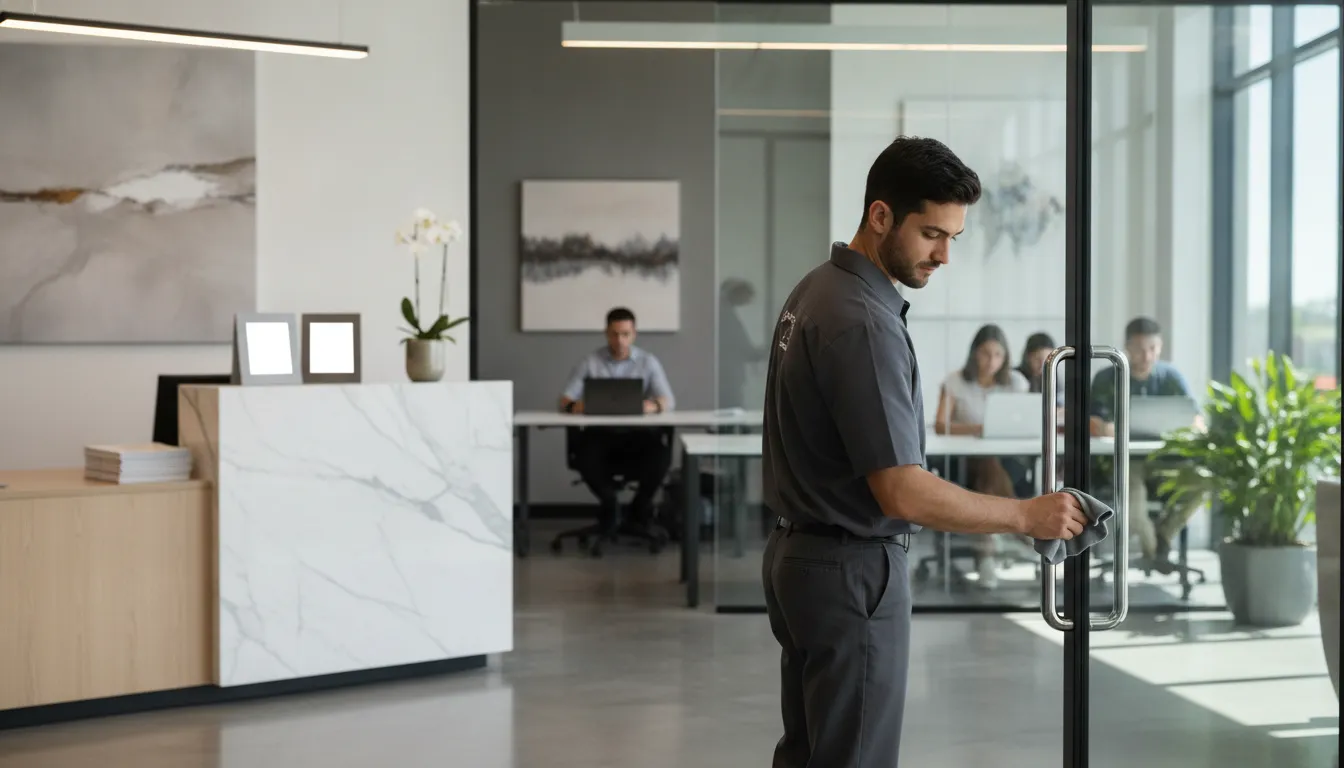
Office owners asking how much does a day porter cost for an office need a useful benchmark, but a benchmark alone cannot define a service plan. During business hours, a spill in a lobby or an overflowing waste receptacle can affect tenant and visitor experience. A restroom that needs attention can create the same problem before a nightly crew arrives. Day porter coverage provides a visible, proactive response while the building is occupied. The right scope follows the facility’s traffic, layout, operating hours, and service priorities.
Request a customized day porter pricing plan for your office building.
Short answer: A published consumer-service pricing reference places day porter work at approximately twenty to forty dollars per porter hour. That is a planning benchmark, not a guaranteed Foreman Pro Cleaning rate. A reliable proposal must account for duties, shift length, frequency, traffic, access requirements, supplies, and local operating conditions in Maryland, Washington, D.C., or Virginia.

For property managers, facilities directors, and office owners, the decision is not simply whether an hourly number looks low. The decision is whether the proposed coverage protects the areas that matter most during the busiest periods. Clear accountability for exceptions and quality control also matters. The sections below explain the major cost drivers and give you a practical way to compare proposals.
How Much Does a Day Porter Cost for an Office?
A published twenty to forty dollars per hour benchmark provides a starting point for day porter budgeting. The final office price depends on scheduled coverage, assigned duties, building traffic, service areas, supply responsibilities, and local operating requirements in Maryland, Washington, D.C., or Virginia.
A reasonable starting point for budgeting is approximately twenty to forty dollars per porter hour, based on the published pricing reference above. The lower or higher end may be appropriate depending on the work involved, the schedule, the facility’s complexity, and the service expectations. Treat the range as a conversation starter rather than as a quote from Foreman Pro Cleaning or any other provider.
The most accurate answer to how much does a day porter cost for an office comes from converting building conditions into scheduled coverage. A small office with limited daytime traffic may need selected coverage during peak periods. A busy, multi-tenant property may need a porter for a larger portion of the workday. A standalone day assignment may also price differently from daytime support coordinated with a broader commercial cleaning services program.
- Scope: Identify restroom replenishment, waste handling, high-touch surface care, glass care, spill response, lobby presentation, and issue reporting.
- Coverage: Define service days, shift hours, response expectations, occupancy patterns, and the periods when traffic is highest.
- Facility requirements: Note floors, restrooms, entrances, kitchens, meeting areas, loading areas, and controlled-access spaces.
- Contract structure: Compare hourly, recurring part-time, full-shift, and integrated day-plus-night service plans.
For transparent budgeting, multiply the cited hourly benchmark by the number of scheduled hours to estimate a service-day labor baseline. That calculation is a planning exercise, not a Foreman Pro Cleaning quote. A written proposal should show which duties are included, how often they occur, and how exceptions are handled.
How Can a Pricing Model Change How Much Does a Day Porter Cost for an Office?
Hourly, recurring part-time, full-shift, and integrated day-plus-night models can all fit an office. The best pricing model depends on the service window, traffic pattern, task list, response expectations, and coordination required between daytime and after-hours cleaning.
Hourly coverage can suit an office that needs a defined list of tasks during a limited window, such as visitor peaks, events, or lunch periods. Recurring part-time coverage may be a better fit when the building needs a predictable presence on selected days or during selected hours. Full-shift service supports properties where conditions change throughout the day and a porter must move between routine work and responsive requests.
An integrated day-plus-night model separates two different operating needs. The day porter maintains appearance and responds to conditions while occupants are present. The after-hours team completes broader scheduled work when the building is less active. When both services are used, the scope should define handoffs so that duties are neither duplicated nor missed.
| Pricing model | Best fit and scope | Primary benefit | Question to clarify |
|---|---|---|---|
| Hourly coverage | Short-term needs, events, peak traffic, or a defined task list. | Flexible scheduling and simple budget testing. | Is there a minimum shift or visit duration? |
| Recurring part-time | Offices needing attention during selected hours or days. | Predictable presence without a full-day assignment. | Do windows cover opening, lunch, and visitor peaks? |
| Full-shift recurring | High-occupancy, multi-tenant, or continuously active buildings. | Proactive attention throughout agreed operating hours. | Are supplies, reporting, inspections, and periodic tasks included? |
| Integrated day-plus-night | Properties needing visible daytime support and broader after-hours cleaning. | Responsive upkeep and scheduled detailed work are coordinated. | How are handoffs and exclusions documented? |
When comparing proposals, ask every provider to price the same assumptions. Include service days, shift length, priority areas, response expectations, supply responsibilities, inspection process, reporting method, and periodic tasks. A documented scope lets a facilities leader compare coverage rather than simply selecting the lowest hourly figure.
How Do Building Size and Shift Hours Change Pricing?
Building size affects day porter pricing because larger or more complex facilities require more travel time, coverage, and coordination. Shift hours affect how often tasks can be completed. Traffic, floors, restrooms, entrances, operating hours, and response expectations can matter as much as square footage for an office plan.
Square footage is useful context, but it is not a complete staffing formula. Two office buildings with similar footprints can have very different daytime requirements. One may have a single entrance, limited occupancy, and few shared amenities. The other may have multiple tenant suites, public-facing areas, frequent deliveries, conference traffic, and restrooms that require more frequent attention.
Shift length also changes what a porter can accomplish. A short service window may focus on priority areas and responsive tasks. A longer window can provide routine checks, waste movement, replenishment, touchpoint care, and issue reporting across more of the building. If a porter must cover several floors, the schedule should allow time for travel between areas, not just time spent performing individual tasks.
Ask for the staffing assumptions behind the proposal. A credible plan should explain the service window and the route through the facility. It should state the frequency of checks and the escalation process for conditions requiring more than routine attention. It should also identify whether the porter works independently or as part of a broader team.
Facilities teams that are evaluating general janitorial budgets may also benefit from the related commercial cleaning cost per square foot guide. That planning perspective is useful, but day porter coverage still requires a duty-and-schedule review because daytime responsiveness is not measured by floor area alone.
What Duties Should a Day Porter Quote Include?
A day porter quote should identify the duties, frequency, service areas, response standard, supply responsibilities, inspection method, and reporting process. Common duties include restroom checks, replenishment, waste handling, lobby and entrance care, spill response, high-touch surface care, and communication of building issues.
Day porter work is most useful when the scope translates a building’s daily rhythm into specific actions. A proposal might include scheduled restroom inspections and replenishment of approved consumables. It may also include waste and recycling handling, spot care for visible floor conditions, entrance and lobby presentation, and response to spills or other immediate issues.
Some offices also need glass and touchpoint care, meeting-room resets, kitchen or break-area attention, loading-area checks, or communication with property management. These duties should not be assumed. List them explicitly, then state whether they are continuous, scheduled at intervals, or performed when requested.
- Routine duties: Scheduled checks and appearance-maintenance tasks for priority areas.
- Responsive duties: Defined response to spills, overflow, unexpected traffic, or tenant requests.
- Supply duties: Replenishment responsibilities and the party providing approved consumables.
- Reporting duties: Escalation of building issues, completed work, exceptions, and inspection findings.
A precise scope prevents a common pricing problem: two providers may use the same label, day porter, while offering materially different coverage. The proposal should identify exclusions as well as included work. Periodic floor care, detailed restroom work, high-level dusting, event support, and emergency response may require separate treatment. Clear boundaries protect both the facilities team and the service provider.
How Does Service Frequency Affect the Office Cleaning Budget?
Frequency affects the budget by changing how much time the porter is scheduled to provide and how quickly conditions are addressed. Daily coverage may support consistent presentation, while selected days or peak-hour visits can target specific needs. The right frequency follows occupancy, traffic, amenities, and response expectations.
A building does not necessarily need the same level of daytime coverage every day. An office with predictable occupancy may benefit from service during the busiest weekdays. A property with variable events, public access, or shared amenities may require a different schedule. The goal is to match staffing to the conditions that affect occupants and visitors, not to purchase unused hours.
Frequency should be considered together with task cadence. Restroom and entrance checks may need a different rhythm from glass care, waste movement, supply replenishment, or issue reporting. Write each task as a frequency or trigger so the provider can staff the plan accurately.
Ask whether the proposal is built around visits, hours, or an ongoing service program. Then ask what happens when a holiday, tenant event, severe weather event, or occupancy change affects the normal schedule. A flexible adjustment process can be more valuable than a low initial number that does not reflect the building’s actual operating calendar.
Foreman Pro Cleaning builds customized plans around facility discovery, documented procedures, trained personnel, and quality control. That approach supports a more useful pricing conversation because the facilities leader can review the proposed duties and coverage before comparing the financial terms.
Mid-article planning questions are also covered in the guide to commercial cleaning RFP questions to ask vendors. Use those questions to request comparable assumptions from each provider.
Ask Foreman Pro Cleaning to review your office’s daytime coverage needs.
How Can Maryland, Washington, D.C., and Virginia Offices Compare Proposals?
Offices in Maryland, Washington, D.C., and Virginia should compare day porter proposals by matching scope, hours, frequency, staffing, supplies, inspections, reporting, and response expectations. Regional operating conditions can affect a proposal, so a facility walkthrough is more reliable than applying one universal rate to every office.
Regional pricing should be treated as a planning consideration, not a substitute for a site review. Labor conditions, parking and access, security procedures, building operations, travel requirements, and facility complexity can change the resources required for a daytime program. A proposal for a controlled-access office may need different coordination from one for a smaller private suite.
Give every provider the same facility profile. Include the service address, approximate footprint, number of floors, restrooms, entrances, kitchens, shared amenities, operating hours, occupancy pattern, and access rules. Add priority duties, desired service days, and reporting expectations. This creates a fairer comparison than requesting a generic day porter rate.
Then compare each proposal in this order:
- What exact duties are included, and what is excluded?
- How many hours and service days are scheduled?
- Who supplies consumables, equipment, and replacement materials?
- How are urgent conditions reported and escalated?
- What inspection, quality-control, and communication process is included?
- How does daytime coverage coordinate with existing office cleaning?
Foreman Pro Cleaning serves commercial facilities across Maryland, Washington, D.C., and Virginia with customized cleaning plans and experience in both facilities management and IT operations. For organizations with controlled areas or higher operational sensitivity, that combined perspective can help align daytime cleaning with access, safety, and continuity requirements.
What Should Office Leaders Ask Before Approving a Day Porter Plan?
Before approving a day porter plan, confirm the schedule, duties, staffing assumptions, supplies, response expectations, inspection process, reporting method, exclusions, and cancellation or adjustment terms. The final proposal should make it easy to understand what the office receives during each scheduled service window.
Price is only one part of the decision. A low hourly figure can become less useful when the scope leaves priority areas uncovered. It can also omit supplies or fail to explain how urgent conditions will be handled. A higher figure may reflect more complete coverage, but the facilities team should be able to see exactly what creates the difference.
Use the following approval checklist:
- Coverage: Are the service days and hours aligned with occupancy and traffic?
- Responsibilities: Are routine, responsive, supply, and reporting duties clearly assigned?
- Quality control: Are inspections, issue escalation, and follow-up documented?
- Coordination: Does the plan work with existing nightly or periodic cleaning?
- Adaptability: Can the schedule or scope change when office operations change?
A walkthrough is valuable because it tests the proposal against real conditions. It can reveal travel time between floors, access restrictions, supply-storage limits, high-traffic areas, and tasks that are easy to overlook in a written request. It also gives the provider enough context to distinguish a budget benchmark from a workable operating plan.
Request an office walkthrough and compare a day porter scope built for your facility.
Frequently Asked Questions About Day Porter Pricing?
Is a day porter priced by the hour or by the building?
Either structure may be used for a day porter plan, depending on the provider and scope. Hourly pricing can describe labor coverage, while a recurring proposal may present a scheduled service amount based on duties, staffing, supplies, inspections, and frequency. Ask what the quoted amount includes before comparing it with another provider’s hourly figure.
Does a larger office always need a more expensive day porter plan?
Not always. Size affects the work, but traffic, number of floors, restrooms, entrances, operating hours, and response expectations also shape staffing. A compact office with heavy public traffic may need more responsive coverage than a larger, lightly occupied office. The walkthrough should evaluate both footprint and activity.
Can day porter service replace nightly office cleaning?
Usually, the two services address different needs. A day porter maintains presentation and responds to conditions while occupants are present. A night team can complete broader scheduled work when the building is less active. Some offices use both services, with a written handoff that prevents duplicate or missed tasks.
What information helps a provider create an accurate quote?
Share the building profile, operating hours, occupancy pattern, priority areas, and desired days and shift length. Include access procedures, current cleaning scope, supply expectations, and reporting requirements. A walkthrough helps when an office has multiple floors, controlled areas, public amenities, or a complex daytime schedule.
