
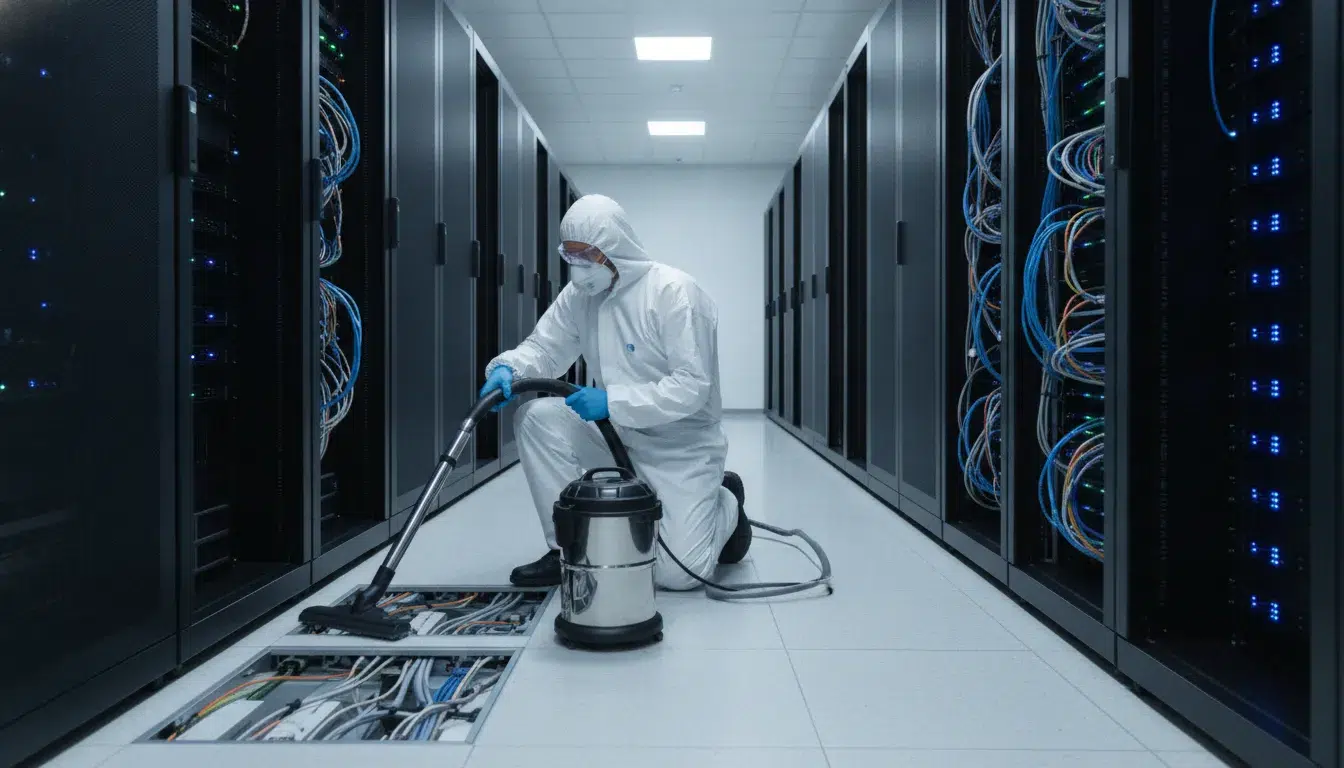
.In a live data center, cleaning is an operational control, not a cosmetic task. The work must account for maintenance windows, change control, access protocols, and airflow. It must also account for rack sensitivity before a technician enters the room.
Data center deep cleaning is a planned contamination-control process that combines defined scope, coordinated scheduling, anti-static methods, HEPA-certified vacuuming, controlled damp-wiping, and post-service verification. A facility-specific plan helps protect uptime while addressing server rooms, raised floors, plenums, hardware surfaces, and cooling-related areas.
Foreman Pro Cleaning builds customized plans around facility staff, IT teams, security requirements, and vendor guidance. Its proprietary critical-environment training and IT operations perspective keep equipment protection central to the work. The first planning decision is determining which spaces and surfaces belong in the scope, and what conditions may require additional controls.
Request a facility-specific review
How Should You Define the Scope of Data Center Deep Cleaning?
A sound scope is a facility map, not a generic list of cleaning tasks. Before work is scheduled, identify the controlled zones, equipment interfaces, floor system, cooling surfaces, access restrictions, and recent infrastructure activity that could affect the plan. The objective is contamination control and operational continuity, with each task matched to the risk profile of the space.
Which Zones and Surfaces Belong in the Scope?
Start by dividing the facility into zones with different sensitivity and access requirements. The scope may include the white space, staging or storage areas, network and server rooms, electrical or mechanical support areas, and transition points between controlled and less-controlled spaces. Document the boundaries clearly so technicians know where clean-zone protocols begin and where airflow or personnel controls change.
Within the white space, define the raised-floor surface and the plenum below it as related but distinct work areas. Surface cleaning addresses the panels, seams, grilles, and accessible edges where particulate can accumulate. Plenum cleaning addresses the concealed space that can influence the air moving toward server cooling systems. Foreman Pro Cleaning treats both as part of a coordinated scope because removing contamination from only the visible surface leaves an incomplete control strategy. Review the dedicated raised-floor cleaning resource when documenting panel access and under-floor requirements.
Next, identify rack exteriors, cabinet tops, cable-management areas, and accessible cooling-system surfaces. The plan should distinguish areas technicians may clean directly from components that require IT, facilities, or manufacturer approval. Cleaning cooling systems and rack environments supports airflow management, but the scope must never assume that a sensitive component can be moved, opened, or contacted without authorization.
How Should Floor Care and Upgrade Conditions Change the Plan?
Floor care deserves its own specification. Anti-static flooring requires compatible agents and methods that do not leave residue capable of attracting further particulate buildup. Note the floor material, finish condition, panel layout, and any areas where tiles must be lifted. Record who will isolate or replace panels, and how removed panels will be protected while work proceeds.
Finally, check for post-upgrade conditions. Server rollouts, cabling projects, equipment replacements, and construction activity can introduce debris or contaminants that require a revised deep-cleaning scope. Coordinate with the project lead before declaring the area ready for routine maintenance. A facility-specific review from Foreman Pro Cleaning can align these zones, surfaces, permissions, and verification needs with the site’s operating requirements.
How Can You Schedule Data Center Deep Cleaning Without Disruption?
A successful schedule treats data center deep cleaning as a controlled facility activity, not an interruption added to the IT calendar. The plan should connect the cleaning scope to approved maintenance windows, change-control requirements, access restrictions, and the responsibilities of every team involved. Foreman Pro Cleaning builds customized plans with facility staff so the work supports operational continuity and contamination control.
What Should Be Confirmed Before the Maintenance Window?
- Map the work to the facility calendar. Identify low-activity periods, planned shutdowns, scheduled maintenance, and restricted operating conditions. Reserve enough time for room preparation, cleaning, inspection, and controlled re-entry. If the facility has multiple zones, sequence them so unaffected areas remain available.
- Complete change control and scope approval. Document the rooms, raised-floor areas, rack exteriors, cooling surfaces, and other approved targets. Note what technicians may touch, what must remain untouched, and which systems require an IT or facilities escort. The scope should also define containment, airflow, approved anti-static methods, and the evidence required at closeout.
- Coordinate staffing, access, and vendors. Confirm pre-cleared personnel, badging or escort requirements, loading access, staging locations, and the facility contact who can authorize each phase. Include IT operations, facilities, security, and hardware vendors when manufacturer guidance or warranty conditions affect the work. Technicians should understand the site airflow plan and equipment-protection requirements before arrival.
- Set an escalation path. Name the decision-maker for unexpected alarms, access changes, visible contamination, airflow concerns, or a condition outside the approved scope. Establish stop-work criteria and the communication channel for immediate notification. This prevents an on-site question from becoming an improvised decision near sensitive infrastructure.
- Schedule verification and controlled handback. Allow time for surface-cleanliness checks, particle-count testing when required, documentation, and review with the facility representative. Record any baseline observations that should inform the next service interval. A clean appearance alone is not sufficient evidence of contamination control.
When Should You Add a Post-Upgrade Cleaning Window?
Do not wait for the next routine appointment after a major infrastructure upgrade, installation, or construction activity. Those projects can introduce post-construction debris and contaminants. The schedule should include a targeted cleaning review after the work area is released and before normal operations resume. The timing must still follow change control and vendor requirements. A phased approach may be appropriate when several rooms or equipment rows are affected.
Request a facility-specific review
For complex environments, the right cadence depends on activity, access rules, infrastructure changes, and the facility’s verification requirements. A documented plan gives every stakeholder a shared sequence and a clear point of escalation. While allowing the cleaning team to work inside the maintenance window rather than competing with it.
Which Anti-Static and HEPA Controls Protect Equipment?
In a sensitive IT environment, the cleaning method is part of the protection plan. A visible surface may look acceptable while fine particulate remains near rack inlets, under access panels, or on raised-floor surfaces. Foreman Pro Cleaning treats contamination control as the operating priority, using procedures that account for the equipment environment rather than applying a general commercial cleaning routine.
How Does ESD Control Reduce Equipment Risk?
Electrostatic discharge control begins before a technician touches a surface. Personnel should follow the facility’s grounding requirements and use specialized anti-static equipment appropriate for the room. The objective is to prevent a static event from transferring energy to sensitive components during work around racks, cabinets, cabling, or control hardware.
Floor care requires the same discipline. Anti-static flooring should be cleaned with agents selected for that surface and environment. A product that leaves residue can attract additional particulate and undermine the intended control. Technicians should confirm the flooring specification, approved products, access restrictions, and any vendor requirements with facility stakeholders before starting.
Why Do HEPA Vacuuming and Damp Wiping Work Together?
HEPA-certified vacuuming captures particulate at the point of removal instead of redistributing it through the room. It is especially important around floor edges, cable pathways, rack exteriors, and other locations where loose material can be drawn toward cooling airflow. Vacuuming must be performed with controlled movement and suitable attachments, not aggressive contact with hardware.
Damp wiping addresses bonded residue and fine films that vacuuming alone cannot remove. The cloth, solution, pressure, and sequence must match the surface. Technicians should avoid applying moisture directly to equipment and should keep liquids away from openings, connectors, and active components. The process also includes residue control, because a surface that appears polished is not necessarily a surface that supports contamination control.
| Control | Primary purpose | Planning question | Verification focus |
|---|---|---|---|
| Grounding and anti-static tools | Reduce ESD exposure during contact with sensitive areas | What grounding and approved-tool requirements apply? | Confirm personnel and equipment followed the facility protocol |
| HEPA-filtered vacuuming | Capture loose particulate without broad redistribution | Which floor, rack, and access-panel areas can be reached safely? | Inspect treated surfaces and check for remaining particulate |
| Controlled damp wiping | Remove residue from approved non-porous surfaces | Which materials, solutions, and moisture limits are approved? | Check for residue, moisture, and surface condition |
| Airflow-aware sequencing | Limit migration toward sensitive equipment | How should work align with cooling and access conditions? | Review the completed scope and facility measurements |
These controls are effective only when combined with facility-specific planning. Foreman Pro Cleaning uses proprietary critical-environment training and an IT operations and facilities-management perspective to align tools, sequence, and access conditions with the room. The result is a data center deep cleaning process designed around equipment protection, measurable cleanliness, and operational continuity.
What Access and Airflow Controls Should Be Agreed Before Work?
In a secure data center, the cleaning plan must account for more than the work area. Facility security, IT operations, environmental controls, and equipment protection all intersect at the clean-zone boundary. Resolve those requirements before the maintenance window so technicians can enter, work, and exit without creating an uncontrolled change to the operating environment.
How Should Access and Clean-Zone Entry Be Controlled?
Start with a written access protocol. Identify each technician by name, complete the facility’s required pre-clearance and background process, and confirm whether badging, escorts, or point-of-contact check-ins apply. Define the approved entry route, staging location, restricted areas, and rules for moving materials through the facility. Security staff should know the planned schedule, while the facilities or IT lead should have authority to pause work if an access condition changes.
Clean-zone entry requirements should be equally specific. Confirm the required personal protective equipment, hand hygiene, garment changes, and material controls before anyone crosses the boundary. Personnel entering the clean zone should use specialized PPE to minimize contaminant introduction. Keep packaging, untreated materials, and unnecessary personal items outside the controlled area. These details are not administrative overhead. They protect the zone from avoidable particulate transfer during every movement.
How Can Airflow and Equipment Protection Be Coordinated?
Agree on the airflow strategy with the facility team before work begins. The plan should identify supply and return paths, adjacent spaces that could introduce contaminants, doors that must remain closed, and any temporary isolation or pressure-control measures. Airflow management helps prevent migration from less controlled areas into sensitive zones. It also gives the team a clear response if conditions shift during the work.
Technicians must understand how their actions interact with racks, cooling infrastructure, raised-floor systems, and active hardware. Establish no-contact boundaries around exposed equipment, cable pathways, sensors, perforated tiles, and CRAC surfaces. Protect equipment from moisture, static discharge, impact, and unintended obstruction of cooling paths. If access panels or floor tiles must be moved, assign responsibility for removal, protection, and documented replacement.
Hardware vendors and authorized maintenance providers should be included when manufacturer-specific restrictions apply. Coordination keeps cleaning protocols aligned with vendor guidance and helps protect hardware warranties. Foreman Pro Cleaning brings an IT operations and facilities-management perspective. Supported by proprietary critical-environment training and CET context, to coordinate these controls with the people responsible for the infrastructure.
How Do You Verify a Data Center Deep Cleaning Result?
A finished service should be evaluated against the facility’s contamination-control objectives, not judged solely by whether the room looks orderly. Visual inspection is useful for confirming that accessible floors, rack exteriors, cable pathways, and other agreed surfaces appear free of visible residue. It cannot establish airborne particle conditions, reveal contamination in concealed areas, or prove that a cleaning process protected the operating environment. Verification should therefore combine observation with defined measurements and service documentation.
What Should a Post-Service Inspection Check?
Begin with a documented walk-through involving the cleaning lead and an authorized facility representative. Compare the completed work with the approved scope, including any raised-floor or plenum areas, equipment-adjacent surfaces, cooling infrastructure, and access points. Note exceptions rather than treating an inaccessible area as complete. If hardware vendors supplied handling restrictions, record whether the work followed those instructions. This creates a clear distinction between work performed, work deferred, and conditions that require a separate maintenance window.
Surface-cleanliness checks add a more useful layer of evidence. Use the facility’s agreed method and sampling locations to assess representative surfaces, especially areas where particulate accumulation could be redistributed into equipment airflow. Results should identify the location, method, date, and acceptance criterion. A visual pass without a defined sampling approach is an observation, not a complete cleanliness verification.
How Do Particle Counts Support a Defensible Baseline?
Post-service particle counts can establish a baseline for future maintenance decisions and help the facility define its required air-quality class. ISO 14644-1 classifies air cleanliness in cleanrooms and clean zones by airborne particle concentration. It should be used carefully here: the standard provides a classification framework, not an automatic promise that every data center must meet a particular class. The facility team should determine the appropriate reference, sampling locations, operating state, and acceptance criteria before testing. See this guide to cleaning standards for deep cleaning for related context.
The final report should connect measurements to decisions. It can include the approved scope, maintenance window, personnel and access notes, areas inspected, surface-check results, particle-count data, exceptions, corrective actions, and recommendations for the next review. Retaining that record supports audit readiness and makes future comparisons meaningful. Foreman Pro Cleaning approaches verification through contamination control. Using proprietary critical-environment training and an IT operations perspective to document what changed without overstating what a single service can prove.
What Should a Recurring Data Center Deep Cleaning Plan Include?
A recurring plan should be treated as a controlled maintenance program, not a fixed calendar appointment. The right cadence depends on facility conditions, traffic, construction activity, equipment density, and the operating team’s cleanliness objectives. Foreman Pro Cleaning, LLC builds each plan around contamination control and operational continuity. Using its critical-environment training and IT operations perspective to define work that can be performed safely within the facility’s procedures.
Which Events Should Trigger a Schedule Review?
Start with a baseline schedule, then identify conditions that warrant an earlier review. A data center deep cleaning plan may need adjustment after a server rollout, cabling project, equipment replacement, or other infrastructure upgrade. Post-construction debris and newly introduced contaminants should be addressed as part of the change-control process, rather than waiting for the next routine visit.
Traffic and access patterns also matter. Increased vendor activity, renovation in an adjacent area, changes to the raised-floor environment, or visible changes in particle accumulation can justify a condition-based assessment. Facility managers can use the data center deep cleaning schedule guide as a planning reference, then adapt the interval to site-specific observations and maintenance windows.
What Should Each Service Record Capture?
Every visit should produce a usable record, not simply a completion note. Document the date, approved work area, access conditions, maintenance window, personnel, equipment controls, and any deviations from the planned scope. Record observations about rack environments, cooling surfaces, floors, and other areas that may influence the next review. If particle counts or surface-cleanliness checks are performed, retain the results with the service report so future measurements can be compared with the established baseline.
Stakeholder review should include facilities, IT operations, security, and relevant hardware vendors when manufacturer guidance affects the work. That review can confirm whether cleaning methods remain compatible with equipment requirements and whether a recent infrastructure change calls for revised controls. For a broader view of scope and coordination, see Foreman Pro’s professional data center deep cleaning resource.
This record-based approach keeps recurring work responsive. It connects each visit to facility conditions, documents why the timing was selected, and gives decision-makers a defensible basis for changing the plan when the environment changes.
Frequently Asked Questions
How often should a data center be deep cleaned?
There is no universal interval. Review the plan against facility conditions, maintenance windows, infrastructure changes, access requirements, and observed contamination. A condition-based schedule can also account for construction or equipment upgrades, which may introduce new particulate concerns. Keep service records and verification results so the next review uses documented conditions rather than appearance alone.
What areas are included in a data center deep cleaning?
The scope may include server rooms, floors, raised-floor surfaces, under-floor plenums, rack environments, and cooling-system surfaces. The exact work should be mapped before the maintenance window, with sensitive zones, exclusions, access points, and escalation contacts identified. Raised-floor work should address both visible surfaces and the plenum when appropriate, because disturbed particulate can re-enter cooling airflow.
What controls protect equipment during cleaning?
Foreman Pro Cleaning uses anti-static, HEPA-certified vacuuming and damp-wiping protocols for critical environments. The work plan should also define grounding and ESD controls, airflow boundaries, approved materials, and equipment-protection procedures. Coordinate with IT staff and hardware vendors when manufacturer guidance or warranty conditions affect the approved method.
How do you verify that the cleaning was effective?
Verification can combine visual inspection with surface-cleanliness checks and particle counts. Post-service particle counts can establish a facility baseline and help define the applicable air-quality class. A service report should record the completed scope, exceptions, verification data, and follow-up actions, supporting operational review and audit readiness.
How Can You Start Planning the Work?
Data center deep cleaning is most effective when scope, access, equipment controls, scheduling, and verification are agreed before the team enters the facility. A facility-specific plan can align the work with maintenance windows and the operating requirements of your server, network, or critical environment.
Foreman Pro Cleaning supports commercial and critical environments across Maryland, Washington, D.C., and Virginia with customized plans, proprietary critical-environment training, and an IT operations perspective.
