
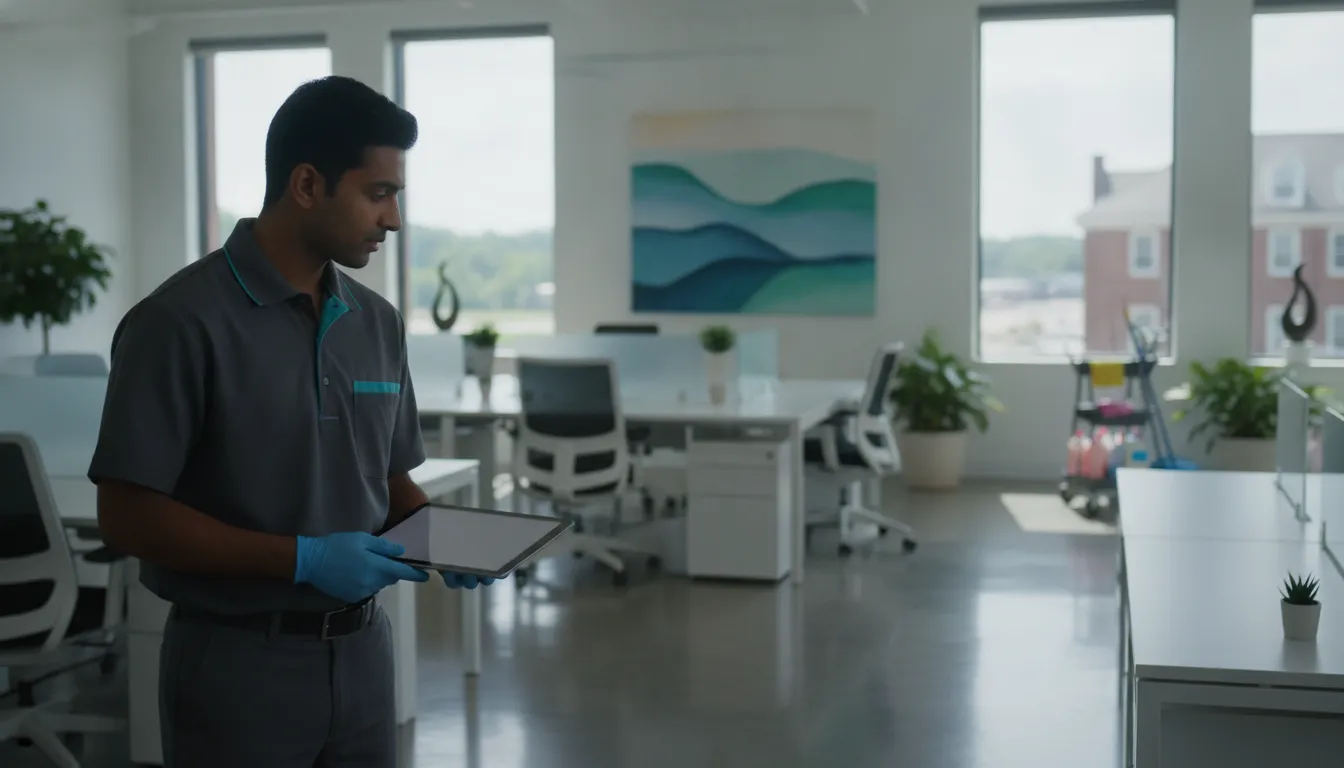
A cleaning contract can look complete on paper and still leave important questions unanswered.
Start before proposals arrive. Define the facility, operating schedule, traffic patterns, sensitive areas, service standards, and the documentation your team needs to review performance.
Effective virginia commercial cleaning is not a one-size-fits-all package. Buyers should compare providers by the quality of their facility assessment, scope of work, staffing and safety training. Environment-specific procedures, scheduling plan, and quality reporting, then select a program that fits the site’s actual risks and operating demands.
Foreman Pro Cleaning, LLC approaches conventional facilities and critical environments through customized planning, supported by experience in facilities management and IT operations. Before requesting proposals, clarify what must be serviced, how work will be verified, and which conditions require specialized expertise.
Request a facility walkthrough to discuss a customized scope and proposal.
What should a Virginia commercial cleaning buyer define before requesting proposals?
A useful proposal starts with a defined operating picture, not a generic list of rooms. Before contacting providers, document what the facility is used for, who moves through it, which areas require controlled access, and what service interruptions are acceptable. This gives each provider the same baseline and makes scope differences easier to evaluate.
Begin with a facility assessment. Record the approximate square footage, floor plan, restroom count, entrances, stairwells, break areas, workstations, storage rooms, and any spaces that need specialized handling. Note surfaces and finishes that require different care, along with areas where equipment, records, or sensitive operations limit access. Foreman Pro uses a walkthrough and discovery stage before developing a tailored cleaning plan, so the assessment should be specific enough to support an on-site conversation. Review custom commercial cleaning plans for the broader program context.
Next, define traffic and timing. Identify peak occupancy periods, visitor traffic, shift changes, delivery windows, and days when certain rooms are vacant. Then separate daily priorities from periodic work. A proposal may need to distinguish recurring tasks from quarterly deep cleaning or rotational maintenance, because service frequency should follow facility needs rather than an assumed package. Document whether the program must operate after hours, overnight, early in the morning, on weekends, or during a maintenance window.
Scope should also reflect the facility type and its risk profile. An office may prioritize consistent appearance, employee health, client impressions, scheduling, accountability, and cross-contamination prevention. A medical, educational, retail, or sensitive technical space may require different procedures, training, access controls, or documentation. Do not ask providers to price or design one universal program for mixed environments. If recurring operational support is the primary need, compare the proposed coverage with the expectations described in structured janitorial services.
Finally, list compliance requirements and specialized protocols before the walkthrough. Proposal inputs can include layout, foot traffic, frequency, environment type, compliance requirements, and specialized equipment or procedures. Focusing the scope on those variables helps buyers compare what is actually included, how work will be scheduled, and how accountability will be documented. The result is a proposal grounded in the facility’s operating needs rather than an unclear promise to provide routine cleaning.
How can you compare cleaning scopes, staffing, and training fairly?
A fair comparison starts with the work required, not with a checklist of generic tasks. Ask each provider to evaluate the facility, document the scope, identify the staffing model, and explain how training supports the environment. Foreman Pro builds customized programs for conventional facilities and sensitive environments, including data centers, laboratories, cleanrooms, and command centers. Custom commercial cleaning plans should reflect the facility’s layout, traffic, operating schedule, and risk profile.
Use the same questions for every proposal. The goal is to compare the completeness and accountability of each program without reducing the decision to a number.
| Criterion. | What to request. | What a strong response shows. |
|---|---|---|
| Scope. | Room-by-room tasks, surfaces, frequencies, periodic work, and exclusions. | A written scope tied to the facility assessment rather than a generic package. |
| Staffing. | Assigned roles, supervision, coverage during absences, and escalation contacts. | Clear ownership for routine execution, inspections, and issue resolution. |
| Training. | Environment-specific training, safety standards, equipment procedures, and onboarding. | Training that matches the facility, materials, hazards, and required protocols. |
| Schedule. | Service windows, frequency, porter coverage, and coordination with operations. | A workable schedule with service windows matched to operations. |
| Quality control. | Inspection method, reporting cadence, corrective-action process, and review meetings. | Measurable follow-through instead of an informal promise to monitor quality. |
Training should also be evaluated in context. Foreman Pro’s medical cleaning capabilities include bloodborne-pathogen-certified technicians, medical-grade disinfectants, HEPA-filtered vacuums, and compliance documentation. A data center or other sensitive environment calls for a different discussion, including precision cleaning, supervisor quality assurance, post-delivery reporting, and program assessment.
Finally, ask how the provider moves from discovery to delivery. Foreman Pro describes a five-stage framework: walkthrough and discovery, tailored plan development, safety training and standards implementation, reliable execution, and quality control and reporting. That sequence gives buyers a practical way to test whether the proposal connects scope, people, schedule, and accountability into one operating plan.
What changes for medical offices, schools, and retail facilities?
A facility’s use should shape the cleaning plan, not simply the square footage. Medical offices require documented attention to disinfection and exposure risks. Schools need a program that follows the academic calendar and responds to concentrated traffic. Retail facilities must protect customer-facing presentation while working around changing occupancy, deliveries, and merchandise. These are different operating environments, so a Virginia commercial cleaning proposal should explain the methods, staffing, timing, and quality controls selected for the site.
How should medical office cleaning be evaluated?
Healthcare administrators should look for a defined process for environmental surfaces, touchpoints, exam areas, waiting rooms, restrooms, and waste-handling responsibilities. The CDC notes that microorganisms can transfer from environmental surfaces to patients largely through hand contact. It also says appropriate cleaning and disinfection are fundamental to reducing the potential contribution of those surfaces to healthcare-associated infections. CDC environmental services guidance also explains that the choice of disinfection procedure depends on the item, the microorganisms present, organic soil, the germicide, contact conditions, and product directions.
That means a buyer should ask how technicians distinguish cleaning from disinfection, verify product dwell time, document completed work, and escalate an unusual exposure or spill. Foreman Pro’s medical capabilities include bloodborne-pathogen-certified technicians, medical-grade disinfectants, HEPA-filtered vacuums, and compliance documentation, as described in its medical office cleaning programs. Those controls belong in a healthcare-specific scope, rather than being presented as a universal requirement for every ordinary office or storefront.
What should school leaders examine?
Schools need coverage that can scale across classrooms, administrative areas, cafeterias, athletic spaces, corridors, and high-traffic restrooms. Leaders should compare proposed service windows with arrival, dismissal, events, breaks, and academic-calendar changes. A useful plan also identifies who handles routine custodial work, floor care, periodic deep cleaning, and day or night porter coverage. Foreman Pro outlines these as distinct options within its school cleaning programs.
The CDC school toolkit describes cleaning and disinfection as a planning process that must be developed, implemented, maintained, and revised. It also identifies cleaning, disinfection, and hand hygiene as everyday actions schools can use to slow the spread of infectious diseases. CDC school cleaning and disinfection toolkit supports evaluating the plan itself, not just the task list. Ventilation is a separate facilities consideration. CDC guidance identifies it as one component of healthy school environments and recommends that HVAC systems be serviced and meet code requirements. CDC ventilation guidance for schools should inform coordination with the facility’s maintenance team, not be misrepresented as a cleaning task.
How does retail evaluation differ?
Retail scopes should focus on customer-facing consistency, entrance and checkout presentation, restroom readiness, high-touch areas, spill response, and work that can occur without disrupting sales activity. Ask whether the provider can separate opening, operating-hours, and closing tasks, and how supervisors verify visible conditions across changing traffic patterns. Retail does not automatically require medical disinfection protocols or critical-environment procedures. The strongest proposal defines the actual risks and service standards for that store, then assigns appropriate methods and frequency.
How should critical environments be evaluated differently?
A critical facility should not be assessed by the same checklist used for a conventional office. The evaluation must account for contamination control, operational continuity, approved maintenance windows, specialized procedures, reporting, and staff competence. The goal is a cleaning program that fits the facility’s risk profile and operating rules, not a generic janitorial schedule. Foreman Pro identifies these factors as central considerations for data centers, laboratories, cleanrooms, and command centers. Critical environment cleaning programs should therefore begin with a technical walkthrough and a clear understanding of restricted areas, access controls, equipment sensitivities, and site-specific procedures.
What should the walkthrough examine?
For data centers, the scope should extend beyond visible floor surfaces. Ask whether the provider can address raised floors and sub-floor plenums with HEPA vacuuming, where particulate movement can affect the space below the finished floor. The assessment should also identify rack and cabinet surfaces, CRAC units and vents, anti-static flooring, and areas where zinc-whisker mitigation strategies may be relevant. These are specialized service elements documented in Foreman Pro’s Virginia data center cleaning capabilities. They should be discussed as separate work activities with defined methods, access requirements, and approval steps.
Facility managers should also ask how cleaning activity is sequenced around live operations. A sound scope distinguishes routine precision cleaning from work that requires a maintenance window or coordination with the facility team. It should state which areas may be entered, what equipment and materials are permitted. How surfaces are protected, and who authorizes work near racks, cabinets, CRAC surfaces, or anti-static floors. The provider should be able to explain how technicians avoid transferring contaminants between zones without relying on vague assurances.
How can competence and accountability be verified?
Staff competence matters as much as the task list. Ask how technicians are trained for the environment, how supervisors confirm that procedures are followed, and how exceptions or access issues are documented. Critical-environment programs should include consultation, custom program creation, precision cleaning, supervisor quality assurance, post-delivery reporting, and periodic program assessment, rather than treating inspection as an informal visual check. Foreman Pro’s critical-environment approach reflects that distinction.
Finally, evaluate the reporting structure. A useful report connects completed work to the approved scope, identifies findings, records limitations, and gives the facility team a basis for follow-up. This level of documentation helps stakeholders review service performance without implying that cleaning alone guarantees uptime or eliminates contamination risk. In Virginia’s Northern Virginia data-center corridor and Hampton Roads, buyers should expect the evaluation to be specific to the facility, its operating schedule, and its controlled environment.
Discuss your facility’s cleaning requirements
Which scheduling and regional coverage questions matter in Virginia?
Scheduling should be treated as an operating requirement, not an afterthought in a Virginia commercial cleaning proposal. Ask whether the provider can work after hours, overnight, early morning, during business hours, or on weekends without disrupting employees, visitors, tenants, or sensitive operations. Foreman Pro identifies after-hours, overnight, early-morning, weekend, day porter, and, for critical facilities, 24/7 or maintenance-window service as possible scheduling models. The right option depends on occupancy, access controls, noise limitations, security procedures, and the tasks included in the scope.
How should frequency match the facility?
Frequency should follow traffic, layout, use, and risk rather than a generic package. A regularly occupied office may need recurring service five, three, or one day per week. While a facility with specialized floor care or seasonal demands may require quarterly deep cleaning or rotational maintenance. These are planning options, not automatic recommendations. The proposal should explain which areas receive service at each frequency, which tasks are recurring, and which work is scheduled separately. Foreman Pro states that frequency is matched to facility needs through recurring and rotational options, alongside factors such as square footage, layout, restroom count, and foot traffic. See the company’s structured janitorial services for recurring-program context.
What regional questions should Virginia buyers ask?
Coverage should be discussed in terms of the facility’s actual location and operational needs. Foreman Pro documents regional operations in Northern Virginia and Hampton Roads, including Northern Virginia’s data-center corridor and the Hampton Roads market. Those clusters are especially relevant when a facility requires coordinated access planning, specialized procedures, or maintenance-window work. A buyer should confirm who will supervise the account, how local response is handled. Whether the team can support the required schedule, and how coverage is maintained when staffing or site conditions change.
For location-specific context, review the page for Virginia Beach commercial cleaning and the page for Richmond commercial cleaning services. These links document specific markets; they should not be read as a guarantee of service in every Virginia locality. The most reliable next step is a walkthrough that confirms travel, access, staffing, frequency, and the maintenance windows your facility can support.
How do inspections, reporting, and communication protect service quality?
A cleaning program becomes easier to manage when its standards are visible. A facility manager should be able to understand what was assigned, what was completed, what was observed during inspection, and what action is recommended next. This is especially important when several shifts, areas, or specialized protocols are involved. The objective is not to create paperwork for its own sake. It is to establish a practical record that supports accountability and informed decisions.
Foreman Pro’s service delivery framework places quality control and reporting after walkthrough and discovery, plan development, training, and execution. That sequence connects the inspection process to the facility’s actual scope instead of relying on a generic checklist. A plan may account for square footage, layout, restroom count, foot traffic, service frequency, environment type, compliance requirements, and specialized protocols. Managers can review the company’s custom commercial cleaning plans to see how those variables shape service design.
What should a useful inspection examine?
An inspection should reflect the agreed scope and the conditions that matter in that facility. Depending on the environment, observations may include completion of assigned areas, appearance standards, restroom conditions, floor-care requirements, access issues, supply concerns, and any variance from the documented procedure. In a sensitive environment, the review may also address whether specialized procedures were followed and whether work was coordinated with maintenance windows.
Supervisor quality assurance adds an independent review between routine execution and the customer’s operational assessment. For critical-environment programs, Foreman Pro identifies consultation, custom program creation, precision cleaning, supervisor quality assurance, post-delivery reporting, and program assessment as parts of the service model. These steps help separate a completed task from a verified result, without claiming that any cleaning program can eliminate every operational or contamination risk.
How does reporting improve communication?
Post-delivery reporting gives the facility team a shared reference point. A useful report can document the service date, areas reviewed, observations, exceptions, corrective actions, and items requiring customer input. It should also make ownership clear. If access was unavailable, a maintenance activity changed the schedule, or a condition needs a different treatment, recording that context prevents assumptions from becoming recurring defects.
Regular communication then turns those records into program assessment. Managers can identify patterns, ask focused questions, and adjust frequency, staffing, or procedures when facility conditions change. The result is a more measurable working relationship: expectations are defined in advance, inspections test them, reports explain the findings, and communication supports the next decision.
What should a facility-specific commercial cleaning proposal include?
A credible proposal should show how the provider understood your facility before recommending a service model. It should connect the work plan to layout, traffic, operating hours, environment type, and documented requirements rather than present a generic package. Foreman Pro’s service framework begins with walkthrough and discovery, then moves through tailored plan development, safety standards, execution, and quality control reporting (service delivery framework).
- Walkthrough and discovery. Confirm that the provider has assessed the facility in person or completed an equivalent detailed review. The discovery should identify access points, occupied areas, sensitive spaces, operational constraints, and the outcomes your team needs to monitor.
- Facility map and scope of work. Look for room-by-room or zone-based coverage, including restrooms, common areas, entrances, workspaces, floor surfaces, and any restricted locations. The scope should distinguish routine tasks from periodic or specialized work, with clear service boundaries.
- Staffing and training. The proposal should identify the expected team structure, supervision, onboarding, and training standards. If the facility has medical, laboratory, technology, or other sensitive areas, ask how procedures and competency requirements change for those environments.
- Schedule and frequency. Require specific service windows and task frequencies. Options may include early morning, after-hours, overnight, weekends, day-porter coverage, or maintenance windows, depending on facility operations. Frequency should follow traffic, use, risk, and seasonal demands, not a default schedule.
- Safety and compliance requirements. Document access controls, personal protective equipment, chemical handling, incident procedures, waste streams, and any customer-specific standards. The proposal should state which requirements are included and which depend on information or approvals from your organization.
- Inspection and reporting cadence. Define who performs inspections, what checklist or measures are used, how deficiencies are recorded, and when results are shared. Quality control and reporting create a basis for corrective action without promising that every issue will be eliminated.
- Communication owner and assumptions. Name the day-to-day contact, escalation path, response expectations, and meeting cadence. Also list assumptions about square footage, restroom count, foot traffic, access, furnishings, frequency, specialized protocols, and compliance needs. These inputs affect customized pricing and should be confirmed before approval (commercial cleaning program details).
A written proposal is strongest when another manager can read it and understand exactly what will happen, where, when, and how performance will be reviewed.
Request a facility walkthrough
Frequently Asked Questions
What should I include when requesting Virginia commercial cleaning proposals?
Provide the facility type, approximate size, layout, restroom count, traffic patterns, occupied hours, preferred service windows, and any sensitive areas. Also identify floor-care needs, access procedures, documentation requirements, and specialized protocols. A walkthrough lets the provider validate those details and build a scope around actual operating conditions rather than a generic package. Foreman Pro’s commercial cleaning services follow a discovery and tailored-plan process.
How often should a commercial facility be cleaned?
There is no responsible universal frequency. Offices, retail sites, schools, and medical facilities may require different schedules based on occupancy, traffic, risk, and operating hours. A program may combine recurring service with rotational floor or detail work. Options can include daily, several-times-weekly, weekly, quarterly, or maintenance-based service, but the facility assessment should determine the final cadence.
What should medical facilities ask about cleaning protocols?
Ask how technicians are trained for bloodborne-pathogen risks, how disinfection procedures are selected and documented, and how the program addresses high-touch surfaces and regulated workflows. The CDC identifies cleaning as the necessary first step before disinfection and notes that product directions and contact conditions influence disinfection procedures. Review the CDC environmental services guidance alongside the provider’s written procedures.
What is different about cleaning a critical environment?
Critical environments require more than appearance-focused janitorial coverage. Ask about contamination-control procedures, staff competence, equipment selection, access controls, maintenance windows, supervisor quality assurance, and post-service reporting. For a data center, the scope may address raised-floor and sub-floor plenum HEPA vacuuming, rack and cabinet surfaces, CRAC vents, and anti-static floor care. These methods should be assigned by environment and risk, not applied to every facility.
How can I verify that service quality is being managed?
Request the inspection checklist, escalation path, reporting cadence, and process for correcting missed or changing requirements. Strong programs make the scope visible, assign accountability, and use recurring quality reviews. Foreman Pro describes a five-stage framework that includes safety standards, execution, quality control, and reporting, giving facility managers a practical structure for evaluating ongoing service.
Choosing a cleaning partner is an operational decision. The right program should reflect your facility, schedule, risk profile, and reporting expectations rather than a generic checklist. Foreman Pro Cleaning serves commercial and critical environments across documented Virginia operating clusters, with a facility-specific approach to planning and quality control.
Request a facility consultation and customized commercial cleaning proposal
