
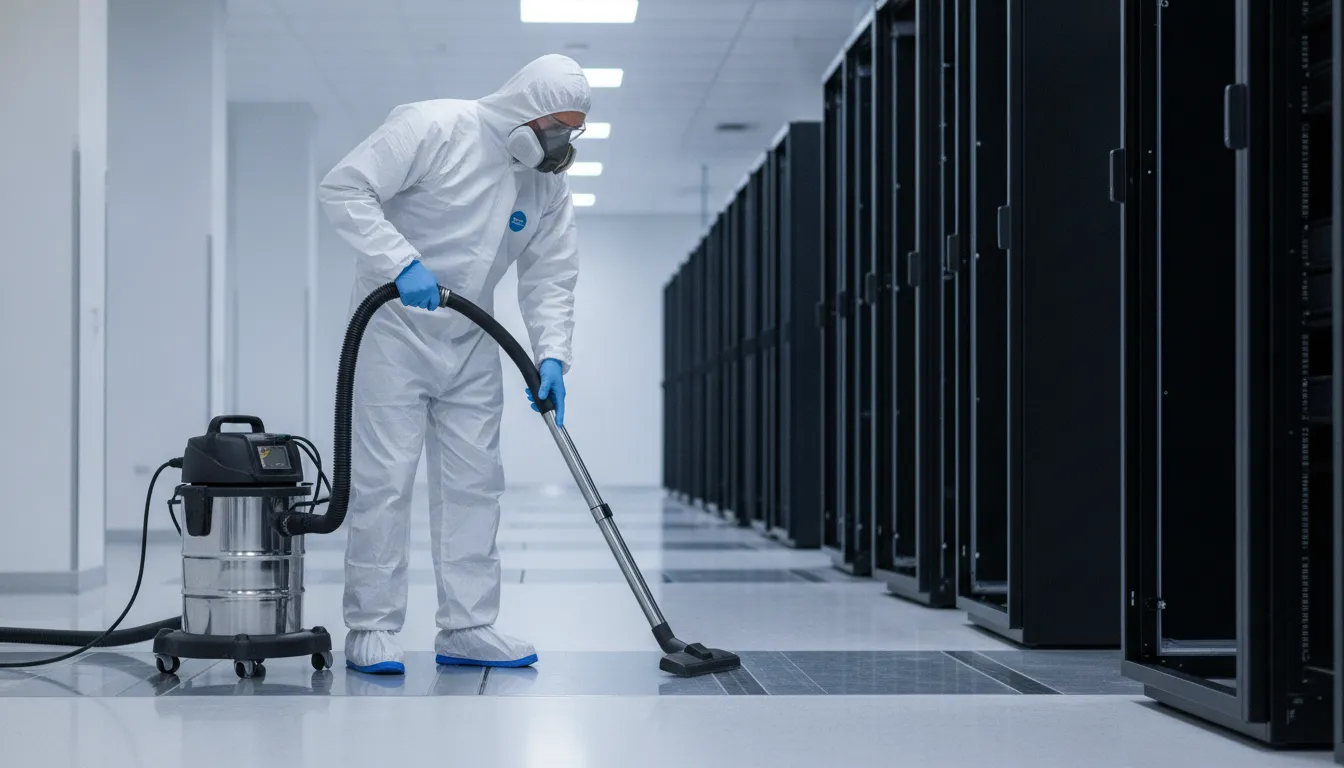
Construction turnover does not end when visible residue is gone. In a data center, raised floors, sub-floor plenums, equipment surfaces, access paths, and adjacent support rooms need a controlled sequence. Inspection records then help the project team evaluate readiness.
Data center commissioning cleaning is a documented readiness activity. It removes construction residue, protects sensitive spaces through static-safe and HEPA-based methods, and verifies that defined areas meet the project team’s agreed criteria before handoff. It supports commissioning decisions, but it does not replace functional testing or authorize the facility for operation.
Foreman Pro Cleaning helps owners, general contractors, commissioning teams, and operators coordinate this work across Maryland, Virginia, Washington, D.C., and Northern Virginia. The process begins by defining what must be inspected, recorded, and corrected, then aligning execution with trade completion and access requirements.
Request a facility walkthrough
The most useful starting point is understanding what this scope can actually verify, and where its boundaries belong.
What Does Data Center Commissioning Cleaning Actually Verify?
Data center commissioning cleaning is a readiness control performed before a facility or defined area transitions into operations. Its purpose is to establish that the space, accessible surfaces, and relevant underfloor areas have been prepared, inspected, and documented against an agreed scope. It contributes evidence to the handoff conversation, but it does not accept the project, validate every building system, or replace the commissioning authority’s functional testing.
What is being verified before handoff?
The cleaning team verifies conditions within its assigned work package. That may include removal of construction residue from equipment-adjacent surfaces and raised-floor components. It may also include pedestals, stringers, the sub-floor plenum, and areas identified by the owner and commissioning team. Foreman Pro Cleaning documents the work through defined methods, checklists, observations, and follow-up actions. Its data center scope includes raised-floor and sub-floor plenum HEPA vacuuming, as well as stringer and pedestal decontamination, when those items are included in the approved plan.
This evidence is useful because commissioning is a quality-control process that can apply during design and across a building’s life cycle, rather than a single final cleaning event. NIST describes testing and verification of design sequences of operation as a commissioning focus. NIST also notes that current commissioning practices require technical expertise and can be labor intensive. Cleaning supports that broader process by controlling a physical readiness condition and recording what was observed, where the team worked, and what remained outside scope.
How does this differ from post-construction cleaning?
Routine post-construction cleaning generally focuses on removing the visible effects of construction so a space can be occupied or presented for turnover. Commissioning cleaning is narrower in purpose and more controlled in execution. It is sequenced around equipment protection, access restrictions, commissioning activities, and the readiness criteria agreed by project stakeholders. A clean-looking room alone does not demonstrate that the underfloor environment, equipment interfaces, or documented exceptions were addressed.
NIST guidance for building systems also describes final inspection and testing procedures before acceptance. That distinction matters. The cleaning report can serve as a documented input to handoff. The owner, general contractor, and commissioning authority retain responsibility for project acceptance and functional system verification. For facilities requiring specialized protocols, review Foreman Pro’s critical environment cleaning approach before defining the work package.
What should the handoff record show?
A useful record identifies the zones covered, methods used, inspection results, observations, exceptions, and corrective actions. It should make clear which conditions were verified by the cleaning team and which decisions remain with the project team. That separation creates a defensible handoff without overstating what cleaning can certify.
How Should Construction Dust and Residue Be Removed Before Handoff?
Construction residue should be removed through a controlled sequence that protects the facility while progressively reducing particulate migration. In a data center commissioning cleaning scope, the objective is not simply to make visible surfaces presentable. It is to prepare defined zones for inspection and handoff without moving residue into rooms, air paths, or equipment areas that are already approaching operational status.
How does source control prevent recontamination?
Start with a walkthrough involving the general contractor, owner representative, commissioning team, facility operations, and affected trades. Identify active work, material staging, access routes, temporary barriers, waste points, and areas where overhead or mechanical work could release additional residue. The cleaning plan should define white space, support rooms, corridors, electrical and mechanical spaces, loading paths, and any restricted areas separately. It should also record which zones are ready for cleaning and which remain under trade control.
Sequence work from the cleanest completed areas toward less-controlled construction zones. Maintain separation between cleaned and active work areas. Use dedicated tools or established changeover controls where appropriate. Pause or repeat cleaning when a trade reopens a ceiling, floor, pathway, or enclosure. This change-control step matters because a completed cleaning pass cannot validate a zone that has materially changed afterward.
Which methods protect surfaces and sensitive equipment?
Use HEPA vacuuming and suitable microfiber methods for floors, ledges, cabinets, pathways, and other specified surfaces. Foreman Pro Cleaning supports raised-floor and sub-floor plenum HEPA vacuuming, stringer and pedestal decontamination, rack and cabinet cleaning, CRAC surface cleaning, and vent and return cleaning. The raised-floor scope should follow the project’s access, tile-handling, and inspection requirements. For background on subfloor plenum requirements, coordinate the cleaning method with the owner and commissioning team before work begins.
Energized or sensitive equipment should not be treated as ordinary construction surfaces. Before cleaning near energized cabinets, controls, sensors, cable pathways, CRAC units, or active air intakes, confirm the equipment boundary and access authorization. Confirm isolation requirements and the approved method with the responsible facility or trade lead. Do not open, move, disconnect, or wet-clean components unless the responsible party has specifically authorized that action. Static-safe protocols and appropriate floor-care methods should be selected for the installed flooring and operating condition.
How should cleaning coordinate with the handoff team?
Agree in advance on zone boundaries, acceptance observations, rework triggers, photographs if permitted, and the person who can release a cleaned area for inspection. Foreman Pro’s critical-environment process includes consultation, custom program creation, precision cleaning, quality assurance, and a post-delivery report. Supervisors inspect against checklists and SOPs, then document outcomes, observations, and insights. That record gives the GC and owner a clear cleaning status without implying that cleaning alone performs functional commissioning or accepts the entire project.
Which Raised-Floor and Room Readiness Checks Belong in the Scope?
A commissioning cleaning scope should define what “ready” means for each zone, surface, and access condition. The owner, general contractor, commissioning team, and facility operator should agree on those criteria before work begins. Readiness is not a universal cleanliness threshold, and cleaning verification does not replace functional testing or the authority responsible for project acceptance.
Start with a room-by-room walkthrough and identify the surfaces that can retain construction residue or affect equipment access. Foreman Pro Cleaning’s data center capability includes raised-floor and sub-floor plenum HEPA vacuuming. It also includes pedestal and stringer decontamination, anti-static care for ESD flooring and concrete, and cleaning for racks, cabinets, CRAC surfaces, and vents or returns. These services should be translated into a project-specific checklist rather than treated as an automatic package. See this data center deep cleaning planning resource when building the initial scope.
| Area | Readiness focus | Record |
|---|---|---|
| Tiles, pedestals, and stringers | Confirm accessible surfaces are free of visible residue and that removed tiles, supports, and edges receive the agreed treatment. | Zone checklist, exceptions, and rework status |
| Raised-floor plenum | Verify the assigned plenum areas were HEPA vacuumed with access points and exclusions documented. | Area map, method, date, and technician initials |
| ESD flooring and concrete | Use the approved static-safe floor-care method and note areas requiring protection or restricted access. | Method record and inspection observations |
| CRAC surfaces, vents, and returns | Check accessible exterior surfaces and air-path grilles for construction residue without disturbing controls or components. | Equipment or zone ID, status, and exceptions |
| Racks and cabinets | Define whether cleaning covers exterior surfaces, interiors, cable-management areas, or only uncommissioned assets. | Asset list, authorized scope, and exclusions |
| Cable pathways and doors | Inspect reachable pathways, thresholds, frames, and door surfaces for residue that could be transferred during occupancy. | Room checklist and corrective actions |
| Adjacent support rooms | Include staging, electrical, storage, network, loading, and service areas when they connect to the turnover path. | Room inventory, access notes, and completion record |
Records should identify the room or zone, date, method, access limitations, observed exceptions, and disposition. Where energized equipment, active controls, or incomplete trade work limits access, the record should say so plainly instead of implying full coverage. The commissioning team can then determine whether the exception affects its inspection sequence or requires another cleaning window.
This level of specificity helps the cleaning crew coordinate around cable work, equipment installation, and controlled access. It also gives the owner and facility team a traceable basis for reviewing readiness before handoff. The distinction between a clean environment and a fully commissioned data center remains clear.
When Should Cleaning Occur in the Commissioning Sequence?
Cleaning should be scheduled as a controlled readiness activity after construction debris-producing work is substantially complete, but before final inspection and operational handoff. The exact date depends on the owner’s commissioning plan, energized equipment status, trade access, and the areas still subject to change. Treating it as a late cosmetic pass can force crews to work around installed equipment or repeat work after additional trades return.
A practical sequence keeps cleaning connected to, but separate from, functional commissioning. NIST describes commissioning as including the testing and verification of design sequences of operation. Removing particulate residue can support room readiness and equipment protection, but it does not prove that electrical, mechanical, controls, fire protection, or cooling systems perform as designed. NIST’s commissioning guidance provides the appropriate distinction between cleaning input and system verification.
- Walk through the facility and establish the sequence. The owner, general contractor, commissioning authority, operations team, and cleaning lead should identify zones and unfinished work. They should also identify energized spaces, restricted pathways, equipment-protection requirements, and the events that must occur before access is granted. Confirm whether the scope includes the white space, raised-floor system, support rooms, loading or staging areas, and adjacent mechanical spaces.
- Approve the scope and access plan. Document the areas, methods, responsible parties, exclusions, and inspection criteria before mobilization. Coordinate badge access, escorts, security rules, material staging, isolation requirements, and waste handling. Foreman Pro Cleaning can coordinate work around maintenance windows, overnight or early-morning access, weekends, and other approved after-hours periods. Those arrangements should be agreed with the facility operator rather than assumed.
- Wait for trade completion or controlled release. Dust-generating overhead, cabling, flooring, drywall, mechanical, and equipment-installation work should be complete in the zone being cleaned, or formally released in phases. If trades must return, define barriers and change control so new work does not invalidate an inspected area.
- Perform controlled cleaning by zone. Use the methods specified for the environment, such as HEPA vacuuming of raised-floor and sub-floor plenums. Use careful treatment of pedestals and stringers, plus approved cleaning of accessible equipment-adjacent surfaces. Foreman Pro’s controlled environment cleaning approach is structured around the facility’s conditions, safety requirements, and access constraints.
- Inspect, record exceptions, and rework. A supervisor should inspect against the agreed checklist and SOPs, identify residue, inaccessible areas, damage, or scope exceptions, and route corrective work to the responsible party. Inspection findings are evidence for the cleaning scope, not acceptance of the entire commissioned system.
- Release the zone with handoff documentation. Provide the approved scope, areas completed, dates, methods, inspection results, exceptions, corrective actions, and post-work observations. The owner and commissioning authority retain responsibility for functional testing, sequence verification, and final acceptance. Cleaning is one documented input to that decision, not a substitute for commissioning.
What Documentation Supports a Defensible Data Center Handoff?
A defensible handoff record shows what was included, where work occurred, how it was performed, and what remained outside the cleaning scope. It should help an owner, general contractor, commissioning authority, and facility team review the same evidence without treating cleaning documentation as acceptance of the entire project.
What should the scope record identify?
Start with the approved scope and a defined area list. Record the building, room or zone names, floor or suite, raised-floor areas, support spaces, and any exclusions. Include the planned work date, completion date, access window, responsible contacts, and access controls used for sensitive areas. If work was divided across shifts or maintenance windows, identify those work periods rather than presenting the project as one undifferentiated visit.
The method record should describe the work at a useful operational level. Depending on the approved scope, that may include HEPA vacuuming of raised-floor and sub-floor plenum areas. It may also include pedestal and stringer treatment, anti-static floor care, rack or cabinet cleaning, and CRAC surface or vent and return cleaning. It should also identify the equipment and protocols used, along with any coordination requirements for energized equipment, restricted zones, escort procedures, or concurrent trades. Foreman Pro documents its critical-environment workflow through consultation, custom program creation, precision cleaning, quality assurance, post-delivery reporting, and program assessment. Foreman Pro’s critical-environment cleaning process provides the company-specific context for that approach.
How should inspection and exceptions be captured?
Inspection records should connect observations to specific zones and agreed project criteria. A supervisor checklist can identify the areas reviewed, surfaces inspected, visible residue or construction material observed, access limitations, and any work requiring correction. Do not replace a finding with a broad statement such as “complete” when an area was inaccessible or excluded.
Photos can strengthen the record when the owner permits photography and security procedures allow it. Use them to document representative conditions, exceptions, or completed corrective actions, with the zone and date recorded. Avoid photographing sensitive information, equipment displays, badges, or restricted materials without explicit authorization.
Who makes the acceptance decision?
The final package should include corrective-action status, outstanding exceptions, reviewer names, dates, and sign-off fields for the appropriate parties. Foreman Pro’s Critical Environment Supervisors inspect against checklists and SOPs, then report outcomes, observations, and insights. That post-delivery report supports review, but the owner, GC, and commissioning authority retain responsibility for determining whether the project or area is accepted.
For teams defining the broader responsibilities around readiness and technical assurance, critical environment certification offers related context. The cleaning record remains one controlled, reviewable input to the handoff, not a guarantee that building systems have passed functional commissioning.
How Can Owners Choose a Commissioning Cleaning Partner?
The right partner should understand that commissioning-phase cleaning is a controlled readiness activity, not a final pass by a general janitorial crew. NIST describes commissioning as a quality-control process that can continue across a building’s life cycle and notes that effective commissioning requires technical expertise. That context matters when evaluating a cleaning provider: the provider should be able to explain how its work supports inspection and handoff without claiming authority over the entire project.
What technical capabilities should the partner demonstrate?
- Specialized training: Ask who performs the work, how personnel are trained for critical environments, and whether supervisors understand access controls, sensitive equipment, contamination pathways, and project-specific SOPs.
- Appropriate equipment and methods: Confirm the scope includes HEPA vacuuming for raised floors and sub-floor plenums. Confirm static-safe protocols, anti-static floor care, and suitable treatment of racks, cabinets, CRAC surfaces, vents, returns, pedestals, and stringers. These are documented capabilities of Foreman Pro’s data center cleaning service.
- Supervisor-led quality assurance: Look for documented inspections against checklists and SOPs, a process for recording exceptions, and a post-delivery report. A credible provider should distinguish cleaning observations from functional testing or formal project acceptance.
How should execution and reporting be evaluated?
Require a written plan that identifies zones, exclusions, protection requirements, trade interfaces, access approvals, and rework procedures. The provider should coordinate with the general contractor, commissioning team, facility operations, and other trades rather than entering controlled areas without a defined release. Reporting should identify the areas addressed, methods used, inspection outcomes, unresolved conditions, and the person responsible for next action. Photos can be included when the owner permits them, but they should supplement, not replace, written records.
Scheduling is another practical test. Ask whether the team can work around maintenance windows, after-hours access, weekends, or other approved periods. Foreman Pro Cleaning serves critical environments in Maryland, Virginia, and Washington, D.C., including Northern Virginia’s data center corridor. And documents a workflow that moves from consultation and custom program creation through precision cleaning, quality assurance, reporting, and program assessment. Review the critical environment cleaning process and ask the same questions of any provider under consideration.
Finally, insist on clear exclusions. The cleaning partner should state what it does not inspect, test, certify, energize, or accept. That clarity protects the owner and commissioning team from treating a cleaning report as evidence that building systems have passed functional verification.
Request a facility walkthrough
Frequently Asked Questions
What are the 5 levels of data center commissioning?
There is no universal five-level framework that should be assumed for every project. Commissioning plans differ by owner requirements, systems, and delivery method. Ask the commissioning authority to define the project’s phases, evidence requirements, responsible parties, and handoff criteria. Cleaning should support those documented readiness checks, not substitute for functional testing or grant acceptance authority.
How are data centers cleaned?
Cleaning is sequenced around construction completion, access controls, equipment protection, and commissioning activities. A qualified team typically uses HEPA vacuuming and static-safe methods for raised floors, plenums, pedestals, stringers, racks, cabinets, vents, returns, and adjacent support spaces. Foreman Pro Cleaning describes these critical-environment services, including anti-static floor care and post-delivery reporting, at its data center cleaning service page.
What should be documented before handoff?
Record the approved scope, cleaned zones, dates, access conditions, methods, equipment, inspection results, exceptions, corrective actions, and permitted photographs. Include the names and sign-off fields for the parties reviewing the work. The owner, general contractor, or commissioning authority should determine whether the evidence satisfies project acceptance requirements.
How can teams verify that raised-floor areas are ready?
Inspect tiles, pedestals, stringers, and the sub-floor plenum for remaining construction residue, then confirm that floor surfaces, cable pathways, equipment interfaces, and nearby rooms meet the project-specific criteria. Document any inaccessible areas or deferred work and assign corrective actions before the final handoff review.
What Is the Next Step for Data Center Commissioning Cleaning?
Commissioning cleaning is most effective when it is planned with the project schedule, facility controls, and handoff records from the beginning. Foreman Pro Cleaning can help owners, general contractors, and facility teams define the scope, coordinate access. Address raised-floor and critical-room requirements, and document the completed work across Maryland, Virginia, and Washington, D.C.
Share the project phase, facility areas, access requirements, and target handoff date so the cleaning plan can be aligned with the people responsible for commissioning and operations.
Request a facility walkthrough for your data center commissioning cleaning plan
