
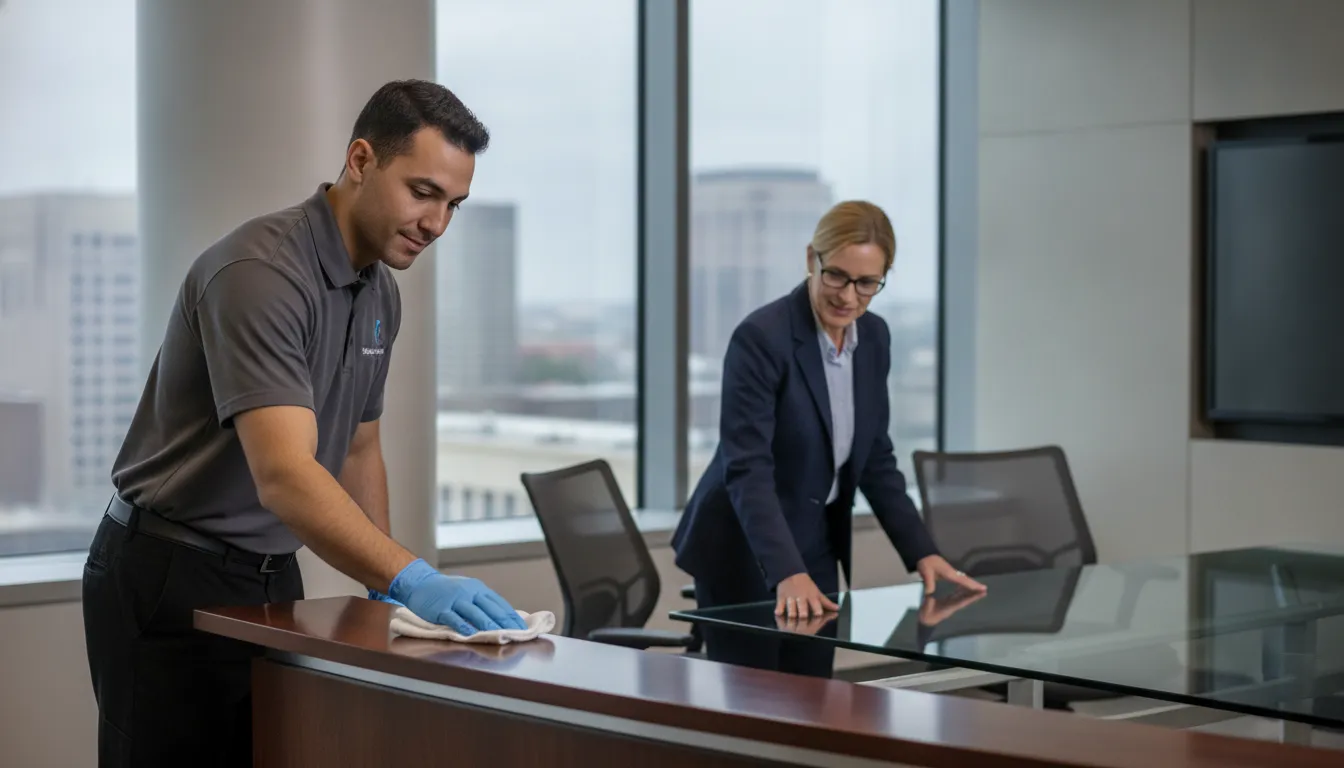
White glove cleaning for business is needed when a facility cannot afford a vague scope, inconsistent execution, or a surface-level inspection. It is a detail-focused service standard built around facility-specific requirements, trained personnel, documented work, and visible accountability. For commercial buyers in Maryland, Washington, D.C., and Virginia, the right question is not simply whether a provider promises premium service. It is whether the provider can show how that promise becomes a repeatable operating program.
Request a facility-specific cleaning review from Foreman Pro Cleaning.
What does white glove cleaning for business mean?
White glove cleaning for business means a cleaning program is planned and reviewed to a higher level of detail than routine appearance-based service. The provider connects the written scope, facility risks, cleaning methods, technician training, supervision, and reporting so the buyer can evaluate performance instead of relying on a promise of thoroughness.
The phrase itself should be treated as a service standard, not as proof of a certification. A credible proposal explains what the standard changes in practice. It should identify the areas, surfaces, schedules, methods, access controls, escalation steps, and inspection criteria that apply to the facility. Foreman Pro Cleaning’s overview of white glove cleaning standards provides the broader definition and detail-focused background; this buyer guide focuses on how a business should decide whether the service fits and how to evaluate a provider.
Look for four connected elements:
- Precision: the scope addresses overlooked, high-touch, and difficult-to-access areas appropriate to the facility.
- Control: methods and products are selected for the surface, occupancy, finish, and operational risk.
- Consistency: trained staff and supervisory checks make the result repeatable across shifts and service dates.
- Evidence: inspections, service logs, corrective actions, and communication show what happened and what was resolved.
When is a white glove cleaning program needed?
A white glove program is most useful when cleanliness affects more than appearance. Consider it when the facility has sensitive occupants, valuable finishes or equipment, strict access requirements, frequent executive or customer visits, contamination-control needs, a history of recurring inspection findings, or a transition such as renovation, expansion, or a new operating schedule.
It may be appropriate when one or more of these conditions are present:
- The facility has a high consequence of error. A missed control in a data center, laboratory, healthcare setting, or command environment can create operational or compliance concerns that ordinary visual checks may not identify.
- The facility has specialized surfaces or equipment. Sensitive finishes, electronic equipment, raised floors, and controlled areas require methods that respect the environment rather than applying one routine everywhere.
- Leadership needs a defensible service record. Facility managers may need to show that work was assigned, completed, inspected, and corrected when necessary.
- Occupancy or reputation raises the standard. Client-facing offices, financial spaces, professional workplaces, and executive areas often need a consistently polished presentation throughout the week.
- A recurring problem has survived routine service. If complaints, missed areas, or failed inspections repeat, the solution may be a better-defined program with stronger supervision rather than simply more visits.
White glove does not automatically mean every task happens every night. The best program separates routine maintenance from periodic detail work and documents the frequency for each task. That approach protects the budget while keeping the service standard measurable.
Which business environments benefit most from this approach?
White glove cleaning can support many commercial facilities, but the program must change with the environment. A professional office may prioritize presentation and high-touch consistency. A medical facility adds infection-control considerations. A data center or laboratory requires contamination control, access awareness, and methods that respect sensitive operations.
| Environment | Buyer priority | What to verify in the proposal |
|---|---|---|
| Office, professional, and client-facing space | Consistent presentation, surface care, and minimal disruption | Task frequencies, finish-safe methods, inspection process, and communication for occupied areas |
| Medical office or healthcare space | Defined environmental-services procedures and exposure awareness | Training, product directions, contact-time requirements, and alignment with CDC environmental infection-control guidance |
| Data center, server room, or network room | Contamination control, access discipline, and protection of operating equipment | Critical-environment training, static-safe methods where required, sequencing, supervisor review, and service reporting |
| Laboratory or controlled technical space | Facility-specific procedures and controlled movement through the space | Site orientation, approved methods, documentation, escalation rules, and coordination with facility personnel |
| Post-construction or newly renovated space | Residue removal, finish protection, and readiness for occupancy | Phased scope, punch-list process, final inspection, and handoff records |
Foreman Pro Cleaning serves both conventional commercial facilities and specialized environments through its commercial cleaning services and critical environment cleaning programs. Buyers should ask a provider to explain which parts of its operating model change between these settings. A generic promise of extra attention is not enough when the facility has technical or regulated requirements.
For healthcare buyers, the CDC’s environmental services guidance is a useful reference for the type of procedure-specific thinking that should inform cleaning programs. It does not replace a facility’s own policies, but it reinforces why a buyer should ask about methods, training, and documented procedures.
Talk with Foreman Pro Cleaning about the controls your facility requires.
What should a commercial cleaning scope include?
A white glove scope should translate the facility’s priorities into observable tasks, frequencies, methods, responsibilities, and acceptance criteria. A buyer should be able to hand the document to a supervisor and understand what must happen, where it happens, how often it happens, and what evidence confirms completion.
Ask for a written scope that addresses:
- Facility zones and access: identify occupied areas, restricted areas, sensitive rooms, access windows, escorts, keys, badges, and security expectations.
- Task frequency: separate daily, weekly, monthly, quarterly, seasonal, and project-based work instead of using one broad term such as deep cleaning.
- Surface and finish requirements: state which methods are approved or prohibited for flooring, glass, furniture, fixtures, electronics, and other materials.
- High-touch and overlooked areas: define the surfaces that routine service often misses without copying an undifferentiated room list into every program.
- Supplies and equipment: explain the type of filtration, microfiber system, floor-care process, or disinfectant application used when relevant to the space.
- Quality acceptance: specify inspection points, response times for findings, who receives reports, and how unresolved items are escalated.
- Change control: show how the scope is updated when occupancy, construction, equipment, schedules, or facility risks change.
Foreman Pro Cleaning’s commercial cleaning scope of work guide can help a facilities team organize these questions before comparing proposals. A scope should be specific enough to manage, but flexible enough to be adapted after a walkthrough. If every bidder receives the same vague request, the resulting proposals may not be comparable.
How can buyers evaluate technician training and safety controls?
Training is the bridge between a written white glove standard and the work performed inside the facility. Buyers should ask who receives training, what the training covers, how competency is confirmed, and how facility-specific instructions are reinforced. The answer should include more than a statement that employees are experienced.
For a commercial program, ask about:
- Initial orientation before a technician enters the facility or restricted area.
- Written standard operating procedures and a process for keeping them current.
- Training on safe product handling, labeling, personal protective equipment, and incident reporting.
- Facility-specific instructions for access, security, sensitive equipment, and operational interruptions.
- Supervisor involvement when a method, surface, or condition falls outside the routine scope.
- Ongoing sign-offs, coaching, or observations that confirm the program remains understood.
OSHA’s Hazard Communication standard is a useful baseline for questions about chemical information and worker training. Where occupational exposure to blood or other potentially infectious materials is possible, buyers should also understand how the provider addresses the OSHA Bloodborne Pathogens standard and the facility’s own exposure-control procedures.
Foreman Pro Cleaning describes a proprietary critical-environment training program informed by IT operations and facilities-management experience. Its critical environment cleaning certification resource offers a starting point for buyers who need to ask how specialized preparation differs from routine commercial service.
What documentation and quality evidence should a provider share?
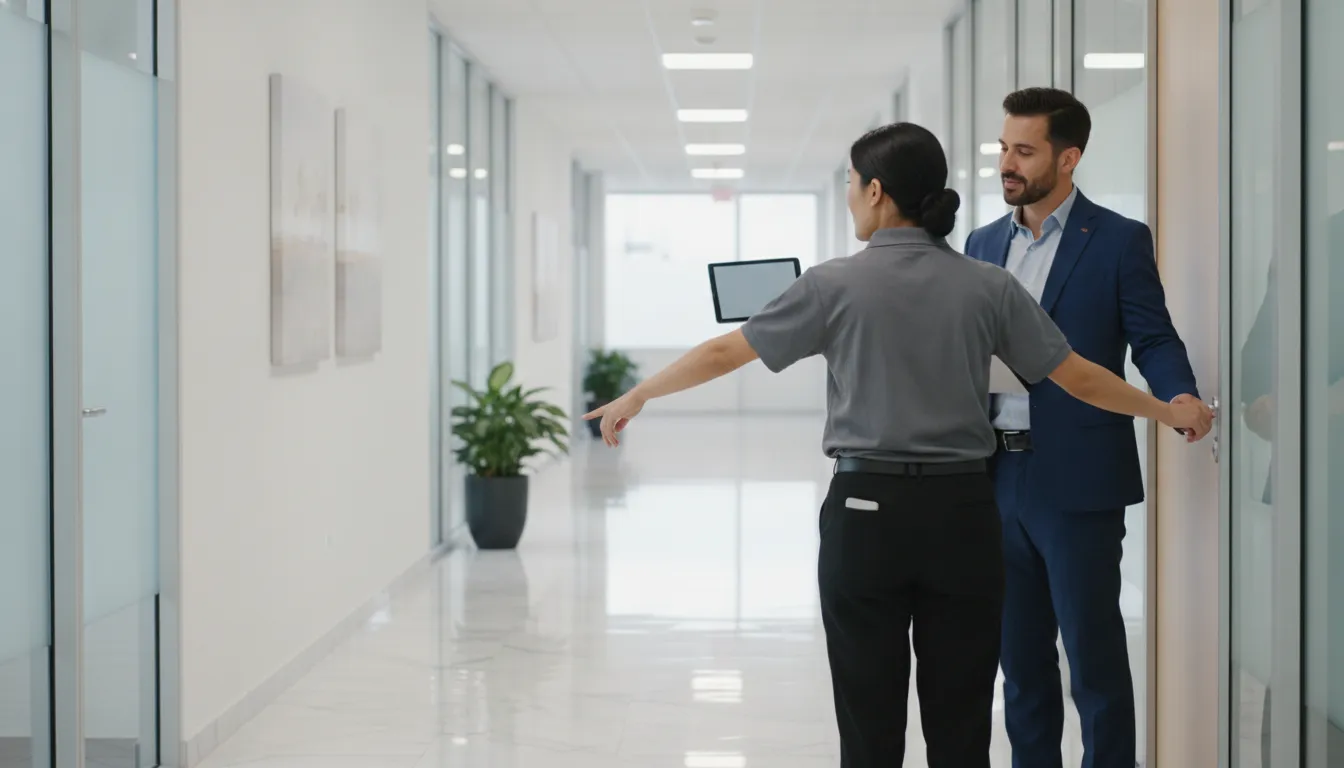
Documentation makes a premium service reviewable. It should help a facility manager answer three practical questions: What was supposed to happen? What was completed and inspected? What changed after a finding was identified? Reports do not need to be complicated, but they should be consistent, specific, and tied to the agreed scope.
Useful evidence may include:
- Service logs showing date, location, assigned team, and completed tasks.
- Inspection checklists tied to actual facility zones and acceptance criteria.
- Photographs or notes for project work when visual confirmation adds value.
- Corrective-action records showing the finding, owner, resolution, and follow-up date.
- Periodic trend reviews that identify recurring findings or needed scope changes.
- A clear contact path for urgent issues, access changes, and service exceptions.
Foreman Pro Cleaning describes supervisor inspections, technology-driven checklists, digital service logging, and post-delivery reporting in its operating model. Buyers can also use the company’s commercial cleaning quality assurance checklist guide as a reference when designing their own review process. The important point is not the software name. It is whether the record supports accountability without creating unnecessary administrative work.
For product selection, the EPA’s Safer Choice program explains how products can be evaluated against safer-chemistry criteria. A provider should still follow the facility’s approved-product list, label directions, and infection-control or technical requirements. A product label alone is not evidence that a method is suitable for every room or surface.
How should Maryland, D.C., and Virginia businesses compare providers?
Regional buyers should compare the operating program, not just the hourly estimate or the number of checklist lines. A provider serving Maryland, Washington, D.C., and Virginia should explain how it maintains consistency across locations, how supervisors communicate with facilities, and how it handles different commercial and critical-environment requirements.
| Evaluation area | Weak proposal | Stronger proposal |
|---|---|---|
| Scope | Uses broad labels such as premium or deep without task frequencies | Maps zones, tasks, methods, frequencies, exclusions, and acceptance criteria |
| Training | Says technicians are experienced without describing preparation | Explains orientation, SOPs, facility-specific training, and competency follow-up |
| Quality | Promises satisfaction without showing inspection ownership | Names supervisors, inspection points, reporting cadence, and corrective-action steps |
| Technical environments | Applies the same routine to every type of space | Adapts methods to data centers, laboratories, medical spaces, and other facility risks |
| Communication | Leaves escalation and service exceptions undefined | Provides contacts, response expectations, change control, and periodic program reviews |
Ask each provider to complete a walkthrough before finalizing the scope. The walkthrough should identify operational constraints that are easy to miss from a floor plan or email, including occupied hours, restricted zones, finish concerns, loading or staging limits, and coordination with facility staff. Foreman Pro Cleaning’s regional service model includes commercial cleaning throughout Maryland, Washington, D.C., and Virginia, with specialized programs for technical facilities such as data centers and laboratories.
For critical spaces, the buyer should also ask whether the provider understands the difference between cleaning a laboratory and cleaning a cleanroom, and whether the proposed method has been reviewed with the facility’s responsible personnel. The goal is a program that fits the site, not a generic premium label.
Request a customized white glove cleaning proposal for your Maryland, D.C., or Virginia facility.
What questions should you ask before signing?
Use the following questions to turn a white glove cleaning promise into a buying decision. Ask for direct answers and supporting examples, then compare each response against your facility’s risk, access, occupancy, finish, and documentation requirements.
Is white glove cleaning a certification?
Usually, the phrase should be treated as a description of service quality rather than as a substitute for a named credential. Ask the provider to define the standard in writing, identify the training behind it, and explain how supervisors inspect and document the work. If a formal management framework matters to your procurement process, ask which recognized standards or certifications the provider actually holds and how they apply to your account. The ISSA’s CIMS standard overview is one example of the type of management framework buyers may research separately from a marketing phrase.
How often should a business schedule white glove cleaning?
There is no single schedule for every facility. Separate routine maintenance from periodic detail work, then set frequencies based on occupancy, surface requirements, traffic, use, inspections, and operational risk. A provider should recommend a schedule after a walkthrough and document what triggers a change. The schedule should be reviewed when the facility, occupants, equipment, or operating hours change.
Does white glove cleaning replace routine janitorial service?
Not necessarily. Many businesses use a routine commercial cleaning program for recurring maintenance and add white glove detail work for periodic, high-visibility, or higher-risk needs. In a critical environment, the specialized program may also include controls that should not be folded into a generic office scope. The proposal should show how the service layers fit together without leaving responsibility unclear.
What should be included in a white glove cleaning proposal?
Request the facility zones, task list, frequencies, methods, approved products, access assumptions, staffing, supervision, inspection process, reporting cadence, corrective-action procedure, exclusions, and change-control process. A written proposal should also identify what the provider needs from the facility, such as escorts, access windows, approved-product requirements, or notice of construction and equipment changes.
How do critical environments change the cleaning requirements?
Critical environments require the cleaning method to account for operational continuity, contamination control, sensitive equipment, access discipline, and facility-specific procedures. A data center, laboratory, and medical space do not share the same risk profile. Ask for specialized training, written procedures, supervisor review, and documentation that can be evaluated by the people responsible for the environment.
How can a facility manager tell whether the service is working?
Start with a baseline inspection and measurable acceptance criteria. Review completed service records, supervisor inspections, recurring findings, response to corrective actions, and feedback from facility users. A good program makes exceptions visible and uses the review process to improve the scope. The goal is not a perfect-looking report. It is a reliable connection between the agreed work and the facility’s condition.
For a business that needs a more accountable standard of commercial cleaning, white glove service can be a practical way to align detail, training, documentation, and quality review. Foreman Pro Cleaning can help facilities in Maryland, Washington, D.C., and Virginia determine whether a tailored commercial or critical-environment program fits the site.
