
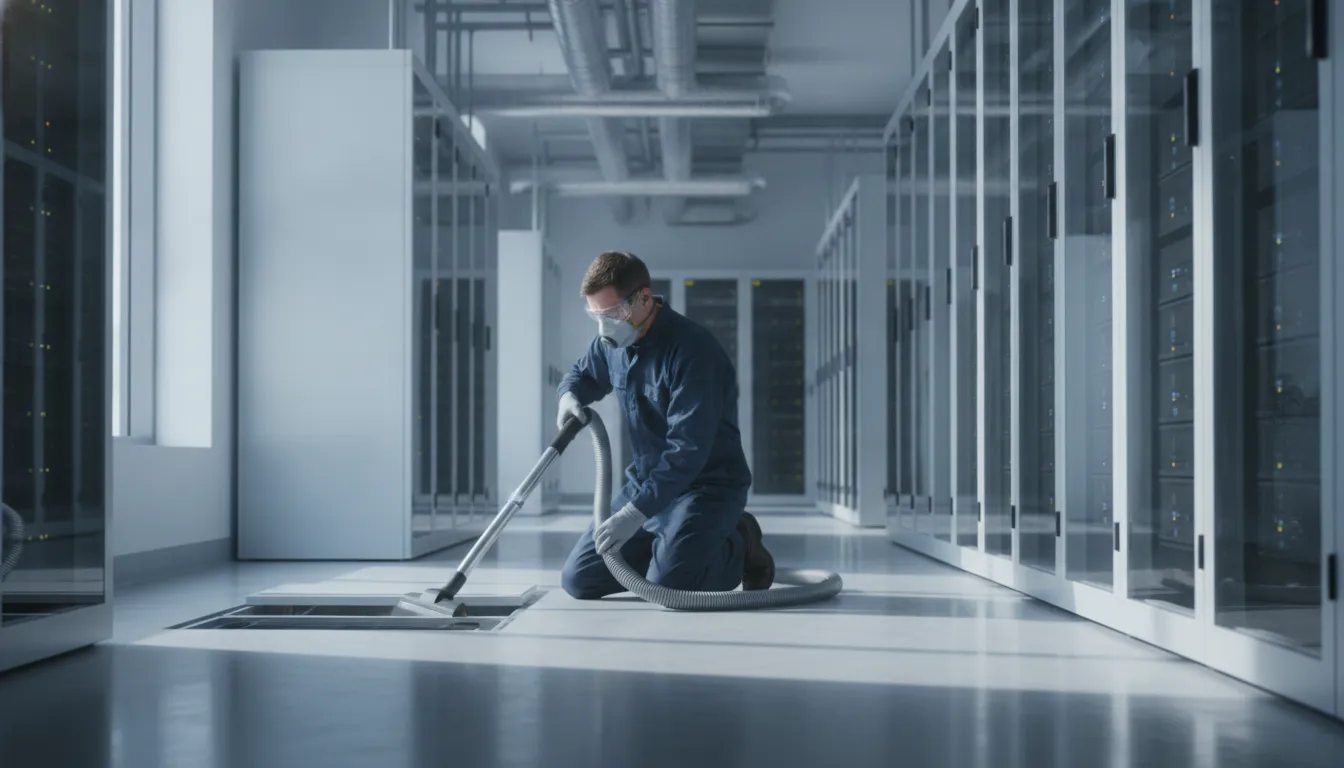
Data center environmental guidance is not the same thing as a janitorial checklist. Temperature, humidity, airflow, filtration, monitoring, and commissioning remain engineering and facility-management responsibilities, while cleaning helps control accumulated particulate within the spaces those systems serve.
ASHRAE data center guidelines describe technical conditions and design considerations for mission-critical facilities, but they do not prescribe a universal cleaning schedule. A facility-specific program should translate those requirements into controlled work around raised floors, plenums, CRAC units, returns, racks, and static-sensitive equipment.
Discuss a data center cleaning program with Foreman Pro Cleaning.
That distinction matters when a team is reviewing contamination risk, planning a maintenance window, or deciding which work belongs in an engineering procedure versus a cleaning SOP. The guidance itself spans more than temperature targets, so the first step is understanding what ASHRAE actually covers and where execution begins.
What Do the ASHRAE Data Center Guidelines Actually Cover?
ASHRAE data center guidelines are best understood as engineering and operational guidance for the thermal, airflow, energy, and contamination conditions surrounding information technology equipment. They are not a janitorial checklist, and they do not replace the facility owner’s engineering decisions, monitoring program, commissioning process, maintenance procedures, applicable codes, or contractual requirements.
What is the role of Technical Committee 9.9?
ASHRAE Technical Committee 9.9 focuses on mission-critical facilities, data centers, technology spaces, and electronic equipment and systems. Its work brings together technical knowledge that helps facility and IT teams evaluate how environmental conditions interact with equipment reliability and facility performance. The committee’s contamination work also recognizes that airborne contaminants can affect equipment through chemical, mechanical, and electrical mechanisms, including corrosion, heat-sink fouling, optical interference, impedance changes, and arcing. These failure modes are documented in an ASHRAE contamination white paper hosted by Lawrence Berkeley National Laboratory: ASHRAE guidance on gaseous and particulate contamination.
That focus matters because contamination is not only a housekeeping concern. Fine particulate and gaseous contaminants can move through designed airflow paths, settle in sensitive areas, or interact with temperature and humidity conditions. The guidance therefore gives facility stakeholders a framework for identifying environmental risks. It does not prescribe a universal cleaning frequency or authorize a cleaning contractor to set room conditions.
What does the Datacom Encyclopedia add?
ASHRAE’s Datacom Encyclopedia organizes related knowledge into one resource hub. The coverage includes facility design considerations, IT equipment design considerations, environmental guidelines, cooling technologies, and energy efficiency. ASHRAE describes the hub as a collection of technical materials that includes publications, standards, guidelines, and research papers, giving engineering and operations teams a starting point for deeper review: ASHRAE’s data center resources hub.
The standards within that ecosystem address different questions. Standard 90.4-2022 provides energy guidance for data centers, while Standard 127-2020 addresses methods for testing and rating air-conditioning units serving data centers and other information technology equipment. Neither standard turns cleaning into a substitute for HVAC design, testing, or facility controls.
How does this article differ from a broader standards guide?
This focused resource examines the environmental and engineering angle, then connects it to contamination-aware cleaning coordination. For broader standards coverage, including the relationship between cleaning practices and standards such as ISO 14644-1, use Foreman Pro Cleaning’s data center cleaning standards guide. The two resources serve different purposes rather than competing for the same answer.
Foreman Pro Cleaning can support the practical side with documented data center cleaning services. Including raised-floor and subfloor-plenum HEPA vacuuming, CRAC surface cleaning, vent and return cleaning, and rack or cabinet cleaning. Those activities can support contamination management, but they do not establish ASHRAE requirements or certify environmental compliance.
How Do ASHRAE Data Center Guidelines Affect Cleaning?
Temperature, humidity, and airflow are engineering-controlled conditions, not variables a cleaning crew should adjust independently. The practical value of ASHRAE data center guidelines is that they help the facility team define the environmental context in which cleaning, maintenance, and contamination-control work must occur. Foreman Pro Cleaning can align its scope, methods, access plan, and reporting with those requirements. But the facility’s engineers and operators remain responsible for set points, alarms, filtration strategy, commissioning, and compliance decisions.
What do temperature and humidity mean for the cleaning plan?
ASHRAE environmental guidance cited in its data-center contamination material identifies a recommended temperature range of 18 to 27 degrees Celsius. With humidity below 60 percent and specified dew-point boundaries. Those figures are reference guidance, not a universal operating prescription for every room or equipment class. The facility team should determine which current standard, owner requirement, equipment specification, and operating envelope apply to the site before work begins. See the ASHRAE contamination white paper for the cited environmental discussion.
Cleaning does not establish or correct those values. Instead, the work plan should account for the approved maintenance window, access controls, equipment sensitivity, and any restrictions on introducing moisture, chemicals, or personnel into the space. A controlled method helps avoid unnecessary disturbance of settled particulate and supports predictable handoffs to operations. If a condition falls outside the facility’s approved range, the engineering or operations team should decide whether to postpone work, modify the scope, or add controls.
How do containment and air distribution shape execution?
Airflow management determines where particulate can travel and which surfaces deserve attention. In a typical arrangement, air moves from the front cold aisle toward the rear hot aisle. Guidance also recommends supplying cold air close to rack inlets and reducing mixing with ambient and exhaust air. The LBNL data-center environmental presentation describes these airflow relationships, including bypass air, recirculation, cable-penetration leaks, blanking panels, and floor-tile management.
For cleaning, that means the team should understand containment boundaries, aisle configuration, raised-floor access, return paths, and nearby sensitive equipment before selecting tools or sequencing rooms. The goal is not to rebalance air or change containment. It is to remove accumulated particulate from approved surfaces without opening an uncontrolled path for redistribution. Raised-floor and subfloor-plenum cleaning can be relevant where the plenum carries conditioned air and particulate may be redistributed through airflow, as described in Foreman Pro’s data center cleaning services.
Monitoring remains a facility function. Operators should identify which temperature, humidity, pressure, particulate, or alarm readings must be reviewed before and after work, and who has authority to interpret them. Foreman Pro can document completed areas, observations, and exceptions for that review. It should not present cleaning activity as proof of an environmental or compliance result without facility data and engineering sign-off.
Which ASHRAE Guidance Addresses Contamination and Maintenance?
ASHRAE guidance can help a facility understand environmental conditions and contamination risks, but it is not a cleaning checklist. The distinction matters. Engineering teams and facility owners remain responsible for interpreting applicable guidance, setting operating requirements, monitoring conditions, and coordinating maintenance or compliance work. Cleaning is one controlled activity that supports those objectives by removing accumulated particulate from defined surfaces and airflow-adjacent areas.
For contamination specifically, an ASHRAE Technical Committee 9.9 contamination white paper describes chemical, mechanical, and electrical effects of airborne contamination on data center equipment. It also states that dust and gaseous contamination should be monitored and controlled alongside temperature and humidity. Those statements establish why contamination management deserves a documented program. They do not, by themselves, prescribe the frequency, sequence, chemicals, or staffing model for a cleaning visit.
| ASHRAE guidance area | What it addresses | Cleaning implication | Accountable owner |
|---|---|---|---|
| TC 9.9 contamination research | Potential chemical, mechanical, and electrical effects of airborne contamination on electronic equipment. | Identify particulate-sensitive areas, protect equipment during work, and remove accumulated contamination with documented, static-safe methods. | Facility and engineering leadership define risk controls; the cleaning provider executes the approved scope. |
| Environmental guidance | Temperature, humidity, dew-point boundaries, and the need to monitor contamination as part of environmental management. | Schedule cleaning around operating conditions and maintenance windows. Do not treat cleaning as a substitute for environmental monitoring or controls. | Facilities, engineering, and controls teams own set points, sensors, alarms, and corrective action. |
| Datacom Encyclopedia and resource hub | Facility design, IT equipment considerations, environmental guidelines, cooling technologies, and energy efficiency, as summarized by ASHRAE’s data center resources hub. | Use the facility design and airflow context to define where HEPA vacuuming, vent and return cleaning, rack exterior cleaning, or other work can be performed safely. | Owner and engineering teams approve the site-specific method statement; the cleaning supervisor verifies execution. |
| Standards for energy and cooling equipment | Standard 90.4 addresses data center energy performance, while Standard 127 addresses testing air-conditioning units serving IT equipment spaces, according to ASHRAE’s standards resource. | Keep cleaning activity coordinated with equipment maintenance and commissioning. Cleaning may support accessible, orderly equipment areas, but it does not test, rate, or certify HVAC performance. | Commissioning agents, engineers, HVAC specialists, and facility operators own testing and performance decisions. |
In practical terms, an approved cleaning scope should reflect the facility’s contamination pathways and maintenance controls. Foreman Pro Cleaning can support data center cleaning services such as raised-floor and subfloor-plenum HEPA vacuuming, CRAC surface and vent or return cleaning, and cabinet or rack exterior cleaning. The company identifies HEPA-filter vacuuming, anti-static-treated equipment, approved anti-static chemicals, and proprietary SOPs as operational controls. These methods address cleaning execution, not ASHRAE interpretation or compliance determination.
The boundary should remain explicit in every maintenance plan: ASHRAE guidance informs engineering judgment. The facility’s procedures define authorization, monitoring, access, and acceptance; and the cleaning team performs the approved work. A documented handoff between those roles makes contamination control more repeatable without implying that a cleaning visit alone establishes compliance.
How Can Cleaning Support Data Center Airflow and Equipment Protection?
Cleaning should be planned as an operational control that supports the facility’s engineering and maintenance program, not as a substitute for it. ASHRAE data center guidelines do not assign a cleaning vendor responsibility for temperature set points, humidity control, airflow design, filtration performance, commissioning, or compliance decisions. Those remain with the owner, engineers, and operating team. A specialized cleaning scope can, however, reduce accumulated particulate in airflow paths and document conditions for the people responsible for the environment.
- Evaluate the facility and define the control boundaries. Begin with a walkthrough that identifies the room layout, raised-floor construction, subfloor-plenum access, rack arrangement, CRAC units, vents and returns, sensitive equipment, floor finishes, security requirements, and known contamination concerns. The evaluation should also identify what may be moved, what must remain untouched, and which activities require engineering or facilities approval. The raised-floor subfloor plenum carries conditioned air toward servers, so accumulated particulate in that space can be redistributed through airflow. Foreman Pro Cleaning uses a facility-specific plan rather than treating a technical room like a general office. Its data center cleaning services are designed around the environment, access requirements, and agreed scope.
- Coordinate access and the maintenance window. Cleaning around active systems requires a schedule that accounts for change freezes, planned maintenance, security procedures, escort requirements, and the facility’s operating conditions. The cleaning supervisor should confirm the work sequence with the authorized facilities or IT contact before equipment is approached or floor tiles are lifted. After-hours, weekend, and maintenance-window scheduling can help reduce interference with normal operations, but the facility owner must determine when work is appropriate. The scope should identify shutdowns, protected zones, emergency contacts, approved outlets, and stop-work conditions before technicians arrive.
- HEPA vacuum the raised floor and subfloor plenum in a controlled sequence. Technicians can carefully remove movable objects and access the floor system according to the approved plan. HEPA vacuuming should cover the agreed sections of the subfloor plenum, with particulate removal performed in a way that does not redistribute contamination toward equipment. The raised-floor program can also address tile surfaces, stringers, pedestals, and ESD flooring where included in the scope. Foreman Pro identifies anti-static-treated equipment, approved anti-static chemicals, and documented procedures as controls for this work. See the detailed raised-floor cleaning service page for the facility conditions that should be reviewed before scheduling.
- Clean CRAC surfaces, vents, returns, and rack exteriors without disturbing airflow components. CRAC surface cleaning and vent or return cleaning help remove accessible particulate from serviceable surfaces. Rack and cabinet exteriors can be addressed with low-lint, non-abrasive microfiber methods. Work should follow airflow direction and equipment access rules, while avoiding unapproved contact with energized components, filters, sensors, cabling, or controls. Cleaning may support cleaner airflow paths, but it does not establish a measured cooling improvement or authorize changes to blanking panels, floor tiles, dampers, or controls. Any airflow defect or equipment concern should be documented and referred to the responsible engineering or maintenance team.
- Apply ESD-safe methods and verify the result. Static-sensitive spaces require appropriate equipment, approved cleaning compounds, maintenance-only outlets where specified, and procedures that preserve the intended properties of ESD flooring and other finishes. Technicians should use HEPA filtration to limit airborne particulate and follow the facility’s chemical, safety, and security requirements. A Critical Environment Supervisor should inspect completed areas against the scope, record observations, note inaccessible or deferred locations, and provide a post-service report. That documentation gives facilities and IT stakeholders a usable record for recurring maintenance, trend review, and follow-up, without overstating what cleaning alone can control.
When Should a Facility Build Cleaning Into Its Maintenance Plan?
A facility should plan recurring data center cleaning before particulate accumulation becomes an operational concern, not only after a visible incident. The right interval depends on the building, air-management design, occupancy, construction activity, filtration, external environment, and the facility’s own inspection findings. ASHRAE data center guidelines can inform environmental and engineering decisions, but they do not prescribe a universal cleaning calendar or replace facility-specific monitoring and maintenance judgment.
How should the facility establish the starting scope?
Begin with a documented site evaluation. The review should identify raised-floor areas, subfloor plenums, CRAC units, supply and return paths, rack exteriors, ESD flooring, cable penetrations, and locations where particulate may enter or migrate. The raised-floor plenum can carry conditioned air toward servers, so accumulated dust in that space deserves deliberate evaluation rather than being treated as ordinary floor care. Foreman Pro Cleaning’s data center cleaning services include raised-floor and subfloor-plenum HEPA vacuuming, CRAC surface cleaning, vent and return cleaning, and cabinet and rack cleaning with microfiber.
Turn the evaluation into a repeatable scope. Document the areas included, access controls, approved methods, equipment requirements, static-safe procedures, exclusions, and the evidence required after completion. A repeatable scope makes changes easier to identify across service cycles. It also prevents a team from cleaning only visible surfaces while overlooking the airflow paths and technical spaces that require coordination.
How do maintenance windows and engineering coordination fit?
Schedule work within an approved maintenance window and coordinate the sequence with facilities engineering and IT operations. The responsible engineering team should confirm equipment-access rules, shutdown or isolation requirements, alarm and monitoring procedures, airflow or containment restrictions, and any areas that must remain untouched. Cleaning personnel should not change temperature, humidity, airflow, filtration, or control settings. Those are engineering and operations decisions, and cleaning does not establish ASHRAE compliance.
Use HEPA-filtered vacuuming, anti-static-treated equipment, approved anti-static chemicals, and maintenance-only outlets where the facility’s procedures call for them. These controls support contamination management, but they do not substitute for monitoring, commissioning, preventive maintenance, or engineering review. If readings change, contamination recurs, or equipment conditions appear abnormal, document the observation and route it to the appropriate owner instead of treating cleaning as the diagnosis.
What records make the program measurable?
After each service, retain the completed scope, date and maintenance window, areas serviced, exceptions, photographs when permitted, supervisor quality review, and follow-up recommendations. Compare recurring observations with facility monitoring and maintenance records. This creates a defensible basis for adjusting frequency without inventing a fixed interval. A written program assessment can also help engineering determine whether a change reflects cleaning conditions, airflow management, construction activity, filtration, or another facility variable.
With this structure, cleaning becomes a coordinated maintenance activity rather than an isolated janitorial visit. It supports contamination control and equipment protection while leaving environmental requirements and compliance determinations with the facility’s qualified engineering and operations teams.
Request a data center cleaning scope before your next maintenance window.
Frequently Asked Questions
Which ASHRAE guidance is most relevant to a data center?
Start with the resources from ASHRAE Technical Committee 9.9, including guidance covering facility design, IT equipment, environmental conditions, cooling, and energy efficiency. ASHRAE also identifies standards such as Standard 90.4 for data center energy performance and Standard 127 for testing air-conditioning units serving IT equipment spaces. The facility engineer should determine which guidance, owner requirements, codes, and monitoring practices apply to the site. ASHRAE’s data center resources provide the technical starting point.
Is ASHRAE a data center cleaning standard?
No. ASHRAE guidance addresses engineering and environmental considerations, not a step-by-step cleaning checklist. Cleaning can support contamination management, but it does not establish temperature, humidity, airflow, filtration, or compliance requirements. Those decisions remain with the facility’s engineering, operations, commissioning, and compliance teams.
How are contamination and airflow connected to cleaning?
Particulate can accumulate in raised-floor plenums, vents, returns, and equipment surfaces, then move through airflow paths. Controlled HEPA vacuuming and surface cleaning can remove accumulated material without substituting for airflow measurement or HVAC correction. ASHRAE’s contamination guidance recommends monitoring and controlling dust and gaseous contamination in addition to temperature and humidity. Read the ASHRAE contamination white paper.
What can a specialized data center cleaning provider support?
A qualified provider can coordinate a documented scope around maintenance windows and perform work such as raised-floor and subfloor-plenum HEPA vacuuming. CRAC surface and vent or return cleaning, rack-exterior cleaning, and static-safe floor care. Foreman Pro Cleaning supports this work with facility-specific planning, approved methods, supervisor quality assurance, and reporting. The provider should coordinate with site engineering before work near sensitive equipment or airflow-control components.
A facility-specific cleaning program should reflect the technical environment, access controls, maintenance windows, approved methods, and documentation requirements of the site. Foreman Pro Cleaning can discuss a scoped approach for data centers and other critical environments across Maryland, Virginia, and Washington, D.C.
