
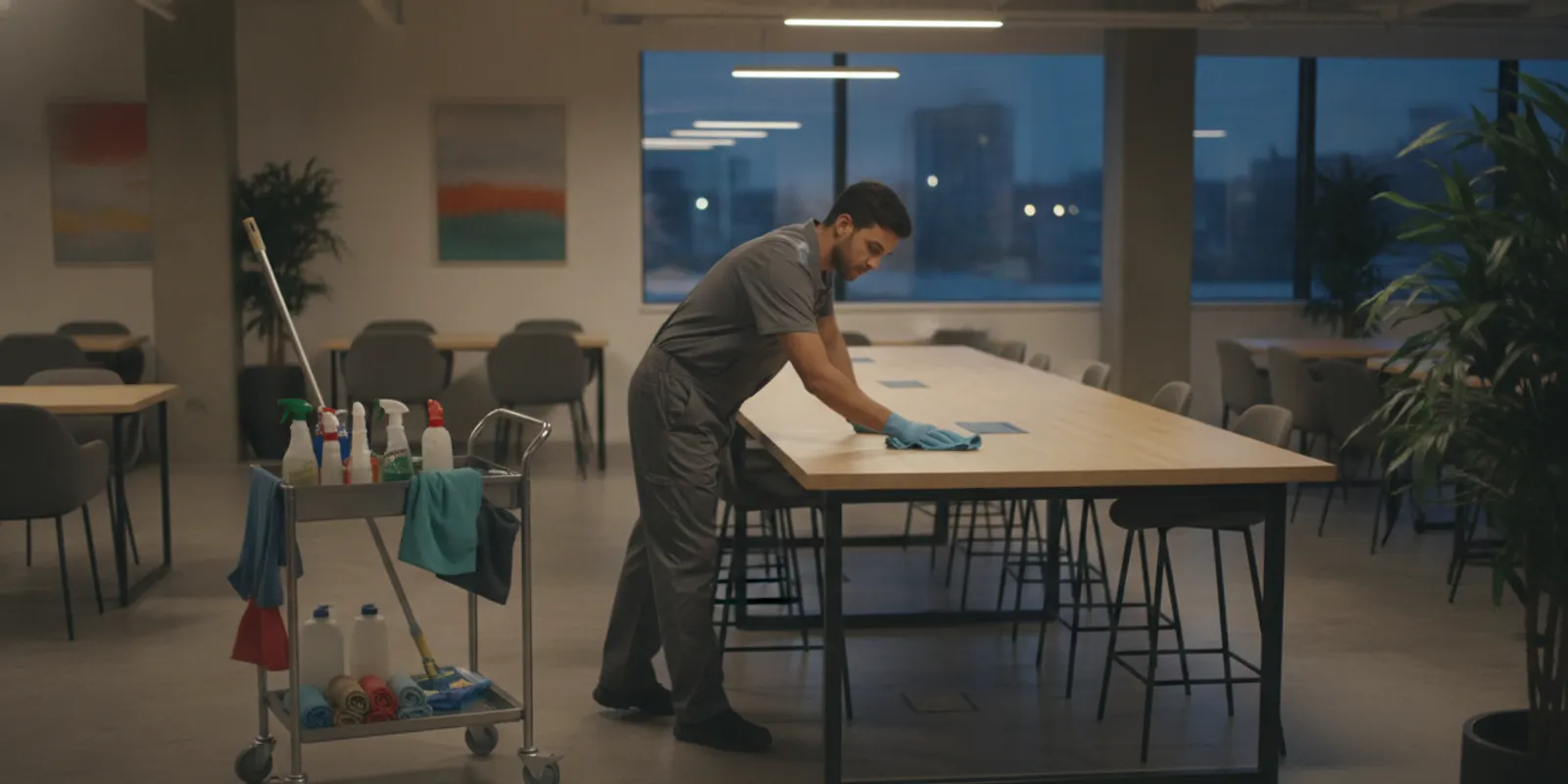
What does nightly janitorial cleaning include? Usually, it covers recurring tasks that restore shared work areas, restrooms, and other agreed spaces after the workday. The exact scope depends on building use, traffic, floor types, and the service plan; not every facility needs the same checklist.
Discuss your facility’s cleaning needs
What does nightly janitorial cleaning include in a typical facility?
A nightly visit generally focuses on visible, frequently used areas and the tasks needed to prepare them for the next business day. A written scope should name rooms, surfaces, and frequencies rather than relying on a broad promise to “clean the building.” Common work may include:
- Work areas: Empty waste and recycling containers as agreed, clean reachable horizontal surfaces, and vacuum or damp-mop floors according to floor type and site instructions.
- Restrooms: Clean and disinfect specified fixtures and touchpoints, replenish agreed dispensers, empty waste, and check that the room is ready for use.
- Breakrooms: Clean counters, sinks, and exterior appliance surfaces; remove waste; and address floors and high-touch points within the defined scope.
- Shared spaces: Maintain reception areas, conference rooms, corridors, and other common areas according to their use and flooring.
- Entry points: Address tracked-in soil around entrances, mats, and nearby floors as specified in the plan.
These are categories, not a universal checklist. A conference room used once a week may not need the same attention each night as a busy restroom. A plan should distinguish routine nightly work from periodic tasks such as carpet extraction, floor refinishing, high dusting, or detailed cleaning. Foreman Pro Cleaning provides customized commercial plans; its janitorial services overview describes recurring facility care.
How should a nightly janitorial scope be organized?
Start with a room-by-room inventory. For each area, record the task, frequency, constraints, and how completion will be checked. This makes service measurable and helps avoid the gap between what a buyer assumes is included and what a contract specifies.
| Area or task | Typical frequency | What to define |
|---|---|---|
| Restroom fixtures and touchpoints | Each scheduled visit | Fixtures included, replenishment responsibilities, restricted surfaces |
| Common floors | Each visit, adjusted by traffic | Vacuuming or damp-mopping method, floor type, priority zones |
| Workstations and offices | By access and agreed frequency | Permitted surfaces and whether desks must be clear |
| Carpet and hard-floor detail | Periodic or project-based | Separate schedule, preparation, access requirements |
| Waste and recycling | Each visit or as specified | Containers included, sorting rules, disposal location |
This is a planning framework, not a fixed specification. The actual scope should reflect facility conditions and the agreed frequency. A sample commercial cleaning schedule can help teams consider recurring tasks and frequencies.
Which details should you settle before service starts?
A well-prepared scope includes more than the task list. Resolve operating details with the facility contact before the first visit:
- Areas and exclusions: Identify included rooms, locked spaces, tenant areas, and surfaces or equipment that should not be touched.
- Schedule: Set service days and an arrival window that works with building operations. Note events, shift changes, and periods when areas must remain available.
- Access: Explain how approved staff enter and secure the site, how keys or credentials are handled, and whom to contact if access fails.
- Safety and site procedures: Share building rules, hazard communication requirements, incident reporting steps, and emergency contacts.
- Materials and responsibilities: State who supplies consumables, who replenishes dispensers, and which products or methods are approved.
- Communication: Identify facility and service contacts and the process for reporting a missed task, spill, damage, or schedule change.
For occupied or sensitive environments, access and sequencing may matter as much as the cleaning task. Keep sensitive documents and personal items secured, clarify whether staff may move objects, and identify areas that require an authorized escort. Review commercial cleaning service information when considering how facility needs shape a plan.
How can you match the schedule to facility use?
Nightly service can suit a busy workplace that needs consistent attention, but frequency should follow actual use. Consider occupancy patterns, public access, restroom demand, food preparation, and the condition expected at opening. A facility may need several visits weekly, a less frequent routine, or daytime support in addition to evening cleaning.
Separate daily reset work from periodic maintenance. A routine visit may address floors and touchpoints, while a planned floor-care project or carpet cleaning needs its own timing and preparation. The sample commercial cleaning schedule is a starting point for considering recurring tasks and frequencies.
Review the plan when conditions change. New employees, a tenant move, renovation, increased public traffic, or revised operating hours can change what is needed. A scheduled review can identify whether the scope still fits without assuming every change calls for more frequent service. For example, if a department moves to hybrid work, the facility contact might compare restroom and breakroom use with office occupancy before changing the schedule. If a lobby begins hosting evening events, it may need a specific post-event floor and waste check rather than an across-the-board increase in every task.
What should quality checks verify?
Quality checks should compare completed work with the agreed scope. Use a practical method: room checklist, inspection notes, or scheduled walkthrough. Focus on observable outcomes, such as whether specified surfaces were addressed, floors are free of loose debris, dispensers were replenished as assigned, and exceptions were recorded.
Agree on how issues are reported and resolved. A useful report identifies the location, task, date, and person responsible for follow-up. That detail helps distinguish a missed task from a changed condition or an item outside the contract. See questions for comparing janitorial service providers when evaluating communication and documentation.
Do not treat a checklist as proof of conditions that were not inspected. Record work and exceptions accurately. If a space is inaccessible, a surface is blocked, or a site event prevents normal work, note the condition and next step. For a simple review, choose a small sample of rooms, verify the agreed visible outcomes, then record any recurring pattern rather than reacting to one isolated observation without context.
When does a facility need specialized cleaning?
Standard janitorial routines are not a substitute for specialized protocols in environments with sensitive equipment, controlled processes, or specific contamination-control requirements. Data centers, laboratories, cleanrooms, and certain healthcare spaces may require approved methods, controlled materials, access procedures, and documentation tailored to the site.
Data center work can involve raised floors, server racks, or other infrastructure where ordinary office assumptions may not apply. Review data center cleaning considerations and critical environment cleaning services if your site includes sensitive operations. Foreman Pro Cleaning draws on IT operations and facilities management experience in its critical-environment work; methods and scope should be discussed for the specific site.
Routine surface cleaning does not establish compliance with a regulation or certification. When a facility has an applicable standard or documented protocol, identify it during planning and confirm that the proposed scope, staff training, materials, and records align with site requirements. As a general workplace planning reference, OSHA’s hazard communication standard describes employer duties for communicating chemical hazards; consult the official OSHA Hazard Communication Standard when defining applicable information and training requirements. The standard is not a cleaning checklist, and its application depends on the workplace circumstances.
How do you prepare a facility for a nightly cleaning team?
Simple preparation can help service proceed efficiently without asking employees to do the cleaning themselves. Before close of business, secure confidential papers, store personal items, and clear surfaces intended to be cleaned. Identify unusual conditions that need attention, and notify the facility contact about events or restricted areas.
Make sure staff know which areas are included and what the cleaning team may move. If employees are expected to leave desks clear or follow another site procedure, communicate that expectation plainly. Route changes through the designated contact so the written plan stays consistent.
For multi-tenant properties, clarify responsibility for shared spaces and tenant-only areas. Building management should coordinate access, elevator use, disposal arrangements, and security check-in. These details reduce the chance a visit is delayed or a space is entered by mistake.
What should buyers ask when comparing nightly janitorial plans?
Ask each provider to describe the same rooms and tasks in its proposal. Comparing the same boundaries makes differences clearer than reviewing a broad service label alone. Ask:
- Which areas and tasks are included at each scheduled visit?
- Which work is periodic or quoted separately?
- How are access issues, exceptions, and service concerns communicated?
- What site-specific safety, security, or equipment restrictions will be followed?
- Who supplies consumables, replenishes dispensers, and handles waste?
- How will the facility review service after startup and when conditions change?
If the scope cannot be defined from plans or a room list, ask for a walkthrough. Look at flooring transitions, access limitations, high-use areas, and sensitive spaces. A useful walkthrough produces a written scope, not just a general impression. Foreman Pro Cleaning is family-owned and serves Maryland, Washington, D.C., and Virginia; learn more about its company background and service locations.
How can you turn a walkthrough into a usable plan?
Use the walkthrough to resolve uncertainties before they become recurring service disagreements. Bring a current floor plan or room list, identify who can approve access, and walk the route in the same order the team is expected to work. Note room names as staff use them, not only as they appear on an old drawing. If one area has multiple names, record both so a checklist points to the right place.
For each space, ask three practical questions: what outcome is needed, how often is it needed, and what could prevent the task? In a reception area, for example, the outcome may be a clear floor and presentable counters each visit. The constraint might be a security desk that remains staffed or a display that cannot be moved. In a storage room, the plan may specify only an accessible floor path and waste container, rather than requiring staff to shift stored materials.
Record assumptions in plain language. If desk surfaces are excluded unless cleared, say so. If a room is cleaned only when unlocked, define who provides access and how the exception is reported. For a restroom, list which dispensers are included and who supplies refills. These small clarifications help facility staff assess proposals on equivalent terms.
Close the walkthrough by reviewing the notes with the facility contact. Confirm room boundaries, frequencies, exclusions, and any periodic work that needs separate scheduling. Assign an owner to resolve open questions, such as product approval or access permissions, and set a date to finalize them before the first visit. A plan that records decisions and unresolved items is more useful than relying on memory after the tour.
How should you assess the first week of service?
The launch period is a useful opportunity to test whether assumptions in the scope match the building in operation. Before the first visit, provide the approved room list, access instructions, emergency contacts, and the method for recording exceptions. Make sure the designated facility contact is available to answer questions promptly, especially when a room is unexpectedly locked or an event changes the normal route.
After the first few visits, review observations against the written tasks rather than relying on a general impression. If a restroom is repeatedly short on supplies, determine whether replenishment is assigned and whether stock is available. If a conference room appears untouched, check whether it was scheduled, occupied, or inaccessible. Record the specific date and condition so follow-up addresses a clear cause.
Use this review to distinguish three types of adjustment. A clarification makes an existing instruction easier to follow. A correction addresses work that did not match the agreed scope. A scope change adds or removes a task, area, or frequency and should be documented as such. Keeping these categories separate makes conversations more constructive and preserves a clear record of what each side agreed to do.
At the end of the initial review period, confirm whether the task list, service window, and communication path are working. Note unresolved issues with an owner and due date. If the facility needs to alter its schedule, agree on the effective date and communicate it to staff who manage access or prepare rooms. This creates a controlled transition instead of relying on informal requests that may not reach everyone involved.
What questions do buyers ask about nightly janitorial cleaning?
Does nightly janitorial cleaning include every room?
Not automatically. The service agreement should list included spaces and exclusions, including locked rooms, tenant areas, and spaces that need special approval.
Are periodic floor projects part of nightly service?
They may be scheduled as separate periodic work. Confirm whether carpet extraction, floor refinishing, or detailed maintenance is included, and how it will be planned.
Can a cleaning plan change when building use changes?
Yes. Review the scope when occupancy, operating hours, events, or facility layout changes. Agree on the adjustment and timing with the service provider.
How should a facility verify the work?
Use checks tied to the written scope, record exceptions accurately, and establish a contact and follow-up process for concerns.
Request a conversation about your cleaning scope
Nightly janitorial cleaning works best when the facility and provider agree on clear tasks, access, timing, and a practical way to review service. A written plan gives both sides a reliable basis for maintaining the building as its needs evolve.
