
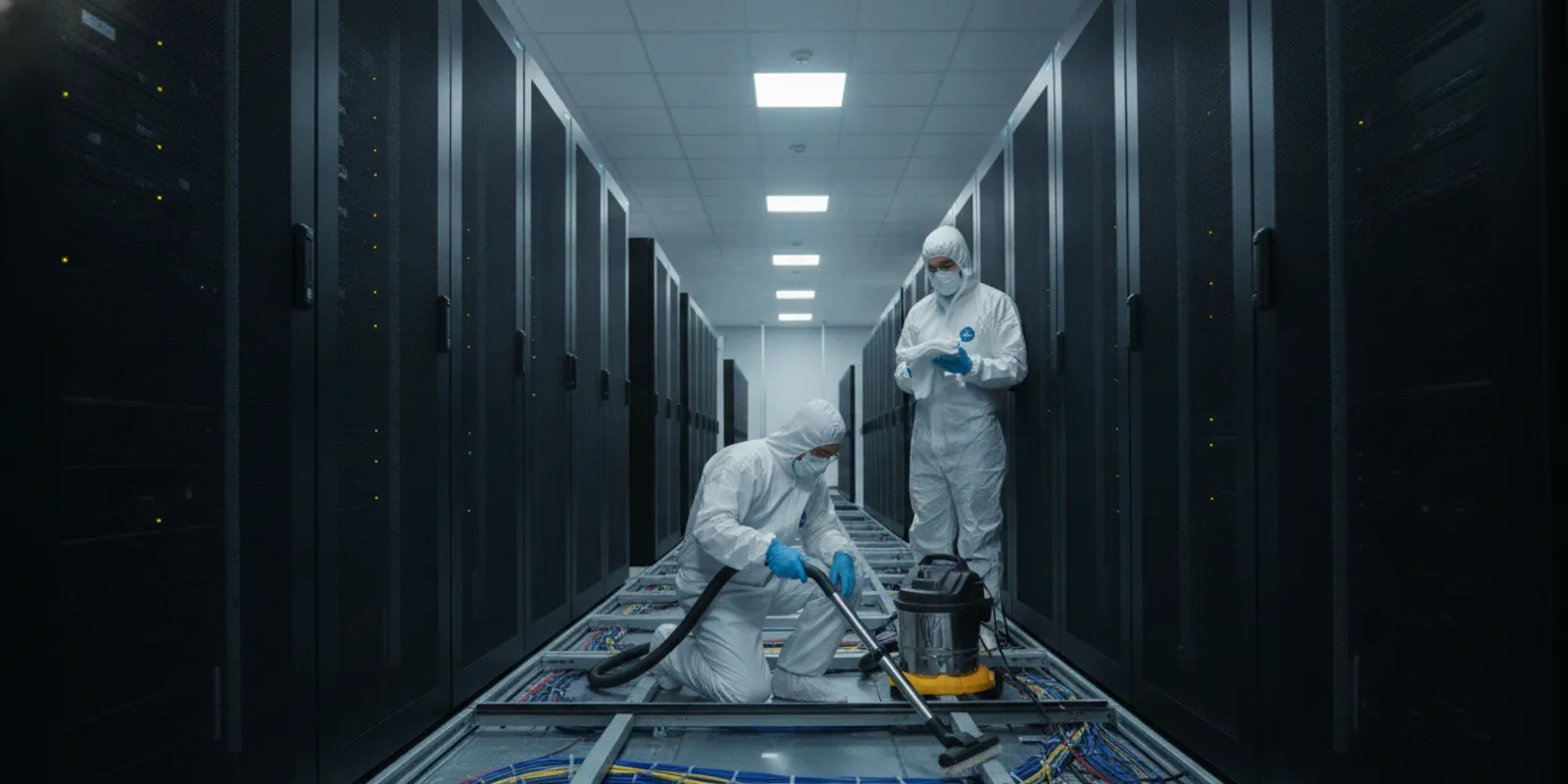
Data center cleaning best practices start with a facility-specific plan that defines approved areas, methods, access, scheduling, and verification. Cleaning should support operations without crossing equipment or safety boundaries. Managers can use the steps below to build a program that fits their facility rather than relying on a generic checklist.
Request a facility cleaning discussion
How do data center cleaning best practices prevent contamination?
Begin by mapping how particles and residues may enter or move through the facility. Potential pathways include personnel, packaging, construction activity, airflow routes, floor openings, and supplies brought into controlled spaces. The facility’s own procedures and design determine which controls apply.
Before work, the facility manager and cleaning lead should walk the proposed route and agree on the following:
- Rooms, aisles, surfaces, and support spaces included, with exclusions clearly named.
- Entry controls, escorts, protective clothing, and restrictions on supplies or packaging.
- Approved tools, materials, transport containers, and storage points.
- How the crew will protect airflow paths, cable routes, doors, and egress.
- Who may pause work and how the crew contacts that person.
- How work will be inspected and accepted when complete.
Bring only the approved materials needed for the defined task. Keep containers and equipment organized so they do not obstruct routes or airflow. A HEPA-filtered vacuum or low-lint wiper may suit some tasks, but the facility must confirm the specific equipment, attachments, surface, and method. Avoid assuming that a product is suitable because it is commonly used elsewhere.
Separate routine accessible-surface work from tasks that can disturb deposits or affect equipment. Cleaning an open aisle is not the same as opening a floor tile or reaching into an enclosure. State the boundary in the work scope. Stop and contact the site lead if the actual conditions differ from the approved plan. For context, see what makes an environment critical and the critical-environment cleaning service overview.
What should work authorization cover before cleaning begins?
Cleaning must fit the data center’s access controls and change-management process. An ordinary service order should not be treated as permission to move equipment, open enclosures, access restricted areas, or alter a floor configuration. The authorization should identify who approved the work, what the crew may touch, when it may occur, and what conditions require a pause.
A useful work package contains these elements:
- Scope and boundaries: Name each approved area and surface, list exclusions, and state the work sequence. Replace broad wording such as “clean racks” with specific wording such as “wipe approved rack exteriors accessible from the aisle.”
- Operational coordination: Identify the facility contact, escalation route, approved window, escort needs, concurrent work, and blackout periods.
- Method and materials: Record which equipment, cloths, and solutions are permitted. Note site restrictions and relevant equipment-specific directions.
- Hazards and controls: Review electrical clearances, trip hazards, restricted zones, and task-specific safety measures with the facility authority.
- Acceptance criteria: Define the expected finished condition, inspection method, and person who closes the work.
Hold a short briefing immediately before entry. Compare the authorization with actual conditions, not just an older floor map. Workers should know to stop and report exposed cabling, moisture, a loose tile, an alarm, a spill, or an unexpected difference in the work area. The cleaning plan complements the facility’s operational controls; it does not replace them.
Managers can prepare with a data center cleaning checklist, then compare proposed scope and responsibilities against data center cleaning services. The provider selection guide offers another set of questions for planning a walkthrough.
How should teams handle ESD awareness?
Electrostatic discharge (ESD) requirements should be governed by the facility’s established controls, not improvised by a cleaning crew. Personnel, materials, tools, and movement may be subject to requirements that vary by zone and task. ESD awareness does not give a worker authority to change grounding arrangements or treat every surface in the same way.
Before service, ask the facility authority to identify ESD zones and applicable procedures. Confirm entry requirements, garments or footwear, permitted tools, and approved products. Do not substitute a material because a label sounds suitable, and do not assume an ordinary vacuum or cloth meets the site’s criteria. Static-dissipative products or methods should be used only when approved for the particular surface and task.
During work, keep the approved method consistent. Do not drag equipment over sensitive surfaces, bring unapproved packaging into a controlled area, or reposition connected components. When a worker cannot confirm whether a tool or material is allowed, stop and ask the site contact. Record the question and the facility’s direction before resuming.
When assessing a provider, ask how training covers ESD awareness, boundaries, escalation, and the distinction between observation and intervention. Foreman Pro Cleaning emphasizes proprietary critical-environment training informed by IT operations and facilities-management experience. The facility remains responsible for providing its current procedures and approvals. See also these questions for choosing a data center cleaning company.
How should raised-floor areas be controlled?
Raised-floor work needs explicit authorization because a tile opening can expose an underfloor space and affect safety, airflow, cable routes, or operations. A tile should not be lifted simply because it appears to need attention. The facility manager must identify whether access is allowed, which tiles are included, and what precautions apply.
For authorized work, agree on the tile sequence, barriers, tool handling, and protection of nearby equipment before starting. Keep openings controlled and attended. Do not leave an opening unattended or place a removed tile where it may be damaged or obstruct a route. Avoid disturbing cables, supports, sensors, or other infrastructure. If debris, moisture, damage, or unexpected cabling is found, stop and report it; do not attempt repairs or move infrastructure.
The scope should distinguish surface work from plenum work and specify who authorizes access, which methods are permitted, how the area is controlled, and who verifies restoration. At closeout, confirm the tiles are returned to their designated positions and the area is clear. Facility procedures and qualified facilities personnel govern every step. Review what a subfloor plenum is and the considerations in data center subfloor cleaning when defining a separate scope.
Which vertical surfaces and equipment boundaries belong in scope?
Dust can collect on vertical surfaces, but access and method matter. A scope may include accessible ledges, doors, walls, and rack exteriors when the facility approves them. It should not imply permission to open a rack, remove panels, touch ports, work above equipment, or enter a restricted space. Identify each surface by location and height, and clarify whether access equipment is permitted.
Plan the sequence to avoid transferring material from higher surfaces to areas already completed. Use approved low-lint materials and controlled technique. Avoid excess moisture, chemical residue, or actions that could push particles toward openings or active equipment. Product selection must follow the site and equipment requirements; stricter manufacturer or facility instructions take precedence.
Specific scope language improves both performance and acceptance. “Rack exterior doors, aisle side only” is clearer than “clean racks.” “Approved wall ledges up to the stated height” is more actionable than “dust walls.” For each item, label it included, excluded, or subject to separate authorization. This avoids assumptions about what a worker may touch.
When should data center cleaning be scheduled?
Schedule around operations, not simply a recurring calendar. Consider change windows, maintenance activity, deliveries, construction, occupancy, planned outages, and escort availability. A quiet period may reduce disruption, but it does not by itself make a task safe or authorized.
Use distinct schedule tiers. Routine work can address approved, accessible surfaces and pathways. Periodic work may include less accessible areas after a separate review. Event-driven work may follow construction, a spill, or an observed contamination concern. Each tier needs a defined scope, authorization route, and record of completion.
| Priority tier | Example trigger and scope | Planning and verification |
|---|---|---|
| Routine | Recurring approved attention to accessible aisles and surfaces. | Confirm the window, access, route, approved method, and completion with the site contact. |
| Planned periodic | Less accessible surfaces or restricted areas requiring separate review. | Obtain task-specific authorization; define barriers, sequence, and post-work inspection. |
| Event-driven | Construction, a spill, or a reported condition that may affect the space. | Assess conditions with operations; document the specific plan, notifications, and acceptance. |
| Hold and escalate | Unexpected moisture, exposed cabling, alarm, damage, or scope mismatch. | Stop; notify the designated authority; resume only after direction and approval. |
This priority matrix is a planning aid, not a universal frequency prescription. Set cadence based on facility conditions, operating procedures, and the site’s risk assessment. Review the plan when layout, equipment, occupancy, or nearby work changes. Where a facility uses multiple service types, keep critical-area tasks under a separately controlled scope; learn about commercial janitorial services without conflating them with data center work.
What should teams do when an incident occurs?
Cleaning personnel should recognize and report conditions rather than make technical decisions outside their authority. A spill, unusual residue, moisture, visible equipment damage, unexpected particle release, alarm, or newly exposed cable may require prompt notification. The data center’s incident and emergency procedures govern the response.
- Stop the task and avoid disturbing the condition.
- Keep people and equipment clear as site rules direct; do not block access or egress.
- Notify the named facility contact through the agreed escalation route.
- Report factual observations, including location, time, nearby work, and what was or was not touched.
- Wait for direction before applying a product, moving materials, expanding the area, or resuming.
- Record the event and the authorization to resume, if applicable.
Do not speculate about cause in a service record. Separate direct observations from conclusions and preserve the facility’s incident process. If emergency cleaning is needed, establish who leads, what work is permitted, and how acceptance will be documented. Managers can review emergency data center cleaning considerations as part of advance planning.
How can records make the cleaning program verifiable?
Useful records show what was authorized, completed, deferred, and escalated. A service log should let the facility compare the work with its approved scope without relying on memory. Use the customer’s designated system and follow its access and retention rules.
- Date, time, service window, and areas covered.
- Assigned personnel identifiers and the facility contact.
- Approved scope, method, equipment, and relevant restrictions.
- Completion status, including areas deferred or excluded.
- Exceptions, unusual conditions, notifications, and incident references.
- Inspection results, corrective actions, and approval to close.
Use consistent area names and report incomplete work plainly. If access was unavailable, record that rather than marking the task complete. Where photos or other evidence are used, follow site privacy and security rules. Review repeated exceptions with operations and the provider; recurring access issues or ambiguous scope may call for a revised plan.
For protocol choices that affect electrical safety, ESD controls, or equipment, defer to the facility’s approved procedures and the relevant equipment guidance rather than treating a general cleaning article as a technical standard. The U.S. Occupational Safety and Health Administration explains general electrical safety requirements and training responsibilities in its electrical safety topic resource; facility-specific authorization and qualified personnel remain essential.
Foreman Pro Cleaning serves commercial and critical environments in Maryland, Washington, D.C., and Virginia. Its programs are developed around facility needs and include proprietary critical-environment training informed by IT operations and facilities-management experience. To learn more about the company’s background, visit Foreman Pro Cleaning’s team and story, or view its commercial and critical-environment services.
Discuss a facility-specific cleaning plan
What questions do managers ask about data center cleaning best practices?
How often should a data center be cleaned?
There is no single schedule that fits every facility. Set frequency according to site conditions, access, operations, observed needs, and approved risk controls, then review it when those conditions change.
Can a cleaning crew open raised-floor tiles?
Only when the facility explicitly authorizes the work and defines the method, boundaries, controls, and verification. Routine service should not be assumed to include tile access.
Should cleaning workers touch server equipment?
The written scope should state which surfaces are permitted. Workers should not move components, open equipment, or touch connections unless the facility separately authorizes a specific task and assigns responsibility.
What should a manager ask a cleaning provider?
Ask how training, access, ESD awareness, approved materials, escalation, records, and completion checks will fit the facility’s procedures. Request a written scope that separates routine work from restricted or event-driven tasks.
A well-controlled program makes cleaning verifiable while protecting operational boundaries. Start with the facility’s procedures, make authorization explicit, and update the plan when conditions or needs change.
