
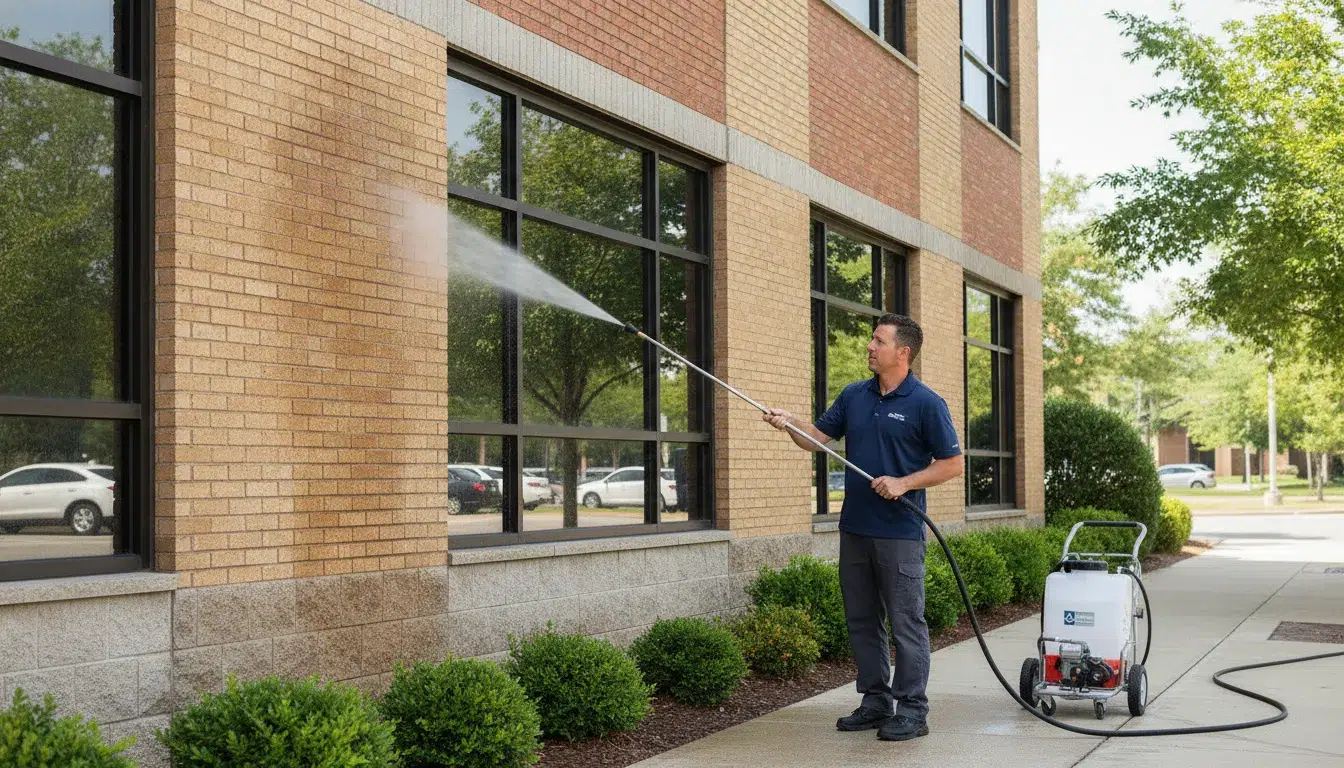
A finished facade can still carry construction film, mortar haze, sealant smear, and dust from the last trade. That residue is a different job from nightly janitorial service, and it is priced as its own scope. Commercial exterior building cleaning cost moves with height, cladding, glass, soil, and the controls a crew needs during handover.
National planning ranges from HomeGuide put a basic commercial wash near $0.10 to $0.35 per square foot and an intensive wash near $0.40 to $1.00. Many jobs land between $200 and $3,000. Those figures are national averages, not a quote for Maryland, Washington, D.C., or Virginia. The number you can defend is the one written after someone walks the envelope.
Request a quote for exterior cleaning after your build
What drives commercial exterior building cleaning cost after a build?
The price is the labor, access, and method required to return the envelope to a handover condition. Square footage is only the starting measure. A one-story retail front and a four-story office with the same wall area can require very different crews, lifts, and water controls.
Foreman Pro Cleaning treats this as a scoped assessment, the same way it treats interior turnover. The walkthrough looks at what the trades left behind, which surfaces can take water, and whether occupants or neighboring tenants are already in the building. A family-owned company serving Maryland, Washington, D.C., and Virginia since 2014, Foreman Pro builds that plan around the site instead of a flat rate card.
Three questions decide most of the number. How high is the work, and what machine reaches it? What is the cladding, and can it take pressure? How heavy is the soil, and is the building already occupied? Answer those before you compare two bids. If the bids assume different answers, the totals are not comparable.
Height and how the crew reaches the work
Ground-level storefronts are the simplest access. Once the work moves above a pole or a short ladder, the quote has to include a lift. Swing stage, or other elevated platform, plus the time to set it up and take it down. HomeGuide notes that height and accessibility change the final price on building exteriors, which it places in a national range of about $0.15 to $0.90 per square foot.
Occupied sites add another layer. A facilities manager may need the crew to work evenings, keep an entrance open, or stage equipment away from a loading dock. Those limits rarely change the square footage. They do change the hours. A lift that has to leave a fire lane by 7 a.m. is a different production rate from an empty site with all-day access.
Cladding, glass, and what the surface can tolerate
Brick, concrete, and some masonry can accept a controlled pressure wash. Painted metal panels, EIFS, sealants, and coated glass often cannot. Soft washing and hand detailing take longer than a single high-pressure pass, and the slower method is the one that protects a new finish. New sealant and fresh paint are especially easy to scar if the crew treats them like a ten-year-old wall.
Glass is its own line. Construction film, sticker residue, and cementitious haze on storefronts and curtain wall should be removed with the right chemistry and tools, not a pressure tip. If the interior post-construction cleaning is already scheduled, write the exterior glass scope beside it so both sides of the handover are priced once.
How should a facilities team separate exterior cost from interior turnover?
Interior post-construction cleaning and an exterior wash answer different questions. The interior scope moves a building from active construction to a space that can pass inspection and receive occupants. The exterior scope restores the envelope, the approaches, and the glass the public will see. Combining them on one line makes both numbers impossible to compare.
Keep the exterior quote attached to surfaces you can walk and measure: walls, storefront glass, canopies, entries, sidewalks, and dumpster pads. Leave floors, restrooms, and above-ceiling dust in the interior scope. Foreman Pro Cleaning runs phased post-construction work across offices, healthcare, schools, retail, and critical facilities in the same three-state region. The two scopes can share a walkthrough without sharing a price.
That split also protects the interior budget. A facade wash with a lift should not be hidden inside a per-square-foot interior figure, and interior HEPA detailing should not inflate the exterior line. When a general contractor asks for one number, still ask for the backup by surface. You will need it when the glass count or the lift plan changes.
What usually belongs on the exterior line
- Removal of construction film, stickers, mortar haze, and overspray on cladding and storefront glass.
- Washing of entries, canopies, sidewalks, and other approaches that collected trade traffic.
- Dumpster-pad and loading-area cleaning where grease or construction waste stained the concrete.
- Water, chemistry, and access controls that keep runoff and overspray off finished interiors and neighboring tenants.
Hard floors inside the building are a separate trade. If the turnover also includes tile, stone, or coated concrete, price that with hard floor cleaning rather than folding it into the facade number. Window timing on a finished building is a maintenance question, not this handover scope. The older note on when to clean commercial windows is about a recurring program after occupants are in.
Which surfaces move the price the most?
National ranges are useful for a first budget and useless as a local bid. HomeGuide’s commercial pressure-washing guide separates basic work from intensive work, then breaks the same market into surfaces. Use the table to see which lines deserve their own number. Then replace every figure with a site quote.
| Surface. | National planning range. | What pushes it up. |
|---|---|---|
| Basic commercial wash. | $0.10 to $0.35 per sq ft. | Light soil on sidewalks, storefronts, and simple walls. |
| Building exterior. | $0.15 to $0.90 per sq ft. | Height, delicate cladding, and soft wash instead of pressure. |
| Intensive wash. | $0.40 to $1.00 per sq ft. | Grease, graffiti, or heavy staining. |
| Sidewalks and walkways. | $0.10 to $0.30 per sq ft. | Gum, grease, and heavy foot traffic at entries. |
| Dumpster pads. | $0.75 to $1.00 per sq ft. | Degreasing and repeat staining. |
| Small flat-fee area. | $200 to $500. | Areas under about 2,000 sq ft. |
| Large-property flat fee. | $600 to $3,000 or more. | Plazas, business parks, and custom access. |
HomeGuide publishes these as national averages and notes that hard-to-remove grease or graffiti is often an extra. None of the rows is a Foreman Pro price. A quote for a building in Annapolis, the District, or Hampton Roads still depends on the walkthrough. Wage rates, water access, and lift rules in this region can sit outside a national band even when the wall area matches the example.
Read the unit before you multiply. A per-square-foot wall price and a per-space parking price do not add together cleanly. Dumpster pads look small on a plan and often cost more per square foot than the facade because the soil is grease, not dust. If the pad is part of the handover, give it a line. Do not let it disappear into “exterior.”
How do access rules and occupied buildings change the number?
Exterior work after a renovation is often done while people are already inside. The U.S. Environmental Protection Agency’s school renovation guidance treats construction dust and fumes as a cause of poor indoor air. It recommends barriers, and it recommends covering supply and return grilles, so renovation pollutants are not pulled into occupied rooms.
An exterior wash does not create the same dust load as demolition. Overspray, an open entry, and a running air handler can still move moisture and residue indoors. Price the protection with the wash, not as a surprise after the crew arrives. On a healthcare floor or a data hall next to the work, that protection is part of the scope, not a courtesy.
That is why a credible quote names the controls. Ask whether entries stay covered, whether nearby intakes are protected, and whether the crew works when occupants are out. Those answers change labor hours even when the wall area stays the same. They also decide whether the interior final clean has to be repeated.
Site limits that should appear on the quote
- Confirm the work window, including any evening or weekend limit while tenants are in place.
- Mark lifts, hoses, and water recovery so entries, docks, and fire lanes stay usable.
- Protect finished interiors, landscaping, and neighboring storefronts from overspray.
- State the chemistry and pressure limits for each cladding and glass type.
- Name who signs off on the envelope before interior touch-up begins.
Ongoing janitorial pricing is a different conversation. If you also need a recurring program after move-in, read what changes janitorial services pricing in the DMV on its own. Do not set a one-time exterior wash next to a monthly contract and treat the gap as a discount.
What should the quote show before you compare bids?
A usable exterior quote can be checked against the building. It lists each surface, the method, the access plan, and what is excluded. A single all-in number with no surface list cannot be compared with another bid, even when both vendors walked the same site.
Use the written scope as the comparison, not the vendor’s lowest total. A lower bid that skips water recovery or glass chemistry is a different project. It shows up later as a change order or as damage on a new finish. Ask the bidder to mark anything they will not clean. Silence is not an inclusion.
Ask for these items in writing.
- Measured or clearly described areas, not a lump sum labeled “building wash.”
- Method by surface, including where pressure is prohibited.
- Access equipment, permits if a lift occupies a public way, and water recovery.
- Exclusions such as graffiti, oxidation, or restoration, which are different work.
- The point at which the exterior is accepted so interior final clean is not delayed.
Foreman Pro Cleaning is licensed, bonded, and insured, and it writes scopes from a walkthrough rather than a universal rate. That practice matters more on a new envelope than on a routine wash. The wrong pressure or chemistry becomes a finish repair, not a callback.
Wes Foreman, who co-founded the company after a career in IT operations, built the service around facilities teams that need a documented scope. The same standard applies when the question is only the outside of the building. Say what will be cleaned, how, and what is out of scope before anyone starts the wash.
Schedule a walkthrough and get a scoped quote
How do you avoid paying twice for the same residue?
The expensive mistake is splitting film, haze, and entry concrete across three vendors who each mobilize once. Pair the exterior scope with the interior turnover. In the walkthrough, decide which side owns the storefront. Glass that is cleaned outside and then sprayed again from an interior ladder gets billed twice.
Sequence helps. Complete heavy exterior washing before the final interior detail, then keep a short touch-up for splash and fingerprints. Teams that want the interior sequence spelled out can use the guide to post-construction cleaning services for rough, final, and touch-up timing. Keep this page for the envelope price.
Recurring cost per square foot will not answer this question either. Monthly office programs and a one-time facade wash share almost no labor. Use the guide to commercial cleaning cost per square foot when you are budgeting the program that starts after occupancy. A broader look at what a cleaning contract includes sits in how much a cleaning service costs, which is the recurring question, not the handover question.
If the only open item is a small storefront, do not force it into a whole-building rate. HomeGuide’s small-area flat fees, often $200 to $500 under about 2,000 square feet, are a reminder that mobilization can matter more than the wall. State the mobilization, the glass, and the sidewalk as separate lines so a modest job stays honest.
Frequently asked questions
How much does commercial exterior building cleaning cost?
There is no single local price. HomeGuide’s national ranges put basic commercial washing around $0.10 to $0.35 per square foot and building exteriors around $0.15 to $0.90. Many projects total $200 to $3,000. Height, cladding, soil, and access move a Maryland, D.C., or Virginia building off those averages, so the reliable figure is a walkthrough quote.
Is an exterior wash part of post-construction cleaning?
Not by default. Post-construction cleaning usually covers debris, fine particulate, and interior surfaces through rough, final, and touch-up phases. Exterior walls, approaches, and storefront glass should be their own line so the facade price is not buried inside the interior scope.
Why do two exterior quotes for the same building differ?
The bids are often for different methods. One may assume a pressure wash from the ground. The other may include a lift, soft washing, glass chemistry, and evening hours because the building is occupied. Compare the surface list and the exclusions before you compare the totals.
What should a facility manager send before the walkthrough?
Send the address, cladding types, approximate height, photos of film or haze, any lift limits, and whether tenants are already inside. Note glass coatings and new sealants. Those details let the crew price access and chemistry instead of guessing from a floor plan.
When should exterior cleaning happen in the handover?
Schedule the heavy exterior wash before the final interior detail. Later touch-up can catch splash at entries. Doing the final interior clean first, then washing the facade, usually means paying to redo glass and thresholds.
