
Medical Office Cleaning Frequency Guide
Medical offices should be professionally cleaned at least once per day, but the right schedule depends on room type, patient volume, procedure risk, and the level of documentation your practice needs for safety and compliance. Exam rooms, restrooms, waiting areas, treatment spaces, and administrative offices do not carry the same infection-control risk, so they should not all be cleaned on the same schedule.
Need a custom medical office cleaning plan for your facility? Contact Foreman Pro Cleaning for medical office cleaning services across Maryland, Washington, DC, and Virginia.
A good cleaning schedule does more than keep the office looking presentable. It reduces cross-contamination risk, supports patient confidence, protects staff, and gives practice managers a repeatable process they can explain during internal reviews or outside inspections. The goal is not to guess at a frequency. The goal is to match the cleaning routine to how each space is used.
This guide breaks down how often medical offices should be professionally cleaned by room type, patient flow, risk level, and compliance expectations, with practical examples for outpatient clinics, dental offices, urgent care centers, specialty practices, and small medical suites.
Quick Answer: How Often Should a Medical Office Be Cleaned?
Most medical offices need daily professional cleaning, with higher-risk spaces cleaned more often. Waiting rooms and administrative areas usually need daily cleaning, public restrooms often need cleaning at least twice daily, exam rooms should be cleaned at least twice per day and disinfected between patients where appropriate, and procedure rooms should be cleaned before and after each procedure.
| Area | Baseline professional cleaning frequency | When to increase frequency |
|---|---|---|
| Waiting room and reception | At least daily | High patient volume, flu season, pediatric care, visibly soiled surfaces |
| Exam rooms | At least twice daily, with targeted disinfection between patients | High-touch use, infectious symptoms, body fluid exposure, urgent care flow |
| Procedure or treatment rooms | Before and after each procedure | Any invasive, wound care, dental, minor surgical, or high-risk procedure |
| Public restrooms | At least twice daily and as needed | Heavy traffic, odors, visible soil, shared patient and visitor use |
| Staff offices and admin areas | Daily for trash, touchpoints, and floors; weekly for low-touch detail | Shared desks, food areas, high staff turnover, after-hours use |
| Floors in patient care areas | At least daily, cleaned last | Spills, tracked-in debris, procedure rooms, high traffic, wet weather |
The CDC’s environmental cleaning guidance for general outpatient areas supports this risk-based approach. It identifies waiting areas as at least daily cleaning, consultation and examination areas as at least twice daily, minor procedure rooms as before and after each procedure, and shared patient toilets as at least twice daily and as needed.
Why Medical Office Cleaning Frequency Cannot Be One-Size-Fits-All
A medical practice is not a standard office building with a few extra disinfecting tasks. The risk profile changes from room to room. A reception desk may have constant hand contact but little clinical exposure. An exam room may turn over patients every 15 minutes. A procedure room may involve body fluid risk, sharps handling, or specialized equipment. A break room may create food-contact concerns even though patients never enter it.
That is why the best medical office cleaning frequency is built around three questions:
- How many people use the space? More patients, visitors, vendors, and staff mean more touchpoints and more frequent cleaning needs.
- What type of care happens there? Consultation rooms, dental operatories, lab draw rooms, and procedure rooms carry different risk levels.
- What needs to be documented? Healthcare practices often need cleaning logs, disinfectant records, scope checklists, and accountability for recurring tasks.
Foreman Pro Cleaning serves healthcare, commercial, and critical environments, so our view of cleaning frequency starts with risk control. A polished floor matters, but in a healthcare environment, the process behind the clean matters just as much as the appearance.
Recommended Medical Office Cleaning Frequency by Room Type
Use the following room-by-room framework as a planning baseline. Your final schedule should be adjusted after a walkthrough that accounts for patient volume, service line, square footage, flooring, fixtures, and hours of operation.
Waiting Rooms and Reception Areas
Recommended frequency: at least daily professional cleaning, plus more frequent disinfection of high-touch points during busy periods.
The waiting room is the first impression of your practice and one of the most visible indicators of patient safety. It also concentrates traffic from patients, family members, delivery drivers, and staff. Daily cleaning should include floors, seating, counters, check-in surfaces, door handles, light switches, kiosks, children’s areas if present, and trash removal.
During respiratory illness season or in high-volume practices, the waiting room may need multiple high-touch disinfection rounds during the day. This is especially true for pediatric offices, urgent care centers, and primary care practices that see symptomatic patients.
Exam Rooms
Recommended frequency: at least twice daily professional cleaning, with targeted disinfection between patients based on use.
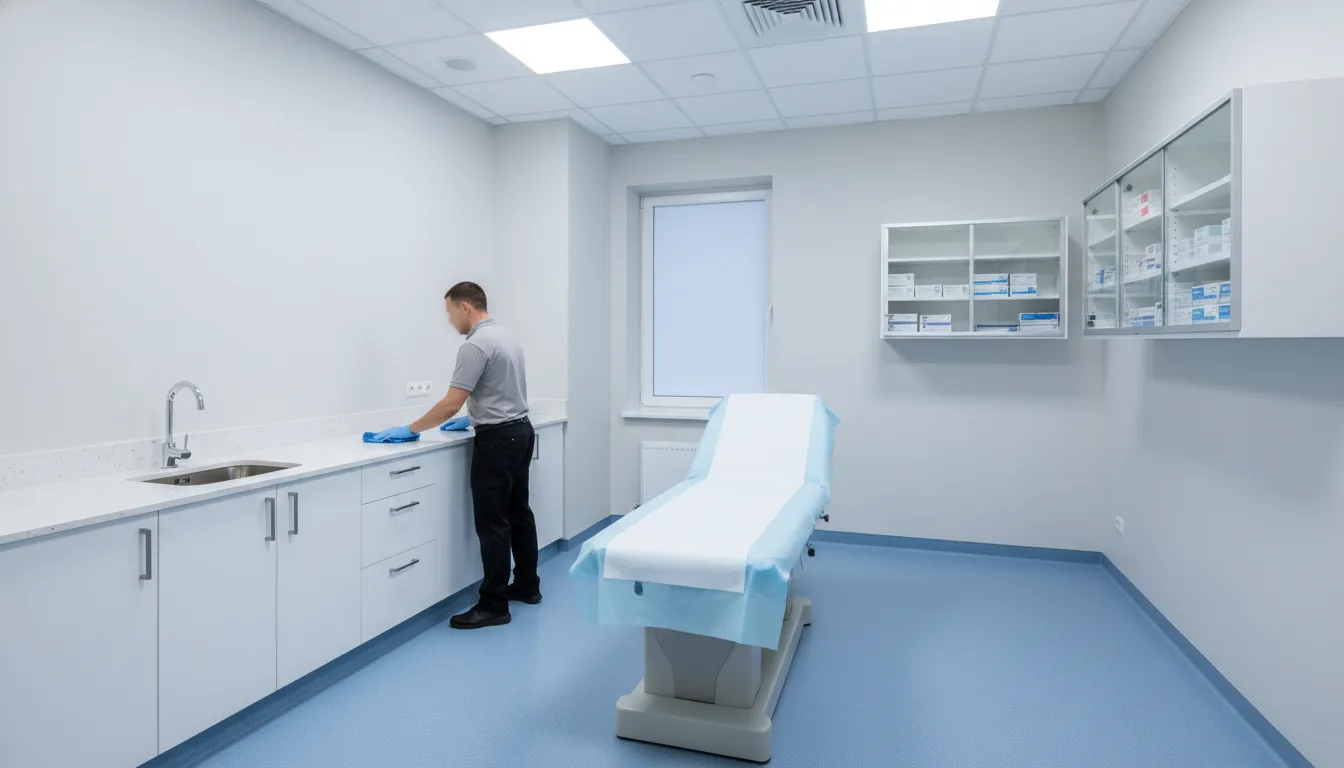
Exam rooms are where medical office cleaning frequency matters most for day-to-day infection control. Baseline cleaning should cover exam tables, counters, chairs, sinks, cabinet pulls, light switches, door handles, floors, and any non-critical equipment surfaces included in the cleaning scope.
Between-patient turnover is typically handled by clinical staff under the practice’s internal protocol, but the professional cleaning partner should support that protocol with scheduled detail cleaning, correct disinfectant use, and consistent end-of-day resetting. If an exam room is used for higher-risk services, wound care, sick visits, or heavy patient flow, the frequency should increase.
Procedure Rooms, Treatment Rooms, and Dental Operatories
Recommended frequency: before and after each procedure, with terminal or end-of-day detail cleaning.
Any room where procedures occur needs a higher standard than a routine office clean. That includes minor surgery rooms, dental treatment rooms, dermatology procedure rooms, infusion spaces, and rooms used for wound care or specimen collection. These spaces require defined cleaning responsibilities, product contact times, and sequencing so surfaces are cleaned before they are disinfected.
Professional cleaners may not be responsible for every clinical turnover task, but their work should fit into the practice’s infection-control program. The schedule should identify what clinical staff handles between patients and what the cleaning team handles after hours, daily, weekly, and monthly.
Public and Patient Restrooms
Recommended frequency: at least twice daily and as needed.
Shared patient restrooms carry higher contamination risk than most non-clinical areas. Cleaning should include toilets, urinals, partitions, sinks, faucets, counters, mirrors, dispensers, door handles, floors, and trash. Restrooms should also be checked for supply levels, odors, spills, and visible soil.
If patients provide samples in a restroom, or if the restroom is used by a high volume of patients and visitors, the schedule should be more aggressive than a standard commercial restroom plan.
Staff Break Rooms and Kitchenettes
Recommended frequency: daily cleaning of high-touch and food-contact-adjacent surfaces, with weekly detail cleaning.
Break rooms are easy to overlook because patients may not enter them, but they affect employee health and morale. Daily tasks should include counters, tables, chair backs, appliance handles, sink areas, trash, floors, and high-touch surfaces. Weekly detail tasks may include cabinet fronts, chair bases, edges, and buildup around appliances.
Administrative Offices and Private Work Areas
Recommended frequency: daily touchpoint cleaning and trash removal, with weekly low-touch surface detail.
Administrative spaces are lower risk than patient care areas, but they still contribute to overall hygiene. Shared workstations, check-out desks, billing areas, and staff-only entrances should be cleaned more often than private offices with limited use.
Floors in Patient Care Areas
Recommended frequency: at least daily and whenever visibly soiled.
Floors should be cleaned last after higher surfaces, which helps avoid recontaminating cleaned areas. High-traffic healthcare floors may also need periodic machine scrubbing, floor finish maintenance, or specialized care depending on the flooring type. For practices with VCT, resilient flooring, or epoxy surfaces, professional floor care protects both appearance and safety.
For more detail on broader facility programs, see Foreman Pro Cleaning’s commercial cleaning services.
How Patient Volume Changes the Cleaning Schedule
Patient volume is one of the biggest factors in medical office cleaning frequency. A small specialist practice with 15 patient visits per day does not need the same schedule as a busy urgent care center seeing 90 patients per day.
| Patient volume | Typical cleaning approach | Best-fit examples |
|---|---|---|
| Low volume | Daily professional cleaning, weekly detail rotation, targeted clinical turnover by staff | Small specialty offices, consult-only practices, therapy offices |
| Moderate volume | Daily professional cleaning, twice-daily restroom attention, more frequent exam room support | Primary care offices, dental offices, outpatient specialists |
| High volume | Daily or nightly professional cleaning plus daytime touchpoint rounds or porter support | Urgent care centers, pediatric offices, multi-provider clinics |
| Surge periods | Temporary increase in high-touch disinfection, restroom checks, waiting room cleaning, and trash removal | Flu season, outbreaks, expanded clinic hours, vaccination events |
If your front desk team is constantly wiping surfaces, emptying trash, or responding to restroom complaints, the professional cleaning schedule is probably too light. In those cases, adding a day porter or daytime cleaning support can be more effective than asking clinical staff to absorb non-clinical cleaning tasks.
For busy practices, Foreman Pro Cleaning can build daytime and after-hours coverage into one program. Learn more about janitorial services.
How Risk Level Changes Cleaning Frequency
Room type matters, but risk level matters even more. A low-volume consult room and a high-volume urgent care exam room may have the same square footage, but they should not receive the same cleaning plan.
Low-Risk Areas
Low-risk areas include private offices, conference rooms, low-traffic administrative areas, and some waiting areas during light use. These spaces usually need daily trash removal, floors, visible surface cleaning, and high-touch disinfection, with weekly low-touch detail.
Moderate-Risk Areas
Moderate-risk areas include standard exam rooms, shared patient areas, check-in desks, nurse stations, and restrooms. These areas usually need daily or twice-daily cleaning, more frequent high-touch disinfection, and clear task logs.
High-Risk Areas
High-risk areas include procedure rooms, treatment rooms, rooms used by symptomatic patients, lab draw areas, dental operatories, and any area with body fluid exposure potential. These spaces need defined cleaning before and after use, end-of-day detail cleaning, and immediate cleaning when surfaces are visibly soiled.
The more risk a space carries, the less room there is for informal routines. A written scope of work, room-by-room checklist, and trained technicians are essential.
Daily, Weekly, Monthly, and Quarterly Cleaning Tasks
Medical office cleaning is easier to manage when tasks are separated by frequency. Daily cleaning maintains safety and presentation. Weekly and monthly detail work prevents buildup in places that daily routines may not reach. Quarterly review helps keep the scope aligned with how the practice actually operates.
Daily Medical Office Cleaning Tasks
- Disinfect high-touch surfaces such as door handles, light switches, counters, check-in areas, chair arms, and railings.
- Clean and disinfect exam room surfaces included in the professional cleaning scope.
- Clean restrooms, replenish supplies where included, and remove trash.
- Clean floors in patient care and traffic areas.
- Remove trash and regulated waste only if the cleaning provider is contracted and trained for that scope.
- Reset visible areas so the practice opens clean the next business day.
Weekly Medical Office Cleaning Tasks
- Detail low-touch surfaces such as baseboards, chair legs, vents, ledges, and corners.
- Clean interior glass, partitions, and non-clinical vertical surfaces where appropriate.
- Rotate deeper attention through administrative spaces, staff rooms, and storage-adjacent areas.
- Review recurring problem areas with the facility manager or practice administrator.
Monthly and Quarterly Tasks
- Perform floor care reviews and schedule scrubbing, polishing, stripping, waxing, or refinishing when needed.
- Deep clean hard-to-reach areas that are outside the daily scope.
- Review cleaning logs, quality-control notes, and scope changes.
- Adjust frequency based on patient volume, seasonality, complaints, inspections, or new services.
This layered approach helps keep daily work realistic. If every task is labeled daily, important detail work may be rushed. If detail work is never scheduled, the practice slowly loses the clean, controlled feel patients expect.
Compliance Expectations That Affect Cleaning Frequency
Healthcare cleaning is tied to compliance expectations, even when a practice is not operating like a hospital. OSHA-related safety practices, bloodborne pathogen awareness, infection-control procedures, disinfectant labels, and internal documentation all influence how a cleaning program should be built.
Medical offices should be prepared to answer questions such as:
- Which surfaces are cleaned daily, twice daily, weekly, and as needed?
- Which disinfectants are used, and are they appropriate for the surfaces and pathogens of concern?
- Are product dwell times being followed before surfaces are considered disinfected?
- Who is responsible for between-patient cleaning versus after-hours professional cleaning?
- How are cleaning tasks documented?
- What happens after a spill, visible soil, body fluid exposure, or suspected infectious exposure?
Foreman Pro Cleaning’s medical office programs use hospital-grade cleaning solutions, medical-grade disinfectants and antimicrobial agents, HEPA-filtered vacuum equipment, and trained technicians. The company also supports compliance documentation for audits and builds custom plans through a four-phase approach: assessment, preparation, cleaning program, and presentation.
Practices that need help beyond routine cleaning may also benefit from commercial disinfection services, especially during outbreak response or seasonal illness spikes.
When a Medical Office Needs More Than Daily Cleaning
Daily cleaning is a baseline, not a ceiling. Many practices need additional support when the facility, patient population, or service mix increases risk.
Consider increasing your professional cleaning frequency if:
- Patients regularly wait in crowded reception areas.
- Restrooms need attention before the end of the day.
- Exam rooms turn over quickly for many consecutive hours.
- Your practice treats symptomatic patients during cold, flu, or respiratory illness season.
- You provide dental, dermatology, podiatry, oncology, wound care, urgent care, lab, or procedure-based services.
- Staff are spending too much time on cleaning tasks instead of patient care.
- You have received patient complaints about cleanliness, odors, floors, restrooms, or dust.
- You are preparing for an inspection, accreditation review, lease transition, or operational change.
Another sign is inconsistency. If one cleaner handles exam rooms differently from another, or if the scope changes depending on who is on shift, the issue may not be effort. It may be the absence of a documented, room-specific plan.
How to Build a Practical Medical Office Cleaning Schedule
A practical schedule starts with a walkthrough, not a generic checklist. The walkthrough should map every space, identify risk levels, confirm operating hours, review flooring and surfaces, and separate clinical staff responsibilities from professional cleaning responsibilities.
Step 1: Map the Facility by Zone
Group spaces into patient-facing, clinical, procedure, restroom, staff, administrative, storage, and specialty zones. Each zone should have its own cleaning frequency and task list.
Step 2: Assign Baseline Frequencies
Start with daily cleaning for the whole facility, twice-daily or as-needed cleaning for restrooms and moderate-risk patient areas, and before-and-after cleaning for procedure rooms. Then adjust based on patient volume.
Step 3: Define Products and Contact Times
Disinfectants only work when used correctly. The plan should identify which products are used on which surfaces and how long they must remain wet to achieve the intended result.
Step 4: Document Responsibilities
Between-patient turnover, sharps management, regulated waste, and clinical equipment may sit outside a standard janitorial scope. Put responsibilities in writing so there is no confusion between clinical staff and the cleaning provider.
Step 5: Add Quality Control
Inspection checklists, supervisor reviews, cleaning logs, and communication channels help maintain consistency. This is especially important for multi-location practices or offices with after-hours cleaning.
For healthcare and sensitive environments that require more specialized contamination-control planning, Foreman Pro Cleaning also provides lab cleaning services.
What to Ask a Professional Medical Office Cleaning Company
Before choosing a provider, ask questions that reveal whether they understand healthcare cleaning or only general janitorial work.
- Do you have experience cleaning medical offices, clinics, dental offices, urgent care centers, or specialty practices?
- Are technicians trained on bloodborne pathogen awareness and healthcare cleaning protocols?
- What disinfectants do you use, and how do you verify proper dwell time?
- Can you create a room-by-room scope instead of one generic checklist?
- Do you provide cleaning logs or documentation for completed tasks?
- Can you support after-hours cleaning, daytime touchpoint service, or porter coverage?
- How do you prevent cross-contamination between restrooms, clinical areas, waiting rooms, and staff spaces?
- Are you licensed, bonded, and insured?
Foreman Pro Cleaning is a family-owned commercial and critical environment cleaning company serving Maryland, Washington, DC, and Virginia. The company supports medical offices with Bloodborne Pathogen Certified Technicians, OSHA-trained staff, EPA-approved cleaning products, HEPA-filtered vacuum equipment, and custom cleaning programs based on facility assessment.
FAQ: Medical Office Cleaning Frequency
How often should medical offices be professionally cleaned?
Most medical offices should be professionally cleaned at least daily. Exam rooms, restrooms, procedure areas, and high-touch surfaces often need more frequent cleaning or disinfection based on patient volume and risk level.
Do exam rooms need to be cleaned between every patient?
High-touch surfaces and patient-contact surfaces in exam rooms should be disinfected between patients according to the practice’s clinical protocol. Professional cleaners typically support this with scheduled daily or twice-daily cleaning and end-of-day detail work.
How often should medical office restrooms be cleaned?
Public or shared patient restrooms should generally be cleaned at least twice daily and whenever visibly soiled. High-volume practices may need additional checks throughout the day.
Is nightly cleaning enough for a medical office?
Nightly cleaning is enough for some low-volume practices, but it may not be enough for urgent care centers, pediatric offices, dental practices, procedure rooms, or clinics with heavy restroom and waiting room traffic.
What is the difference between cleaning and disinfecting?
Cleaning removes soil and organic matter from a surface. Disinfecting uses an appropriate disinfectant for the required contact time to reduce pathogens. In healthcare settings, surfaces often need to be cleaned first so disinfection can work correctly.
Final Recommendation
For most practices, the safest starting point is daily professional cleaning, twice-daily attention for restrooms and higher-use patient areas, targeted between-patient disinfection for exam rooms, and before-and-after cleaning for procedure rooms. From there, adjust the schedule based on patient volume, risk level, seasonality, and compliance documentation needs.
The right plan should be specific enough that everyone knows what gets cleaned, when it gets cleaned, which products are used, and who is responsible. That level of clarity protects patients, supports staff, and keeps the practice ready for the next day of care.
If your practice needs a medical office cleaning schedule built around real room use, patient flow, and compliance expectations, request a custom quote from Foreman Pro Cleaning.
Foreman Pro can tailor medical office cleaning schedules for practices in Annapolis, Washington, D.C., and Yorktown.
