
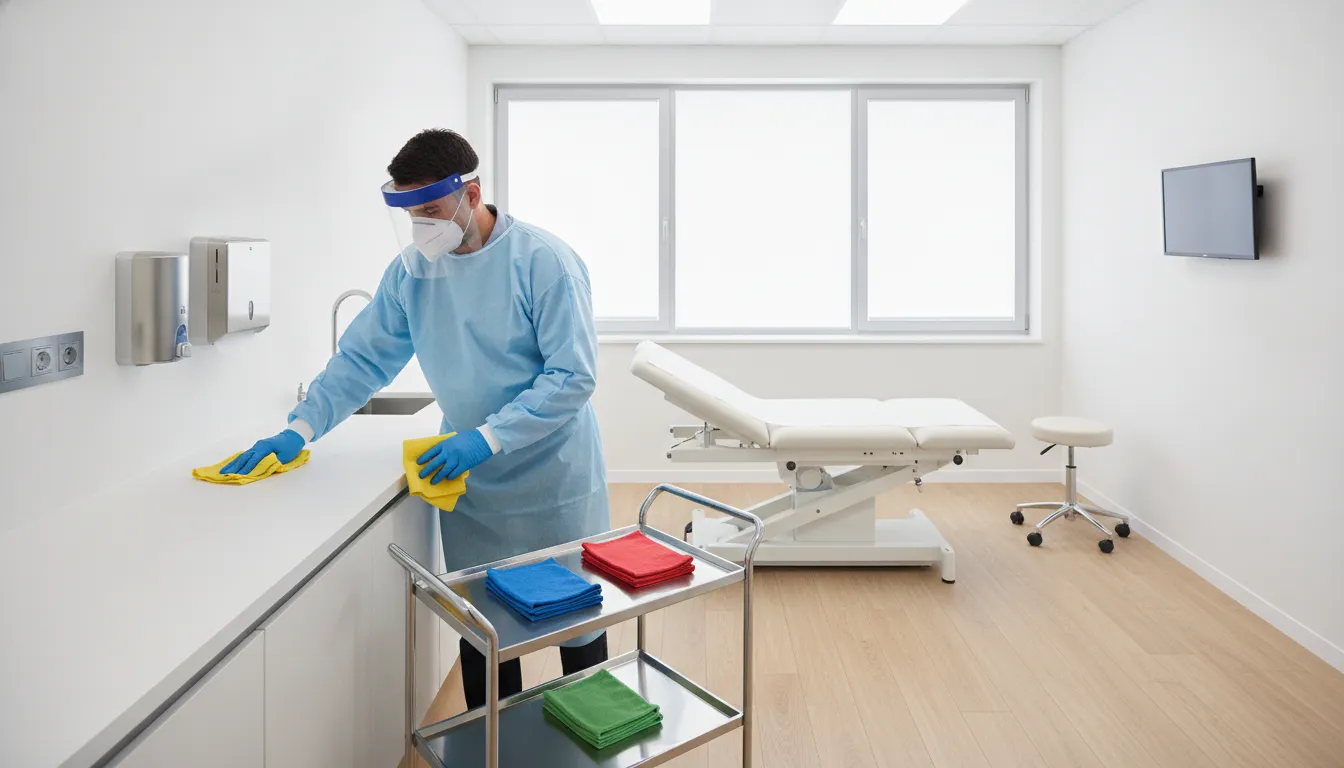
A cloth moves from a restroom sink to a reception counter. A cart rolls from an exam room into a staff break area. Small workflow errors can undermine an otherwise careful program. To prevent cross contamination medical office cleaning must be organized around separated tools, defined room zones, correct product use, and verifiable routines. For medical office administrators in Maryland, Washington D.C., and Virginia, the goal is not to promise a germ-free facility. It is to establish a practical, repeatable process that reduces avoidable transfer risks and supports a professional care environment.
Prevent Cross Contamination Medical Office Cleaning: Why cross contamination control needs a written system
Short answer: Cross contamination control works best when each room, tool, task, and handoff has a defined procedure. A written system helps cleaning staff follow the same sequence every shift and gives administrators a clear way to review performance.
Cross contamination occurs when soil or microorganisms are transferred from one person, surface, tool, or area to another. In a medical office, transfer can happen through hands, cloths, mop heads, gloves, carts, waste handling, or equipment shared between rooms. The concern is not limited to exam rooms. Door handles, check-in counters, chair arms, staff keyboards, and restroom fixtures all sit within the same operating environment.
A written plan turns broad expectations such as “clean thoroughly” into instructions that can be taught and checked. It should identify the rooms included in service, the responsible party for each task, the required frequency, the approved product, the cleaning sequence, and the documentation method. It should also define what clinic employees must handle before a cleaning team enters, such as securing records, removing clinical supplies, or reporting a spill that requires a specific response.
Start with a facility-specific risk review
No two medical offices have identical layouts or traffic patterns. An urgent care location with extended hours has different needs from a small specialty practice with scheduled visits. Administrators should map patient flow, staff-only areas, waste routes, supply storage, and the points where clean and used items may cross. This review helps prioritize high-touch surfaces and rooms that require dedicated tools or more frequent attention.
Define the scope without overstating outcomes
A professional cleaning plan can support environmental hygiene and reduce preventable transfer caused by cleaning practices. It does not replace clinical infection prevention policies, hand hygiene, sterilization of medical instruments, or the guidance of a qualified healthcare professional. Keeping these responsibilities distinct helps administrators assign work correctly and evaluate vendors on services they can reasonably deliver.
Create zones and a clean-to-dirty workflow
Short answer: Divide the office into defined zones, assign tools to each zone, and move from lower-risk areas toward higher-risk areas. Within each room, work from cleaner surfaces to dirtier surfaces and from high surfaces to low surfaces.
Zoning gives the cleaning team a simple decision framework. The exact labels can vary by facility, but a practical plan often separates administrative and reception spaces, general patient areas, exam or treatment rooms, staff spaces, and restrooms. The purpose is not to declare one area harmless. It is to prevent a tool used in a higher-soil area from being carried into another area without proper handling.
Map a repeatable route
The route should account for when rooms become available, where supplies are stored, and how waste leaves the building. A team may begin in private offices, continue through reception and waiting areas, move into patient rooms, and finish in restrooms. If clinic operations require a different order, the written plan should explain how tools and gloves will be changed between zones.
Within an individual room, staff should generally move from higher surfaces to lower surfaces so loosened debris does not fall onto a finished area. They should also move from relatively cleaner surfaces toward dirtier ones. Used cloths should be folded to expose fresh sides and replaced at a defined point rather than carried indefinitely. Administrators can adapt the detailed sequence with their clinical leadership and product instructions.
Plan for exceptions before they happen
Unexpected events can disrupt a routine route. A room may need immediate attention, a waste container may leak, or a patient may remain after normal hours. The plan should state who has authority to pause routine work, which supplies are used for the event. How the area is isolated when appropriate, and how completion is documented. Staff should never improvise a response to blood or other potentially infectious material without the training, supplies, and procedures required for that work.
Administrators building the first version of a route can use this medical office cleaning checklist as a discussion aid, then tailor every item to the facility’s actual rooms and responsibilities.
Separate tools with color coding and safe storage
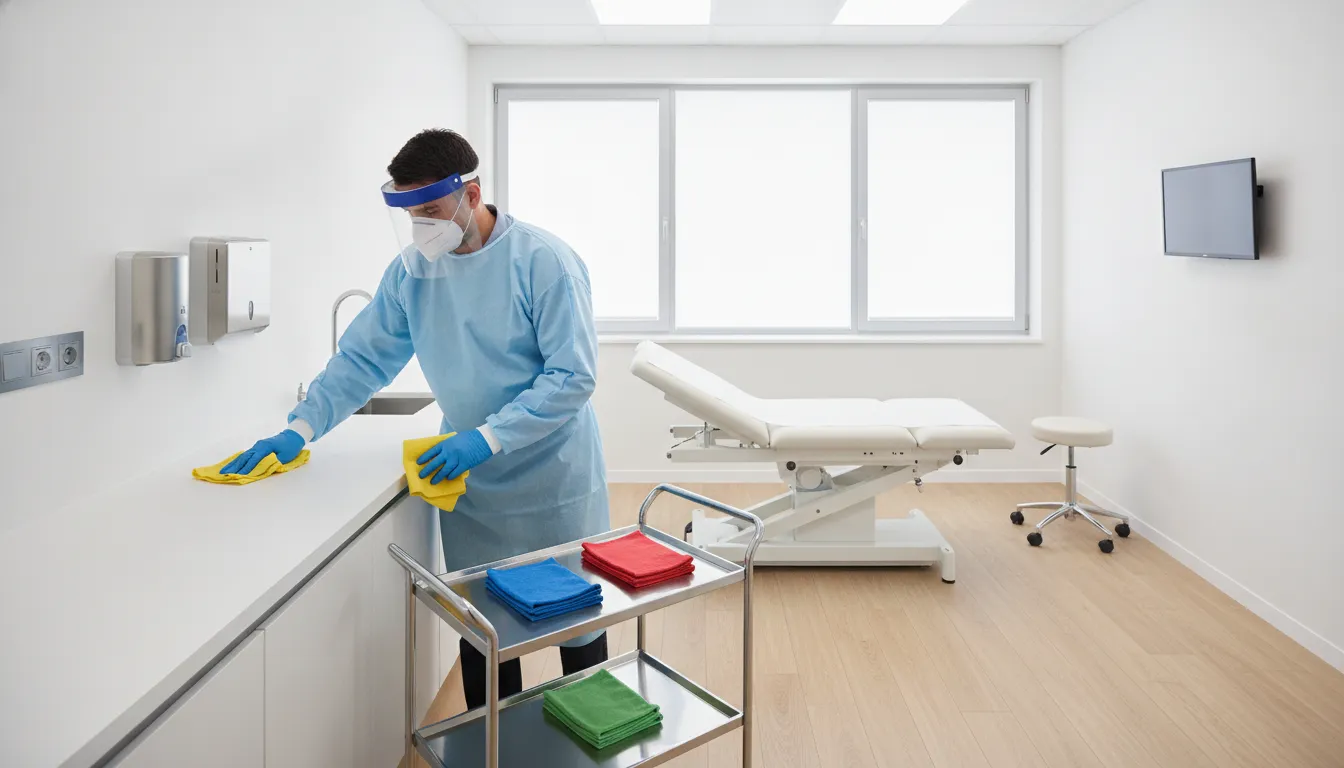
Color coding makes tool separation visible. A facility might assign one cloth color to restrooms, another to general offices, and another to patient-facing rooms. The specific colors matter less than consistent use, clear signage, and enough inventory to prevent staff from reaching for the wrong item during a busy shift. Mop heads, buckets, brushes, and caddies may also need separation where the risk review supports it.
Compare a basic program with a controlled program
The table below shows how practical controls change day-to-day cleaning. It is a planning comparison, not a substitute for facility-specific clinical policies.
| Program element. | Basic approach. | Controlled approach. | Administrator check. |
|---|---|---|---|
| Cloths and mop heads. | Shared across several rooms. | Assigned by zone and changed at defined intervals. | Confirm colors, quantities, and replacement rules. |
| Cleaning route. | Based on convenience. | Documented from cleaner areas toward dirtier areas. | Review route after layout or schedule changes. |
| Product use. | Applied from memory. | Used according to label directions and surface compatibility. | Keep labels and safety information accessible. |
| Quality review. | Problems addressed after complaints. | Logs, observations, and corrective actions reviewed routinely. | Track recurring misses and verify follow-up. |
Control what happens after use
Separation fails if used items return to a clean shelf or if cloths from different zones are mixed in an open container. The supply room should have clearly marked locations for clean inventory, used reusable items, waste, and products. Reusable tools need a defined collection and laundering or reprocessing process. Carts should be cleaned on a set schedule, and staff should avoid placing personal belongings or unrelated supplies on them.
Inventory levels also affect compliance. If the correct cloth or glove is unavailable, staff may be tempted to substitute an item. Administrators should review consumption, maintain reasonable backup stock, and make reorder responsibilities explicit. Foreman Pro Cleaning can discuss customized commercial cleaning workflows and available service options, but the final program should reflect the office’s policies and requirements. Learn more about its broader commercial cleaning services.
Clean and disinfect high-touch surfaces correctly
Short answer: First remove visible soil using the appropriate cleaning method. Then, when disinfection is required, apply a compatible product exactly as its label directs, including the stated contact time. Never assume that a quick spray and wipe completes both steps.
High-touch surfaces deserve attention because many people contact them during the day. Examples may include entry handles, check-in surfaces, chair arms, light switches, faucet handles, dispensers, and selected non-clinical equipment surfaces. The facility’s risk review should determine the list and frequency. A generic checklist can help identify candidates, but administrators should confirm the final scope with clinical leadership.
Distinguish cleaning from disinfection
Cleaning removes soil and debris from a surface. Disinfection uses an appropriate product to address microorganisms on a cleaned surface when the task and product call for it. These terms are not interchangeable, and more product is not necessarily better. Staff must follow the product label, use the correct dilution when applicable, respect contact time, and confirm compatibility with the surface or equipment manufacturer’s instructions.
Avoid common technique errors
Common errors include spraying a product near sensitive electronics, wiping before the required contact time has passed. Returning a used cloth to the product container, and using one cloth across too many surfaces. Another frequent problem is cleaning around objects without confirming who should move them. The plan should address these details so workers do not have to guess during service.
Review the healthcare cleaning services guide before your next vendor scope meeting.
Administrators should also decide how responsibilities are divided during operating hours. Clinic staff may handle certain patient-care surfaces between appointments, while a commercial cleaning team handles agreed environmental surfaces after hours. A responsibility matrix prevents both duplication and missed tasks.
Align PPE, products, and staff responsibilities
Personal protective equipment, or PPE, must match the task, product label, exposure assessment, and facility policy. Gloves are not a universal solution. They must be selected appropriately, changed at the correct times, removed without contaminating hands or nearby surfaces, and followed by required hand hygiene. Other PPE may be needed for specific tasks, but it should never be chosen casually or used as a substitute for training.
Build an approved product list
An approved list helps prevent incompatible products, unapproved substitutions, and confusing instructions. For each product, document its intended use, required dilution if any, contact time, compatible surfaces, storage location, and relevant safety information. Staff should have access to labels and safety data sheets. Products should remain labeled and should never be mixed unless the manufacturer explicitly directs it.
Make handoffs explicit
Medical office administrators, clinical staff, and cleaners each have different responsibilities. Clinical teams may need to secure sharps, medications, instruments, patient information, and specialty equipment before environmental cleaning begins. Cleaners need a reliable method to report damage, supply issues, blocked access, or a condition outside the agreed scope. A simple room-ready signal and escalation contact can prevent uncertainty.
If a facility uses an outside contractor, the scope should identify training expectations, restricted rooms, approved products, access times, documentation, and who can authorize changes. Foreman Pro Cleaning serves commercial and critical environments across Maryland, Washington D.C., and Virginia and can discuss a customized approach. Administrators should verify that any proposed service aligns with their own policies and operational needs.
Verify performance through training, logs, and audits
A plan only works when people can follow it consistently. Initial training should explain not just what to do, but why tool separation, contact time, glove changes, and room sequence matter. Staff should demonstrate the process rather than merely confirm that they read it. Refresher training is useful when the layout, product list, staffing, or service scope changes.
Use records that support action
Logs should be useful enough to guide management decisions. A room checklist can record completion, but administrators may also need exception notes, supervisor observations, inventory issues, and corrective actions. The goal is not paperwork for its own sake. The goal is to identify patterns, such as a surface that is repeatedly missed or a supply that routinely runs out.
Audit the process, not only appearance
A room can look orderly even when the wrong cloth was used or a product was wiped too soon. Observational audits help verify technique, sequence, and tool separation. Periodic scope reviews help confirm that the written plan still matches how the practice operates. When an audit finds a gap, document the correction, retrain when needed, and verify that the change lasts.
Useful review questions include whether zone signs remain accurate, whether clean and used supplies are separated, whether staff can explain product directions, and whether unusual events are escalated correctly. Administrators should also invite feedback from both clinic personnel and cleaners. The people performing the work often notice operational obstacles before they appear in a formal audit.
Frequently asked questions
What is the first step to prevent cross contamination during medical office cleaning?
The first step is a facility-specific risk review that maps rooms, traffic, high-touch surfaces, staff responsibilities, and possible transfer routes. Use that review to create zones, assign tools, and document a clean-to-dirty workflow.
Should medical office cleaning tools be color-coded?
Color coding is a practical visual control that can help keep tools assigned to their intended zones. It works only when the colors are documented, staff are trained, enough inventory is available, and used items are stored and processed separately.
How often should high-touch surfaces be cleaned?
Frequency should be based on the facility’s risk assessment, traffic, clinical policies, operating schedule, and the surface or equipment instructions. Administrators should define the frequency in writing and adjust it when operations change.
Can a commercial cleaning company handle every medical office cleaning task?
Not necessarily. The service scope should distinguish environmental cleaning from clinical responsibilities such as instrument reprocessing, sharps handling, and tasks requiring specialized training. Administrators should verify capabilities, exclusions, products, and escalation procedures before service begins.
Request a medical office cleaning assessment
A reliable cross contamination control program is built from practical details: mapped zones, separated supplies, approved products, explicit responsibilities, trained staff, and documented quality checks. When those details fit the facility’s layout and schedule, administrators gain a clearer way to manage cleaning performance and correct gaps.
Foreman Pro Cleaning can review your medical office’s service needs and discuss a customized commercial cleaning plan for locations in Maryland, Washington D.C., and Virginia. The conversation can cover room priorities, scheduling, tool separation, documentation, and the boundaries between environmental cleaning and clinical responsibilities.
Contact Foreman Pro Cleaning to request a medical office cleaning assessment.
