
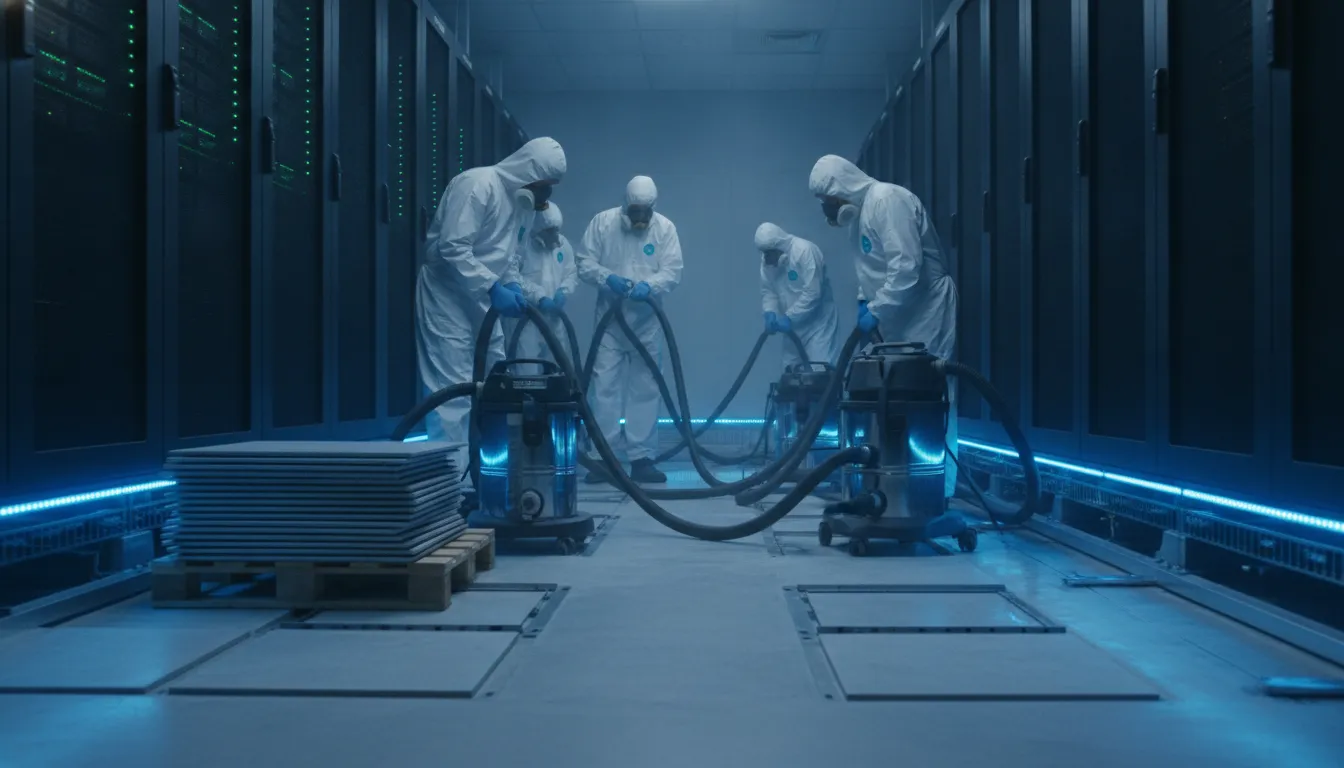
Heavy buildup of microscopic particulates in data center plenums leads to major hardware failures. Foreman Pro Cleaning provides the technical skills to manage these risks in colocation facilities.
Sub floor cleaning data center work is vital for keeping high-density colocation sites safe. Good maintenance plans need a deep cleaning of the sub-floor plenum at least four times each year. This helps stop microscopic particulates from clogging important systems. This specialized data center sub-floor decontamination includes lifting raised floor tiles to find conductive debris and corrosive contaminants with HEPA-filtered vacuum tools. These steps ensure that the site meets the ISO 14644-1 Class 8 standards needed to keep hardware warranties valid. By following these strict contamination control protocols, site managers can lower the risk of heat events and downtime from blocked airflow. Foreman Pro Cleaning uses these technical rules across Maryland, Virginia, and Washington D.C. to make sure multi-tenant sites stay strong against the threat of dust ingress.
Site managers must understand how the cooling system works before they start a deep cleaning plan. Learning What Is a Sub-Floor Plenum and Why Does It Need Cleaning? is the first step toward full site control and hardware safety. The path toward better uptime starts by asking.
Sub Floor Cleaning Data Center: What Is a Sub-Floor Plenum and Why Does It Need Cleaning?
A sub-floor plenum is the space between the main floor and the raised floor tiles in a data center. It acts like a large air duct to move cold air from cooling units to server racks. This system helps keep hardware at the right heat level to stop it from failing. But because it moves so much air, it also gathers many microscopic particulates over time. Proper sub floor cleaning data center work is needed to keep these areas clear.
How the Plenum Manages Cooling Airflow
In a raised-floor setup, fans push cold air into the plenum. This air then flows up through floor tiles with holes to cool the hardware. If the plenum is dirty, the air can carry contaminants right into the servers. These bits can block heat sinks and lead to hardware failure. Keeping this space clean helps airflow stay smooth and safe for all systems.
Data shows that fire events cause 21 percent of data center outages. Often, these fires start from debris or dust in the sub-floor area. Frequent cleaning lowers this risk by removing fuel for potential fires. This care is a key part of meeting ISO 14644-1 Class 8 standards in your facility.
Common Sources of Sub-Floor Contamination
Contaminants get into the sub-floor in a few ways. Dust falls through floor tile holes when people walk in the room. Debris from old build work can also hide under the floor. One big risk is the growth of zinc whiskers on old floor legs. These tiny metal bits can break off and float in the air. These can cause short circuits in electronic parts if they get inside.
Foreman Pro Cleaning uses HEPA-filtered tools to trap these small bits. Big firms like IBM set strict limits for dust levels in their guides. IBM suggests a limit of 0.39 grams per 1000 cubic meters of air. Meeting these rules helps you keep your hardware under warranty. Our team has the critical environment training to clean these spaces without risk to your live systems.
How Often Should Colocation Data Centers Clean Their Sub-Floor Plenums?
Colocation sites need tight cleaning plans because many people enter the space. Most pros suggest a deep clean of the sub-floor plenum at least twice a year. Busy centers often need this service every three months to keep air paths clear. Foreman Pro Cleaning sets up a four-time per year schedule for large sites in Maryland and Virginia to manage microscopic particulates.
What sets the best cleaning cycle?
The rate of new server setups changes how fast dust builds up. When crews move tiles and pull new cables, they drop debris into the plenum. This can block air and hurt hardware. Regular checks help find when contamination levels rise. A good routine sub-floor cleaning procedure keeps the air moving and helps the cooling systems work well.
How do visual checks help between deep cleans?
Staff should look at the sub-floor every day. They should check for large items or clear signs of dust. Weekly cleaning of high-traffic zones helps stop debris from moving deeper into the racks. This tiered plan lowers the risk of big problems. You can find more details on these layers in our guide on how often a data center should be cleaned.
Why do technical standards matter for timing?
Data centers must follow strict rules to stay safe. Most sites aim for a cleanliness level of ISO 14644-1 Class 8 to protect their infrastructure. If tests show too many contaminants, you must start a deep clean right away. This differs from a standard subfloor contamination response guide because it focuses on planned care. Foreman Pro Cleaning uses HEPA-filtered vacuums to meet these high standards every time.
What Procedures Are Used for Sub-Floor Plenum Decontamination?
Data centers must stay clean to keep servers safe. The space under a raised floor is called a sub-floor plenum. This area moves cool air to your equipment. But over time, microscopic particulates can build up there. These tiny bits of debris can block airflow and cause heat risks. Foreman Pro Cleaning uses expert steps to clear these risks. We use data center cleaning methods that keep your site running well.
Pre-cleaning and planning
First, we check the space. We count microscopic particulates to set a baseline. This helps show that our work meets ISO 14644-1 Class 8 standards. We also work with you to pick a safe time for the job. Our team sets up a Method of Procedure (MOP) for your review. This doc shows how we will keep your data safe during the deep clean. Proper planning ensures that our team does not disrupt your daily operations.
Tile removal and deep cleaning
We lift the floor tiles in a clear grid. Each tile is logged so it can go back in the right spot. This keeps the floor level and strong. Once the floor is open, we use HEPA-filtered vacuums. These tools trap tiny contaminants that a normal vacuum would just blow around. We clean the floor, cable trays, and every metal support. We also clean each pedestal and stringer to remove residue. These metal parts can hold onto dust that flows into the air. Our team uses anti-static wipes to clean every part. This ensures that no microscopic particulates remain under the floor.
- Perform a pre-cleaning test to find current particulate levels and establish a baseline.
- Set up a maintenance window and get MOP approval from your site team.
- Remove and log floor tiles one by one to keep them in the correct order.
- Vacuum all sub-floor surfaces with HEPA-filtered tools to trap microscopic contaminants.
- Clean pedestals and stringers to remove microscopic particulates and old debris.
- Apply anti-static treatment to all sub-floor areas to stop static build-up.
- Replace tiles and take final readings to confirm the space is clean and safe.
A clean plenum helps your facility stay in line with uptime rules. It is about more than just looks. It is about protecting the life of your hardware. Our team also offers raised floor cleaning for the top side of your tiles. This two-part approach helps you pass SOC 2 and ISO 27001 audits. Keeping your plenum clear is a key part of your data center care plan. It stops hardware fails and keeps your cooling costs low. Our teams in Maryland, DC, and Virginia are ready to help you meet these goals. By following these steps, you reduce the risk of downtime and extend the life of your equipment.
What Standards Govern Data Center Sub-Floor Cleaning?
Data center cleaning is not just about looks. It is about following strict industry rules that keep hardware safe. These rules tell facility managers how clean a sub-floor plenum must be. If you do not follow them, you risk equipment failure. You could also lose your maker warranty. Expert sub floor cleaning data center teams must meet these rules to protect your systems.
ISO 14644-1 Cleanroom Rules
The main rule for data center air quality is ISO 14644-1. Most facilities aim for Class 8 levels. This means the air has no more than 100,000 microscopic particulates per cubic meter. These particles are 0.5 microns or larger in size. Meeting this ISO standard is a common goal for expert crews. It helps ensure that cooling systems do not pull dust into your servers.
Following Class 8 rules protects delicate parts from harm. Fine dust can cause heat to build up in racks. It can also cause short circuits if the dust is conductive. Foreman Pro Cleaning uses HEPA-filtered vacuums to reach these levels. Our team captures 99.97% of particulates to keep your room within spec. This helps your systems run at their best for a long time.
Maker Equipment Rules
Major hardware makers have their own rules for dust levels. These specs are often found in setup guides. For example, the IBM Installation Manual GC22-7072-1 has a strict limit. It says dust in the air must not go over 0.39 gram per 1,000 cubic meters. Other firms like Unisys and Amdahl have similar rules. Their manuals, like Unisys MA5227 and Amdahl MM-108334-010, list these goals for a clean site.
If you fail to meet these rules, it can hurt your bottom line. Vendors may not honor a warranty if they find high dust levels in their systems. This is why logged cleaning is so vital for colocation sites. Foreman Pro Cleaning provides the logs you need to show you follow the rules. This proof helps you stay safe during audits or service calls. It shows you take care of the shared air space.
ANSI/ISA and Gas Contaminants
Standards also cover gases that can rust hardware. The ANSI/ISA-71.04-1985 standard sets a level for these gases. Most data centers must stay at the G1 level. This level means the risk of rust is low. A whitepaper from LBNL shows how these gases affect IT systems. Managing these gases often starts with a clean sub-floor plenum. Dust and debris can trap moisture and gases near the floor.
Foreman Pro uses experts with CET and CVI training to do this work. This training helps our staff find and fix risks in your facility. We focus on critical environment cleaning services to protect your uptime. Our goal is to give you a facility that meets every rule. This keeps your uptime high and your clients happy. We serve data centers in Maryland, DC, and Virginia with pride.
What Are the Consequences of Neglecting Sub-Floor Cleaning in a Colocation Facility?
Failing to maintain the sub-floor plenum in a colocation facility creates many risks for the operator and the tenants. Over time, microscopic particulates build up in the dark spaces under the floor tiles. This dust and debris can lead to hardware failure, poor cooling, and even fire risks. For colocation providers, these issues can lead to broken service level agreements (SLAs) and lost trust with customers. Foreman Pro Cleaning provides specialized data center sub-floor decontamination to stop these problems before they start.
How dust leads to equipment failure
In a data center, dust is not just a nuisance; it can be conductive and corrosive. Microscopic particulates can get into customer cabinets and settle on circuit boards. This buildup can cause short circuits or block small fans inside hardware. According to ASHRAE, data centers should stay at a cleanliness level of ISO 14644-1 Class 8 to prevent damage. When you neglect the plenum, these contaminants are constantly moved by the cooling fans into the equipment.
Why neglect increases fire and cooling risks
A dirty plenum also harms the cooling system. Dust buildup on pedestals and cables blocks airflow, making the cooling units work harder and use more power. This waste of energy raises costs for the facility. More importantly, accumulated debris can act as fuel. Research shows that fire incidents cause 21% of all data center outages. Keeping the sub-floor area clear of soils and debris is a vital part of fire prevention and operational safety.
What are the risks of zinc whiskers?
Another major risk in older raised floors is the formation of zinc whiskers. These are tiny, conductive hairs that grow on zinc-plated floor tiles or pedestals. If they break off, they float in the air and land on electronics, causing sudden failures. Regular routine sub-floor cleaning procedures help find and remove these threats. Finding these risks early protects the hardware and keeps the site in line with manufacturer warranty terms.
| Risk Area | Consequences of Neglect | Benefits of Maintenance |
|---|---|---|
| Hardware Integrity | Dust ingress leads to short circuits and data loss. | Clean airflow protects sensitive customer servers. |
| Cooling Efficiency | Blocked plenums raise kW costs and heat levels. | Clear pathways ensure best cooling performance. |
| Fire Safety | Accumulated debris increases the risk of ignition. | Low fuel load reduces the chance of outages. |
| Tenant Trust | SLA breaches from preventable equipment downtime. | Proven cleaning logs help with tenant audits. |
| Standards Compliance | Risk of failing ISO 14644 or SOC 2 checks. | Facility meets strict global cleanliness goals. |
Scheduled sub-floor cleaning is not optional for professional colocation sites. It is a needed step to keep the facility safe and efficient. By using a professional team, operators can ensure their infrastructure stays healthy and their tenants stay happy.
Frequently Asked Questions
Why is sub floor cleaning important in a data center?
Sub floor cleaning is vital because the plenum under a raised floor acts as a main air path for cooling systems. Over time, microscopic particulates and contaminants build up in this space. These particles can enter server intakes, causing hardware to overheat or fail. According to ASHRAE, maintaining clean air is necessary to meet ISO 14644-1 standards. Regular decontamination prevents data loss and costly system downtime while protecting your infrastructure investment.
How often should you clean the data center sub floor?
Foreman Pro Cleaning recommends a deep clean of the sub floor plenum at least four times each year. While some facilities wait for a yearly visit, quarterly service prevents large buildups of conductive microscopic particulates. High-traffic colocation centers may need more frequent care to maintain operational integrity. Regular schedules help you stay in line with manufacturer warranty requirements. This proactive approach ensures your cooling systems work at top efficiency. It also reduces the risk of fire from debris or zinc whiskers.
How do you clean the sub floor in a data center without downtime?
Professional teams use specialized contamination control protocols to clean sub floors while servers stay online. According to industry experts, HEPA-filtered vacuums are required to trap microscopic particulates without letting them back into the air. Technicians follow strict anti-static rules and use static-safe equipment to protect live hardware. This process allows colocation managers to maintain high uptime. It provides a deep clean without the risk of stopping critical business operations.
What standards govern data center sub floor cleaning?
The main global standard for data center air quality is ISO 14644-1. Most facilities must meet Class 8 cleanliness levels to protect their hardware. This standard limits the count of microscopic particulates allowed in the air. Large tech companies like IBM and Unisys also set strict contamination rules for their systems. Following these rules is the best way to avoid equipment corrosion and failure. Documented cleaning plans also help managers meet SOC 2 compliance goals and protect their critical facility assets.
How can you book a sub-floor plenum cleaning consultation today?
If you wait on this work, you risk microscopic particulates building up and blocking the vital airflow that keeps your mission critical systems running well. This buildup leads to higher power costs and fire risks, but starting now ensures you meet ISO standards and protect your site from costly downtime. Our team at Foreman Pro Cleaning provides the specialized data center sub-floor decontamination you need to pass audits and maintain operational integrity across your site.
Ready to schedule a consultation for raised floor and sub-floor plenum cleaning? Call 888-360-1608 to talk to a critical environment expert at Foreman Pro Cleaning today and start your own professional contamination control program now.
