
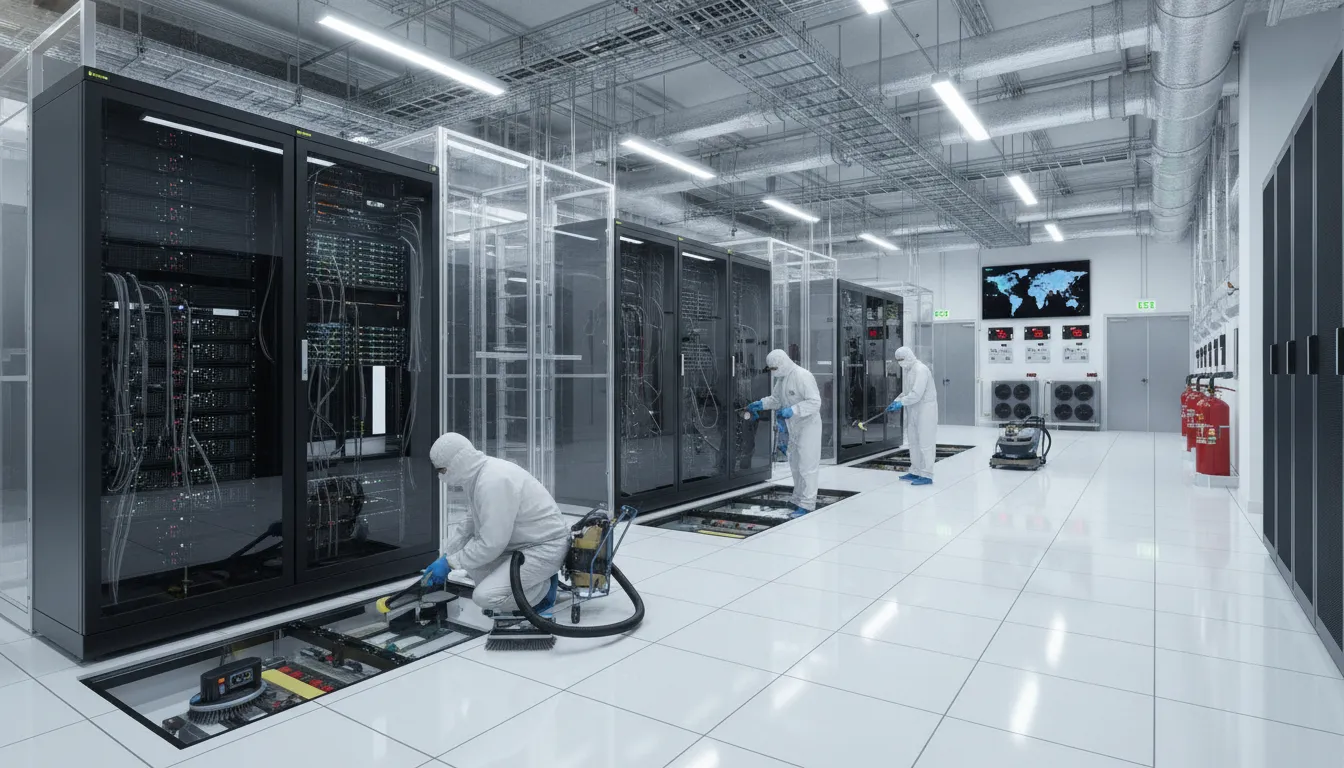
The primary data center cleaning standards are governed by the ISO 14644-1 classification system and ASHRAE TC 9.9 guidelines. Under these compliance frameworks. Critical facilities must maintain an airborne particulate level equivalent to ISO Class 8 or cleaner to ensure the operational integrity of sensitive servers and storage components. This standard limits the volume of microscopic particulates, specifically focusing on particles ranging from 0.1 to 5.0 micrometers, which can cause hardware failures if left managed. Adhering to these precise protocols requires specialized, continuous particulate management, specialized HEPA-filtered vacuums, and certified decontamination teams to prevent costly downtime.
Every facility manager understands that server room hardware needs stable climate controls. However, a major threat to uptime is invisible microscopic particulates that bypass standard air filters. For leading operations across Maryland, Virginia, and Washington D.C., Foreman Pro Cleaning delivers specialized contamination control protocols built on technical precision.
Managing a critical environment requires strict alignment with national and global benchmarks. Knowing how to measure, control, and prevent airborne contamination is key to protecting your hardware. What Are Data Center Cleaning Standards and Why Do They Matter? is the first step toward building a reliable, long-term maintenance strategy, and the details below show how to achieve absolute compliance.
What Are Data Center Cleaning Standards and Why Do They Matter?
For mission-critical facilities, maintaining a clean space is not about looks. It is a vital strategy for risk control. Airborne particles in data centers can lead to hardware failure, making strict air cleanliness standards essential for maintaining infrastructure integrity. Standard office cleaning is not enough for these spaces. High-tech equipment requires precise dust and particle control to run without error.
Protecting Your Vital Hardware
Specialized systems need constant care to prevent costly damage. If microscopic particulates settle on servers, they can trap heat and block airflow. Over time, this buildup causes systems to overheat or short-circuit. To prevent this, critical environment cleaning protocols must be put in place. These steps keep harmful dust out of your servers and switches.
Reducing the Risk of Downtime
In a commercial tech facility, even a few minutes of downtime can cost thousands of dollars. Regular maintenance and professional cleaning programs can significantly reduce the risk of downtime caused by particulate-related hardware failures. Clean spaces run with fewer disruptions. This is why top facility directors trust specialists like Foreman Pro Cleaning to manage their cleanrooms and server spaces.
Meeting Strict Compliance Rules
Many firms must follow strict rules to keep their insurance or vendor warranties. Cleaning is not just about aesthetics; it is about risk mitigation for mission-critical infrastructure. To prove compliance, facilities must meet formal metrics. Earning a critical environment cleaning certification shows that a site meets these high standards. It proves to clients that their data is safe from physical hazards.
What Is ISO 14644-1 and How Does It Apply to Data Centers?
To keep data centers safe from micro-particulates, facility managers must follow formal protocols. The central standard for this work is ISO 14644-1. Set up by the International Organization for Standardization, ISO 14644-1:2015 specifies how to classify air cleanliness in controlled spaces like server rooms. This standard measures the volume of microscopic airborne particulates rather than generic surface soils.
How Does the Classification System Work?
The standard uses a nine-class system to rate air cleanliness, from ISO Class 1 to ISO Class 9. Under ISO 14644-1 rules, testing is limited to airborne particulates between 0.1 and 5 micrometers in size. Technicians use airborne particle counters, also called light scattering discrete airborne particle counters, as the primary tool to track these levels. For most commercial data centers, achieving and maintaining an ISO Class 8 environment is the standard target.
What Are the Operational Requirements for ISO Compliance?
Clean air requires more than a one-time clean. Under ISO 14644-5:2025, facility managers must establish a formal operations control programme. This plan coordinates staff training, material entry, routine monitoring, and regular maintenance. Operators should pair these protocols with specialized critical environment cleaning programs. This combined approach ensures that daily operations do not introduce new contaminants to the server room.
How Does Surface Cleaning Fit Into the Framework?
While air quality is key, airborne particulates eventually settle onto physical surfaces. To address this risk, ISO 14644-13:2026 provides clear rules for surface cleaning in controlled zones. These standards help teams clean hardware and floors to exact particle limits. By hiring a skilled partner like Foreman Pro Cleaning, data centers can meet both airborne and surface requirements to protect their vital systems.
What Does ASHRAE TC 9.9 Recommend for Data Center Cleanliness?
To keep server rooms running well, facility managers must follow clear rules for air and surface quality. The Technical Committee (TC) 9.9 of the American Society of Heating, Refrigerating and Air-Conditioning Engineers (ASHRAE) sets the global standard for these spaces. ASHRAE TC 9.9 guidelines provide essential advice on data center facility management, showing that keeping things clean is a main way to keep hardware reliable.
How Do ASHRAE Cleanliness Standards Protect Hardware?
Dust and tiny particles build up over time on hot circuit boards. This dirt blocks air flow and traps heat, which causes parts to fail. To stop this, ASHRAE guidelines suggest that data centers should adhere to particle cleanliness standards to ensure reliable equipment operation. They recommend that facilities meet the ISO 14644-1 Class 8 cleanliness level. This target keeps airborne dust low and stops heat build-up. It is a key part of professional data center cleaning services that protect vital infrastructure.
What Are the ISO 14644-1 Cleanroom Classes?
The table below shows the ISO 14644-1 cleanliness classes from Class 3 to Class 9. It lists the particle limits for each class and where they are used. ASHRAE TC 9.9 points to Class 8 as the safe standard for modern data center environments.
| ISO Class | Max Particles per Cubic Meter (size ≥ 0.5 µm) | Max Particles per Cubic Meter (size ≥ 5.0 µm) | Typical Industry Application |
|---|---|---|---|
| Class 3 | 1,020 | Not specified | Microchip production cleanrooms |
| Class 4 | 10,200 | Not specified | Advanced biotech laboratories |
| Class 5 | 102,000 | 293 | Surgical suites and drug packaging |
| Class 6 | 1,020,000 | 2,930 | Medical device manufacturing |
| Class 7 | 3,520,000 | 29,300 | Precision optical labs |
| Class 8 (ASHRAE Target) | 3,520,000 | 29,300 | Standard enterprise data centers |
| Class 9 | 35,200,000 | 293,000 | Basic computer rooms and storage |
Why Are HEPA Filters Critical for Cleaning?
Standard vacuums blow fine dust back into the room. This recirculates the very same particulates you are trying to remove. To prevent this, HEPA filters are critical in vacuuming processes within data centers to ensure particulates are captured rather than recirculated. Using certified HEPA filtration stops tiny particles from escaping back into the air stream. The trained technicians at Foreman Pro Cleaning use these specialized tools to keep your air clean and protect your sensitive hardware.
How Do ISO 14644 Classifications Work for Commercial Data Centers?
ISO classifications establish the baseline for data center cleanliness by setting strict limits on airborne particle counts. For most enterprise facilities, the target standard is ISO Class 8. Maintaining this level of cleanliness protects sensitive hardware from particulate-induced thermal issues and electrical shorts. A key part of meeting these ISO criteria involves following a structured data center cleaning checklist to manage contaminants systematically.
What are the limits of Class 8 and Class 9 environments?
Cleanroom standards define the exact volume of microscopic particulates permitted in the air. While Class 9 represents standard room air, ISO Class 8 is significantly cleaner, allowing no more than 3,520,000 particles of 0.5 micrometers or larger per cubic meter. Achieving this standard requires specialized knowledge of how particles behave. At Foreman Pro Cleaning, we apply these rigorous cleanroom principles directly to critical IT spaces to safeguard uptime.
How do technicians manage static and protect equipment?
Standard cleaning methods can generate static electricity, which poses a severe threat to server components. Technicians must use specialized electrostatic discharge (ESD) cleaning protocols to protect sensitive electronic components from static damage during cleaning. This includes using static-dissipative solutions and specialized equipment. Additionally, implementing ESD-safe flooring cleaning protocols is essential for data center maintenance to prevent static-related component damage over time.
Why are microfiber tools and complete plenum care required?
Standard materials like cotton or paper can shed fibers, adding to the particle load in a facility. Instead, the use of microfiber technology is recommended in data center environments to efficiently lift and trap particulates without leaving residues. Furthermore, surface-level wiping is not enough to maintain ISO standards. Comprehensive cleaning programs must include sub-floor and ceiling plenum cleaning to ensure a holistic approach to particulate management across all air-handling zones.
What Equipment and Protocols Are Required for Compliance Cleaning?
To meet strict commercial standards, facility teams cannot use standard office janitorial tools. Safe decontamination of mission-critical hardware needs specialized tools and structured, repeatable steps. Using the right combination of physical equipment and certified processes is the only way to protect complex electronics from microscopic particulates.
What Specialized Cleaning Equipment Is Essential?
Data room environments require tools that trap contaminants rather than scattering them into the air. True high-efficiency particulate air (HEPA) filters are critical in vacuuming processes to ensure tiny elements are captured rather than recirculated. Technicians must also use static-dissipative materials to wipe down hardware surfaces safely. Using high-quality microfiber wipes helps lift and trap soils without leaving behind fine residues or lint.
How Do ESD and Gowning Protocols Protect Hardware?
Static electricity can destroy microchips instantly without visible signs. Specialized ESD-safe apparel, including wrist straps, conductive footwear, and anti-static smocks, must be worn by all personnel. In addition to personal gear, electrostatic discharge (ESD) safe flooring cleaning protocols are essential for data center maintenance to prevent static-related component damage. These specialized clothing and floor protocols must be followed strictly during every entry.
- Use HEPA-Filtered Vacuums: Technicians must extract loose dust using specialized vacuums. According to industry guidelines, HEPA filters are critical in vacuuming processes within these environments to prevent any particulate recirculation.
- Wipe Surfaces with Static-Dissipative Microfiber: Personnel use specialized anti-static microfiber wipes. This material helps pull microscopic particulates off server racks and cable trays without generating any static charges or leaving fiber residues.
- Wear Certified ESD-Safe Apparel: All team members must wear grounded wrist straps, anti-static lab coats, and static-safe shoe covers. This gear keeps static electricity from discharging into sensitive circuit boards.
- Apply Approved Chemical Agents: Technicians only apply non-conductive, non-volatile, and fast-drying solvents. These chemical agents must be compatible with cleanroom materials to prevent residue buildup or plastic degradation.
- Execute Systematic Documentation: A compliant project requires clear record-keeping. Effective cleaning programs depend on a formal documentation and reporting system to track all cleaning tasks and verification results.
Why Is Certified Technical Training Required?
Reliable decontamination cannot be done by untrained staff. Professional critical environment cleaning services must utilize specialized training and certifications, such as Critical Environment Technician (CET) and Certified Ventilation Inspector (CVI) credentials, to perform these sensitive tasks. At Foreman Pro Cleaning, our technicians undergo this training to learn how to identify early signs of particulate accumulation. Choosing a partner with a critical environment cleaning certification ensures your sensitive systems are managed according to the highest industry standards.
How Often Should a Data Center Be Cleaned to Maintain Standards?
Establishing the right cleaning schedule is vital to meet strict data center cleaning frequency guidelines. Rather than relying on rigid, calendar-based cleaning cycles, modern facilities use a strategic, continuous process to control microscopic particulates. Reactive or sporadic cleaning leaves sensitive electronic equipment vulnerable to sudden dust buildup, which can cause overheating and electrical shorts.
How does continuous management prevent downtime?
Because mission-critical hardware runs twenty-four hours a day, contamination control protocols should be continuous rather than reactive to protect your assets. Relying on annual or semi-annual cleaning creates windows of high risk where contaminants can accumulate. Implementing regular, scheduled maintenance and professional contamination control programs by certified experts like Foreman Pro Cleaning can significantly reduce the risk of downtime from hardware failures caused by particulate buildup.
Why is systematic monitoring better than calendar scheduling?
Leading organizations shift away from simple calendar intervals toward schedules driven by real-time environment data. To maintain operational integrity, continuous particulate management is preferred over ad-hoc cleaning in critical IT spaces. By adopting a systematic approach to particle monitoring, facility operators can track actual air quality and airborne particle counts. This proactive tracking tells technicians exactly when to clean, ensuring the environment always meets strict data center standards.
What Are the Risks of Non-Compliance with Cleaning Standards?
Operating a mission-critical facility without strict adherence to established protocols carries severe operational hazards. Neglecting data center cleaning standards is not merely an aesthetic oversight. Instead, failing to maintain these standards directly compromises the safety and reliability of your entire IT infrastructure. Professional remediation by a trained crew like Foreman Pro Cleaning is a necessary strategy for risk mitigation.
How Do Contaminants Cause Hardware Failure?
When microscopic particulates accumulate inside server racks, they create thermal and physical hazards. Over time, these airborne particles settle on delicate electronic pathways, which can quickly lead to sudden hardware failure. This particulate accumulation blocks the natural airflow, insulating key components and causing heat to build up. This process triggers thermal events that force system shutdowns and can even void manufacturer equipment warranties.
What Are the Financial Costs of Poor Maintenance?
The financial impact of a contamination event can be devastating for any business. Uncontrolled dust and debris frequently cause unplanned system downtime, costing organizations thousands of dollars per minute in lost productivity and damaged reputation. By implementing a professional sanitation program, facility managers can significantly reduce their operational risks. For more details on maintaining these environments, you can review our comprehensive data center cleaning checklist to keep your systems running safely.
How to Choose a Qualified Data Center Cleaning Partner
Selecting the right service team to maintain your server environment is a critical operational decision. You must find a partner who understands specialized contamination controls rather than standard office protocols. Evaluating candidates based on their technical credentials and specific field training ensures your hardware remains protected.
What Certifications Should You Look For?
A qualified partner must have documented proof of technical expertise. Look for teams whose personnel hold critical environment cleaning certification, such as Critical Environment Technician (CET) or Certified Ventilation Inspector (CVI) credentials. These professional designations, supported by Foreman Pro Cleaning, guarantee that the technicians understand the physics of airflow, static control, and particulate migration.
Furthermore, these certifications ensure that technicians can recognize early signs of microscopic particulate accumulation before it can impact your hardware health. This technical foresight is what separates an elite specialty crew from standard commercial cleaners.
Why Is a Customized Cleaning Plan Necessary?
Every facility has its own architectural challenges, from raised floor configurations to complex overhead cable trays. Because of these variations, cleaning plans must be customized to your specific room layout, air handling systems, and local equipment load. A cookie-cutter checklist cannot address the unique airflow currents and static zones within your server rooms.
Your partner should conduct a physical assessment to draft this plan. This step is also a core part of establishing an operations control programme to maintain precise air cleanliness levels under industry-wide standards, such as ISO 14644-5:2025 guidelines.
What Equipment and Background Do Cleaners Need?
Server rooms contain delicate, high-density computing components that are highly sensitive to static electricity and physical shock. Because of these risks, your cleaning partner must use dedicated electrostatic discharge (ESD) safe tools and HEPA-filtered vacuums. Standard shop vacuums will merely blow fine particulates back into the room, creating greater risk for your hardware.
An elite cleaning service benefits from an active IT operations and facilities management background. Having run server infrastructure ourselves, our team at Foreman Pro Cleaning designs protocols that protect your physical network layers while keeping air cleanliness within certified boundaries.
Frequently Asked Questions
What ISO standard applies to data center cleaning?
Commercial facilities must meet the air cleanliness criteria set by the International Organization for Standardization under the ISO 14644-1 standard. Most mission-critical facilities aim to achieve and maintain an ISO Class 8 rating. This rating restricts the concentration of microscopic particulates to protect sensitive hardware from failure.
What is the ASHRAE recommendation for data center cleanliness?
The American Society of Heating, Refrigerating and Air-Conditioning Engineers Technical Committee 9.9 recommends that data centers adhere to the ISO 14644-1 Class 8 standard. This standard helps ensure reliable equipment operation. Regular contamination control protocols are necessary to prevent particulate accumulation on servers and cooling systems.
How often should a data center be cleaned?
Facility managers should implement continuous particulate management rather than ad-hoc cleaning. According to protocols established by Foreman Pro Cleaning, high-traffic surface areas need weekly care. Subfloor plenums and ceiling voids require specialized deep cleaning at least once or twice per year to prevent microscopic particulates from circulating.
Why is standard commercial office cleaning insufficient for data centers?
Standard office janitorial practices do not use the specialized protocols needed for critical environments. Standard vacuums recirculate fine particles, whereas data centers require certified HEPA-filtered vacuums. Professional technicians from Foreman Pro Cleaning use electrostatic discharge-safe protocols and microfiber technology to capture microscopic particulates safely.
How Can You Schedule Your Critical Environment Assessment?
Delaying professional data center cleaning allows microscopic particulates to accumulate on sensitive hardware, which increases your risk of costly equipment downtime and premature components failure. Protecting your critical infrastructure requires continuous particulate management and proven contamination control protocols. By acting now, you can keep your systems within strict compliance standards and ensure maximum operational uptime.
Ready to secure your facility? Call (410) 741-3450 to schedule a critical environment cleaning assessment with Foreman Pro Cleaning.
