
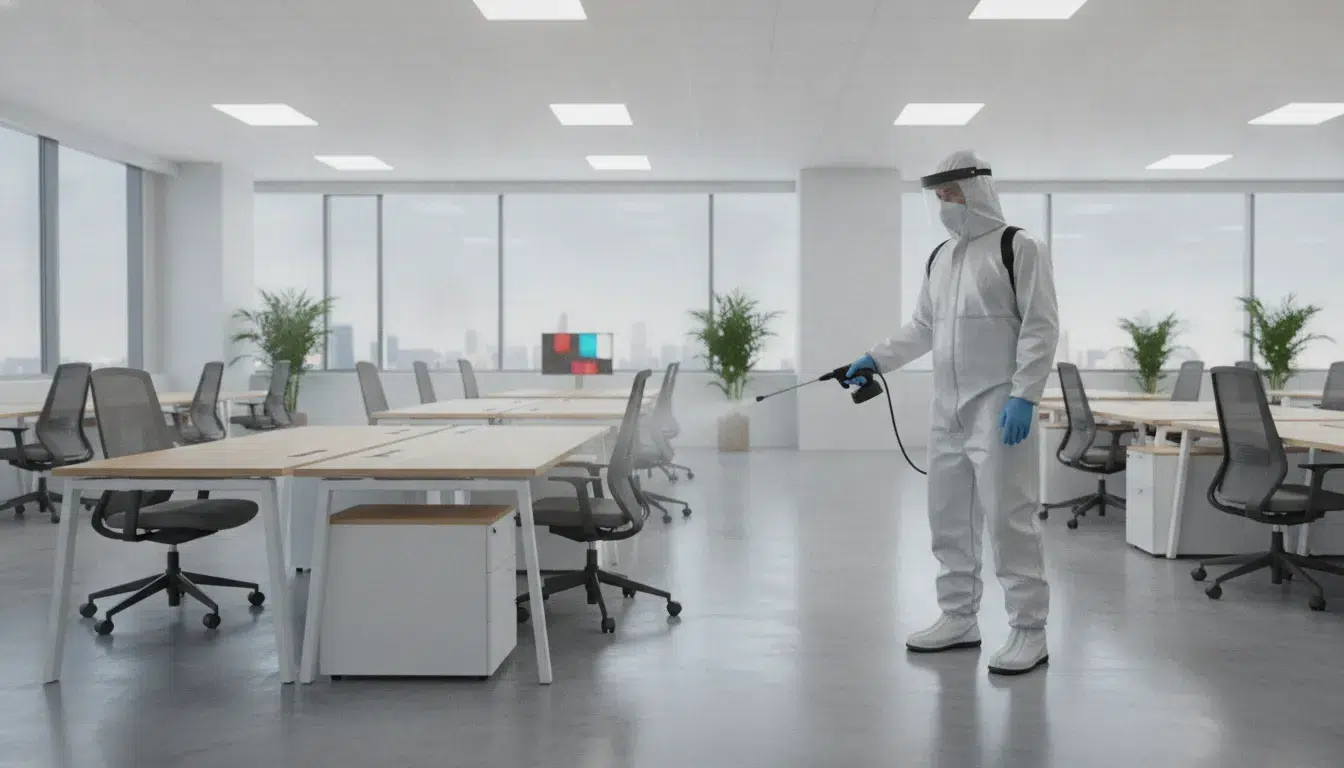
In a busy office, medical facility, school, or fitness center, the surfaces touched most often can receive repeated contact long before a routine cleaning cycle occurs. Door handles, light switches, elevator buttons, keypads, handrails, restroom fixtures, and shared equipment all require a deliberate contamination control strategy. The CDC identifies high-touch surfaces as requiring more frequent cleaning than low-touch areas, with frequency determined by transmission risk and surface contact patterns: CDC environmental cleaning guidance.
Commercial disinfection services are structured programs that identify high-touch points, apply EPA-registered disinfectants according to label directions and required dwell times, and verify coverage across the facility. Foreman Pro Cleaning customizes these protocols for organizations throughout Maryland, Washington D.C., and Virginia, using trained personnel and, where appropriate, electrostatic application to support consistent surface coverage.
The objective is not simply to treat more surfaces. It is to align the method, product, frequency, and documentation with how each facility is used. That framework clarifies what professional disinfection includes and how it differs from routine cleaning.
What Are Commercial Disinfection Services?
Commercial disinfection services are structured programs that reduce or eliminate pathogenic microorganisms on workplace surfaces through the controlled application of EPA-registered disinfectants. Unlike an informal wipe-down, the service is built around product labels, required dwell times, surface compatibility, occupant safety, and a documented plan for the facility’s risk profile.
When applied exactly as directed, professional disinfectants can demonstrate efficacy against approximately 99.9% to 99.99% of specified germs, bacteria, and viruses. That performance is a product- and pathogen-specific claim, not a blanket guarantee for every surface or organism. The EPA registration and label instructions determine the approved use, concentration, contact time, and organisms covered. Published disinfectant efficacy information illustrates why label-compliant application matters.
How Does Disinfection Differ from General Surface Care?
Routine cleaning removes soils, residue, and debris. Disinfection is a separate control measure performed after appropriate surface preparation, with the objective of destroying pathogens that may remain on frequently contacted areas. The Centers for Disease Control and Prevention identifies high-touch surfaces as items frequently contacted by hands, including doorknobs, telephones, light switches, and areas around toilet fixtures. CDC guidance on high-touch surfaces supports prioritizing these points within an environmental cleaning program.
Depending on the facility, a program may address entry hardware, shared workstations, reception areas, breakrooms, restroom fixtures, elevator controls, and other touchpoints identified through a site assessment. Foreman Pro Cleaning develops customized plans for offices, medical facilities, schools, retail spaces, and other commercial environments instead of applying one generic schedule. Its commercial cleaning services can integrate routine cleaning with targeted disinfection so both visible residue and microbiological risk receive appropriate attention.
How Are Safety and Efficacy Balanced?
Product selection should account for the facility’s occupants, materials, ventilation, and operational requirements. Some EPA-registered products carry a Category IV toxicity rating, described as practically non-toxic and not an irritant when used according to the label. Category IV product information provides context for evaluating safety claims, but facility managers should still require trained application, appropriate personal protective equipment, and compliance with the product label.
For organizations across Maryland, Washington, D.C., and Virginia, the strongest program is measurable, site-specific, and coordinated with normal operations. It should identify priority surfaces, specify approved products and procedures, and establish a repeatable service cadence based on occupancy and contamination risk.
How Do Commercial Disinfection Services Differ from Routine Cleaning?
Routine cleaning and professional disinfection address different control objectives. Cleaning removes visible soils, debris, and organic residue from a surface. Disinfection follows cleaning and uses an EPA-registered chemical, applied according to its label, to destroy specified pathogens that may remain. A facility that performs only routine custodial work can look orderly while still requiring a targeted contamination-control program.
The CDC recommends basing environmental cleaning frequency, methods, and processes on a risk assessment that considers the probability of pathogen transmission and how often surfaces are contacted. Areas not exposed to blood or other body fluids, such as offices, libraries, and lounges. May be classified as lightly contaminated, while heavily soiled or higher-risk areas require more intensive protocols. Foreman Pro Cleaning uses this risk-based distinction to help facility managers allocate services where they provide the greatest operational value.
| Process | Definition | Pathogen kill rate | Products used | Frequency guidance |
|---|---|---|---|---|
| Cleaning | Physically removes soils, debris, and residue from surfaces. | No standardized pathogen-kill claim; removal can lower contamination. | Detergents, cleaners, microfiber materials, and water. | Routine schedule, increased for high-touch points and visible contamination. |
| Sanitizing | Reduces microorganisms to a level considered safe by a public-health standard. | Reduction depends on the product label and organism tested; it is not sterilization. | EPA-registered sanitizers approved for the intended surface and use. | After cleaning, according to facility risk, occupancy, and product directions. |
| Disinfecting | Destroys specified pathogens on inanimate surfaces when applied correctly. | Product-specific; the EPA label identifies tested organisms, concentration, and dwell time. | EPA-registered disinfectants, including products selected for the facility environment. | Risk-based and targeted, with increased attention to frequently touched surfaces. |
| Sterilizing | Validated process intended to eliminate all forms of microbial life. | Highest control level; results require a validated method, not a routine spray application. | Specialized validated equipment and processes appropriate to the item. | Used when the item and regulatory or clinical protocol require it. |
For offices, medical environments, schools, and shared commercial spaces, the practical objective is usually not sterilization. It is an integrated program that combines soil removal, targeted disinfection, correct dwell time, and documented cross-contamination prevention. That distinction helps organizations choose commercial disinfection services that match actual exposure risks rather than applying the same protocol to every room.
What Does a High-Touch Disinfection Program Include?
A high-touch disinfection program is a documented, risk-based process rather than a generalized pass through common areas. Foreman Pro Cleaning develops the program around how a facility is used, which surfaces receive repeated contact, and whether the space has specialized contamination-control requirements.
- Assess the facility and map high-touch points. The process begins with a walkthrough, use-pattern review, and risk assessment. Technicians identify the surfaces most likely to transfer contaminants through repeated hand contact, including door handles. Light switches, keypads, elevator buttons, handrails, restroom fixtures, breakroom surfaces, telephones, and shared equipment controls. CDC guidance identifies doorknobs, telephones, light switches, bedrails, and related fixtures as examples of high-touch surfaces that require frequent attention: CDC high-touch surface guidance. The resulting map defines treatment points, access requirements, and any surfaces requiring a specialized method or product.
- Select an appropriate EPA List N disinfectant. Product selection must account for the facility type, surface compatibility, expected pathogens, worker safety, and manufacturer instructions. EPA List N provides a recognized reference for disinfectant products with claims against SARS-CoV-2. But the label remains the controlling document for application, concentration, approved surfaces, personal protective equipment, and wet contact time. A medical facility, school, office, or critical environment may therefore require a different product strategy. Foreman Pro Cleaning uses EPA-registered disinfectants selected for the documented conditions instead of relying on a one-product-fits-all approach.
- Maintain the required dwell time. Disinfectant must remain visibly wet on the surface for the full label-directed contact period. For many List N products, that wet contact time is approximately five to ten minutes, although the product label determines the exact requirement. Wiping the product away too early can prevent the disinfectant from achieving its stated efficacy. Technicians plan the work sequence, application volume, and room access controls so surfaces remain undisturbed throughout the required dwell time.
- Apply the disinfectant with the right method. Depending on the environment and mapped surfaces, technicians may use electrostatic application for broad. Even coverage or manual targeted methods for touchpoints, sensitive components, and areas requiring close control. Electrostatic systems help disinfectant particles adhere around surfaces and reach some shadowed areas, while manual application provides deliberate treatment of handles, switches, buttons, fixtures, and other defined points. In critical environments, application is coordinated with contamination control protocols and operational requirements. Learn more about critical environment cleaning.
- Verify, document, and refine the program. Completion records should identify the treated area, date, product, technician, application method, and any exceptions or inaccessible surfaces. Supervisors review coverage and adherence to label requirements, then adjust the map or frequency when traffic, occupancy, or facility operations change. Foreman Pro Cleaning supports this controlled approach through proprietary Critical Environment Technician (CET) and Critical Environment Cleaning (CVI) training, which emphasizes safety, compliance, and specialized-environment protocols. The result is a repeatable commercial disinfection services program that facility leaders can evaluate and improve over time.
How Do Disinfection Frequencies and Protocols Vary by Facility Type?
A defensible disinfection schedule follows exposure risk, contact volume, and the consequences of contamination. The CDC states that cleaning frequency should be based on risk stratification, including the probability of pathogen contamination. While high-touch surfaces require more frequent attention than low-touch surfaces such as walls and ceilings. CDC environmental cleaning guidance supports this risk-based approach. The matrix below provides a practical starting point for facilities in Maryland, Washington, D.C., and Virginia. Foreman Pro Cleaning adjusts it after reviewing occupancy, workflows, surface materials, and incident history.
| Facility type | Minimum frequency | Priority areas and protocol considerations |
|---|---|---|
| Medical facilities | Daily; after each patient contact or contamination event | Disinfect exam surfaces, treatment areas, rails, fixtures, and other high-touch points. Use specialized protocols aligned with OSHA requirements and applicable AORN guidance. Medical facilities require higher frequency than standard offices because contamination risks are elevated, as documented in the customer knowledge base. |
| Schools and daycares | Daily high-touch disinfection; immediately after visible contamination | Prioritize desks, tables, door hardware, shared learning equipment, restroom fixtures, and frequently handled play surfaces. Products and application methods must balance pathogen control with student and staff safety, consistent with CDC-informed risk assessment. |
| Office buildings | Daily shared spaces; weekly private offices; high-traffic zones more often | Treat reception areas, conference rooms, elevators, breakrooms, restrooms, and shared devices daily. Increase service for dense occupancy, shift changes, public-facing operations, or reported illness. |
| Gyms and fitness centers | Daily full disinfection; more frequent high-touch cycles during peak use | Cover exercise equipment, adjustment points, locker rooms, showers, restroom fixtures, and entry hardware. See Foreman Pro’s high-touch surface disinfection guidance for a facility-specific checklist. |
| Retail spaces | Daily; checkout areas, fitting rooms, and cart handles at repeated intervals | Map customer-contact points, including payment terminals, baskets, carts, fitting-room hardware, counters, and door pulls. High-volume periods may require additional cycles rather than relying on one end-of-day service. |
| Restaurants | Daily dining areas and washrooms; after each seating for tables | Disinfect tables and other food-service contact surfaces between guests, following product label directions and required dwell time. Address menus, payment devices, door hardware, counters, and restroom touchpoints according to traffic and operational risk. |
These intervals are operational baselines, not substitutes for a documented assessment. A facility with an outbreak, unusually dense occupancy, vulnerable occupants, or frequent cross-traffic may need shorter intervals. The objective is consistent contamination control, with staff training, product-label compliance, and records that show when each zone was serviced.
What Technology and Methods Do Professional Disinfection Services Use?
Professional disinfection combines chemical selection, controlled application, and trained execution. The objective is not simply to distribute product quickly. It is to achieve consistent coverage on identified high-touch and complex surfaces while following the disinfectant label, facility requirements, and applicable contamination control protocols.
How Does Electrostatic Application Improve Surface Coverage?
Electrostatic application charges disinfectant particles as they leave the sprayer. The charged particles are attracted to grounded surfaces and can wrap around exposed edges, fixtures, and irregular shapes, including areas that a straight-line application may miss. This wrap-around effect can improve coverage consistency across furniture, hardware, and complex fixtures. Independent commercial service descriptions identify electrostatic technology as a method for extending disinfectant coverage into hard-to-reach areas. But performance still depends on correct equipment settings, appropriate product selection, and disciplined application technique.
Technology does not replace surface mapping or operator judgment. A trained technician must identify surfaces that require treatment, protect sensitive equipment, maintain appropriate distance, and avoid applying product where the label prohibits it. Foreman Pro Cleaning pairs specialized equipment with certified cleaning professionals who understand how application methods affect offices, medical facilities, schools, and critical environments.
Which Disinfectants Are Appropriate for Commercial Facilities?
Product selection begins with the EPA registration and label. EPA List N identifies products that meet the agency’s criteria for use against SARS-CoV-2 when used according to label directions. A hospital-grade disinfectant should also be selected for the pathogens, surface types, and operational conditions relevant to the facility. Some EPA-registered products carry a Category IV toxicity classification, described as practically non-toxic and not an irritant when used as directed. That classification does not eliminate the need for personal protective equipment, ventilation, storage controls, or label compliance.
Why Does Dwell Time Matter?
Dwell time, also called wet contact time, is the period a surface must remain visibly wet for the disinfectant to work as tested. Requirements vary by product and organism. Technicians must consult the EPA-approved label and maintain the specified contact time rather than wiping the product away immediately. Foreman Pro Cleaning’s method integrates product-specific dwell time into the work sequence, helping ensure that electrostatic coverage translates into effective disinfection rather than merely visible application.
Why Choose Foreman Pro Cleaning for Commercial Disinfection Services?
Effective disinfection depends on more than applying a chemical to visible surfaces. It requires a documented infection control protocol, appropriate product selection, correct dwell times, high-touch point identification, and disciplined execution. Foreman Pro Cleaning brings that operational rigor to offices, medical facilities, schools, retail spaces, and other commercial environments throughout Maryland, Washington D.C., and Virginia.
How Does Technical Leadership Improve Cleaning Decisions?
Foreman Pro combines leadership experience in IT operations and facilities management. That combination is particularly valuable where cleaning activities must protect business continuity, sensitive infrastructure, and occupant health at the same time. The team understands how contamination control protocols affect server rooms, network environments, workstations, shared spaces, and facility systems. Its critical-environment background supports continuous particulate management and a methodical approach to reducing contamination risks, rather than treating disinfection as an isolated, one-time service.
What Training Supports Consistent Infection Control?
Foreman Pro Cleaning uses proprietary Critical Environment Technician (CET) and Critical Vulnerability Inspection (CVI) training for specialized facility requirements. The training emphasizes safety, compliance, contamination control, and protocols for environments where small process deviations can create operational or health consequences. This expertise is applied to commercial settings through controlled workflows, appropriate equipment, and trained personnel who understand why sequence, surface compatibility, and contact time matter.
How Are Commercial Plans Customized?
Every facility has a different occupancy pattern, traffic profile, surface inventory, and risk assessment. Foreman Pro develops customized cleaning plans that coordinate routine sanitation with targeted high-touch disinfection. Door hardware, light switches, shared workstations, elevator controls, restroom fixtures, breakroom surfaces, and other frequently contacted areas can be mapped and prioritized according to facility use. This approach supports infection control protocols and helps reduce cross-contamination in shared environments. Review the elements of customized commercial disinfection services when evaluating a scope of work.
For organizations across MD, DC, and VA, Foreman Pro offers a technically informed partner that can adapt service delivery to the facility. Document expectations, and maintain consistent standards as operational needs change.
Frequently Asked Questions
How often should a business schedule high-touch disinfection?
There is no universal schedule. Frequency should reflect traffic levels, shared-space density, surface contact, and the probability of pathogen transmission. The CDC recommends basing environmental cleaning frequency and methods on a risk assessment, with high-touch surfaces treated more often than low-touch areas such as walls and ceilings. See the CDC environmental cleaning procedures for the risk-based framework.
Are professional disinfection products safe for employees and visitors?
They can be, when the selected EPA-registered disinfectant is appropriate for the facility and applied exactly according to its label. The label governs dilution, personal protective equipment, ventilation, and wet contact time. Foreman Pro Cleaning plans application procedures around those requirements rather than treating every workplace, school, medical facility, or retail environment identically.
What is the difference between cleaning and disinfection?
Cleaning removes soils, residue, and debris from a surface, while disinfection uses an EPA-registered chemical to destroy specified microorganisms that remain after cleaning. A high-touch program may require both steps, because a disinfectant must be applied correctly and remain visibly wet for the label-specified dwell time to achieve its tested result.
Which facilities benefit from a high-touch disinfection program?
Any facility with shared spaces or frequent hand contact may benefit, including offices, medical facilities, schools, daycares, fitness centers, retail locations, and critical environments. A customized plan identifies door hardware, light switches, keypads, elevator buttons, handrails, restroom fixtures, and breakroom surfaces according to the facility’s operating risks.
Ready to Protect Your Facility with Professional Commercial Disinfection Services?
Foreman Pro Cleaning provides comprehensive commercial disinfection services for businesses throughout Maryland, Washington D.C., and Virginia. From routine high-touch disinfection programs to specialized electrostatic applications, our trained professionals deliver measurable contamination control for your facility.
Schedule a consultation to discuss your facility’s disinfection needs and receive a customized program tailored to your operations.
