
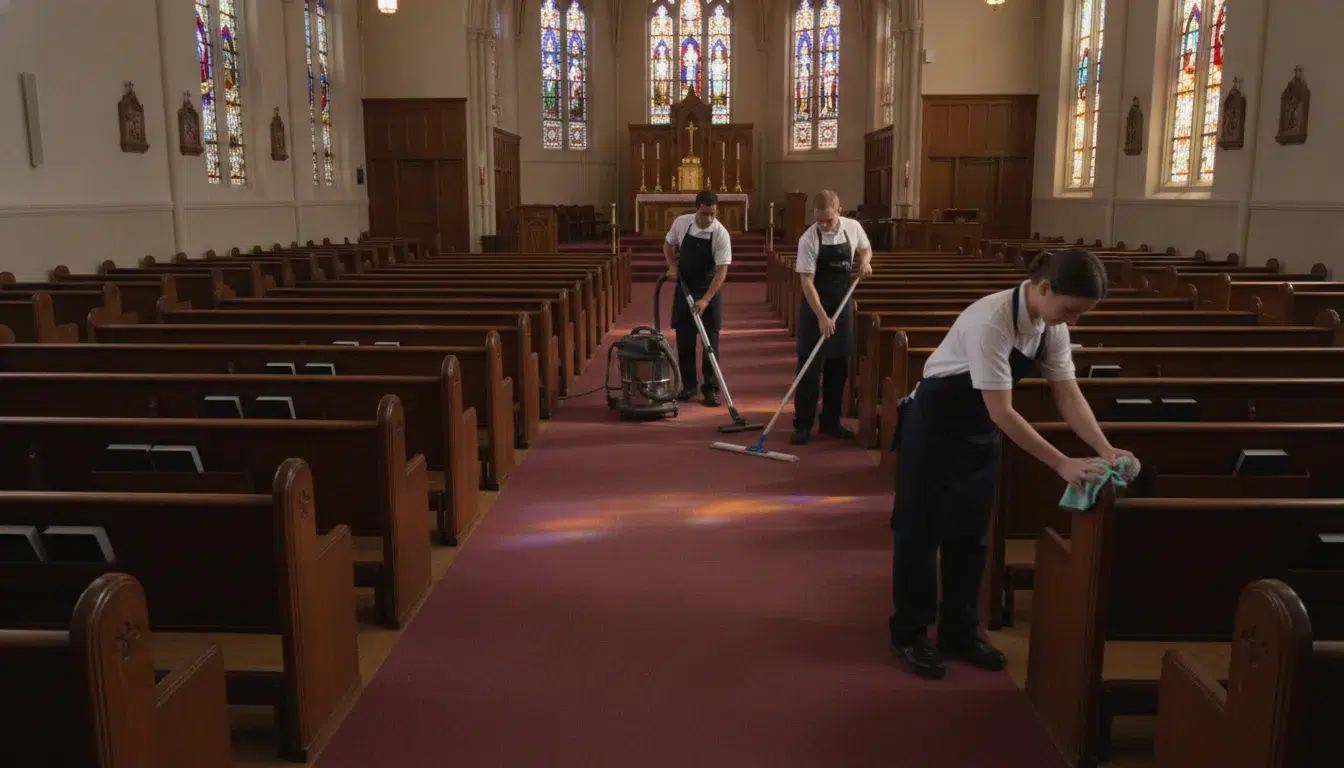
A church is not a single-use facility. Weekly worship services, community programs, childcare, offices, kitchens, and special events can create shifting demands across sensitive surfaces and high-traffic areas. The challenge is maintaining a welcoming environment without compromising material care, occupant health, or operational consistency. The U.S. Environmental Protection Agency notes that older houses of worship may contain environmental conditions that pose increased risks to congregants and staff: EPA guidance on healthy houses of worship.
Professional church cleaning services should cover sanctuary care, restroom deep-cleaning, post-event turnover, and documented contamination control protocols tailored to the facility. The right provider also uses appropriate equipment, trained personnel, and a cleaning plan that reflects the building’s surfaces, schedule, and congregation.
Foreman Pro Cleaning approaches these requirements through customized commercial cleaning plans and precise service protocols. Evaluating the differences between a church and a standard office is the first step toward selecting a provider capable of protecting both the facility and the people who use it.
What Makes Church Cleaning Different from Standard Commercial Cleaning?
Churches require a cleaning program that accounts for both intensive public use and the architectural character of the facility. A sanctuary may receive concentrated foot traffic during services, ceremonies, and community events, while pews, carpeting, aisles, and entry surfaces accumulate soil and microscopic particulates at different rates. Unlike a conventional office, the building may need to support worship, education, meals, childcare, meetings, and public gatherings within the same week.
How Do Traffic Patterns and Multi-Purpose Rooms Change the Work?
Cleaning priorities shift according to how each space functions. Sanctuary carpets and pews require methods that remove embedded residue without saturating upholstery or damaging finishes. Fellowship halls and kitchens need careful attention to food-related residue and high-touch points. Nurseries require disciplined disinfection procedures and product selection appropriate for spaces used by children. Restrooms, vestibules, and door hardware demand frequent attention because they connect multiple areas and experience repeated contact.
This variability makes a fixed office-cleaning checklist inadequate. A useful plan maps service frequency, surface materials, occupancy patterns, and the transition between worship services and other events. Foreman Pro Cleaning develops customized commercial cleaning services plans that can be adapted to those operating conditions.
Why Do Older Church Buildings Require Additional Assessment?
Many houses of worship occupy buildings constructed decades ago or earlier. The U.S. Environmental Protection Agency notes that older houses of worship may contain environmental conditions that pose increased risks to congregants and staff. Facility managers should therefore evaluate ventilation, moisture, material condition, and chemical use alongside visible cleanliness. A cleaning provider should document deterioration before selecting a process, particularly around older flooring, painted surfaces, woodwork, and historic architectural details.
Stained glass, hardwood, carved wood, decorative metal, and religious artifacts may require low-abrasion tools, controlled moisture, and product compatibility checks. These surfaces should not be treated as interchangeable with modern office finishes. Protecting their condition is part of responsible facility stewardship.
How Does Disinfection Support a Safer Congregational Environment?
High occupancy and frequent contact across shared spaces make contamination control an important operational consideration. Research published through the National Institutes of Health identifies effective on-site disinfection as critical to preventing infectious disease transmission in high-traffic public facilities. Commercial disinfection services should be integrated into a documented plan, not treated as an occasional substitute for routine cleaning.
Foreman Pro Cleaning uses electrostatic application of EPA-registered disinfectants to support comprehensive coverage where the process and surface are appropriate. The objective is a measured program that protects congregants, staff, finishes, and the long-term function of the building.
Which Areas of a Church Require the Most Specialized Care?
Church facilities combine high-traffic public areas with spaces that require careful treatment of furnishings, finishes, and shared surfaces. A comprehensive scope should address the sanctuary, restrooms, fellowship areas, kitchens, nurseries, classrooms, and administrative spaces rather than treating the building as a single uniform environment.
How Should Sanctuary Floors and Pew Surfaces Be Maintained?
Sanctuary floors receive recurring foot traffic, tracked-in soils, and microscopic particulates that can become embedded in carpet fibers or accumulate along hard-floor edges. Carpet should be maintained through scheduled extraction and interim care appropriate to the fiber and backing. Hardwood, resilient flooring, and other finished surfaces require methods that remove residue without creating excess moisture or compromising the finish.
Pews and other fixed seating also require measured care. Cleaning teams should use compatible microfiber technology, controlled moisture, and products selected for the specific wood, upholstery, or protective coating. High-touch points such as armrests, door hardware, and railings should be incorporated into the facility’s contamination control protocols.
What Protocols Are Appropriate for Restrooms?
Restrooms require frequent attention because they combine high-touch fixtures with moisture and concentrated traffic. A professional protocol should include toilets, sinks, dispensers, partitions, faucets, handles, floors, and ventilation-adjacent surfaces. EPA-registered disinfectants should be applied according to label directions, with adequate contact time, rather than relying on an appearance-only cleaning pass.
Daily service may be appropriate for active congregations, while additional attention is warranted before and after large services or community events. Foreman Pro Cleaning can incorporate electrostatic application of EPA-registered disinfectants when the facility’s risk profile and surfaces make that approach appropriate.
How Do Fellowship Halls, Kitchens, Nurseries, and Classrooms Differ?
Fellowship halls need flexible floor care and rapid reset procedures after meals, meetings, and community programs. Kitchens require separation of food-preparation surfaces from general cleaning tasks, along with removal of grease and residue from counters, equipment exteriors, floors, and adjacent touchpoints. Product selection and application must support the intended use of each surface.
Nurseries and classrooms demand particular care because children and other sensitive populations share confined spaces and frequently handled materials. Teams should clean toys and touchpoints using compatible, low-residue products, while addressing floors, tables, changing areas, and door hardware through documented protocols. Professional commercial cleaning services can cover these areas comprehensively through a customized plan.
Foreman Pro Cleaning develops customized cleaning plans for sensitive facility needs and offers 24/7 emergency response when an unexpected incident requires rapid attention. That combination allows church leadership to establish routine service while retaining a defined response pathway for spills, contamination concerns, and post-event turnover.
How Often Should a Church Schedule Professional Cleaning Services?
A reliable church cleaning schedule should follow occupancy, service frequency, and the sensitivity of each surface rather than relying on a single weekly visit. Clean the sanctuary after every service, service restrooms daily, and address high-touch surfaces after each gathering. Carpet extraction, detailed floor care, and HVAC vent cleaning generally belong on a quarterly cycle, while windows benefit from monthly cleaning. This cadence supports presentation, hygiene, and the preservation of sanctuary materials that require specialized care.
| Season | Sanctuary | Restrooms | Fellowship areas | Building systems |
|---|---|---|---|---|
| Spring | Detail pews, hardwood, carpet edges, and other sensitive surfaces after routine service cleaning. | Maintain daily cleaning; detail partitions, fixtures, and grout. | Deep-clean floors, kitchens, and seating before increased event activity. | Clean HVAC vents and review filters as part of the quarterly cycle. |
| Summer | Continue after-service cleaning and inspect carpet for tracked-in soils and moisture. | Clean daily and disinfect high-touch hardware after gatherings. | Increase attention to food-preparation surfaces and ventilation during events. | Clean windows monthly and assess cooling performance and visible vent residue. |
| Fall | Schedule quarterly carpet deep-cleaning before holiday services and high attendance. | Continue daily service and post-gathering touchpoint disinfection. | Deep-clean fellowship floors, tables, chairs, and kitchen surfaces before seasonal programs. | Repeat quarterly HVAC vent cleaning and inspect entry systems for particulate accumulation. |
| Winter | Remove tracked-in debris after each service without compromising flooring finishes. | Clean daily, with post-event attention to dispensers, handles, and faucets. | Clean promptly after holiday meals, concerts, and other large gatherings. | Maintain monthly windows and review energy-management opportunities. |
In-house teams can manage immediate after-service tasks when staffing, training, and documented procedures are consistent. However, professional church cleaning services provide scheduled deep cleaning, specialized equipment, and a repeatable scope for sensitive sanctuary surfaces. Foreman Pro Cleaning can build that scope around worship services, community events, and seasonal turnover. The U.S. Environmental Protection Agency reports that houses of worship can achieve at least 25% energy savings through low-cost or no-cost actions and energy-management practices. Making quarterly HVAC attention part of a broader facilities strategy rather than an isolated cleaning task (EPA guidance). For high-touch disinfection and contamination control, review Foreman Pro’s commercial disinfection services.
What Should Facility Managers Look for in Church Cleaning Services?
Facility managers should evaluate a provider as an operational partner, not simply as a source of routine janitorial labor. The right church cleaning services partner should understand the distinction between a sanctuary, a childcare area, a kitchen, administrative offices, and event spaces that may change function several times each week.
Which qualifications and controls can the provider document?
Request current certificates of insurance, bonding documentation, and a written explanation of employee screening and supervision. Ask whether staff training covers OSHA requirements, bloodborne pathogens, chemical handling, safe work practices, and the protection of sensitive finishes. A credible provider should be able to explain how incidents, spills, and exposure risks are reported and managed, rather than relying on informal assurances.
Look for contamination control protocols instead of generic instructions to “clean as you go.” Those protocols should identify high-touch surfaces. Restrooms, nursery areas, food-service spaces, and post-event conditions, with defined products, contact times, personal protective equipment, and verification steps. The EPA also recommends chemical management and facility assessment as part of maintaining healthy houses of worship: review its healthy worship guidance before approving a service specification.
How do equipment and training align with the facility?
Ask what equipment and methods will be used on carpet, hardwood, upholstered pews, flooring transitions, and other sensitive surfaces. HEPA-filtered vacuums and microfiber technology can support particulate removal while limiting redistribution. Where appropriate, electrostatic application of EPA-registered disinfectants can promote more comprehensive coverage. Foreman Pro Cleaning documents this approach through its commercial disinfection services.
Training should extend beyond product operation. Staff need instruction in protecting religious furnishings, controlling access during services, securing chemicals, and working respectfully around worshippers, clergy, volunteers, and children. Ask for evidence of refresher training and a designated account supervisor. Experience with religious facilities is particularly valuable because schedules, ceremonies, memorials, and community programs can create requirements that a standard office checklist does not address.
What should the proposal and references reveal?
Reject one-size-fits-all proposals that list hours without defining outcomes. Cleaning investment varies with square footage, service frequency, and facility needs, so compare proposals using a documented commercial cleaning cost framework. Require a room-by-room scope, frequencies, exclusions, emergency procedures, and measurable quality expectations. A commercial cleaning scope of work can help standardize that review.
Finally, contact references from comparable facilities and ask about communication, staffing continuity, inspection results, and retention. Foreman Pro Cleaning reports a 98% retention rate and combines facilities-management experience with specialized training. Those indicators, supported by verifiable references and a site-specific plan, provide stronger evidence of reliability than a low initial quote alone.
How Do Seasonal and Post-Event Turnover Cleanings Work?
Church facilities often move rapidly from worship services to receptions, community programs, or private gatherings. A documented turnover plan allows each space to be prepared without compromising sensitive surfaces, sanitation controls, or the expectations of congregants and guests.
What Happens Before a Major Service or Event?
Before Easter, Christmas, weddings, funerals, or other high-attendance services, professional church cleaning services typically begin with the sanctuary. Crews remove accumulated particulates from pews, ledges, flooring, and entry areas using microfiber technology and HEPA-filtered vacuums appropriate for the surface. Restrooms receive detailed cleaning and disinfection, with particular attention to touchpoints, partitions, fixtures, and floor edges.
Fellowship halls and kitchens require a separate readiness check. Food-preparation surfaces, serving areas, tables, and floors should be cleaned according to the facility’s use requirements. The goal is not merely visual presentation. It is a controlled sequence that reduces residue and prepares each area for its next function.
How Is the Facility Restored Afterward?
Post-event turnover reverses that sequence. Crews collect waste, address tracked-in soils, vacuum or extract carpet when needed, disinfect high-touch surfaces, and inspect restrooms before the building reopens. Carpet extraction should be scheduled according to fiber, moisture, and drying requirements, especially where rapid reoccupancy is necessary. Sanctuaries also require care around hardwood, upholstered seating, decorative finishes, and other sensitive materials.
The U.S. Environmental Protection Agency provides a chemical-management assessment for houses of worship as part of its healthy-worship guidance. That framework supports reviewing product storage, labeling, worker practices, and chemical use rather than treating cleaning products as an afterthought. Review the EPA’s healthy houses of worship guidance when developing facility procedures.
When Is Emergency Response Necessary?
Unexpected water damage, illness concerns, or a contamination event can disrupt worship and scheduled programming. Foreman Pro Cleaning offers 24/7 emergency response and customized plans for sensitive facility needs, allowing church leaders to escalate the response instead of improvising under pressure. Its broader commercial cleaning services can be structured around recurring seasonal cycles, special-event turnover, and urgent conditions.
Frequently Asked Questions
How much should you expect to pay for church cleaning services?
Pricing depends on square footage, service frequency, room types, surface requirements, and the scope of post-event or deep-cleaning work. A facility manager should request a written scope of work and custom estimate rather than rely on a generic per-visit figure. The proposal should identify labor, equipment, disinfectant applications, and any specialized floor or upholstery care.
What areas do church cleaning services typically cover?
A complete plan can address the sanctuary, pews, flooring, restrooms, fellowship areas, kitchens, offices, nurseries, and entrance spaces. The scope should distinguish routine custodial work from periodic deep cleaning, high-touch disinfection, and care for sensitive finishes. Foreman Pro Cleaning can build the plan around the facility’s layout, schedule, and operational priorities.
How often should a church schedule professional cleaning?
Frequency should follow occupancy, service schedules, events, and the level of contamination risk. Restrooms and high-touch points may require attention after heavily attended services, while sanctuaries, kitchens, and fellowship areas need documented routine and periodic deep-cleaning cycles. A provider should assess the building and adjust the schedule for holiday services, childcare use, and community events.
How can a church prepare for cleaning after a special event?
Share the event calendar, access instructions, room assignments, spill or damage concerns, and any areas requiring restricted chemical use before the service begins. The provider can then sequence waste removal, restroom service, floor care, touchpoint disinfection, and room resetting. For urgent needs, Foreman Pro Cleaning lists 24/7 emergency response and customized cleaning plans for sensitive facility requirements: commercial cleaning services.
Ready to Plan Your Church Cleaning Services?
A customized cleaning plan can help align routine care, event turnover, and facility priorities with the way your church is used. Foreman Pro Cleaning can discuss your Maryland, D.C., or Virginia facility and outline appropriate next steps. Schedule a free consultation and facility walkthrough to get started.
