
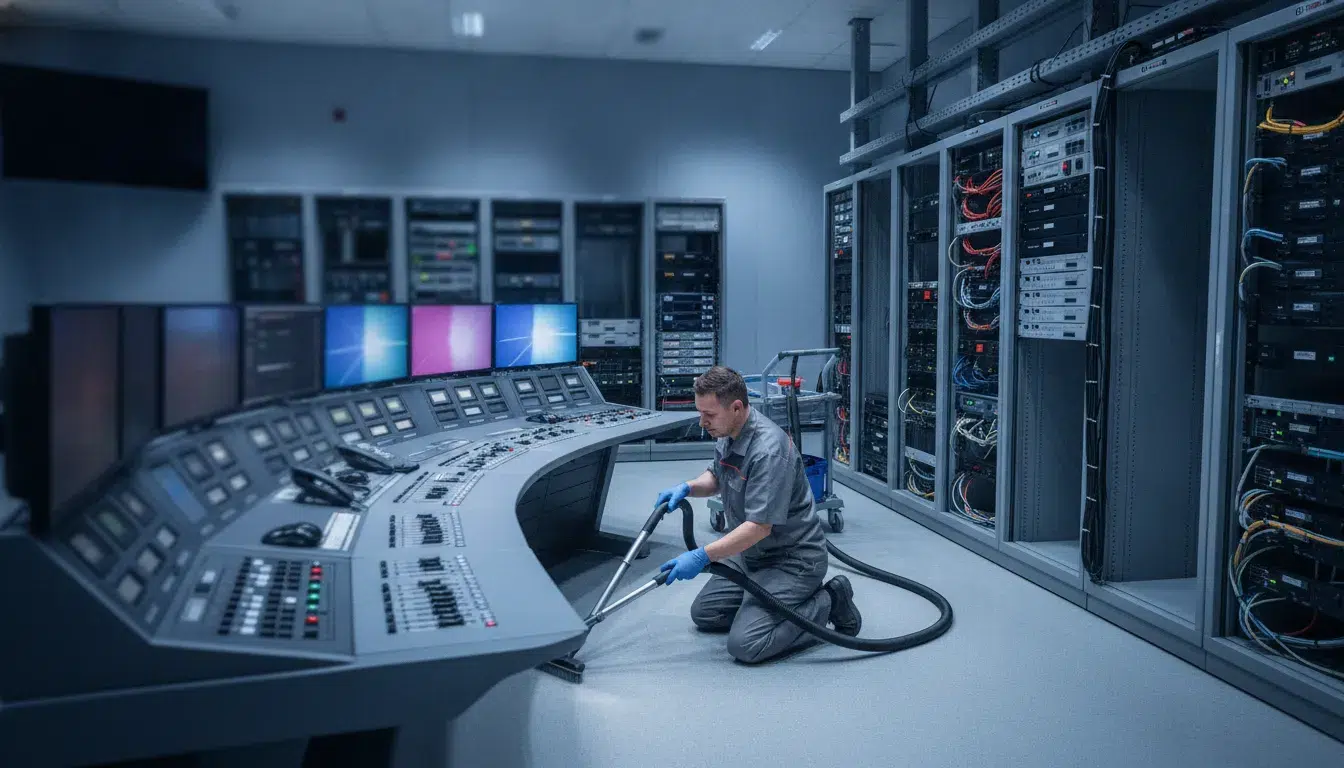
A broadcast studio is not priced like an empty office. Control rooms, edit rooms, server spaces, raised-floor areas, sensitive AV equipment, and restricted access can all change the work required. That is why a responsible proposal starts with the facility, not a generic rate card.
There is no honest universal answer to how much does it cost to clean a broadcast studio. The final scope depends on square footage, layout, production traffic, service frequency, access windows, and equipment sensitivity. ESD-safe and low-lint protocols, plus required documentation, also affect the proposal. A walkthrough and written scope are the practical way to compare proposals.
Request a broadcast studio cleaning walkthrough and customized plan.
Foreman Pro Cleaning serves Maryland, Washington, D.C., and Virginia with critical-environment experience rooted in IT operations and facilities management. The first step is understanding what your studio includes and what must remain protected during service.
What Does Broadcast Studio Cleaning Include?
Broadcast studio cleaning can cover far more than visible work areas. A facility may include master control rooms, production control rooms, edit rooms, A/V rooms, associated data centers, server rooms, network rooms, and raised-floor areas. Each space can have a different operational purpose, access expectation, and cleaning sensitivity. So the scope should be defined room by room rather than treated as one undifferentiated floor plan. Broadcast studio cleaning services should begin with an understanding of how these areas support the production environment.
The work is critical-environment cleaning because contamination control and equipment protection are central priorities. In an ordinary office, a general cleaning routine may be sufficient for common surfaces and traffic areas. In a studio, the cleaning plan must account for technical rooms and the equipment surrounding them. The objective is not simply to make the facility look orderly. It is to establish a controlled approach that respects the environment, the equipment, and the operating requirements identified in the scope.
That distinction also affects how cleaning methods are selected. Broadcast-studio procedures may need to distinguish ESD-safe and low-lint practices from ordinary cleaning methods. Static-sensitive technical areas, for example, should not automatically be approached with the same tools or materials used in a conventional office. The appropriate process depends on the applicable requirements for the space and the equipment within it. Broadcast studio cleaning standards can provide additional context for evaluating those distinctions.
A useful scope of work should identify the spaces included, the surfaces or areas to be addressed, and any boundaries around technical equipment or restricted areas. It should also make clear which procedures are appropriate for each environment. This level of definition helps facility teams compare proposals accurately and reduces the risk of assuming that a standard office-cleaning checklist covers a specialized studio. For Foreman Pro Cleaning, the starting point is a facility-specific understanding of the technical environment, with contamination control and equipment protection kept at the center of the plan.
How Much Does It Cost to Clean a Broadcast Studio When Size and Layout Vary?
Square footage provides a starting point, but it does not explain the full workload inside a broadcast facility. A compact control room with dense equipment, restricted movement, and narrow maintenance windows may require a more carefully defined scope than a larger, open support area. Layout, room mix, traffic patterns, service frequency, environment type, specialized equipment, and approved protocols all influence the quote. Facility size is only one cost factor, not a reliable standalone rate.
During a walkthrough, the assessment should distinguish production control rooms, edit rooms, A/V rooms, server or network rooms, and raised-floor areas. Each space can have different access rules, floor surfaces, equipment sensitivities, and cleaning boundaries. A proposal that treats every room as identical may overlook the controls needed to protect operations and equipment.
| Facility condition | What to assess | Why it affects the scope |
|---|---|---|
| Open office areas. | Open access with fewer equipment restrictions. | Separate routine work from technical controls. |
| Control or edit rooms. | Approved movement and surface methods. | Protocols can change the plan. |
| Server or raised-floor areas. | HEPA and anti-static methods. | Technical requirements exceed routine cleaning. |
| High-traffic routes. | More traffic and changing access. | Traffic changes maintenance needs. |
These distinctions help answer the practical question, how much does it cost to clean a broadcast studio, without pretending that one facility’s quote applies to another. They also clarify what is included, what requires specialized handling, and which areas need separate scheduling or approval. In raised-floor settings, Foreman Pro may use HEPA vacuuming and anti-static methods where the facility requirements call for them, as described in its technical cleaning protocols.
The final scope should connect each area to its floor type, equipment sensitivity, traffic level, frequency, and documentation needs. That creates a defensible proposal and gives facility leaders a clear basis for comparing service plans without relying on an unsupported per-square-foot figure.
How Do Production Schedules and Access Windows Change Cost?
A broadcast studio cannot always be cleaned on a fixed office schedule. Service may need to occur after hours, overnight, early in the morning, on weekends, or during a defined maintenance window, depending on production demands and operational risk. Those scheduling requirements affect the proposal because the team must work within the facility’s available access period without interfering with recording, editing, transmission, or other technical activity. Foreman Pro identifies use, traffic, production demands, and risk as factors in determining the appropriate service frequency and program structure. Learn more about broadcast studio cleaning standards.
How do maintenance windows and turnover deadlines affect staffing?
A short maintenance window can require more concentrated labor than the same tasks performed across a longer period. Turnover work is especially time-sensitive when a space must be ready for the next production or operational phase by a defined handoff deadline. The scope should therefore identify the available window, the areas that must be completed first, and the level of staffing needed to complete the work without rushing sensitive procedures. If schedules change frequently, the proposal may also need a flexible staffing plan rather than a single fixed crew assumption.
Production calendars matter for recurring service as well. A studio may need different cleaning frequencies during active production, lower-use periods, technical maintenance, or facility turnover. The right schedule should be based on actual use and traffic, not simply on the building’s square footage. After-hours, weekend, and 24/7 critical-environment capability can be considered when continuity requirements make ordinary daytime access impractical. See the broadcast studio cleaning service scope.
What should restricted access and out-of-scope areas include?
Restricted rooms, controlled entrances, escort requirements, badge procedures, and equipment sensitivities should be reviewed during the walkthrough. The written scope should state which floors, rooms, surfaces, and objects are included, along with what the cleaning team must not touch or move. This boundary is important in control rooms, edit rooms, server rooms, and other technical spaces where a cleaning task can create operational risk if performed without authorization. A clear escalation process also helps staff pause and ask when an item falls outside the approved scope.
NIOSH workplace evaluations illustrate why access planning should account for more than appearance. Its broadcast-related evaluation included air sampling and industrial-hygiene review, while recommendations addressed warning signs, emergency protective equipment, chemical storage and labeling, ventilation, and possible cross-contamination. These findings do not establish a cleaning price or apply identically to every studio, but they reinforce the need to coordinate cleaning access with facility safety procedures. Review the NIOSH broadcast workplace evaluation.
A facility-specific walkthrough and written scope make these scheduling, access, staffing, and boundary decisions visible before work begins. They also give the buyer a defensible basis for comparing proposals without relying on an invented universal rate.
Which Cleaning Protocols and Documentation Affect Pricing?
Technical cleaning methods can change a broadcast studio proposal because they address risks that ordinary office cleaning does not. A scope may call for ESD-safe procedures, low-lint materials, HEPA-filtered vacuuming, advanced microfiber, anti-static equipment, or approved anti-static chemicals, depending on the rooms, surfaces, equipment, and access rules. These methods are part of a broader critical-environment cleaning program, not automatic add-ons applied to every space.
How do ESD-safe and low-lint methods shape the scope?
Static control matters where sensitive broadcast, networking, or audio-visual equipment is present. The appropriate approach may include static-safe protocols and anti-static products selected for the technical environment. In a raised-floor or sub-floor plenum, HEPA vacuuming and anti-static methods may be required to address the area without treating it like a conventional carpeted office. The cleaning plan should identify which floors, plenums, control rooms, edit rooms, server rooms, or equipment-adjacent areas are included. Foreman Pro describes these capabilities for applicable technical spaces, while its standards guidance distinguishes ESD-safe and low-lint procedures from ordinary cleaning.
Microfiber selection and technique also affect the work. Advanced microfiber can support low-lint cleaning, but the proposal should still define where it is used, what surfaces may be touched, and which equipment remains outside the cleaning scope. That specificity helps protect production continuity and prevents a buyer from paying for a generic method that does not match the facility.
What documentation is included in a professional program?
Documentation is a deliverable when a studio needs repeatable execution, internal accountability, or records for an audit. A written scope of work can identify rooms, surfaces, methods, exclusions, approved access conditions, and service frequency. Standard operating procedures and checklists then give technicians a consistent sequence to follow. Supervisor inspections add a quality-assurance step, while digital logs can record completion, exceptions, and follow-up needs.
Post-service reporting and program assessment can summarize what was completed and support routine-maintenance recommendations. These elements require planning and review, so they can affect the proposal even when they do not increase the physical area being cleaned. Foreman Pro identifies expert consultation, custom program creation, precision cleaning, supervisor quality assurance, and post-delivery reporting as parts of its critical-environment process. The right comparison is therefore not only a method or a labor line. It is the complete scope, including the controls and records needed to manage a sensitive studio responsibly.
How Can You Compare Broadcast Studio Cleaning Proposals?
The lowest-looking proposal is not necessarily the most useful comparison. For a technical broadcast environment, evaluate whether each provider has translated your facility, access rules, production calendar, and equipment sensitivities into a clear operating plan. A responsible process begins with a consultation, walkthrough, pre-inspection, and needs assessment before the provider prepares a written scope of work and customized proposal. Foreman Pro’s consultation process follows that facility-specific approach.
- Confirm the areas and tasks included. The proposal should identify each space, such as control rooms, edit rooms, A/V rooms, server rooms, or raised-floor areas, along with the surfaces and tasks assigned to each. Look for a clear distinction between routine service, precision cleaning, periodic work, and items outside the scope. A written scope makes competing proposals easier to compare and reduces assumptions after service begins.
- Check the schedule and access plan. The document should show when work occurs, how maintenance windows are handled, and how the team coordinates around production activity and restricted areas. Ask how schedule changes, urgent turnover needs, locked rooms, and delayed access affect staffing and service completion. These details matter more than a generic frequency label.
- Review methods against the environment. Look for procedures that match the studio’s risk profile, including ESD-safe or low-lint practices where applicable. The proposal should explain whether HEPA vacuuming, advanced microfiber, approved anti-static equipment, or other controlled methods are required, rather than simply listing broad terms such as “deep clean.”
- Evaluate staffing, supervision, and training. Identify the personnel responsible for the work, supervision, escalation, and access control. Ask how team members are instructed about surfaces or equipment they must not touch. A credible proposal should connect staffing to the scope and maintenance window instead of promising an undefined crew.
- Verify quality assurance and reporting. Compare the deliverables, not just the service frequency. Supervisor inspections, detailed checklists, SOP-based execution, digital logging, and post-service reporting create an evidence trail. Buyers may also need service reports, quality checks, and recurring-maintenance recommendations for internal records or audits.
- Clarify changes and exclusions before approval. Ask how the provider handles added rooms, production-calendar changes, special projects, access restrictions, incidents, and tasks outside the original scope. The proposal should explain the review and approval process for modifications, so operational changes do not become undocumented assumptions.
Request a broadcast studio walkthrough and customized cleaning plan.
Frequently Asked Questions: What Should You Know About Broadcast Studio Cleaning Costs?
How much does it cost to clean a broadcast studio?
There is no responsible universal price. A quote should reflect the facility’s size, room layout, traffic, service frequency, equipment sensitivity, approved protocols, access rules, and documentation requirements. A walkthrough and written scope are more useful than a generic hourly or per-square-foot figure. Broadcast studio cleaning pricing is facility-specific.
Is a one-hour cleaning rate appropriate for a broadcast studio?
Not by itself. The time required depends on which areas are included, whether the work must occur during a maintenance window, and whether the scope calls for ESD-safe, low-lint, HEPA, or other controlled methods. A responsible proposal defines tasks, exclusions, staffing, and the approved service window instead of reducing the work to a standalone hourly number.
How often should a broadcast studio be cleaned?
Frequency should follow use, traffic, production demands, and operational risk. Some facilities need recurring service, while others may combine routine work with periodic deep or rotational maintenance. The appropriate schedule should be set after assessing the studio’s production calendar and sensitive technical spaces, not copied from an ordinary office program. Broadcast studio cleaning standards provide additional context.
What should be included in a broadcast studio cleaning proposal?
Look for a defined scope of work covering rooms and surfaces, access procedures, equipment boundaries, approved methods, service frequency, quality checks, and reporting. For critical environments, accountability may include supervisor inspections, SOP-based checklists, digital logs, and a post-service report. A walkthrough, needs assessment, and customized written proposal help align the work with production requirements.
Do ESD-safe and low-lint procedures change the quote?
They can. Static-safe protocols, HEPA vacuuming, advanced microfiber, anti-static equipment, and approved chemicals may be appropriate for applicable technical areas. These methods should be matched to the equipment, flooring, and facility rules rather than applied as a blanket promise. That technical scope is one reason broadcast studios should not be priced like standard office cleaning. Critical-environment cleaning methods can help frame the discussion.
What Is the Best Next Step for a Broadcast Studio Cleaning Quote?
A reliable quote starts with a walkthrough, clear access rules, a room-by-room scope, and an understanding of your production calendar. Foreman Pro Cleaning can help facilities in Maryland, Washington, D.C., and Virginia define the protocols, frequency, quality checks, and reporting their technical environment requires.
Request a broadcast studio cleaning walkthrough and customized proposal.
