
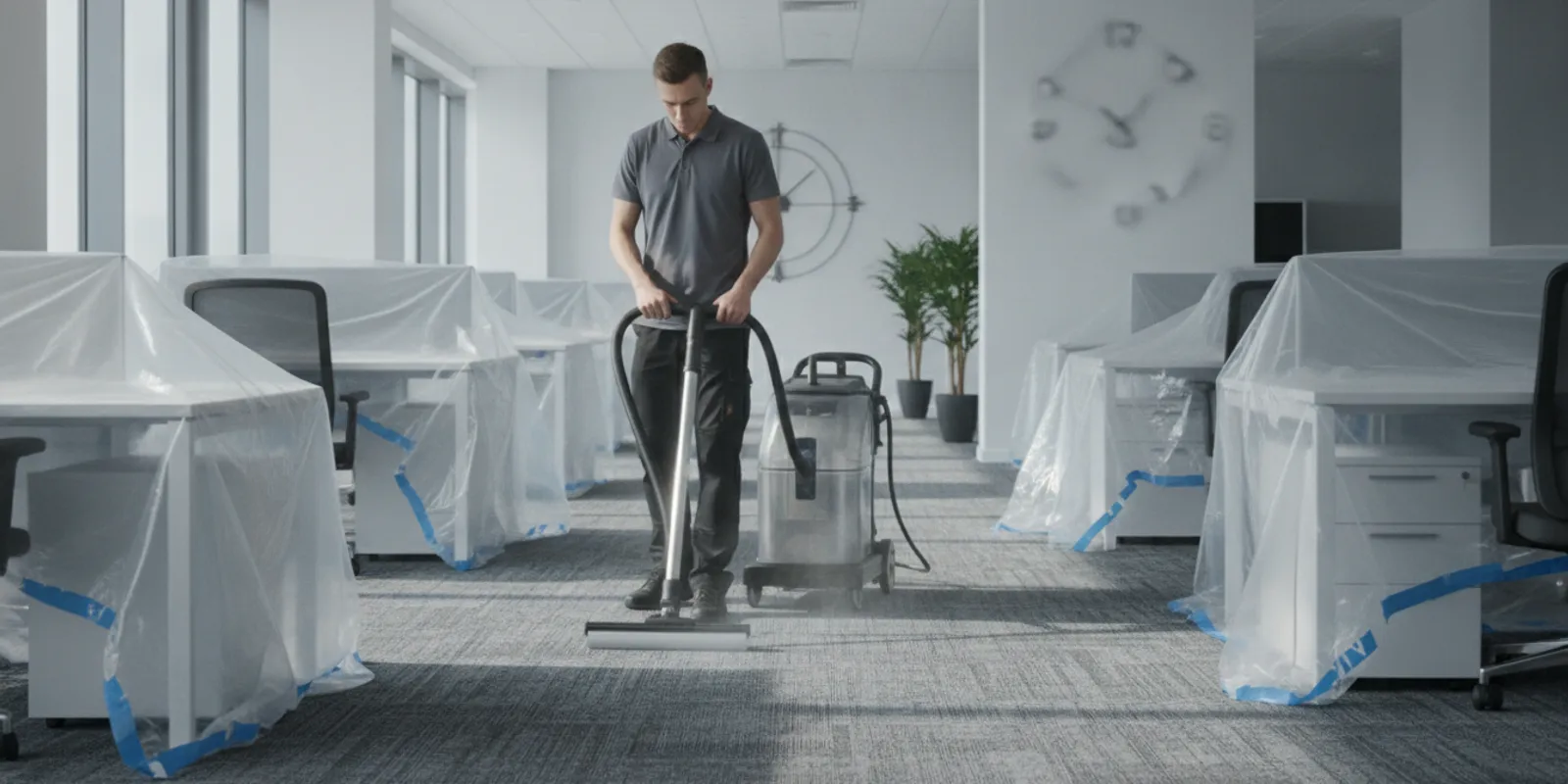
Office carpet deep cleaning can help address embedded soil and persistent appearance problems that routine vacuuming does not resolve. The right time to schedule it depends on what you see, where carpet is used, the carpet manufacturer’s care guidance, and whether the space can be managed safely while it dries.
Discuss an office carpet care plan
When Does Office Carpet Deep Cleaning Become Necessary?
Carpet does not need restorative treatment simply because a calendar date has arrived. Begin with a walk-through and look for patterns that routine vacuuming and prompt spot response no longer improve. Check the same areas under consistent lighting, and compare heavy-use zones with less-traveled carpet of the same type.
- Traffic lanes look persistently gray or flattened. Entrances, elevator approaches, corridors, and paths between work areas receive repeated foot traffic. If their appearance remains different after routine maintenance, embedded soil may be contributing.
- Spots return or remain visible. A mark that reappears after a surface treatment may need a different approach, or may have altered the carpet fiber. Repeatedly applying a spot product without identifying the stain can worsen appearance or leave residue.
- Odors linger after ordinary upkeep. First look for the source, including a spill, moisture, or a building issue. Cleaning the carpet without addressing the source may not resolve the odor.
- Surface texture or color appears uneven. Compressed pile and accumulated residue can affect appearance. However, fading, wear, fiber damage, and permanent staining are not necessarily reversible through cleaning.
- A change in use has increased the maintenance load. More occupants, a reconfigured office, construction nearby, or a change in how an entrance is used may mean the existing vacuuming and spot-response plan is no longer adequate.
Use the walk-through to map conditions rather than label the entire floor as needing the same treatment. Note the room, approximate affected area, type of concern, and whether it is recurring. A narrow, heavily used route may call for targeted work; uniformly dull carpet across several rooms may warrant a broader review.
The U.S. Environmental Protection Agency says it has not issued a specific recommended frequency for carpet cleaning and points readers toward manufacturer recommendations and industry standards. That is a useful reason to avoid a one-size-fits-all interval: review the carpet maker’s care instructions, the facility’s actual conditions, and the cleaning provider’s proposed process together. Read the EPA’s carpet-cleaning frequency guidance.
How Should You Assess Carpet Before Scheduling Office Carpet Deep Cleaning?
Before selecting a process, identify what the carpet is made of if that information is available, how it was installed, and what prior treatments have been used. Check the manufacturer’s care instructions and any facility records. Different fibers, backings, adhesives, and installation conditions may respond differently to moisture, heat, agitation, and cleaning agents. If the construction is unknown, ask the service provider to inspect it rather than assume a method is suitable.
Walk the site with facilities staff and record:
- Carpet type or product documentation, if available, and any known warranty or care restrictions.
- Areas with traffic lanes, recurring spots, discoloration, odor, or visible damage.
- Furniture, electronics, floor transitions, and other items that need protection or relocation.
- Known spills, previous spot treatments, moisture incidents, or repairs.
- Building access times, occupant schedules, ventilation considerations, and any spaces that cannot be taken out of use.
Separate a cleaning need from a repair or building-maintenance issue. A stain caused by a continuing leak, for example, calls for the moisture source to be addressed before a carpet treatment is planned. Frayed seams, loose transitions, or damaged backing should be reported and evaluated; cleaning should not be presented as a repair.
A clear scope makes the decision easier to review. It should identify the areas included, pre-inspection steps, proposed process, expected access restrictions, furniture responsibilities, and how completion will be checked. If the office has both carpet and resilient flooring, coordinate carpet work with the broader commercial floor-care program, rather than treating each floor type as interchangeable.
Which Carpet-Cleaning Method Fits the Condition?
Method selection should follow the carpet manufacturer’s instructions, the fiber and backing, the type and extent of soil, prior treatments, and the amount of time available for the space to be unavailable. A provider should explain why its proposed process fits these conditions and what it cannot reasonably correct. There is no single process that is right for every carpet, every stain, or every office schedule.
| Approach | Best suited to | Key consideration |
|---|---|---|
| Routine vacuuming and prompt spot response | Ongoing removal of loose particulate and attention to fresh, localized spills. | It supports routine care but may not address soil held deeper in carpet or widespread appearance changes. |
| Targeted restorative treatment | Defined sections or specific concerns identified in the site assessment. | Confirm the spot or area can be treated with a process appropriate to the fiber; some discoloration or wear may be permanent. |
| Hot water extraction | Planned restorative carpet cleaning when inspection and care guidance indicate the method is appropriate. | Plan for controlled moisture, extraction, drying time, and temporary limits on access. Foreman Pro’s commercial carpet service uses hot water extraction as part of a seven-step process with HEPA pre-vacuuming. |
The table is a planning aid, not a substitute for a product-specific assessment. The service provider should explain what preparation is needed, what treatment will be used, how moisture is managed, and how the work will be verified. Foreman Pro Cleaning offers commercial carpet cleaning and can discuss a process matched to the facility’s needs.
For hot water extraction, ask what the stated seven-step process includes at your site and which steps apply to the carpet and condition in question. The company overview identifies HEPA pre-vacuuming and hot water extraction, but the exact scope should be confirmed for the project. Do not infer that a named method guarantees stain removal, restores worn fibers, or eliminates every odor.
Arrange a site-specific carpet assessment
How Can an Office Prepare for Carpet Cleaning?
Good preparation protects furniture and equipment, helps the crew reach the agreed areas, and reduces interruptions. Assign one facilities contact to coordinate access and answer questions. Share the work map with the provider in advance, then confirm it together before the appointment.
- Agree on the scope. Mark rooms, corridors, included sections, exclusions, and any priority spots. Point out previous treatments and known moisture problems. Ask how the team will handle a stain that appears different from the description.
- Set furniture responsibilities. Decide what the provider will move and what staff must clear. Remove personal items and fragile objects from desks, shelves, and floor-level areas. Avoid moving heavy or connected equipment unless authorized.
- Protect sensitive items and pathways. Identify computers, power connections, cables, adjacent hard floors, and door thresholds. Confirm how these will be kept clear of cleaning solution and moisture, and how equipment will remain stable.
- Choose a workable schedule. Consider evenings, weekends, phased work, or one area at a time. Schedule around meetings, deliveries, and access requirements. Do not assume that a room will be ready for use at a fixed hour; drying depends on site conditions and the process.
- Notify occupants. Explain which areas are restricted, when work is planned, what routes remain available, and whom to contact with concerns. Provide notice early enough for staff to move belongings and plan alternate routes.
- Confirm site logistics. Review building entry, keys or badges, water access if needed, waste handling, loading arrangements, and the designated contact. Share relevant facility procedures with the service team before work begins.
For a multi-room office, agree on a sequence that keeps essential routes available as long as practical. A phased plan can reduce the number of areas closed at once, but the provider must confirm that the work can be divided without compromising the specified process. Building operations, occupant safety, and the cleaning scope should guide sequencing.
Foreman Pro provides commercial and critical-environment cleaning in Maryland, Washington, D.C., and Virginia. For broader recurring building coverage, facilities teams can also review commercial janitorial services and coordinate carpet work with regular service rather than assuming routine janitorial tasks include restorative carpet treatment.
How Should You Manage Drying and Occupant Safety?
Drying and safe access are part of the work plan, not an afterthought. Ask the provider what access restrictions apply during treatment and while the carpet dries, how those areas will be marked, and what conditions must be met before occupants return. Follow the provider’s site-specific instructions and the product label directions for any cleaning agents used.
- Keep people out of active work areas. Use the agreed barriers or signs and maintain an alternate route. Do not let staff cross wet carpet or enter a room while equipment is operating.
- Protect trip and slip routes. Coordinate transitions between treated carpet and adjacent flooring. Make sure hoses, cords, and equipment do not obstruct exits or normal circulation.
- Wait for the provider’s release guidance. Do not use a generic drying-time estimate as permission to reopen. Conditions such as airflow, humidity, carpet construction, and the amount of moisture affect drying, so confirm the status for each area.
- Follow chemical-use precautions. Ask which products are planned, where their instructions can be reviewed, and whether occupants with particular sensitivities should avoid the work area. Follow label directions and facility procedures.
- Escalate unexpected moisture or odor. If carpet remains unusually wet or a concern develops after service, notify the provider and facilities contact promptly. Investigate the source rather than masking the symptom.
For offices with specific indoor-air, accessibility, or operational requirements, communicate those constraints before selecting the process. A qualified provider should be able to describe the planned equipment and controls in terms the facility manager can evaluate. Foreman Pro’s critical-environment expertise includes specialized cleaning capabilities, but an ordinary office carpet scope should not be represented as a validated cleanroom or data-center protocol.
For context about the service team’s approach and company background, facilities decision-makers can learn about Foreman Pro Cleaning. Service coverage and scheduling vary by facility and scope, so discuss site-specific requirements directly.
How Does Office Carpet Deep Cleaning Fit Into a Maintenance Plan?
Restorative cleaning works best as one part of a documented floor-care program. It is not a substitute for routine vacuuming, entryway soil control, prompt response to spills, or correction of moisture problems. Begin by assigning clear responsibilities: who checks high-use areas, who reports a spill, who approves a treatment, and who confirms an area is ready to reopen.
Use observations to adjust the plan instead of selecting an arbitrary whole-building frequency. A practical review can include:
- Zone-based inspection: Compare entrances, corridors, open work areas, and low-traffic rooms. Record recurring changes and whether they return after routine care.
- Routine tasks: Specify which spaces receive vacuuming, who handles spot response, and how completion is reported. Match the plan to building use and the carpet manufacturer’s guidance.
- Periodic restorative work: Use condition reviews to decide whether targeted or broader deep cleaning is warranted. Set the scope for the affected areas rather than defaulting to identical treatment everywhere.
- Seasonal and operational review: Reassess after changes in occupancy, construction, entrance conditions, or the office layout. Update access and occupant notices when the service plan changes.
- Completion records: Document the areas serviced, exceptions, follow-up needs, and any recommendations. Use the record to compare future conditions and refine the schedule.
Evaluation should focus on observable outcomes agreed in advance, such as completion of the mapped areas, removal of movable furnishings as specified, and communication of areas needing follow-up. Avoid promising that cleaning will make old carpet look new. The surface may retain permanent stains, wear, fading, or fiber damage even after a correctly selected process.
A facilities team managing several building services can use commercial cleaning service information to consider how regular office cleaning and specialized floor care fit together. The scope should state which work is recurring and which carpet treatments are scheduled separately.
Request a facility-specific carpet cleaning discussion
What Should You Ask a Carpet-Cleaning Provider?
Use the proposal review to test whether the service is tailored to your carpet and building constraints. Ask for direct answers, not just a method name.
- Will you inspect the carpet and review available manufacturer care instructions before confirming the process?
- Which areas are included, and how will recurring spots or pre-existing damage be recorded?
- What steps are included in the proposed process, and how does it address this carpet’s fiber, backing, and installation?
- What should facilities staff move or protect, and what will the cleaning team handle?
- How will the team control access, protect adjacent surfaces, and communicate drying and reopening guidance?
- How will you report areas that need follow-up or conditions that cleaning cannot correct?
- What records will we receive to coordinate future service and review the result?
A provider that explains limitations and asks about building use gives the facility manager a better basis for approval than a blanket promise. Confirm any required access procedures, site safety rules, and scheduling terms in writing before service begins.
Frequently Asked Questions About Office Carpet Deep Cleaning
How often should an office schedule carpet deep cleaning?
There is no single interval that fits every carpet and workplace. Review the carpet manufacturer’s instructions, actual use, appearance, and prior maintenance. The EPA guidance does not set a specific cleaning frequency; use the site assessment to decide when treatment is appropriate.
Will deep cleaning remove every stain?
No. Results depend on the stain, fiber, prior treatment, and whether the carpet has been permanently discolored or damaged. Ask the provider to identify expectations and limitations for visible spots before work begins.
Can employees work in the office while carpet is being cleaned?
Possibly, if the project is phased and safe alternate routes and work areas are available. The provider and facility contact should agree on barriers, access limits, and occupant notices before service. Staff should stay out of active work areas and follow reopening instructions.
How long will the carpet take to dry?
Drying time varies with the process, carpet construction, airflow, humidity, and site conditions. Ask the provider for area-specific guidance and do not reopen treated spaces until the agreed release conditions are met.
Does routine office cleaning include carpet deep cleaning?
Not necessarily. Routine janitorial work and restorative carpet treatment are different scopes. Confirm in the service agreement which carpet tasks are included, how often they occur, and whether deep cleaning requires separate scheduling.
How Can You Plan the Next Step?
Start with a documented walk-through, identify the areas and concerns, and check the carpet’s care instructions. Then compare a proposed method, preparation needs, access restrictions, drying plan, and follow-up records against the facility’s operating requirements. A condition-based plan helps protect carpet while giving occupants clear expectations. Foreman Pro Cleaning can discuss commercial carpet care for offices across Maryland, Washington, D.C., and Virginia; review its regional service locations for coverage details.
