
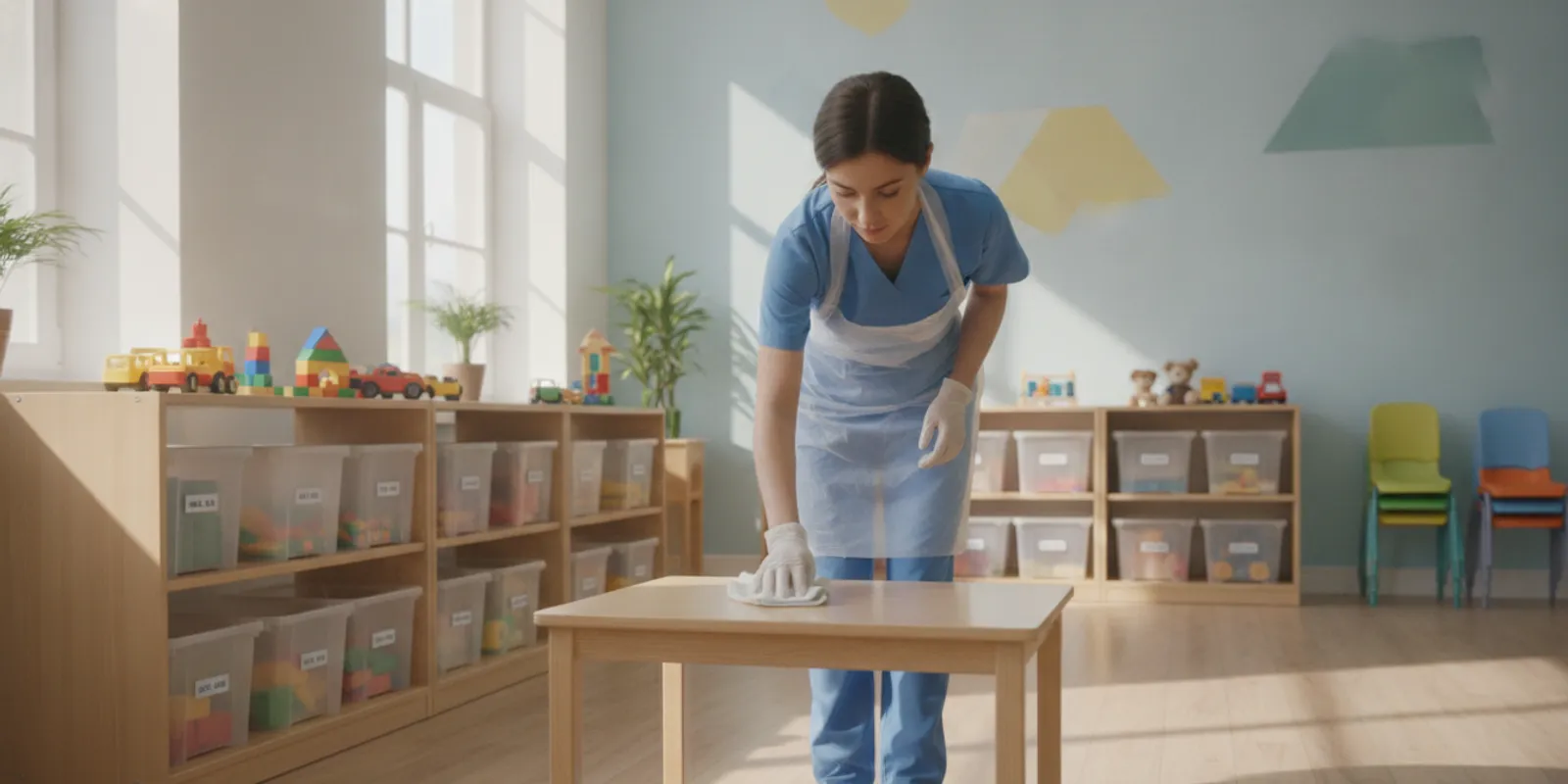
Knowing how to disinfect a daycare center means doing more than applying a product to every surface. The sequence matters: remove visible soil, clean first, select a product approved for the intended use, follow its label, and keep children away until the surface is ready for use. A clear routine helps staff protect children and caregivers without exposing them to unnecessary chemical residues.
Request a daycare cleaning consultation
How to disinfect a daycare center safely: what should you know first?
Cleaning, sanitizing, and disinfecting are different steps with different purposes. Cleaning removes soil and many germs from a surface. Sanitizing reduces germs to a level considered safe under the applicable public-health requirements. Disinfection uses a product intended to inactivate specified germs on surfaces. The right choice depends on the surface, how it is used, the contamination involved, and the product’s directions. The CDC guidance for early care and education settings distinguishes cleaning, sanitizing, and disinfecting, and explains when each process is appropriate. The University of California, Berkeley’s early-childhood green-cleaning toolkit also discusses selecting practices for child-care environments.
Do not treat a product as suitable for every job just because its label uses the word “disinfectant.” Check the label for the organisms it addresses, approved surface types, required protective measures, and directions for use. A product that is appropriate for a bathroom fixture may not be appropriate for a surface that touches food, a child’s mouth, or a sensitive material.
Build the routine around written directions and applicable licensing, public-health, and facility requirements. Local rules can vary. If a requirement conflicts with a general cleaning practice, follow the authority that governs your facility and ask the relevant regulator for clarification. Foreman Pro Cleaning’s daycare cleaning checklist can help operators organize routine tasks, but it does not replace product labels or local requirements.
How do you prepare a daycare room for disinfection?
Start by deciding which rooms and items need attention. Use the facility’s written schedule and respond to specific contamination events, rather than applying disinfectant indiscriminately. Identify surfaces that are frequently touched, shared, mouthed, or used for food. Separate tasks that require different products or cloths so that a cleaning tool used in a restroom does not move to a classroom or food area.
- Keep children out of the immediate work area. Arrange supervision and choose a time that allows surfaces to remain unused for the period required by the product label.
- Gather the right materials. Check that the chosen product is labeled for the intended surface and use. Prepare clean cloths, any required personal protective equipment, and waste containers before starting.
- Read the full directions. Confirm whether the surface must be cleaned first, how to apply the product, how long it must remain wet, whether rinsing is required, and when the area can be used again.
- Clear and sort items. Move toys, dishes, and other portable objects out of the work area. Sort them by material and use so each can be cleaned with a method suitable for it.
- Work from cleaner areas toward more contaminated areas. Use separate cloths or change them as needed. Do not dip a used cloth back into a clean solution if doing so could contaminate it.
Plan the work so staff are not rushing through contact times or leaving treated surfaces accessible to children. The CDC early-care and education guidance recommends regular cleaning and attention to high-touch surfaces, with the product label controlling the application details. Child-care sanitation guidance from the University of North Carolina’s Healthy Child Care program offers additional practical context in its child-care sanitation procedures. That reference is dated, so use it alongside current local requirements and the product label.
How should you clean before disinfecting?
Remove visible soil and residue before applying disinfectant unless the product label specifically permits a combined cleaner-disinfectant use for the situation. The CDC explains that surfaces should be cleaned before sanitizing or disinfecting because impurities can make it harder for chemicals to work as intended. Cleaning first also helps the product reach the surface rather than sit on residue. The National Pesticide Information Center’s daycare and school poison-safety guidance adds safe-use and storage considerations.
Use a cleaning product and method appropriate to the surface. Follow its directions for dilution, application, and any rinsing. Do not combine cleaning products. Never improvise a mixture, transfer chemicals into an unlabeled container, or assume that a stronger concentration or extra product will work better. Store products in their original containers, away from children, and according to label instructions.
After cleaning, use the disinfectant only if the surface and situation call for it. Apply it as directed and keep the surface visibly wet for the full contact time stated on the label. The EPA’s six-step disinfectant guidance says to read the label, use the product as directed, and observe the required contact time. If the product dries too soon, follow its label on whether and how to reapply. Some products require rinsing before a surface is used for food or touched by children; check the label every time.
Which daycare surfaces need routine attention?
Prioritize surfaces based on touch frequency, shared use, and the activity taking place. A high-touch list may include door handles, light switches, faucet controls, table edges, chair backs, shared learning materials, and bathroom fixtures. Clean and disinfect them at the frequency set by your facility’s policy and applicable guidance. Increase attention when there is a specific illness-related or body-fluid incident, following local instructions and the product label.
Use a written room-by-room checklist so staff can see what was completed and what remains. Include classroom tables, shared equipment, sinks, toilets, diapering areas, and other relevant surfaces. A checklist should distinguish routine cleaning from sanitizing or disinfecting, rather than marking every task as the same process. For more practical routine ideas, see Foreman Pro Cleaning’s daycare cleaning tips and its overview of why daycare cleaning matters.
| Area or item | Routine approach | Key check before use |
|---|---|---|
| Frequently touched, hard, nonporous surfaces | Clean; then disinfect when the facility schedule or incident calls for it | Use only a product labeled for that surface and follow contact time |
| Food-contact surfaces | Clean and use a sanitizer only when appropriate to the surface and requirement | Check whether rinsing is required; do not assume a disinfectant is food-safe |
| Toys and mouthed items | Separate from general surfaces; clean and sanitize or disinfect as appropriate | Confirm material compatibility, method, and any required rinse or air-dry step |
| Soft, porous items | Launder or clean by a method suitable for the material | Do not apply a hard-surface product unless its label expressly allows it |
| Body-fluid incident area | Restrict access, remove contamination safely, then clean and disinfect as directed | Follow the facility incident procedure, product label, and applicable health guidance |
The table is a planning aid, not a substitute for site-specific rules or labels. For food-contact surfaces, use a product only when its label specifically permits that use, and complete any required rinse before food or children contact the surface. The EPA’s food-contact surface label requirements explain why the label must control this decision. Review the National Pesticide Information Center’s school and daycare poison-safety information when establishing storage and use practices.
How should you clean and disinfect toys?
Sort toys by how they are used and what they are made of. Put toys that children place in their mouths in a separate container for prompt cleaning and appropriate sanitizing or disinfection before they return to play. Remove items that cannot be cleaned according to their material or the facility’s requirements. Keep clean items separate from used ones, and allow items to dry as directed before returning them to children.
For washable toys, follow the manufacturer’s care instructions. The CDC recommends cleaning and sanitizing objects children use, including toys and play surfaces, with a product suitable for the surface. For hard, nonporous toys, observe the product directions, including any required rinse. Do not soak electronic toys or use a liquid product on electrical components unless the manufacturer and product label permit it. Keep products away from children during application and storage. Where an item’s material or cleaning method is uncertain, set it aside and check the manufacturer’s instructions rather than improvising.
Use bins marked for items awaiting cleaning and items ready for use, and keep those bins in separate locations. A staff member can be assigned to manage the collection and return process so potentially contaminated items do not circulate between groups. For a broader approach to environmentally preferable products and child-care settings, consult the Berkeley green-cleaning toolkit and verify each product’s intended use on its label.
What should staff do after a bodily-fluid incident?
Follow the daycare’s written incident procedure and applicable public-health or licensing directions. Keep children and unnecessary staff away from the affected area. The person responding should use the protective equipment specified by the procedure and product label. If staff have not been trained for the type or scale of incident, restrict access and contact the designated supervisor rather than attempting an unfamiliar cleanup.
- Secure the area. Prevent access until cleanup and any required disinfection are complete and the surface is ready for use.
- Use the designated procedure. Follow the facility’s instructions for the material involved, including the specified protective equipment and disposal method.
- Remove visible material and clean the surface. Use the procedure’s appropriate materials; avoid spreading contamination to nearby surfaces.
- Apply a suitable disinfectant as labeled. Verify that it is intended for the surface and situation, and observe the complete contact time and any ventilation precautions.
- Complete hand hygiene and documentation. Record the incident, area, actions taken, product used, and any follow-up required by facility policy.
Do not treat every bodily-fluid event as an ordinary high-touch cleaning task. The CDC advises using gloves and standard precautions for body fluids, removing the fluid, and then cleaning and disinfecting the affected surface. Follow current local instructions on isolation, reporting, protective equipment, and waste handling. The UNC child-care sanitation reference provides additional context, but facility operators should check current local guidance for incident-specific requirements.
Talk with Foreman Pro Cleaning about your facility
How can ventilation and safe chemical handling protect children?
Use cleaning and disinfecting products only as their labels direct. The EPA directs users to check the product label for the intended surface, application method, contact time, protective equipment, and other precautions. Check whether the label calls for ventilation or restricted access. Provide the ventilation specified for the product and the room; do not assume that opening a window is sufficient in every building. Keep children out during application and for the full period required before re-entry.
Store products in original, clearly labeled containers in a secure location inaccessible to children. The CDC says to keep cleaning products out of children’s reach and to follow product directions. Keep caps closed and follow any temperature or storage instructions. Never mix products, including bleach with other cleaners. If bleach is used, follow its label and the facility’s approved procedure rather than relying on a homemade recipe; the University of Nebraska-Lincoln’s safe cleaning and sanitizing guidance also emphasizes using the correct process. If a product spills or a person is exposed, follow the label’s emergency instructions and the facility’s response plan.
Establish a simple communication method so staff know which rooms are being treated and when they can safely be used again. Post a temporary notice outside the area if that fits facility policy, and remove it only after the required steps are complete. Avoid leaving open containers or prepared solutions unattended.
What records make the disinfection routine reliable?
Records help a director verify that a procedure was followed and identify missed tasks. Keep the record practical and consistent with facility policy. Depending on the task, it may capture:
- Date, time, room, and surface or item addressed.
- Whether the task was routine or prompted by a particular incident.
- Cleaning and disinfecting steps completed, including any required rinse or drying step.
- Product name and label directions relevant to the task, including contact time and protective measures.
- Staff initials, any exception, and who was notified about a follow-up.
Keep current product labels and written procedures accessible to trained staff, while storing chemicals securely. Review the log for repeat missed tasks, unclear assignments, or steps that cannot be completed within the available schedule. Update the written routine when a product or applicable requirement changes, and train staff before expecting them to follow a new procedure. Foreman Pro Cleaning serves commercial facilities in Maryland, Washington, D.C., and Virginia; its service-location information outlines the regional coverage. A customized facility routine should still reflect the center’s own operations and governing requirements.
How can you turn the procedure into a workable routine?
Assign ownership for each room and task. Use a schedule that identifies the responsible role, approved product, required supplies, and completion record. Keep instructions concise enough for staff to use during a shift, but specific enough to prevent guessing about surface compatibility, contact time, or re-entry. Train new staff and revisit the process when the room layout, toys, products, or applicable rules change.
Check the routine periodically. Walk through a room with the checklist and confirm that supplies are available, product labels are legible, clean cloths are separated from used ones, and storage remains secure. Ask staff where instructions are ambiguous. Correct practical gaps instead of adding more chemical use by default. The green cleaning guidance from Foreman Pro Cleaning can provide additional general considerations, while product labels remain the controlling reference for each product.
Centers that need a recurring professional program can compare the scope of commercial cleaning services and janitorial services with their facility’s own needs. Define which tasks staff retain, which tasks are assigned to a provider, and how completion and incident communication will be documented. Foreman Pro Cleaning is a commercial and critical-environment cleaning company serving Maryland, D.C., and Virginia; the exact plan should be tailored to the center and its requirements.
Ask Foreman Pro Cleaning about a customized daycare cleaning plan
Frequently asked questions about how to disinfect a daycare center
Should every daycare surface be disinfected every day?
Not necessarily. Follow the center’s schedule and applicable requirements, and prioritize surfaces according to use and contamination risk. Disinfection is not a substitute for routine cleaning, and unnecessary product use can create avoidable exposure. Use the product only for labeled purposes.
How long should a disinfectant stay on a surface?
Use the contact time on that product’s label. Different products and intended uses can have different directions, so do not rely on a general time from another product or a staff member’s memory. The surface must remain wet for the required period when the label specifies that condition.
Can daycare staff use disinfectant on tables where children eat?
Only if the product label and applicable rules permit the intended use, and staff complete any required rinse or other step before the surface is used. Some disinfectants are not intended for food-contact surfaces. Check the label rather than assuming one product is appropriate for all tables.
What should staff do if a toy cannot be safely disinfected?
Set it aside and check its manufacturer care instructions and the facility’s requirements. Do not use a product on a material or electronic component unless its directions allow it. If the toy cannot be cleaned using an approved method, do not return it to children until the director determines an appropriate next step.
How can you request a daycare cleaning plan?
A reliable daycare disinfection routine combines careful cleaning, label-compliant product use, safe access controls, and records that show what was done. Review your procedure against the surfaces and activities in your own center, confirm it aligns with current local requirements, and assign trained people to carry it out consistently.
