
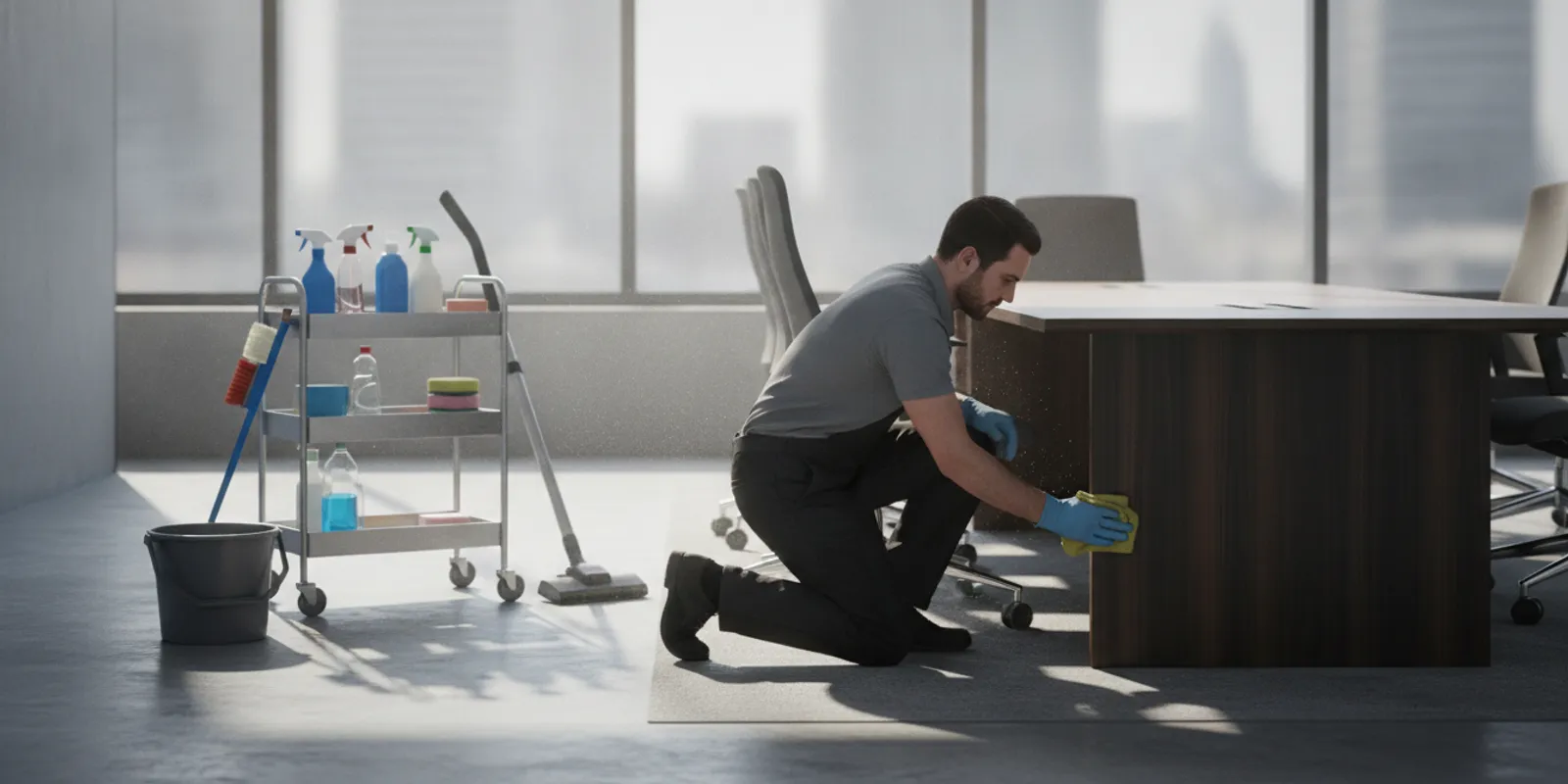
Office building deep cleaning goes beyond the visible, recurring tasks that keep a workplace presentable. It addresses accumulated residue, overlooked surfaces, and periodic maintenance needs across shared offices, restrooms, breakrooms, meeting rooms, and circulation areas. The right scope depends on the building’s materials, use, access requirements, and existing janitorial plan.
Request an office cleaning consultation
What Does Office Building Deep Cleaning Include?
A deep clean is a defined, more detailed service visit or project. It supplements routine service rather than replacing it. The goal is to address work that cannot be completed consistently during a standard nightly or weekly cleaning window, while protecting finishes and respecting building operations.
A scope may include some or all of the following, depending on the facility:
- Detailed dust removal: Accessible ledges, horizontal surfaces, vents and grilles, furniture edges, partitions, and other areas identified during the walkthrough. Cleaning at height should be specifically scoped and performed only with suitable access controls.
- High-touch and shared areas: More detailed attention to door hardware, conference-room tables, reception counters, shared equipment exteriors, and other frequently handled surfaces. The product and method should suit the surface and the facility’s requirements.
- Restrooms and breakrooms: Detail work on fixtures, partitions, splash areas, cabinet fronts, and other surfaces beyond routine touchpoint service. Food-contact surfaces require an appropriate product and use directions.
- Floor care: Thorough edge and corner cleaning, machine scrubbing where appropriate, and periodic carpet extraction or hard-floor maintenance where included. The method must match the flooring material and finish.
- Glass and interior detailing: Reachable interior glass, frames, door tracks, and other agreed details. Exterior windows, elevated glass, and specialty surfaces should be listed separately if needed.
- Waste and overlooked spaces: Cleaning behind or beneath movable furnishings only when access is safe and the furniture can be moved without risk; detailed cleaning of accessible corners, kick plates, and waste-area surfaces.
“Deep clean” is not one universal checklist. For example, carpet extraction may be worthwhile in a heavily used conference area but unnecessary in a room with resilient flooring. A facility with extensive glass partitions may need more interior glass detailing than a small suite. A useful scope names the areas, methods, exclusions, and access assumptions rather than relying on the label alone.
Foreman Pro Cleaning provides customized commercial cleaning plans. A facility manager can start by reviewing the company’s commercial cleaning services and janitorial service options, then identify which periodic tasks are missing from the current schedule.
How Is Office Building Deep Cleaning Different From Routine Janitorial Work?
Recurring janitorial work is designed to maintain baseline cleanliness on a repeat schedule. It commonly covers tasks such as waste removal, restroom servicing, floor maintenance, and cleaning of accessible surfaces. Deep cleaning is a planned supplement for detailed or less frequent work. It does not automatically include every item below; the written scope determines what is included.
| Planning factor | Recurring janitorial service | Office building deep clean |
|---|---|---|
| Primary purpose | Maintain agreed conditions through repeat service. | Address periodic detail work or buildup beyond the routine scope. |
| Typical cadence | Set frequency, such as weekly or several times per week, based on use and contract scope. | Scheduled as a one-time project or recurring periodic task; timing depends on observed need and work included. |
| Task examples | Routine restroom care, waste removal, floor upkeep, and accessible surface cleaning as specified. | Detailed edges, interior glass, selected high-detail surfaces, carpet extraction, or specialty floor work if included. |
| Planning needs | Access, service windows, supply responsibilities, and routine quality checks. | Room-by-room scope, furniture and equipment access, occupant notices, special methods, and any areas excluded. |
| How to verify | Review recurring task lists and service records. | Compare the agreed project scope with completed areas and document any inaccessible or deferred work. |
This comparison describes common planning distinctions, not a regulatory standard or a promise that every provider uses identical definitions. The Massachusetts state office cleaning guidance is a useful reference for thinking about office cleaning protocols. The CDC’s facility cleaning and disinfection guidance explains that cleaning needs depend on facility conditions and that cleaning and disinfection are not interchangeable tasks. Use your organization’s policies and applicable requirements when setting procedures.
When Should You Schedule Office Building Deep Cleaning?
Set timing according to condition, traffic, material type, and what your recurring program already covers. A calendar can help prevent neglected tasks, but it should not replace a site assessment. A building’s needs may change after renovations, a shift in occupancy, a tenant turnover, or a change in how shared areas are used.
Consider arranging a scope review when:
- Edges, corners, vents, ledges, or other agreed areas show visible accumulation despite regular service.
- Carpet, entry flooring, or other surfaces show wear or soiling that routine maintenance is not resolving.
- A change in occupancy or room use increases demand on conference spaces, kitchens, restrooms, or reception areas.
- Furniture or equipment has been moved, making previously inaccessible areas available for cleaning.
- A renovation, move, or substantial maintenance project creates dust or residue that falls outside the normal janitorial scope.
- Your team has identified recurring quality concerns and needs to determine whether the issue is a missed routine task, a periodic detail task, or a repair or replacement need.
Use observation and documented service results to decide whether a task should be added to regular service or scheduled separately. A daily high-touch task may be better addressed through the recurring plan. Carpet extraction, by contrast, is generally a planned floor-care task, with frequency based on traffic, carpet condition, and the facility’s maintenance approach. Do not assume that a one-time deep clean will solve a maintenance issue that needs a continuing schedule.
For more detail on assessing the need for a project, see how to determine whether a facility needs deep cleaning. If your space requires a continuing cleaning schedule rather than a single project, review office deep-cleaning considerations alongside your regular service plan.
How Can You Define a Useful Scope of Work?
Start with a walkthrough and divide the building into practical zones: entrances and reception, open office areas, private offices, conference rooms, kitchens and breakrooms, restrooms, corridors, and specialty spaces. Note finish types, furniture, access limitations, operating hours, and any areas that need advance approval. If a building includes controlled or sensitive rooms, identify them before work is scheduled and define separate procedures.
For each zone, document four things:
- Location and surface: Name the room or area and identify the surfaces to be addressed, such as carpet, resilient flooring, glass, or furniture.
- Task and method: Describe the action clearly. “Detail the conference room” is vague; “clean interior glass partitions and frames” is reviewable. Confirm that the method and product suit the surface.
- Frequency or project timing: State whether the task is one-time, seasonal, or part of a repeating maintenance cycle. Avoid assigning the same frequency to every area without considering use.
- Acceptance and exceptions: Explain what completion looks like, how inaccessible items will be reported, and who can approve changes or added work.
Also identify responsibilities that can affect the result: who moves desk items, who secures confidential material, whether furniture can be shifted, and who provides access to locked rooms. List exclusions such as exterior windows, equipment interiors, high-level work, or repairs if they are not part of the cleaning agreement. Clear exclusions prevent mismatched expectations.
Where cleaning and disinfection are both part of a facility protocol, name them separately. Cleaning removes soil from surfaces; disinfection uses a product and process intended to address microorganisms on a surface. The CDC notes that facilities should select and perform these tasks according to the situation and product directions. See its guidance on when and how to clean and disinfect a facility and align any work with your own safety, infection-prevention, or building policies. A generic promise to “sanitize everything” is less useful than a precise list of surfaces, methods, and responsibilities.
Foreman Pro Cleaning has a background in commercial and critical-environment work, but an ordinary office scope should not imply that every room requires a controlled-environment protocol. For specialized spaces, define access, approved materials, and documentation separately. Learn more about critical environment cleaning services if your facility has areas with specific contamination-control needs.
Discuss a customized office cleaning scope
How Should You Sequence the Work Across the Building?
A clear work sequence can reduce repeat handling, protect finished floors, and limit disruption. It also gives the site contact a practical way to check progress without treating every room as an identical task. Agree on the sequence before the service date, especially if some areas must remain available to occupants.
- Confirm the work zones and access window. Mark which rooms are included, which are restricted, and which must remain open. Identify the point of contact who can resolve a locked door or unexpected conflict.
- Address high and dry-detail work first. If the scope includes accessible ledges, fixtures, frames, or other elevated surfaces, arrange that work before floor detailing so any displaced residue can be addressed afterward. Work at height requires suitable access planning and should not be assumed to be included.
- Complete room-specific surfaces. Detail desks or counters only when they have been cleared and the scope authorizes the work. Handle restrooms, food areas, and shared touchpoints with methods appropriate to those spaces, and follow product directions.
- Schedule floor work with drying and traffic in mind. Identify routes that must stay open, wet-floor communication needs, and any period when a room cannot be used. In carpeted areas, confirm preparation and drying expectations; for hard floors, verify that the selected process matches the finish.
- Review zones before releasing them. The site contact can compare completed work with the task list, note inaccessible areas, and agree on a practical follow-up. Documenting an exception is better than treating an inaccessible room as completed.
For example, a conference suite with glass walls, carpet, and frequent meetings may need separate time for glass detailing and carpet maintenance. A small private office with resilient flooring may need only scheduled edge cleaning and a careful surface detail. If the same team is servicing the building routinely, confirm whether the project changes the regular schedule for that evening or week. That simple coordination prevents a gap in essential restroom or waste service while project work is taking place.
Keep the sequence flexible when facility operations require it. A reception area may need to be completed outside visitor hours, while a seldom-used meeting room can be closed for longer. Record those differences in the scope instead of relying on verbal instructions on the service day.
How Should You Prepare Occupants and the Facility?
Preparation reduces delays and helps protect staff property, building systems, and the cleaning team. Give occupants notice of affected rooms and expected access windows. If work will occur during business hours, identify quieter or less disruptive sequences. If it will take place after hours, confirm building access, alarm procedures, and the person authorized to resolve access issues.
- Clear work surfaces: Ask occupants to remove personal items, papers, and valuables from desks or counters that are in scope. Do not ask cleaning staff to handle confidential files or personal belongings.
- Identify sensitive equipment: Mark equipment or rooms that must not be moved, unplugged, or cleaned without authorization. Computers, laboratory instruments, and specialized devices may need separate instructions.
- Confirm room access: Arrange keys, badges, escort requirements, restricted-area permissions, and a list of rooms that should remain locked.
- Plan around occupants: Communicate which restrooms, meeting rooms, or kitchen areas will be temporarily unavailable and provide alternatives where possible.
- Share site rules: Review product restrictions, ventilation needs, waste handling, emergency contacts, and any internal safety or security requirements with the provider in advance.
- Protect floors and furnishings: Identify delicate finishes, recently installed flooring, specialty coatings, or furniture requiring a particular method. Confirm what may be moved and by whom.
Before the work begins, walk the agreed scope with the provider or designated site contact. After completion, review the same zones, note any work that could not be performed, and agree on follow-up actions. This does not need to become a complicated audit. A concise completion record tied to the scope is usually more actionable than a general statement that the building was “deep cleaned.”
If recurring service needs to continue while project work is underway, coordinate the two schedules so the project does not disrupt essential restroom, waste, or floor maintenance. A daytime support plan may also help keep common areas usable during busy periods; learn what a day porter can handle and whether that service fits your facility’s needs.
What Should You Ask Before Approving the Work?
Before confirming a service date, ask for a written description of included areas and tasks, the proposed methods for sensitive surfaces, and any assumptions about access or furniture. Confirm whether carpet or specialty floor care is included or quoted separately. Ask how the provider will report inaccessible areas, damage noticed during work, or tasks that require additional approval.
For a regional provider, confirm the facility location, service window, and operational contact. Foreman Pro Cleaning serves organizations in Maryland, Virginia, and Washington, D.C.; its service locations page can help you verify regional coverage. Share the building’s requirements when requesting a plan so the scope reflects actual conditions rather than assumptions.
Also ask how the provider will coordinate changes if the walkthrough reveals a surface or access condition that differs from what was expected. Agree on who can approve an adjustment, whether the work should pause in that area, and how the revised scope will be recorded. If particular products, tools, or access methods are restricted by building policy, raise that before the work date rather than relying on a last-minute substitution.
Request a customized office cleaning plan
Frequently Asked Questions About Office Building Deep Cleaning
Does a deep clean replace recurring janitorial service?
No. A deep clean is typically a supplemental project for detailed or periodic work. Routine janitorial service maintains agreed conditions on a continuing schedule. Facilities generally need to define both if they expect regular upkeep and occasional detail work.
How often should an office building be deep cleaned?
There is no single schedule that suits every building. Consider surface condition, foot traffic, occupancy, materials, and the tasks already included in routine service. Review the schedule when usage or facility conditions change, and set intervals for specific tasks rather than treating every area identically.
Does office building deep cleaning always include carpet extraction?
No. Carpet extraction should be listed in the scope if it is expected. Confirm the areas, method, preparation, drying considerations, and timing with the provider, and keep carpet care separate from other detailed cleaning tasks when that makes the plan clearer.
Should occupants leave the building during a deep clean?
Not necessarily. Whether the building can remain occupied depends on the work, timing, access, products, and site rules. Coordinate room closures and any ventilation or safety requirements with the provider and the facility’s responsible staff before work begins.
How can a facility manager check whether the work is complete?
Compare completed areas with the written task list. Record any rooms that were inaccessible, tasks deferred, or follow-up items identified. A clear scope and completion review make it easier to resolve gaps and improve the next service plan.
How Can You Plan the Next Step?
Walk the building, identify the tasks that fall outside routine janitorial service, and document areas, methods, access, and timing. Then compare the proposed scope with your facility’s needs and operating rules before setting a date. A well-defined office building deep cleaning plan gives occupants and the cleaning team a clear, practical understanding of the work.
