
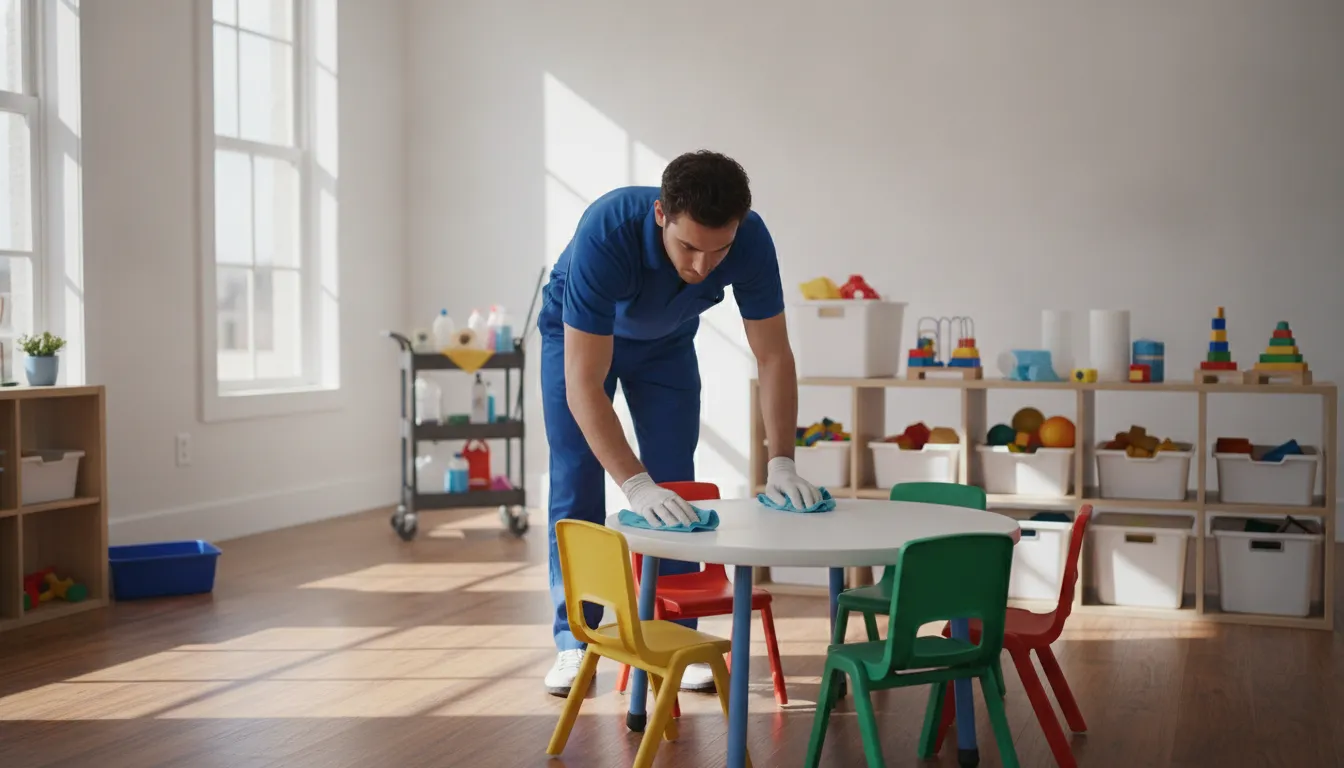
In a childcare facility, the same cleaning approach does not fit every surface or activity. A snack table, a frequently handled door pull, a mouthed toy, and a diaper-changing area each present different operational questions, especially when children may touch surfaces or place objects in their mouths.
Effective daycare sanitizing and disinfection starts with identifying how a surface is used, then selecting the appropriate cleaning sequence, product, contact time, rinsing requirement, and documentation. Operators should follow current public-health guidance and the product label, keep chemicals inaccessible to children, and adapt procedures for food areas, high-touch surfaces, child-use items, and body-fluid incidents.
Request a customized daycare sanitizing and disinfection plan
This guide focuses on planning those decisions clearly rather than applying a universal schedule. It also explains how age-appropriate safeguards and practical records can help staff communicate consistently across classrooms, shifts, and service teams.
What Does Daycare Sanitizing and Disinfection Mean in Practice?
These terms describe different levels of surface care, and choosing the right one starts with the surface, its use, and the type of exposure involved. Cleaning uses soap, water, and scrubbing to remove germs, soil, and other impurities. Sanitizing then reduces germs on an inanimate surface to levels considered safe by applicable public-health codes or regulations. Disinfection is a separate treatment intended to destroy or inactivate most remaining germs on an inanimate object, although it does not destroy bacterial spores. See the CDC guidance for early care and education settings and the NAEYC cleaning and sanitation definitions.
Why Must Cleaning Come Before Sanitizing or Disinfecting?
Cleaning is not an optional preliminary step. Residue and other impurities can make it harder for a sanitizer or disinfectant to work effectively. So staff should remove visible soil first, then apply the product appropriate for that surface and use pattern. A food-service table or high chair may call for sanitizing, while a diaper-changing table, toilet, or bathroom surface may call for disinfection under the facility’s applicable guidance. The product label and current jurisdictional requirements control the exact application.
What Does Wet Contact Time Mean?
Wet contact time, also called dwell time, is the length of time a surface must remain visibly wet for the sanitizer or disinfectant to work as directed. It is found on the product label, not guessed from how quickly a surface appears clean. If the liquid dries too soon, the operator should follow the label’s instructions for reapplication rather than treating the process as complete. CDC explains that the surface should stay wet for the full contact time stated in the directions: CDC contact-time guidance.
This distinction gives a daycare sanitizing and disinfection plan a defensible structure: remove soil, select the appropriate treatment, maintain the required wet time, and document exceptions or surface-specific instructions.
How Should You Match Cleaning, Sanitizing, and Disinfection to Each Surface?
The right action depends on how a surface is used, whether children place it in their mouths, and whether it could be contaminated with bodily fluids. Use this matrix as a planning aid, then confirm the product label and applicable state or local requirements before implementation.
| Surface or situation | Typical action | Operational checkpoint |
|---|---|---|
| Food-contact and child-use items, including trays, toys, and pacifiers | Clean, then sanitize before child use. | For highchair trays, wash, rinse, and sanitize immediately before and after meals. Allow sanitized items to air dry completely before storage or use. CDC guidance and NAEYC guidance provide the underlying distinctions. |
| High-touch surfaces, such as handles, tabletops, faucets, and shared toys | Clean routinely; increase cleaning or add disinfection when use patterns or contamination risk warrant it. | Do not assign a universal frequency without considering room use, age group, visible soil, and current public-health direction. Document the trigger for any additional service. |
| Diapering areas and restrooms | Clean, then disinfect according to the product label and facility procedure. | NAEYC identifies diaper tables, handles, toilets, and bathroom surfaces as possible disinfection targets. Keep the required contact time in view, and do not return the area to use until the procedure permits it. |
| Soft items, cloth toys, rugs, and washable textiles | Clean or launder according to the manufacturer’s instructions. | Use the warmest appropriate water setting when possible and dry items completely, as advised by the CDC. Remove items that cannot be safely cleaned for the intended use. |
| Blood or body-fluid incident | Use gloves and standard precautions, remove the fluid, then clean and disinfect. | Restrict access during the response and follow the product label. Record the incident and any required follow-up rather than treating it as a routine task. |
For food-contact surfaces, a sanitizer must be suitable for that use and applied exactly as directed. Wisconsin childcare guidance emphasizes following label instructions for dilution, application, contact time, and rinsing, and using EPA-registered products where required by that guidance: Wisconsin Department of Children and Families guidance. A surface must remain wet for the full stated contact or dwell time, not merely receive a quick pass.
Operators can pair this decision matrix with a daycare cleaning checklist to assign ownership and document completion. Foreman Pro Cleaning can help translate those surface categories into a customized plan without treating every room or item as though it carries the same use pattern.
When Should Daycare Staff Sanitize or Disinfect High-Touch and Child-Use Items?
Timing should follow how an item is used, what happened on its surface, and who may contact it next. A shared toy that children mouth, a table used for meals, and a door handle do not present the same operational decision. A written daycare cleaning checklist can assign responsibility, but staff should still use conditions in the room to trigger the appropriate response.
Start with visible soil. The CDC advises cleaning visibly dirty surfaces, including lunch tables and craft areas, after a meal or activity and daily. Cleaning is also necessary before sanitizing or disinfecting because residue can interfere with chemical action. For items used by infants or children, such as feeding items, toys, and play surfaces, the CDC notes that sanitizing may be needed after each use. High-touch objects such as tabletops, handles, faucets, drinking fountains, and toys also warrant regular attention, with more frequent cleaning or disinfection considered when an area receives heavy use.
Use the activity calendar as a practical signal. Meal service, sensory play, art projects, and water activities can leave surfaces visibly soiled or increase contact with shared objects. Mouthing, repeated handling, or an item moving between classrooms strengthens the case for cleaning and, where the product and surface are appropriate, sanitizing before the next child uses it. Highchair trays have a specific CDC recommendation: wash, rinse, and sanitize them immediately before and right after eating.
Illness changes the response. The CDC recommends disinfection when someone is sick and careful adherence to cleaning and disinfection procedures during diapering and infant feeding. Body-fluid contamination calls for standard precautions, removal of the fluid, then cleaning and disinfection. Staff can use these triggers alongside practical daycare cleaning practices rather than relying on a universal timetable. Product labels and applicable local guidance determine the final method, contact time, and any rinsing requirement.
How Can Daycare Operators Protect Children and Staff From Chemical Exposure?
Safe daycare sanitizing and disinfection depends on controlling the entire application process, not simply selecting a stronger chemical. Start with a product that is suitable for the specific surface and use pattern. Then follow the current label and applicable childcare guidance for dilution, application, required wet contact time, and rinsing. Wisconsin’s childcare guidance also states that products used for sanitizing or disinfecting must be registered by the U.S. Environmental Protection Agency and that working containers must be labeled appropriately: Wisconsin Department of Children and Families guidance.
Contact time is a practical safety control as well as an efficacy requirement. The treated surface must remain visibly wet for the full period stated on the label. If it dries sooner, staff should not assume the intended result was achieved. Rinsing is equally important when the label requires it, particularly for surfaces that may contact food, mouths, hands, or children’s skin. Do not improvise a dilution, transfer solution to an unlabeled container, or use a method that the label does not authorize.
How Should Staff Control Storage, Airflow, and Mixing?
Store and use all cleaning chemicals out of children’s reach, with access limited to trained staff. Keep the area adequately ventilated according to the product label and facility procedures. Never mix cleaners or disinfectants unless the labels specifically permit the combination. The CDC warns that combining chlorine bleach with ammonia cleaners can cause serious injury or death.
Age-appropriate controls matter because children play close to floors and may mouth toys or touch their hands to their faces. A childcare product-selection guide summarizing EPA label principles advises against fogging, fumigation, wide-area, or electrostatic application unless the product label specifically includes that use. For a broader facility plan, Foreman Pro Cleaning can coordinate these controls within school and educational facility cleaning programs serving Maryland, Washington, D.C., and Virginia.
Talk with Foreman Pro Cleaning about your facility’s cleaning plan
What Should a Daycare Sanitizing and Disinfection Plan Document?
A usable plan should let a trained employee answer five questions before starting: which surface is being treated, which product is approved for that use, how is it prepared, how long must it remain wet, and who verifies the work? That level of detail turns daycare sanitizing and disinfection from a general intention into a repeatable operating system.
- Product identity: Record the manufacturer, product name, intended use, and EPA registration information. Wisconsin childcare guidance states that products used to sanitize or disinfect must be registered by the U.S. Environmental Protection Agency. Review the guidance and confirm the current product label.
- Label instructions: Keep the label directions for dilution, application, contact time, rinsing, surface suitability, and preparation limits with the plan. The surface must remain wet for the full contact time specified by the product, not merely until it looks treated. CDC guidance explains contact time.
- Safety information: Maintain current safety data sheets (SDS) where employees can access them. OSHA’s Hazard Communication standard addresses workplace chemical communication through container labels, SDS, written programs, and employee training. See OSHA’s standard.
- Working containers: Identify every secondary container, its contents, preparation date, discard date, and responsible preparer. Wisconsin guidance calls for working containers to be labeled and used within the manufacturer’s stated timeframe. Store them out of children’s reach.
- Execution and review: Use logs that capture date, room or surface group, task, product, contact time, exceptions, and staff initials. Document missed tasks, spills, product substitutions, and illness or body-fluid events separately. Assign one manager to review logs, inspect the program, and update it when labels, rooms, staffing, or applicable guidance changes.
Foreman Pro Cleaning can help daycare operators translate this recordkeeping structure into a customized service plan, while the facility retains responsibility for confirming applicable local requirements and current product directions.
How Should Facilities Handle Diapering, Food Areas, Soft Items, and Body-Fluid Incidents?
Special-use areas need a response matched to the material, activity, and contamination event. A documented daycare sanitizing and disinfection plan should distinguish these workflows rather than apply one product or timing assumption everywhere.
How should staff manage diapering areas?
Diaper-changing tables and bathroom surfaces are identified by the CDC as areas for regular disinfection. After a diapering event, staff should follow the facility’s approved procedure, use a product suitable for that surface, and follow the label’s directions for application and contact time. The surface must remain wet for the full stated contact time when disinfection is required. See the CDC’s early care and education cleaning guidance for the distinction between removing soil, sanitizing, and disinfecting.
What is different about food-contact areas?
Food-contact surfaces require a sequence that protects both hygiene and the next meal. The CDC specifically advises washing, rinsing, and sanitizing highchair trays just before and immediately after they are used for eating. Infant feeding items, food-service surfaces, and similar child-use objects may also require sanitizing after use. Keep the product label and any required rinsing directions with the procedure, because a product appropriate for a bathroom surface is not automatically appropriate for a food-contact surface.
How should facilities handle soft or cloth items?
Remove visibly soiled clothing, cloth toys, and rugs from use and launder them when possible according to the manufacturer’s directions. Use the warmest appropriate water setting and dry each item completely before returning it to children, as recommended by the CDC. Items that cannot be processed safely should be evaluated against their care instructions rather than treated with an improvised chemical application.
What should happen after a body-fluid incident?
For blood or other body-fluid contamination, keep children away from the area, use gloves and other applicable standard precautions, remove the fluid, then clean and disinfect the surface. Staff should follow the product label and the facility’s incident documentation process, including any required notification or escalation. This event-based workflow is distinct from routine surface care and should be easy for every shift to locate and follow.
How Can Operators Turn the Plan Into a Reliable Service Program?
A matrix becomes useful when it is translated into an operating program that staff and service partners can follow consistently. Start with a walkthrough of every classroom, restroom, diapering area, food-service space, entry point, and shared activity zone. Record the surfaces present, how children and staff use them, access limitations, and which items require cleaning, sanitizing, or disinfection. This keeps the scope tied to actual conditions rather than a generic daycare schedule.
Next, define triggers instead of relying on a single universal frequency. Meals, craft activities, mouthing, heavy traffic, illness, and body-fluid incidents can change the required response. CDC guidance identifies toys, handles, tables, faucets, and drinking fountains as frequently touched surfaces, while food-contact items and child-use objects may require sanitizing after use: review the applicable early-care guidance. The program should also assign staffing responsibilities, approved access windows, contact-time requirements, and a process for keeping surfaces unavailable while a product is working.
Build quality review into the handoff. A supervisor can verify room scope, label use, completion records, exceptions, and any work that must be rescheduled because children or staff were present. Brief communication with the facility manager should document changes in room use, new equipment, illness events, and concerns raised by caregivers. These records help the plan evolve without turning this article into another general checklist.
Foreman Pro Cleaning uses a safety-first, tailored approach for childcare facilities in Maryland, Washington, D.C., and Virginia. Explore daycare cleaning services or customized commercial cleaning programs to discuss a program aligned with your facility’s rooms, use patterns, and access needs.
Request a customized daycare service plan
Frequently Asked Questions
What is the difference between sanitizing and disinfecting?
Cleaning removes impurities with soap, water, and scrubbing. Sanitizing reduces germs to levels considered safe by public-health codes or regulations, while disinfection uses chemical products to destroy remaining germs after cleaning. The appropriate choice depends on the surface, use pattern, and applicable guidance. CDC guidance explains these distinctions.
How should daycare operators decide which surfaces to sanitize?
Start with how the surface is used. Infant feeding items, toys, play surfaces, food-service tables, and high chairs may require sanitizing, including after use when applicable. High-touch objects such as handles, tables, faucets, and toys should be cleaned regularly, with the frequency informed by use and visible soil. Follow current public-health guidance and the product label rather than applying one schedule to every room. NAEYC guidance provides useful surface examples.
How long should a disinfectant remain on a daycare surface?
The surface must remain visibly wet for the complete contact time stated on the product label. If the product dries sooner, the required exposure may not have occurred. Staff should verify the label’s suitability, dilution, application method, rinsing instructions, and contact time for the specific surface before returning it to child use. CDC explains contact time.
How can staff reduce children’s exposure to cleaning chemicals?
Keep children away from treated areas until the label permits re-entry or use. Store chemicals out of children’s reach, and never mix products unless the labels specifically allow it. Use only the intended application method, and maintain labeled working containers. CDC warns that mixing chlorine bleach with ammonia can cause serious injury or death. Review CDC chemical-safety guidance.
What should a daycare document in its sanitizing and disinfection plan?
Document the surfaces and use patterns covered, approved products, label directions, contact times, preparation dates, responsible staff, training, and exception procedures for body-fluid incidents or illness response. Keep safety data sheets accessible to employees and review the plan when products, rooms, equipment, or applicable guidance changes. Documentation should support consistent execution without replacing the product label or local requirements.
How Can You Request a Customized Daycare Cleaning Plan?
Every daycare has its own rooms, use patterns, access windows, and documentation needs. Contact Foreman Pro Cleaning to request a customized daycare sanitizing and disinfection plan for your facility in Maryland, Washington, D.C., or Virginia.
