
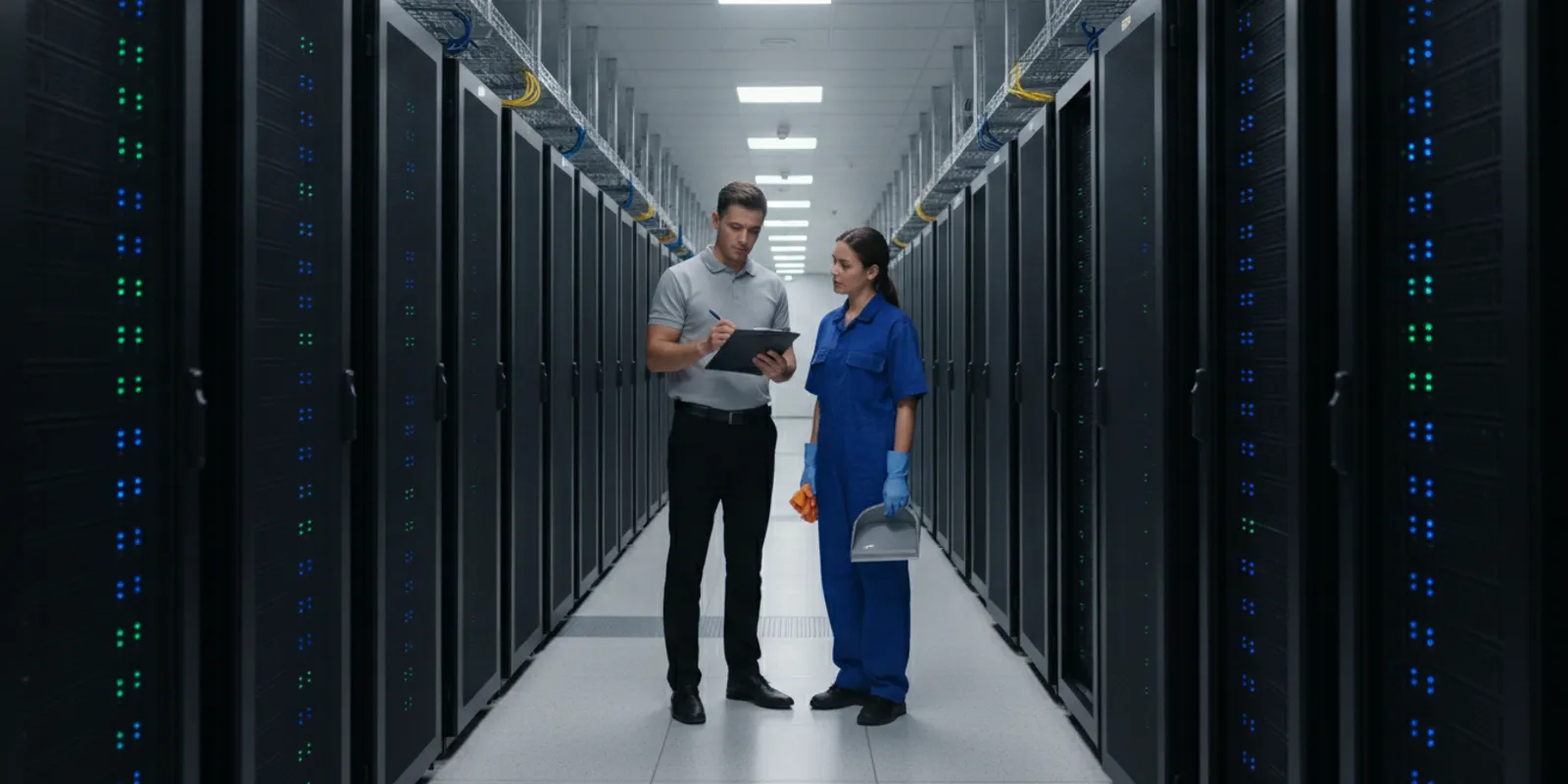
To get a quote for data center cleaning that you can compare fairly, give each provider the same facility details, access limits, requested tasks, and documentation expectations. A useful proposal should explain what areas are included, how work will be coordinated around operations, what methods and equipment are proposed, and what remains outside the scope. This guide gives facility and IT leaders a practical way to prepare a request and evaluate the response.
Request a data center cleaning consultation
What should you prepare to get a quote for data center cleaning?
A quote is only as useful as the description behind it. Before contacting providers, assemble a concise site brief. It does not need to disclose sensitive infrastructure details. Share only what a provider needs to scope the work, and use your organization’s approved process for confidential information.
- Facility type and operating context: Note whether the work is in a data center, server room, network room, or another critical environment. Say whether the site operates continuously, has restricted windows, or requires work to be coordinated with an operations contact.
- Areas in scope: Identify the data hall, raised-floor area or subfloor plenum, server rack exteriors, support rooms, HVAC or CRAC areas, and adjacent corridors as applicable. Indicate clearly which areas are excluded.
- Approximate size and layout: Provide an approximate cleanable area, number of rooms, number of aisles, floor type, and whether raised flooring is present. A simple marked-up plan can clarify boundaries. Avoid sending sensitive rack or network diagrams unless approved.
- Requested task types: Separate routine maintenance from a one-time project, post-construction work, an incident response, or a specifically requested subfloor service.
- Site controls: Describe escort, badging, sign-in, background-check, tool-control, PPE, security, and work-permit rules that apply. If a requirement is determined during onboarding, say so.
- Timing and frequency: State preferred dates, acceptable work windows, desired service frequency, and any change freezes, maintenance periods, or access restrictions that affect scheduling.
- Current concerns and acceptance criteria: Describe the condition or concern in observable terms, then explain how your team will decide the work is complete. Include any site-specific documentation or review process.
For a first-pass scope, Foreman Pro’s data center cleaning checklist can help identify areas to discuss. If you are still defining the type of service, the overview of data center cleaning services and the guide to what a subfloor plenum is offer useful starting points.
How should you describe the work without exposing sensitive details?
Use functional descriptions rather than unnecessary infrastructure specifics. A provider may need to know that an area contains active server racks, that only exterior surfaces are included, or that the subfloor plenum requires separate review. They generally do not need credentials, network diagrams, system names, or a detailed inventory of assets to prepare an initial scope.
Where the site has strict confidentiality requirements, request a preliminary discussion using non-sensitive information. Then follow your organization’s process for a nondisclosure agreement, approved site visit, or controlled document exchange before sharing additional details. Confirm who may enter the space and who will escort the team. Never assume a vendor’s routine access process satisfies your security policy.
If work may involve raised floor tiles, identify whether the work is limited to accessible surfaces or includes lifting tiles and cleaning beneath them. Make the distinction explicit. The practical considerations in data center subfloor cleaning can help frame a discussion about scope boundaries; it is not a substitute for your site’s authorization and safety procedures.
Which cleaning tasks belong in a data center quote?
Write each requested task as a defined line item. Broad wording such as “clean the data center” can conceal important differences in access, method, and time. A task list lets your team see what is included and makes proposal comparisons more meaningful.
| Scope item | What to specify | What to confirm in the proposal |
|---|---|---|
| Room and aisle surfaces | Rooms, aisles, floor types, and whether work is routine or project-based | Included boundaries, method, frequency, and exclusions |
| Rack exteriors | Which exterior surfaces may be addressed and which are off limits | Approved approach, access limits, and whether any work near equipment is excluded |
| Raised-floor area | Whether the scope includes the floor surface, tile edges, or access beneath tiles | Who authorizes tile lifting, how work is sequenced, and the areas covered |
| Subfloor plenum | Whether a separate assessment or service is requested | Access method, work boundaries, controls, and any separate pricing or approval |
| HVAC or CRAC exterior surfaces | Specific accessible surfaces, with internal work excluded unless expressly approved | Method, permissions, limits, and coordination with facilities staff |
| Closeout and records | Required checklist, service report, issue escalation, and sign-off contact | Deliverables, timing, recipient, and how exceptions are recorded |
This comparison is a scoping tool, not a claim that every site needs every task. The site owner should determine what is appropriate and authorize any access or work near active infrastructure. Ask the provider to list assumptions and exclusions in writing. If an area cannot be safely or permissibly assessed during an initial visit, have the proposal identify that limitation rather than treating it as included.
How can you compare cleaning methods and operational controls?
Do not compare proposals by service name alone. Ask each provider to describe the proposed method for each task and explain how the work fits your site’s controls. Foreman Pro’s critical-environment capabilities include HEPA-filtered vacuum equipment, ESD-safe methods, static-dissipative cleaning solutions, low-lint wipers, contamination-control entry protocols, and GFCI electrical safety protocols. Whether a specific method is appropriate depends on the approved scope and site requirements.
Use specific questions to test whether the proposal addresses your actual operating constraints:
- What equipment and materials are proposed for each area, and how are they selected for the environment?
- What surfaces are treated, and which surfaces or components will not be touched?
- How will the crew follow escort, access, tool-control, and site safety procedures?
- Who is the point of contact if the team identifies an unexpected condition or needs a decision?
- What documentation will show the work completed, exceptions, and any follow-up recommendation?
- How will the work be scheduled to avoid a conflict with operations or maintenance activity?
Do not assume that a general cleaning description establishes authorization to work inside equipment, move components, lift floor tiles, or alter airflow controls. Specify what is permitted and require the provider to seek approval when a task falls outside the written scope. For context on one potential facility concern, see the guide to zinc whiskers in data centers; any assessment or mitigation should be scoped and approved for the individual site.
Data center sustainability and resource use can also shape facility planning. MIT’s Climate Portal discusses the energy implications of AI use and data centers, while Yale Environment 360 reports on energy and water demands associated with AI infrastructure. These sources provide context, not a cleaning specification; use your own facility requirements to determine any relevant service or reporting criteria. MIT Climate Portal: Is AI’s energy use a big problem for climate change? Yale Environment 360: As Use of A.I. Soars, So Does the Energy and Water It Requires.
What qualifications and documentation should you request?
Ask how the provider prepares staff for critical-environment work and how supervisors confirm that site procedures are followed. Request an explanation of relevant training, documented procedures, and quality checks. Foreman Pro’s company background includes IT operations and facilities management experience, as well as proprietary critical-environment procedures. Read more about Foreman Pro Cleaning’s team and story and the background of Wes Foreman, co-founder and CEO.
Credentials and standards should be discussed in the context of the actual facility. If your site requires a specific certification, qualification, or designation such as CET or CVI, name it in the request and ask the provider to document whether the assigned personnel meet it. Do not treat a designation as a guarantee of performance. If a facility includes a laboratory or cleanroom, identify any applicable standards, such as ISO 14644, and the required documentation. Do not apply a laboratory requirement to a data hall unless the site’s own program calls for it.
Also set expectations for records. The proposal can state whether it will provide a task checklist, service report, exception log, attendance record, or closeout confirmation. Define who receives those records and when. If the site requires a particular format or retention practice, provide it before the provider prepares a final scope.
How can you compare proposals when you get a quote for data center cleaning?
There is no useful way to compare a low headline price with a higher one when the proposals cover different work. Give each bidder the same written scope and ask for pricing by service type or area where practical. Ask whether the price is recurring or one-time, what visit frequency it assumes, and whether any initial assessment, after-hours access, or separately authorized work is priced apart.
Have each proposal state its assumptions. Examples include estimated cleanable area, access to rooms, escort availability, number of scheduled visits, and whether the subfloor is included. Ask for exclusions and possible change conditions in plain language. If a provider cannot verify a condition without an approved site visit, ask whether the quote is preliminary and what information is needed to finalize it.
Compare offers against a common set of questions:
- Does the scope name the rooms, surfaces, and boundaries?
- Are task frequency, work windows, and site coordination defined?
- Are methods and operational controls explained for each requested task?
- Are reporting, exception escalation, and sign-off addressed?
- Are assumptions, exclusions, and separately approved work visible?
- Can your team identify who owns decisions during the service?
Consider asking for a brief scope review before the final proposal if the facility has several room types or unusual access controls. A walk-through, when approved by your site team, can help confirm boundaries and identify questions that a written summary may miss. Ask what the provider needs to see, who must attend, and whether the visit changes the proposal from preliminary to final. Keep the same decision-makers involved in later clarifications so that operational restrictions are not lost between an initial discussion and service scheduling.
If the work is limited to a smaller network room rather than a full data hall, describe that distinction directly; the guide to cleaning a server room safely and effectively may help you identify scope questions. For mixed-use critical environments, review critical environment cleaning services and ask the provider to distinguish the applicable work methods instead of applying one broad label to every room.
A provider’s response to these questions is often more useful than an unexplained total. Foreman Pro’s guide on how to choose a data center cleaning company offers additional criteria for assessing a service relationship.
Discuss your facility scope with Foreman Pro Cleaning
What should a data center cleaning request for quote include?
A clear request for quote (RFQ) can be brief while still giving providers enough to respond. Use a consistent template and leave sensitive information out until your security process permits sharing it.
- Facility type, general location, and a contact for scope questions.
- Approximate areas and room types, with a plan or boundary description where appropriate.
- Task list, service frequency, preferred schedule, and requested start window.
- Site access, escort, safety, security, and confidentiality requirements.
- Required equipment or method restrictions, if established by your site.
- Required staff qualifications or training records, if applicable.
- Reporting, quality review, exception escalation, and closeout requirements.
- Requested proposal format, including itemized pricing, assumptions, exclusions, and validity period.
- Process for a site walk, follow-up questions, and approval before any work outside scope.
State whether you want proposals by a particular date, but allow time for questions and an authorized site review if needed. Provide one channel for bidder questions so each provider receives the same clarifications. If your team changes the scope during the process, distribute the update to all bidders and ask them to confirm how it affects their proposal.
What questions do facility leaders ask about getting a data center cleaning quote?
Can I request a quote without sharing a network diagram?
Yes. Start with non-sensitive details such as room types, approximate areas, requested tasks, and access restrictions. Share more only when necessary and through your organization’s approved security process.
Should subfloor cleaning be included in the same request?
It can be requested, but identify it as a separate scope item. State whether tile access is permitted, who authorizes it, and whether a site assessment is needed. This makes it clear whether the proposal includes subfloor work or only accessible floor surfaces.
Does a quote include work inside or on active equipment?
Not unless the written scope expressly includes it and the site owner authorizes it. Identify permitted surfaces and exclusions, and require approval before any work beyond those boundaries.
What if I do not know the exact cleanable area or task frequency?
Give your best estimate, label it as an estimate, and ask the provider what information or approved site review would help refine the scope. A proposal should disclose assumptions rather than silently treating unknown details as settled.
How can I start a quote request with Foreman Pro Cleaning?
Prepare the site brief and task list, then use the contact page to discuss the facility and next steps. Foreman Pro serves Maryland, Washington, D.C., and Virginia; confirm the location and requested scope when you reach out.
How can you plan the next step?
Before selecting a provider, make sure the proposal connects each requested task to a defined area, method, schedule, control, and deliverable. Record open questions and resolve them before approval, especially around access, tile lifting, equipment boundaries, and reporting. A clear scope gives your operations team a sound basis for comparing proposals and coordinating the work.
Start a data center cleaning quote discussion
With a consistent request and written assumptions, your team can evaluate the proposed service on scope and operational fit rather than price alone.
