
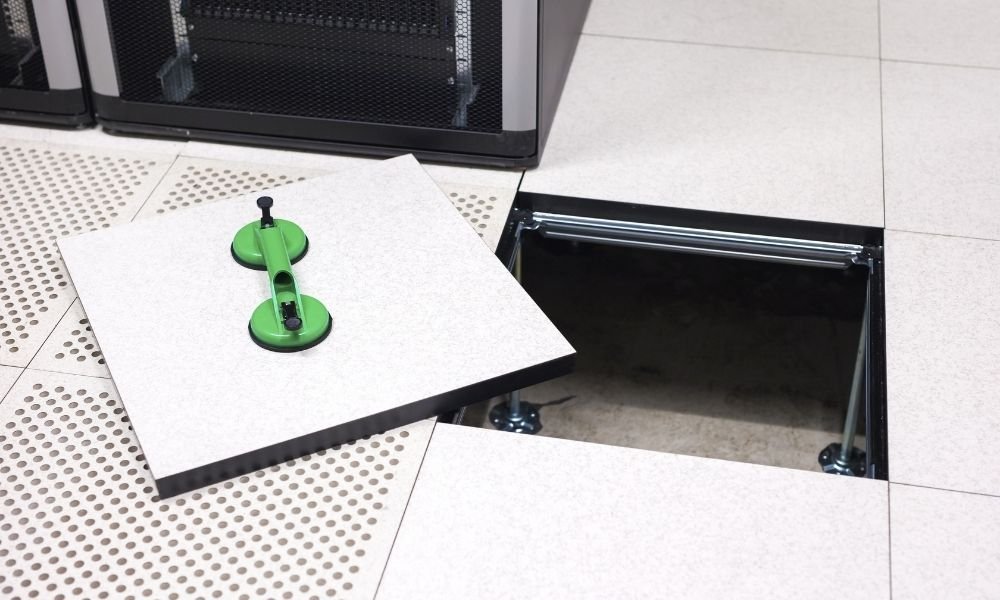
Raised access floors are essential infrastructure for data centers, server rooms, and other critical environments. The space beneath the floor—called the subfloor plenum—circulates cool air to your servers and organizes cabling for computers and communication systems.
Without proper maintenance, neglected raised floors create serious operational risks. Dust and debris accumulate in the subfloor plenum, get carried by airflow, and collect on your servers and hardware. This particulate contamination can block cooling fans, cause equipment overheating, and in severe cases, create fire hazards from accumulated equipment particles.
Regular care and maintenance of raised access floors protects your mission-critical equipment, extends the lifespan of your floor system, and ensures optimal airflow for cooling. This guide covers everything you need to know—from daily inspections to when to call in professionals.
Daily Inspection Checklist
Start each day with a visual inspection of your raised floor. Managers should conduct daily walkthroughs to catch problems early before they become costly repairs or cause equipment damage.
What to look for:
- Scratches, scuff marks, or surface damage on floor tiles
- Missing or loose tiles that could become trip hazards
- Warped, buckling, or de-laminating panels
- Damaged edge trim or missing grounding clips
- Signs of moisture or liquid spills
- Debris accumulation around perforated tiles
Document any issues you find and schedule repairs immediately. Small problems like a single warped tile can quickly escalate if heavy equipment rolls over the weakened area.
How to Clean Raised Floor Tiles
Cleaning raised floor tiles requires specific techniques to protect the anti-static properties of the surface and avoid damaging the laminate. Follow these best practices for daily and weekly cleaning.
Daily cleaning:
- Vacuum the floor surface using a HEPA filter vacuum. The HEPA filter prevents dirt from blowing back into the room and becoming airborne.
- Use a damp mop with warm water and a mild detergent—never saturate the mop, as excess moisture can seep into seams and damage adhesives.
- Spot clean stains immediately using a damp cloth with mild detergent. Do not use harsh solvents or abrasive cleaning tools, as they damage the laminate surface.
Critical don’ts:
- Never use wax on raised floor tiles. Wax stains and damages panels, and can interfere with the floor’s anti-static properties.
- Never use a dry mop. Dry mopping pushes dirt into perforated tile openings, reducing airflow to your equipment.
- Never use strong solvents or abrasive cleaners. These damage the laminate and void manufacturer warranties.
Cleaning under the floor:
Subfloor cleaning is more challenging because you can only remove two tiles at a time to maintain structural integrity. Work in sections, using a HEPA or ULPA filtered vacuum to clean cables, pedestal assemblies, stringers, and the concrete subfloor. Schedule this deeper cleaning at least quarterly, or more frequently in high-traffic environments.
Airflow and Panel Care
Raised floors work by circulating cool air through the subfloor plenum to your servers. Maintaining proper airflow is critical for equipment performance and longevity.
Airflow maintenance:
- Clean out airflow and perforated panels at least twice a year. Blocked perforations starve your equipment of cool air.
- Inspect perforated tiles for debris buildup—dirt in the openings reduces airflow efficiency.
- If your raised flooring has carpet, vacuum the carpeting with a static dissipating vacuum and clean using dry foams or powders.
Panel rotation:
Rotate panels at least twice a year from high-traffic areas to low-traffic areas. This distributes wear evenly across the floor and extends the lifespan of individual tiles. Mark the original locations so you can track wear patterns over time.
Entrance protection:
Consider using entrance rugs or carpeting in areas near doors and high-traffic walkways. This protects panels from the impact of foot traffic and makes those areas easier to clean. The rugs also trap debris before it spreads across the raised floor.
Structural Maintenance
Beyond cleaning, raised floors require ongoing structural maintenance to ensure safe operation and prevent equipment damage.
Panel replacement:
- Replace any panels that are damaged, worn, warped, or de-laminating immediately when found.
- Check panel edges for chips or cracks that could worsen under load.
- Replace broken edge trim, grounding clips, stringers, and gaskets as needed.
- Repair untrimmed cutouts around cable penetrations immediately.
Annual inspection:
Schedule an annual inspection by a certified raised floor technician. A professional can identify structural problems you might miss, including:
- Pedestal alignment and stability issues
- Grid system adjustments needed to correct structural problems
- Load capacity concerns for planned equipment installations
- Zinc whisker formation on galvanized components (a major risk for electronic equipment)
- Subfloor concrete condition and potential sealing needs
When to Call a Professional Raised Floor Cleaning Service
While daily maintenance can be handled in-house, professional raised floor cleaning should be performed at least once or twice a year—more frequently for data centers with heavy operations.
Professional services include:
- Complete subfloor plenum cleaning with HEPA/ULPA vacuums that capture particles down to 0.3 microns
- Cleaning of all cables, conduits, pedestal assemblies, and stringers
- Equipment surface cleaning including server cabinets, racks, and enclosures
- Zinc whisker testing and mitigation
- Air quality testing and particulate count verification
- Post-construction cleaning for newly built or renovated spaces
Professional cleaning crews understand the unique requirements of critical environments. They use maintenance-only power outlets, proper ESD-safe equipment, and follow protocols that protect your operations while achieving deep cleaning results you can’t accomplish in-house.
Need Professional Raised Floor Cleaning?
Foreman Pro Cleaning provides expert raised floor and subfloor cleaning for data centers throughout Maryland, Virginia, and Washington DC. Our IT-experienced team understands critical environments and uses HEPA/ULPA filtration to protect your equipment.
- HEPA/ULPA vacuum cleaning of subfloor plenum
- Zinc whisker testing and mitigation
- Flexible scheduling to minimize downtime
Related Resources:
