
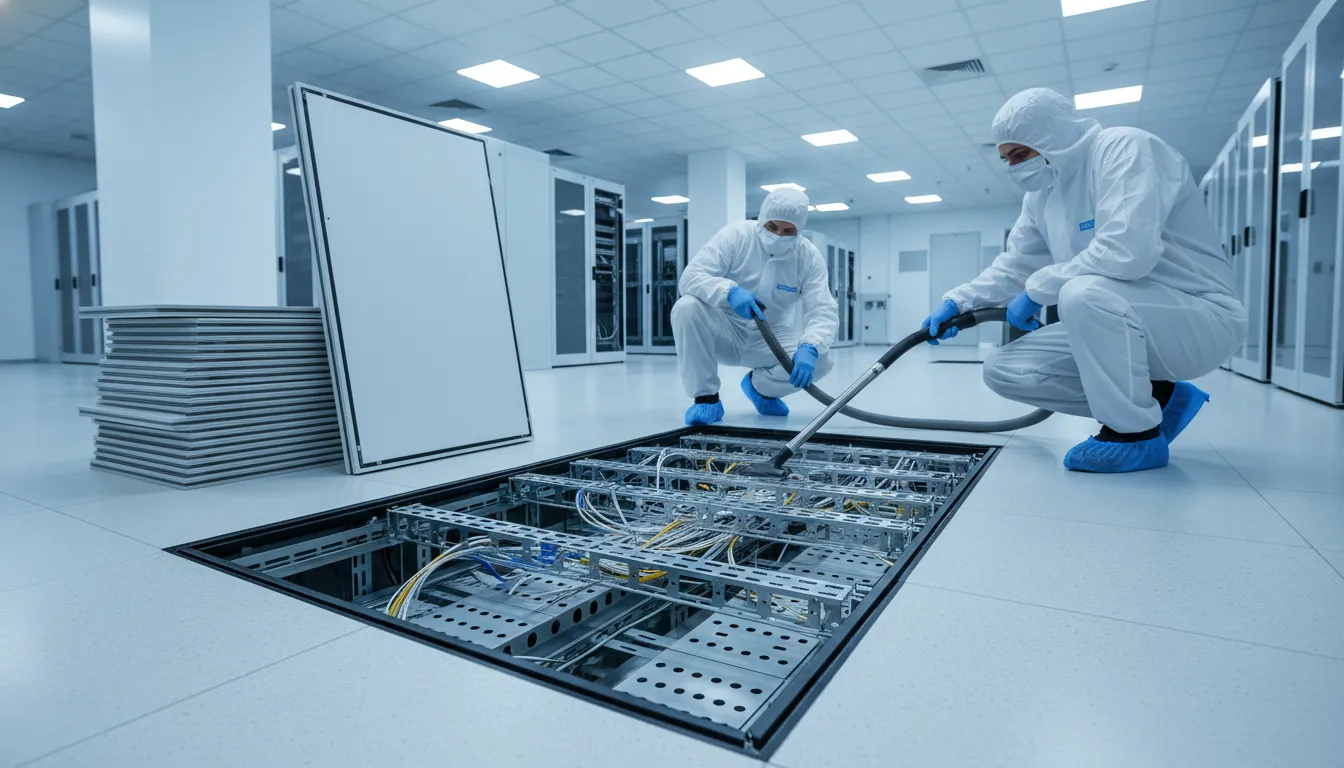
Dust beneath a raised floor can move from hidden plenum to sensitive equipment. In data centers and other critical spaces, ordinary floor care can become an uptime risk.
Raised floor cleaning is the controlled removal of dust, debris, and contaminants from access floor surfaces, perforated panels, understructure, and the sub-floor plenum. In a critical environment, that hidden space may support airflow, cable pathways, or sensitive operations, so disturbed debris can migrate toward valuable equipment. Research shows that walking can resuspend particles from flooring, making control of floor contamination more than a cosmetic concern. At minimum, raised-floor maintenance guidance recommends professional surface cleaning and subfloor vacuuming twice yearly, with added attention where traffic or operating demands increase soil. Specialized teams plan tile access, equipment-safe methods, compatible products, and contamination control so cleaning supports airflow and uptime without creating new operational exposure.
Facility leaders need to know what belongs in the scope, how often work should occur, and why trained methods reduce avoidable risk. Before setting a schedule, start with the system itself.
Request a free critical environment cleaning consultation for your raised floor cleaning plan.
What raised floor cleaning means in a critical environment
A floor system, not just a walking surface
Raised floor cleaning is the controlled removal of dust, debris, and tracked soil from an access floor system. In a data center, server room, lab, or telecom room, that system includes more than visible tiles. It also includes panel seams, perforated tiles, supports, and the space below the panels.
This scope matters because the floor is part of the operating environment. People and carts bring soil onto the surface during routine access. Research has found that shoe soles can transfer microorganisms to floors. That evidence helps explain why effective floor cleaning matters in sensitive spaces.
Surface tile cleaning versus sub-floor cleaning
Surface tile cleaning addresses the top side of the raised floor. Work may include removing loose dust, treating soil on solid panels, and clearing debris from perforated panels. The goal is a clean, stable walking surface while limiting dust near operating equipment.
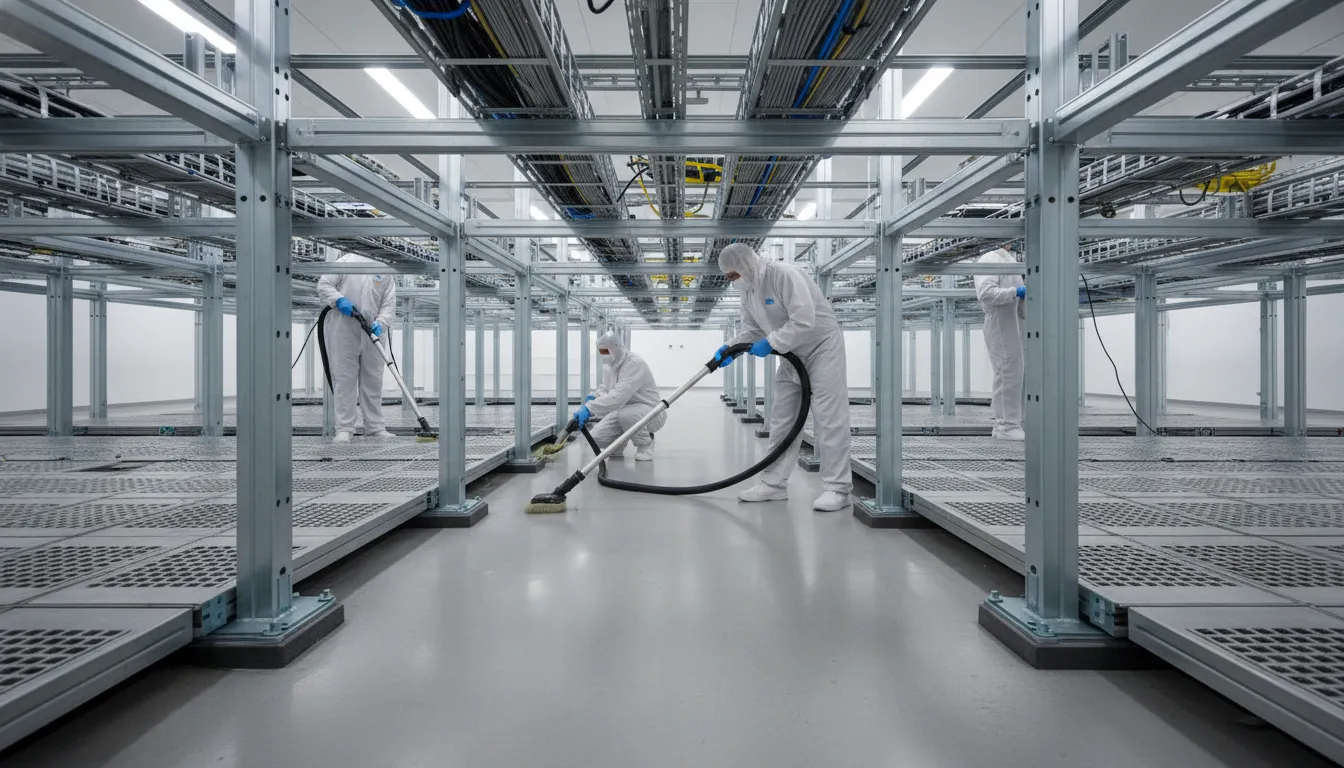
Underfloor plenum and sub-floor cleaning address hidden areas beneath removable panels. This work targets settled dust on the structural deck, supports, cable paths, and open zones in the plenum. For a closer look at hidden contamination, see our data center subfloor cleaning services overview.
The two tasks are related, but they are not interchangeable. A floor can look clean while dust remains beneath panels. In rooms where underfloor space supports cables or air movement, that hidden layer needs its own plan and controls.
This distinction helps define the work order. Surface service covers the panels that staff see and walk across. Sub-floor service covers the concealed area that staff must access with care.
Cleaning planned around uptime
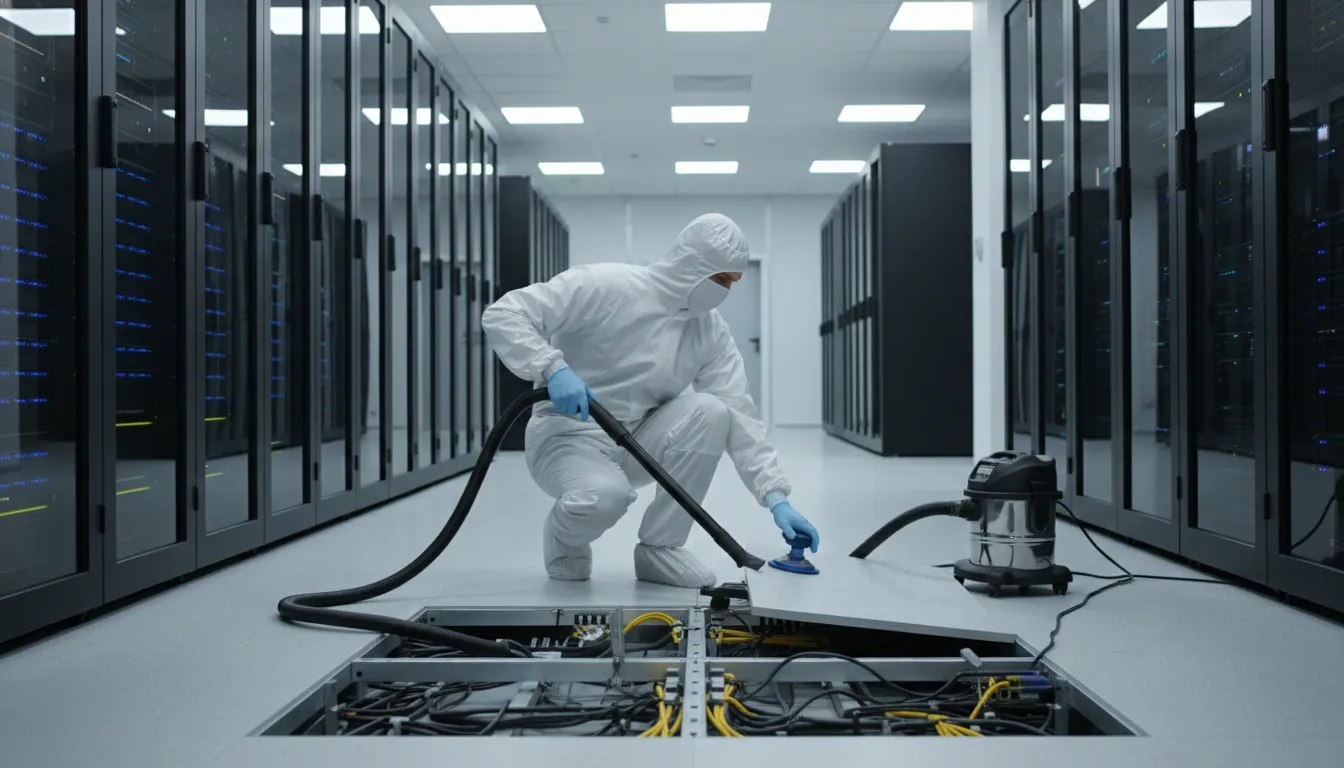
Critical environment cleaning starts with risk control, not appearance alone. Teams need to plan access, panel lifting, equipment choice, and work zones before cleaning begins. The aim is to remove soil without creating avoidable dust movement, access issues, or disruption near active assets.
Floor dust can move again after activity on the surface. One study examined the spread of virus particles from flooring after human activity indoors. This supports a basic point: floor dust movement is relevant when uptime and controlled conditions matter.
That is why raised floor cleaning in a critical room is not standard janitorial floor care. It is planned service for visible surfaces and, when needed, the space below them. The scope should fit the room, its active systems, and the way staff enter and work there.
Why contamination below the floor threatens uptime
A hidden contamination path
A raised access floor can hide dust, scraps, fibers, and tracked-in grit beneath working equipment. This space is easy to overlook because problems can remain out of sight during routine room checks. Research on built spaces found that activity can resuspend particles from floors, with dust affecting their spread. The floor particle resuspension study supports careful control of floor-level debris in sensitive rooms.
Below-floor checks should note unusual particles, not just ordinary dust. Zinc whiskers, metal fragments, fasteners, and wire clippings may be conductive. Moisture, signs of pests, and sticky maintenance residue can add more concerns. These items do not prove an incident will occur. They do call for prompt review and controlled cleanup.
Airflow and cooling pressure points
When the underfloor space serves as an air path, loose debris can collect near openings and perforated panels. Dust on grilles or panels can narrow the route used for supply air. Cooling then has a harder job reaching the areas that need it. Raised floor cleaning should cover the visible panel surface and the plenum below it.
Obstructions are not limited to dust. Packaging pieces, old cable material, and dried residue can remain after repairs or moves. A planned survey helps staff spot these issues before they become part of the room condition. Foreman Pro’s overview of underfloor plenum cleaning support explains why hidden debris and airflow routes deserve close attention.
Equipment reliability and incident control
Contamination becomes an uptime concern when particles move toward racks, power paths, or cooling equipment. Conductive debris calls for care because it can enter places where ordinary dust is less concerning. Water or damp residue should prompt an investigation. Staff should not wipe it away without checking the source.
A useful underfloor inspection records what is found and where it appears. The review may include:
- Dust buildup near air outlets, cable openings, and panel supports.
- Metal particles, zinc whisker-like fibers, clips, or cut wire strands.
- Moisture, staining, pest evidence, or residue left after maintenance.
- Loose material that may shift when panels are lifted or air moves.
Controlled cleaning removes visible risks while protecting nearby systems from careless disturbance. It also gives facility teams a clear baseline for later checks. That record can connect new debris, moisture, or residue to a service event or building issue. The source may then be easier to trace.
How often should raised access floors be cleaned?
A baseline cleaning schedule
Raised floor cleaning should not follow one fixed calendar in every facility. Start with routine surface care for visible dust, debris, spills, and traffic marks. Check entry paths and perforated panels during each cleaning round. Floors can collect material tracked in from footwear. Research documents floor contamination transfer from shoe soles.
For a typical controlled equipment room, build the plan in layers. Handle surface debris during regular housekeeping rounds. Schedule planned surface cleaning based on soil load and floor finish. Published raised floor maintenance guidance calls for professional surface cleaning and subfloor vacuuming at least twice yearly. It also calls for perforated panel cleaning twice yearly.
- Routine surface care: remove visible soil, spills, and debris on the room’s set housekeeping cycle.
- Twice-yearly baseline: clean the surface, perforated panels, understructure, and subfloor where the system permits access.
- Yearly review: have a qualified technician inspect the access floor condition and grid system.
When the schedule should be tighter
A twice-yearly deep service is a baseline, not a limit. High-risk spaces may need quarterly or semiannual checks between full cleanings. Tighten the schedule when traffic increases, racks move, cables change, or contractors work above or below the floor. These events add debris or disturb dust that routine surface care cannot reach.
Airflow design also matters. If the subfloor serves as an air path, buildup near openings and equipment paths needs closer review. Perforated panels deserve added attention because dust at those openings can restrict clean air paths. Foreman Pro’s guide to critical environment sub-floor cleaning explains why hidden areas need planned care.
Document what drives the interval. Record traffic level, equipment changes, recent debris, floor type, airflow use, and site rules. Regulated or closely controlled rooms may require a shorter interval and stronger service records. The facility’s own procedure should control if it is stricter than a general schedule.
Cleaning after work in the room
Do not wait for the next scheduled visit after construction or maintenance activity. Plan raised floor cleaning after cable pulls, panel lifting, equipment moves, ceiling work, or nearby building work. Inspect the work path and nearby perforated panels first. Then assess the subfloor where panels were opened or debris may have fallen.
Post-work cleaning should match the event. A small service visit may call for spot cleanup and a documented inspection. A larger installation or remodel may call for surface cleaning plus professional subfloor vacuuming. Use the planned schedule as a minimum, then add service after work that creates or moves debris.
A practical schedule is simple: maintain the surface often, inspect higher-risk areas more often, and clean below the floor on a planned cycle. Add an extra service after any event that introduces dust or opens the floor system.
Talk with Foreman Pro about the right raised floor cleaning frequency for your facility.
A safe process for raised floor and sub-floor cleaning
Planning before panels are lifted
Raised floor cleaning needs a controlled work plan, not a quick pass with a vacuum. Floors can carry tracked-in material, and activity near dusty surfaces can move particles back into the room. Research on flooring and human activity reports this resuspension risk in built spaces. See the study of particle movement from flooring for the underlying concern.
A safe plan starts with a site walk. The team notes live equipment, air tiles, cable pathways, alarms, access limits, and areas with visible soil. It also sets boundaries, approved tools, panel handling rules, and a stop-work path. For more detail on work below the panels, review Foreman Pro’s planned sub-floor cleaning support.
Controlled cleaning sequence
The sequence below keeps the work zone small and makes each stage easy to check. Only a limited number of panels should be lifted at one time. This helps keep open floor spaces controlled, limits foot traffic near exposed areas, and allows panels to be replaced in order.
-
Complete the site walk. Confirm the service zone, restricted aisles, panel type, perforated tiles, and any items that must remain untouched.
-
Set the risk plan. Mark barriers and approved paths. Confirm panel lifting tools, HEPA-filtered vacuum equipment, anti-static compatible products, and the response for a dropped item or exposed hazard.
-
Open a small work area. Lift only the planned group of panels. Label and stage each panel safely, so it returns to its correct position.
-
Clean the upper surfaces. Vacuum dry soil first with HEPA-filtered equipment. Then clean suitable panel surfaces with a product approved for the floor finish and static-control needs.
-
Clean below the floor. Vacuum the sub-floor, pedestal bases, stringers, and reachable debris points. Keep tools clear of cables and do not disturb equipment connections.
-
Replace and move forward. Put panels back before opening the next small zone. Check that each panel sits flat and that perforated tiles return to their mapped locations.
-
Inspect and document. Record the cleaned zones, noted defects, damaged panels, moisture concerns, access limits, and work that needs follow-up.
Records and final inspection
Documentation turns a cleaning visit into a usable facility record. It should list the work area, products and equipment used, panels opened, exceptions found, and the person who checked final placement. Photos may support the record when site policy allows them.
The final inspection confirms that access panels are seated, pathways are clear, barriers are removed, and no tools remain under the floor. It also flags cracked panels, loose fits, unusual debris, or airflow-tile concerns for facility review. Teams setting ongoing service intervals can use recommended cleaning frequency guidance with their site needs and operating rules.
Raised floor cleaning methods compared
Raised floor cleaning is not a single task. The visible panel surface, perforated tiles, edges, and hidden void each collect different soils. A safe plan uses the least disruptive method that removes the soil at hand.
That choice matters in critical spaces. Foot traffic can move contaminated material onto flooring. Activity can also lift particles back into the air. Research supports careful surface cleaning in sensitive settings, as reported by the National Library of Medicine.
Method fit and limits
No one method covers routine dust, bonded soil, static concerns, and below-floor buildup. This comparison shows how each tool fits into a controlled cleaning plan.
| Method. | Best fit. | Limit. | Caution. |
|---|---|---|---|
| Dry dust mopping. | Loose surface dust. | Misses hidden soil. | Can push dust into gaps. |
| Standard mopping. | Approved hard-floor soil. | Moisture can reach seams. | Use only when approved. |
| HEPA vacuuming. | Fine dry dust. | May miss stuck residue. | Use suitable equipment. |
| Auto-scrubbing. | Large open surfaces. | Limited near equipment. | Confirm moisture controls. |
| Anti-static damp wiping. | Targeted panels. | Slow for large areas. | Control liquid use. |
| Professional sub-floor cleaning. | Underfloor dust. | Needs planned access. | Work around cables. |
Surface methods for daily control
Dry dust mopping can gather visible debris in simple areas, but it may shift fine dust instead of containing it. HEPA vacuuming is a stronger choice for dry particles around tile edges and perforated panels. It collects dust rather than spreading it across openings.
Moist methods need tighter control. Damp wiping can handle small marks or residue while limiting liquid near seams. Standard mopping and auto-scrubbing may fit approved open surfaces. Neither should be the default near equipment. Teams can align those choices with server room maintenance best practices.
When the hidden space needs service
Cleaning only the upper face leaves the sub-floor outside the scope of the work. That space may hold dust near cable routes, supports, and airflow paths. Lifting panels and working below them calls for a planned process, not casual surface work.
A trained crew can isolate the area, manage panels, and use controlled vacuuming below the floor. This is where specialized underfloor cleaning differ from daily surface care. They address concealed soil while reducing disruption around sensitive infrastructure.
The practical split is simple: use controlled surface methods for routine soils. Plan below-floor cleaning when hidden buildup is part of the risk. Method selection should follow the room, floor finish, equipment, and approved site controls.
What should teams avoid when cleaning raised floors?
Raised floor cleaning should remove dust without creating a second problem below the panels. In critical spaces, a rushed pass can leave soil in seams, spread moisture, or disrupt safe access near live equipment. Teams should avoid the shortcuts below and set a clear work plan before tools enter the room.
Moving debris instead of removing it
A dry mop may look quick, but it can push loose debris toward panel seams and perforations. Once soil enters gaps, later foot traffic can disturb it again. Research on built environments found that walking can resuspend particles from floors, as described in a study of floor dust and resuspension. Capture loose soil with suitable vacuuming methods instead of sweeping it across the access floor.
Over-wetting is another avoidable error. Excess liquid can reach panel edges, seams, or the space below the floor. Teams should not assume that a cleaner suited to a standard hard floor also suits access panels. Check the panel finish and the approved product list before applying any chemical.
Working without equipment and panel controls
Do not begin around active equipment without a plan for routes, tools, cables, airflow panels, and restricted areas. The work plan should state what will be cleaned, what will remain untouched, and who can approve changes. Foreman Pro’s server room maintenance best practices can help teams frame safe work in equipment spaces.
Lifting too many tiles at once is also poor practice. Open only the area needed for the task and manage removed panels in an orderly way. This helps avoid mix-ups, damaged edges, unsecured openings, and accidental contact with items below the floor. Perforated panels should be tracked so airflow locations remain clear after the work.
Missing hidden soil and missing records
Surface-only work leaves a key part of the system out of scope. Soil can remain on the subfloor, understructure, cable pathways, and hard-to-see corners. When access and site rules permit it, include below-floor inspection and cleaning in the scope. See how data center sub-floor cleaning guidance address hidden areas beneath panels.
Finally, do not finish raised floor cleaning without documenting what was found. Record opened areas, panel issues, moisture concerns, unusual debris, blocked access, and any condition needing review. A short record helps the facility team compare later work and follow up on findings. It also shows which areas were not accessed, rather than leaving gaps to guesswork.
When to bring in a specialized cleaning partner
Trigger events that call for help
A specialized cleaning partner may help when normal housekeeping cannot cover the risk or scope of the work. Key triggers include data center commissioning, construction dust, cable pulls, and work that disturbs the underfloor plenum. Before an audit, a scoped cleaning can help teams record the condition of sensitive spaces.
An incident creates a different reason to act. Dust, fragments, or tracked debris near racks and air paths call for review. Research shows that human activity can resuspend particles from floors. The study examined particle-linked virus movement in built environments.
Commissioning work can leave a facility team with many trades exiting at once. The practical question is whether the floor and plenum are ready for site controls. After cable pulls, record the route worked, debris seen, panels opened, and areas needing a focused clean.
Warning signs beneath the floor
Visible debris in the plenum is not a cosmetic issue. It is a reason to review access, work zones, equipment limits, and debris removal. Persistent cooling concerns can also prompt an inspection for debris around panels and underfloor paths. The goal is to test whether cleaning is part of the response, not to assume a cause.
Raised floor cleaning needs a plan when work touches panels, cable routes, or live critical areas. Foreman Pro’s raised floor cleaning support page explains the hidden-area focus for data center spaces. A partner should define scope, access rules, debris controls, and a clear check after work is done.
Cleaning scope should follow the signal. Surface dust near entry points may call for a different plan than debris below lifted panels. Teams should note where debris is found, whether it returns, and whether recent work explains its location. This record helps a partner plan the right work area.
Choosing support for limited resources
Bring in specialized help when the in-house team lacks time, tools, training, or safe access for a controlled clean. This is common before turnover, after contractor work, or when an audit date leaves little room for rework. Select a partner that can set boundaries, work with site staff, and explain what was cleaned.
Start with the need, not a fixed service package. For a server room, review server room maintenance best practices before choosing access windows and cleaning limits. Then ask for a scope that matches the trigger: commissioning, dust, cable work, an incident, cooling concerns, or audit preparation.
In-house staff may know the room well, yet still need added capacity for controlled work. A specialist should fit the site’s change control, escort rules, access schedule, and post-clean review. That fit matters when cleaning must happen while other facility tasks continue.
Ask for a walk-through, a written scope, and an end-of-work check before approving work. This process keeps the decision tied to observed conditions and site limits, rather than a broad cleaning promise.
Frequently Asked Questions
How often should raised access floors be cleaned in critical environments?
Frequency depends on traffic, particle load, floor finish, and operating risk. As a baseline, Access Floor Systems recommends professional surface cleaning, subfloor vacuuming, and perforated panel cleaning at least twice yearly. High-traffic spaces, construction activity, visible dust, or airflow concerns may justify a tighter schedule. Facility teams should pair scheduled cleaning with routine inspections and document conditions that trigger additional service.
What contamination risks can improper raised floor cleaning create?
Dust and debris can gather on the surface, around perforated panels, and in the subfloor plenum. Air movement or foot traffic may move particles into equipment areas. Research in the peer-reviewed literature reports that human activity can resuspend viral particles from flooring. In a critical environment, proper removal methods help limit redistributed particulate load near cooling pathways and sensitive assets.
Why is specialized cleaning important for raised floors in critical environments?
Critical environments contain active equipment, cable pathways, airflow openings, and flooring materials that require controlled work practices. Specialized technicians plan panel access, use equipment suited to sensitive spaces, and avoid introducing moisture or loose debris. That approach supports cleaner airflow paths and reduces avoidable maintenance disruptions. It also lets facility teams align cleaning with operating windows, access rules, and documented risk controls.
What should be cleaned below a raised floor?
Below-floor cleaning should address accessible dust, debris, pedestal bases, stringers, panel edges, and areas around cable paths without disturbing active connections. The exact scope depends on room design, airflow use, access rules, and site hazards. A qualified team should document what was opened, what was cleaned, and what conditions need facility follow-up.
Ready to Protect Your Critical Environment?
Waiting to remove dust and debris below raised floors leaves contamination concerns unresolved in areas where controlled conditions and dependable operations are essential. Starting now gives your team time to align specialized cleaning with access limits, maintenance schedules, facility requirements, and operational priorities before work begins. A clear plan also helps decision makers prepare the needed scope, timing, and coordination for raised floor and sub-floor cleaning.
Ready to address cleaning needs below your floor system before maintenance planning becomes more difficult for your facility team? Use a focused conversation to outline your site needs, access considerations, operational priorities, and preferred service timing. Request a critical environment cleaning consultation to identify a practical next step for your raised floor and sub-floor areas.
