
A single zinc-plated floor tile can shed millions of conductive metallic filaments into server airflow. These microscopic particulates cause unexplained short circuits and severe equipment failures that standard maintenance cannot fix.
A zinc whiskers data center hazard occurs when microscopic, needle-like metallic crystals grow on the electroplated zinc coatings of subfloor pedestals and cable trays. According to researchers at the University of Maryland CALCE Center, a single zinc-plated floor tile can host up to ten million zinc whiskers. These brittle filaments easily break free during routine maintenance or tile movement, float into server cooling intakes, and settle on delicate circuit boards. Because they conduct electricity, they bridge closely spaced circuits to cause sudden short circuits, unexpected data loss, and intermittent hardware resets. Mitigating this critical risk requires a careful mix of visual inspections, professional HEPA-filtered subfloor vacuuming, and replacing zinc-coated floor tiles.
Identifying this silent subfloor hazard early is key to maintaining server uptime and preventing severe equipment failures. To protect your critical systems, facility operators must first answer the primary question, What Are Zinc Whiskers? Finding the source of these microscopic filaments starts with
Zinc Whiskers Data Center: What Are Zinc Whiskers?
Zinc whiskers are hair-like, electrically conductive crystal structures that grow on their own from zinc-plated metal surfaces. These metallic filaments are a major risk in a zinc whiskers data center because they can float in server airflow. They often grow on the zinc-electroplated steel structures used in raised floors. When floor tiles are moved, or when cables are pulled, these brittle structures break off easily. Once free, they are swept up by the cooling systems and travel through the room. This movement can carry them directly into active server racks where they cause severe damage.
Discovery and growth mechanism
Bell Laboratories first found zinc whiskers in the late 1940s on zinc-plated brackets. Research shows that zinc whiskers grow from the base of the structure rather than the tip. This growth phase often starts after an incubation period that can last from days to many years. While the exact growth mechanism remains unclear, experts believe that compressive stress in the electroplated zinc layer drives the growth over time. Over time, the zinc atoms are pushed outward by internal forces in the plating. This stress forces the metal to form tiny, crystalline threads. Unlike some other growths, they do not need moisture, heat, or light to form. They can grow in perfectly dry, dark, and cool subfloor spaces without any warning.
Physical dimensions and scale
These conductive crystal structures are microscopic and difficult to see with the naked eye. They typically grow to a length of less than one millimeter, but some can reach up to ten millimeters. Their diameters measure only a few microns. Despite their tiny size, they pose a massive threat. A single raised floor tile with a four square foot area can host an estimated one to ten million zinc whiskers. Because they are so thin, they act like dust particles. They can float in the air for hours before settling on electronic cards. Standard filters often fail to catch these tiny fibers because of their narrow shape. This means they can slip past normal barriers and land directly on sensitive computer chips.
Common locations under floors
In critical rooms, these filaments form on zinc-plated surfaces beneath the floor. They grow on the underside of floor tiles, pedestals, stringers, cable trays, and electrical boxes. If these parts have electroplated zinc, they can shed millions of micro-filaments. This issue makes regular raised floor cleaning from an expert like Foreman Pro a vital task to prevent contamination of active hardware. Many older data centers built in the 1980s and 1990s used electroplated flooring parts because it was cheap and rust-free. Over the years, these parts have developed dense crops of whiskers. If you work in a legacy room, you must know what materials are under your feet. Keeping these subfloor spaces clean is the first line of defense against hardware failure.
Why Are Zinc Whiskers Dangerous to Data Center Equipment?
Conductive Bridging and Vaporization
When zinc filaments break free from the bottom of floor tiles, they enter the server airflow. Because zinc is a conductive metal, these tiny hairs can settle on printed circuit boards. They bridge the gap between two live traces on a chip. This bridging creates an electrical short circuit that can stop a server at once. Research from the University of Maryland CALCE shows these shorts can vaporize. This creates a plasma of metal ions that causes massive hardware damage.
Finding the root cause of these shorts is hard. When the metal filaments vaporize, they leave no soot, burn marks, or physical proof behind. Systems may crash and reboot for no clear reason. This makes fixing a long and hard task. IT teams often waste hours swapping parts because the source remains hidden. To stop this threat, teams must perform routine raised floor cleaning to capture loose metal debris before it travels.
Power Failures and System Resets
Unseen metal hairs also threaten power supply units. When loose filaments enter server intakes, a zinc whiskers data center hazard develops. Industry experts at Dataspan note that these filaments can bypass standard air filters. Once inside the PSU, the conductive dust bridges thin circuits. This bridging can trigger a sudden power supply shutdown. It leads to loss of system redundancy and puts critical workloads at risk.
In older sites, these issues often cause random system resets. Hardware design experts at Chatsworth warn that even tiny voltage dips can trigger server reboots. Teams may see an increase in these resets without any log events to explain them. This makes it hard to pinpoint the true cause of the crashes. Over time, the constant power cuts damage server drives and corrupt data. Professional teams like Foreman Pro Cleaning can find and clear these risks before they cause total outages.
| Failure Type | Key Symptoms | Diagnosis Difficulty | Operational Impact |
|---|---|---|---|
| Intermittent Short | Brief voltage drops or erratic signals. | Extreme; filament vaporizes instantly. | Random software errors and data corruption. |
| Permanent Short | Complete circuit failure or burnt traces. | Low; visible physical damage on cards. | Total component replacement required. |
| Power Supply Failure | Sudden shutdowns of power units. | Moderate; mimics normal wear. | Loss of redundancy and hardware replacement. |
| System Reset | Unexplained server reboots or crashes. | High; logs show generic power events. | Unexpected downtime and service disruption. |
How Are Zinc Whiskers Detected?
Detection challenges in raised floor plenums
Finding these metal filaments is hard. They are microscopic and grow on the underside of steel floor tiles. Standard cleanings will not show them. Often, on-site teams only find them when they lift tiles during routine maintenance. According to a University of Maryland CALCE study, a single floor tile can host 1 to 10 million of these filaments. This movement can shed millions of particles into the air.
A multi-step protocol for finding metal filaments
When hunting for zinc whiskers data center teams need a clear testing plan. Standard testing helps find the source of contamination before it spreads to IT systems. In a NASA NEPP technical paper, experts share the best ways to test for these growths. To protect your servers, you should follow these needed inspection steps.
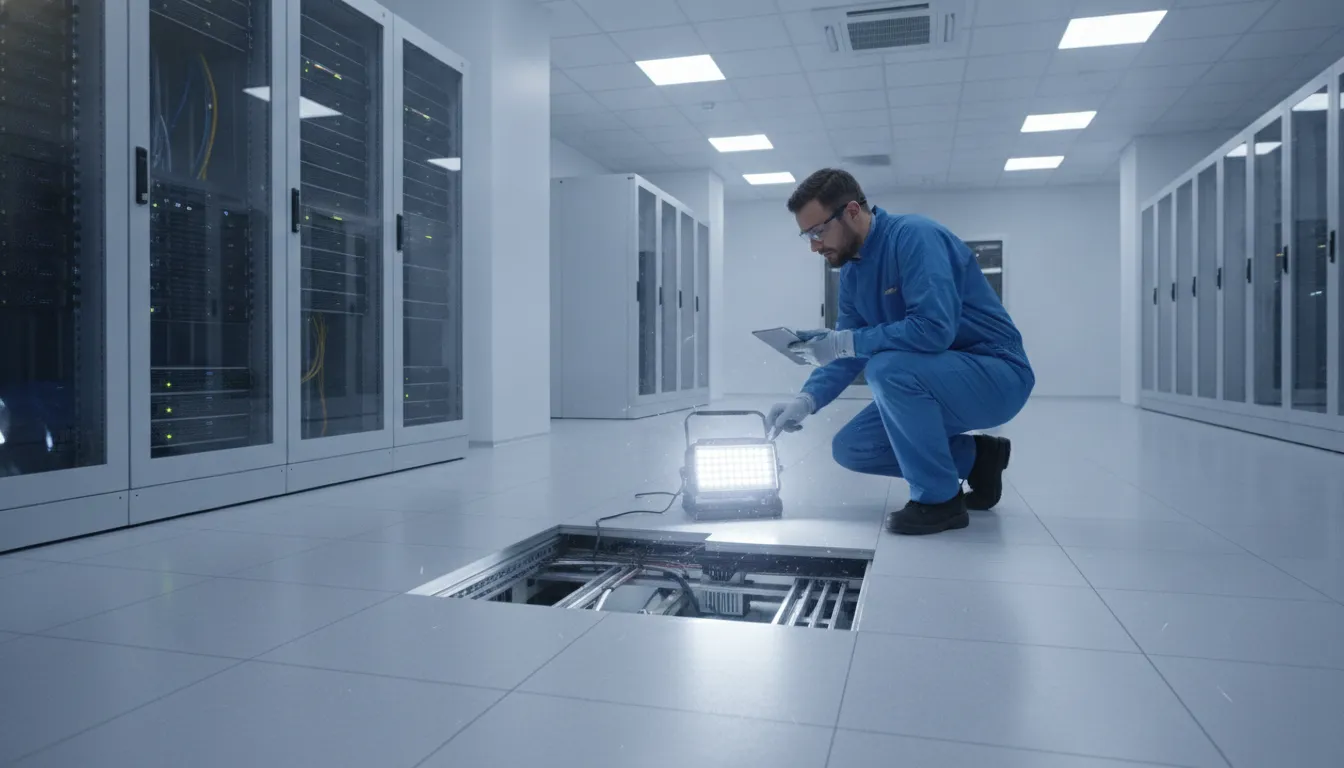
- First, lift some floor tiles to look at the undersides. Inspectors use bright lights and magnifying lenses to spot the tiny, shiny metal hairs. Since these filaments are very thin, they are hard to see with the naked eye.
- Next, use tape lift sampling to collect samples from the tile. Press a clean, sticky tape onto the tile bottom to capture any loose filaments. This method helps gather the hairs without breaking them into pieces.
- Then, send the tape samples to a lab for scanning electron microscopy (SEM). Lab technicians use this method to confirm if the fibers are zinc. The lab test gives a clear view of the crystal structure.
- Finally, set up airborne particle counters to track dust and debris in the subfloor plenum. High counts of small particles often point to active whisker shedding. This testing helps you track air quality over time.
Standardized testing and regular checks
Testing the space under your floor is a key part of raised floor cleaning. When you find these growths early, you can prevent server damage. Regular testing should be part of your data center cleaning standards to keep systems safe. Do not wait for unexplained power cuts to start checking your subfloor.
Many data center managers do not know they have a problem until a server fails. This is because zinc whiskers can grow for years without causing any clear signs of trouble. Regular checks help you find the danger before it leads to costly downtime. An expert team from Foreman Pro Cleaning knows how to lift floor tiles safely without spreading these dangerous metal hairs into the air. Safe cleaning keeps your key systems running without any break in service.
What Are the Best Practices for Zinc Whisker Remediation?
When you find zinc whiskers in a raised floor system, you must act fast to protect your hardware. These tiny metal filaments can break off and enter server airflow, causing short circuits. To remove this risk, experts must use a planned, step-by-step cleaning approach.
Replacing Electroplated Components
The best way to stop this threat is to remove all electroplated zinc parts from the room. You should replace old floor tiles with new ones that do not have zinc coatings. You can use hot-dip galvanized steel or inert parts like fiber-reinforced plastic (FRP) cable trays. Using these inert materials stops new growths from forming on cable paths. Guides by Chatsworth Products show that safe support systems protect your server rooms.
According to research from the University of Maryland CALCE, a single raised floor tile can hold millions of these microscopic particulates. Simply wiping or brushing these surfaces will not solve the issue. In fact, rough handling will only dislodge more filaments into the air. When replacing parts, cleaners must follow strict data center subfloor contamination rules to stop the spread of dust. Technical guides from Eaton suggest that replacing zinc-plated steel with powder-coated alternatives is the best way to protect server rooms.
Specialized HEPA Vacuuming Protocols
Never use standard vacuums inside a data center subfloor. These common vacuums do not have fine enough filters, so they will exhaust microscopic particulates back into the room. This stirs up the zinc whiskers and sends them into server air intakes. To prevent this, cleaners use specialized HEPA vacuums to sweep the area safely.
Vacuuming must be combined with a full dust control plan. Cleaners must wipe all surfaces with lint-free microfiber cloths to trap any loose metal dust. This careful work is part of the standard subfloor cleaning procedures used by experts. Following these rules keeps your systems running with no unplanned downtime.
Surface Encapsulation and Airflow Control
If you cannot replace all floor tiles at once, you can seal the existing surfaces. Painting or coating the undersides of the tiles is a way to encapsulate the zinc whiskers. This paint layer binds the whiskers to the tile and stops them from breaking free. But sealing is only a temporary fix. It does not stop new growth underneath the paint over time. Reports from DataSpan show that replacing parts is still the best long-term choice.
During any cleaning or sealing work, you must control the airflow in the room. Workers often shut down subfloor fans or use plastic sheets to block off the work zone. This keeps the rest of the room safe from loose dust. All remediation activities should aim to meet strict data center cleaning standards. Maintaining these levels helps you keep the room within the class limits set by ISO 14644-1. By partnering with Foreman Pro Cleaning, you can ensure that your critical spaces remain secure and clean.
How Does Professional Critical Environment Cleaning Reduce Zinc Whisker Risk?
Rigorous Critical Environment Training
Server room contamination needs expert care to prevent costly hardware downtime. Foreman Pro Cleaning has cleaned critical spaces in Maryland, Virginia, and Washington D.C. since 2014. We train our teams through our own Critical Environment Training (CET) program. This training ensures that every team member knows how to work around live server systems and helps us maintain a 98% client retention rate.
We know that even a small error during cleaning can dislodge metal dust. That is why our team does not use standard commercial cleaning methods. Instead, we use highly controlled steps that protect your servers. This careful process is why data center managers across the Mid-Atlantic trust our team with their critical systems.
How Do Critical Venue Inspections Find Risks?
Before starting any work, our experts run a Critical Venue Inspection (CVI). This process helps us find hidden threats beneath your raised floor tiles. A single raised floor tile of four square feet can host up to ten million zinc whiskers.
Based on research by the University of Maryland CALCE Center, these tiny metal strands can easily break off and enter server airflow. These loose strands often cause strange power supply failures and sudden hardware resets. Our audits find these hazards before they damage your server systems.
Specialized Contamination Control Protocols
Once we find a hazard, we set up strict contamination control plans. Our team uses HEPA-filtered vacuums to clean dust and particulates from subfloor plenums. Standard vacuums must not be used because they can spread and stir whiskers in the air.
We also apply special sealants to seal the underside of affected floor tiles. These steps help sites maintain high data center cleaning standards and meet ISO rules. If you need to secure your site, hiring a professional data center cleaning service is the best choice.
When we perform raised floor cleaning, we focus on every part of the subfloor assembly. This includes cleaning pedestals, stringers, and cable trays where zinc whiskers often grow. By removing dust from these surfaces, we stop contaminants from entering the cooling stream. Regular cleaning prevents these metal strands from building up over time.
Our hands-on work in legacy data centers makes us a trusted partner for regional sites. We understand how subfloor contamination threatens your critical systems and overall uptime. Our experts work closely with IT operations directors to clean subfloors with zero downtime. By fixing these threats early, we keep your network rooms running safely.
Frequently Asked Questions
How fast do zinc whiskers grow?
According to research from the University of Maryland CALCE, zinc whiskers can wait a long time before they grow. This delay can last from days to several years. Once growth starts, these tiny metal hairs can grow for months or years. They usually stay under one millimeter long, but some can grow up to ten millimeters.
Can you clean zinc whiskers off floor tiles?
No, you cannot clean zinc whiskers off floor tiles to solve the problem for good. Cleaning only removes the loose hairs on the surface. Because stress inside the metal drives the growth, new whiskers will keep forming. A single tile can host up to ten million whiskers, as shown by the University of Maryland CALCE. To fix this, you must replace the bad parts.
Does hot-dip galvanized steel grow zinc whiskers?
No, hot-dip galvanized steel does not grow zinc whiskers. According to the American Galvanizers Association, whiskers only form on electroplated zinc coatings. The hot-dip process does not create the high metal stress that causes whiskers to grow. Using hot-dip galvanized steel is a safe way to prevent whisker risks in your data center.
Can subfloor cleaning prevent zinc whisker issues?
No, subfloor cleaning alone cannot stop zinc whiskers from growing if electroplated metals are present. However, regular subfloor cleaning procedures by Foreman Pro Cleaning are vital to keep the room safe. Specialized cleaning removes loose contaminants and stops them from entering server airflow. This reduces the risk of hardware failures. For long-term safety, you must also replace the bad floor parts.
How Can You Protect Your Data Center From Zinc Whiskers?
Leaving zinc whiskers under your raised floor can lead to sudden short circuits, costly equipment damage, and server downtime. These tiny, conductive metal growths break free easily during routine work and can travel into server airflow without warning. Once inside your servers, they bridge circuits and trigger sudden system resets that disrupt your business. Cleaning your subfloor today prevents these contaminants from building up and keeps your server rooms running safely. Do not wait for a critical failure to address this hidden threat. A professional deep clean from Foreman Pro Cleaning removes current growths and helps secure long term uptime.
Ready to protect your hardware? Call (888) 360-1608 to schedule a data center cleaning consultation.
