
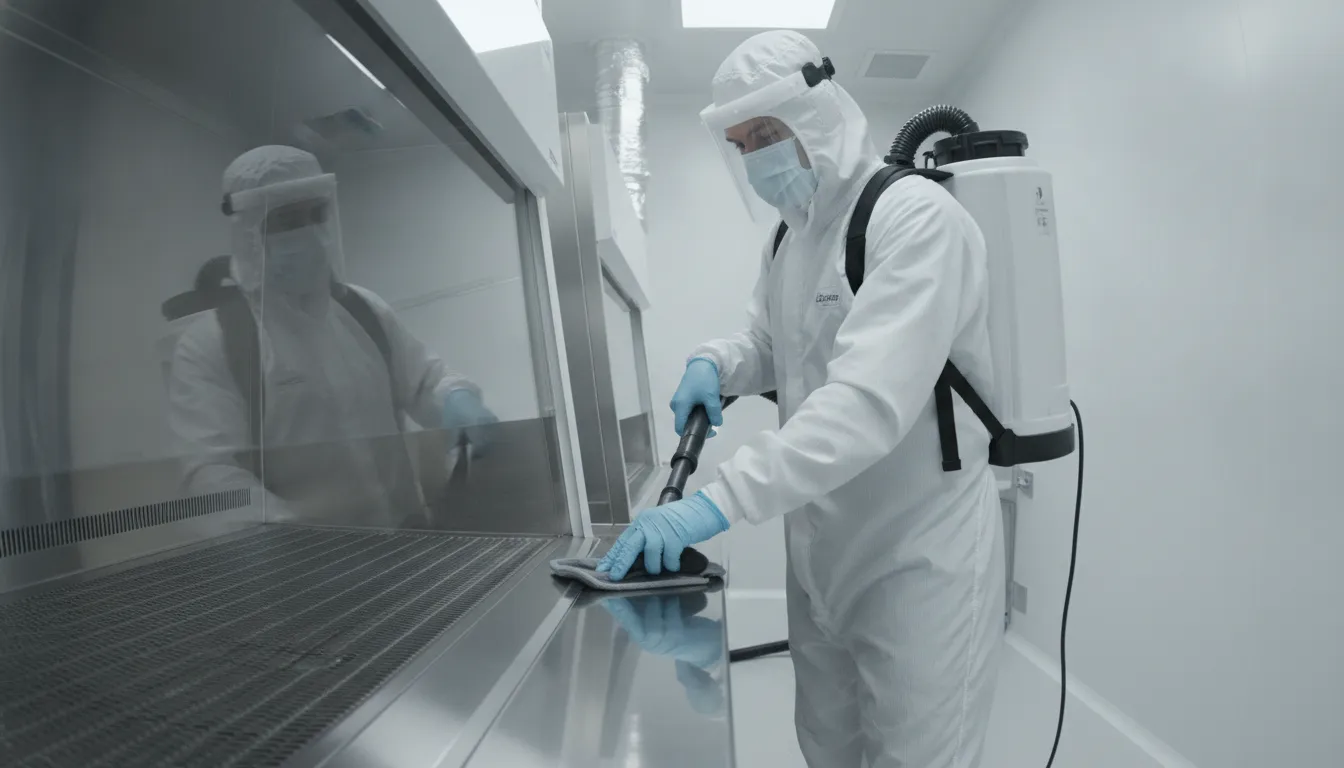
In a controlled environment, a cleaning plan cannot be separated from how the room is measured, used, and supported by facility operations. ISO 14644-1:2015 classifies air cleanliness in cleanrooms and clean zones by airborne particle concentration, using defined particle-size thresholds rather than treating every contamination risk as the same (ISO).
In practical terms, ISO 14644-1 class 8 describes an airborne-particle cleanliness classification, not a complete cleaning method or certification. A suitable program combines contamination-control procedures, equipment-sensitive techniques, documented work, and coordination with the facility’s operational and qualification requirements.
Discuss a site-specific critical-environment cleaning plan with Foreman Pro Cleaning.
That distinction matters because the classification tells you what the airborne-particle measurement addresses. While the cleaning plan determines how people, materials, equipment, scheduling, and records are managed around the room’s intended use. The first step is understanding exactly what the standard measures. You also need to know what it leaves outside its scope.
What Does ISO 14644-1 Class 8 Actually Measure?
ISO 14644-1 Class 8 describes airborne particle concentration in a cleanroom or clean zone. It is a classification of the air, not a rating of how thoroughly a room was cleaned. The standard considers cumulative particle populations at threshold sizes from 0.1 to 5 micrometers, using light-scattering discrete airborne particle counters at designated sampling locations. ISO’s scope for ISO 14644-1 explains the measurement basis and its limits.
For Class 8, commonly referenced limits are expressed as maximum concentrations per cubic meter of air. The table summarizes the relevant thresholds.
| Particle size threshold. | Maximum concentration per cubic meter. | What the figure represents. |
|---|---|---|
| 0.5 micrometers and larger. | 3,520,000. | Count of airborne particles at or above the threshold. |
| 1 micrometer and larger. | 832,000. | Count of airborne particles at or above the threshold. |
| 5 micrometers and larger. | 29,300. | Count of airborne particles at or above the threshold. |
The table values are concentration limits, not a universal pass or fail result for every condition.
These Class 8 values are reproduced in published cleanroom research, including the particle-count table in this review of cleanroom standards. Sampling design, room state, designated locations, and the applicable classification procedure all matter when interpreting measurements.
What does the classification leave out?
ISO 14644-1 does not classify particle populations outside its specified threshold range. It also does not identify whether counted particles are viable, biological, chemical, radiological, or otherwise hazardous. A Class 8 result therefore does not prove sterility, surface cleanliness, chemical control, or effective contamination control by itself.
Classification is also different from cleaning, monitoring, qualification, and certification. Cleaning removes or controls contaminants through a defined, equipment-compatible program. Monitoring tracks conditions over time. Qualification verifies that a space or system meets specified performance requirements. Certification is a separate professional or organizational designation, not something cleaning alone establishes.
For facility managers, the practical implication is to coordinate particle classification with a site-specific contamination-control program. Foreman Pro Cleaning supports this broader work through critical environment cleaning, while the facility’s qualified technical team remains responsible for defining and verifying its classification requirements.
How Should You Build an ISO 14644-1 Class 8 Cleaning Plan?
A useful plan translates the room’s intended use and contamination risks into controlled work practices. It should not treat a cleaning schedule as a substitute for qualification, particle monitoring, or facility engineering. ISO 14644-2 ties monitoring-plan requirements to a risk assessment based on intended use, so the cleaning scope should begin with the same discipline. Review the monitoring framework alongside the facility’s quality and operations requirements.
- Define the room’s zones and risk points. Map the classified room, gowning areas, airlocks, pass-throughs, material staging areas, and adjacent support spaces. Identify where personnel movement, packaging, maintenance access, process residues, or high-touch surfaces could introduce contamination. Set priorities according to the work performed in each zone, rather than applying one identical task list everywhere. Document boundaries, access restrictions, approved entry procedures, and surfaces that require special handling.
- Set the work sequence from cleaner areas to less controlled areas. Establish a repeatable route that prevents personnel and equipment from carrying contamination back into completed work. Coordinate the sequence with production, laboratory, maintenance, and quality teams so cleaning does not interrupt active processes or conflict with material transfers. Define when the room must be unoccupied, what equipment must be powered down or isolated, and how deviations from the route will be recorded.
- Control personnel, materials, and equipment before entry. Specify gowning expectations, hand hygiene, approved consumables, packaging removal, and staging procedures. Select tools that can be dedicated to the zone and maintained in a controlled condition. The plan should also address chemical compatibility, hazardous-material procedures, and sensitive surfaces. Foreman Pro’s laboratory-cleaning approach includes contamination-control procedures, equipment-sensitive protocols, chemical-handling awareness, and sensitive-surface handling, all of which support a site-specific scope. See laboratory and cleanroom cleaning considerations.
- Specify equipment-safe cleaning methods. Identify approved cleaning agents, concentrations, contact times, wiping materials, and application methods through the facility’s validated procedures. Define how floors, walls, ceilings, benches, cabinets, fixtures, and difficult-to-access surfaces are addressed without damaging equipment or disrupting airflow. Where HEPA-filtered equipment is required, include inspection, maintenance, storage, and use controls rather than assuming ordinary janitorial equipment is suitable.
- Coordinate execution, verification, and reporting. Assign responsibilities among the cleaning team, facilities, quality, and process owners. Include training requirements, room-release criteria, issue escalation, and a post-service report that records completed tasks and exceptions. Cleaning records provide evidence of work performed, while monitoring data provides evidence over time of particle performance. Neither should be presented as proof that cleaning alone establishes an ISO classification. Foreman Pro Cleaning uses an evaluation, customized program, precision cleaning, quality assurance, reporting, and program-assessment workflow that can be adapted to the facility’s procedures.
Which Controls and Records Support Class 8 Performance?
A defensible control program separates three related responsibilities: performing the cleaning, verifying the controlled space, and monitoring whether conditions remain within the facility’s requirements. A cleaning log can show what work occurred, but it does not replace qualification or particle-monitoring evidence.
How do facility conditions fit the record?
HVAC performance is part of the operating context, not a detail to leave out of the service record. ISO-classified spaces use HVAC designed to reduce airborne contaminants below specified levels. With temperature and relative humidity controlled more tightly than ambient conditions, according to applicable aseptic processing guidance. The site team should identify relevant room status, pressure or airflow conditions, temperature, and relative humidity requirements in the approved procedure. Cleaning personnel should document observations or exceptions and escalate conditions they are not authorized to adjust.
What should monitoring evidence demonstrate?
Particle monitoring is a separate evidence stream. ISO 14644-2 describes monitoring as a way to provide evidence of cleanroom performance related to airborne particle concentration. With the monitoring plan based on a risk assessment of intended use (ISO 14644-2 overview). Records should therefore identify the room or zone, sampling context, date and time, instrument or responsible function, result, applicable acceptance criteria, and reviewer. The schedule and sampling locations should come from the facility’s approved qualification and monitoring program, not from a generic cleaning checklist.
How should cleaning deviations and signoff be handled?
A useful cleaning record connects the completed task to the controlled procedure. It can include the area and surfaces addressed, method or approved chemical, equipment used, personnel, start and finish times, and any access or operational restrictions. If a surface could not be serviced, a material was unavailable, or an unexpected condition affected the work, record the deviation, immediate containment, notification, and disposition. Signoff should distinguish the person who performed the work from the person who reviewed it. This makes the record more useful during an investigation or audit than a simple completed/not-completed mark.
Foreman Pro Cleaning describes a critical-environment workflow that includes site evaluation, a customized program, precision cleaning, quality assurance, a post-delivery report, and program assessment (critical environment cleaning). For facility managers, the post-service report should make the next decision clear: accept the work, investigate a deviation, coordinate a facility-system review, or schedule follow-up monitoring. A data center cleaning checklist can also help organize access, responsibility, and signoff controls where cleaning intersects with operations.
How Does Class 8 Compare With Other Controlled Environments?
The class designation helps describe airborne particle concentration, but it does not choose the right facility design or cleaning program by itself. The comparison below uses the cited limit at or above 0.5 micrometers. The figures are classification thresholds, not a complete description of facility risk or performance.
| ISO class | Particles per cubic meter | How to interpret the comparison |
|---|---|---|
| ISO Class 7 | 352,000 | A lower airborne-particle limit than Class 8. |
| ISO Class 8 | 3,520,000. | A defined particle-concentration class for the intended controlled environment. |
| ISO Class 9 | 35,200,000 | A higher airborne-particle limit than Class 8. |
The Class 7, Class 8, and Class 9 values come from a published review of cleanroom classification thresholds (reviewed ISO particle limits). A lower or higher class is not automatically better for every operation. The appropriate classification depends on the intended use, process sensitivity, facility design, qualification requirements, and the site’s risk assessment.
What does the class comparison leave out?
ISO 14644-1 addresses airborne particle concentration. It does not characterize whether particles are physical, chemical, radiological, viable, or otherwise hazardous. Airborne molecular contaminants may require separate consideration, and ISO 14644-8 addresses grading airborne chemical concentrations rather than classifying surface chemical contamination (ISO 14644-8 scope).
That distinction matters when planning work. Cleanroom cleaning should support the site’s contamination-control procedures and must not be treated as a substitute for laboratory-specific protocols, process controls, monitoring, or qualification. Foreman Pro Cleaning can coordinate a site-specific critical environment cleaning approach with facility and quality teams, while the facility owner retains responsibility for defining the applicable requirements.
Frequently Asked Questions About ISO Class 8: What Should You Know?
What is a Class 8 cleanroom?
A Class 8 cleanroom is a controlled space classified by the concentration of airborne particles at specified sizes. ISO 14644-1 uses particle thresholds from 0.1 to 5 micrometers, but the classification does not identify whether particles are biological, chemical, radiological, or otherwise hazardous. See the ISO 14644-1 standard summary.
Is ISO 8 the same as Class 100,000?
ISO 8 is commonly associated with the former Federal Standard 209E Class 100,000 designation. Treat that comparison as historical terminology, not as a substitute for the current ISO classification method, sampling plan, or facility-specific qualification records.
How do you maintain an ISO Class 8 cleaning program?
Build the program around the space’s intended use, contamination risks, materials, equipment, personnel movement, and coordination requirements. Cleaning records support execution and accountability, while particle monitoring and qualification are separate activities that demonstrate environmental performance.
Does cleaning alone establish ISO Class 8 compliance?
No. Cleaning helps control sources of contamination, but it does not by itself establish or maintain an ISO classification. The facility’s HVAC, operating controls, monitoring approach, and qualification responsibilities must be evaluated with the appropriate quality and facilities teams.
Is a Class 7 cleanroom better than a Class 8 cleanroom?
Neither class is universally better. Class 7 permits a lower airborne-particle concentration than Class 8, but the appropriate classification depends on the process, product, risk assessment, and applicable quality requirements. Use the classification that matches the work rather than selecting a stricter class by default.
Facility managers should also ask which room state applies to the decision. A count taken while a room is at rest does not answer every question about performance during active operations. The approved qualification and monitoring program should define the relevant state, locations, frequency, instruments, acceptance criteria, and response to an excursion. Cleaning staff can support that program by following controlled methods, protecting the room during entry and exit, and documenting exceptions. They should not change a classification target simply because a stricter class sounds more reassuring.
The choice also affects coordination. A lower particle limit may bring different engineering, gowning, scheduling, and verification expectations. A Class 8 room may be appropriate for one process and insufficient for another. The decision belongs to the facility’s technical and quality stakeholders, with the cleaning scope designed to support the selected requirements.
Discuss a site-specific ISO 14644-1 Class 8 cleaning plan with Foreman Pro Cleaning.
