
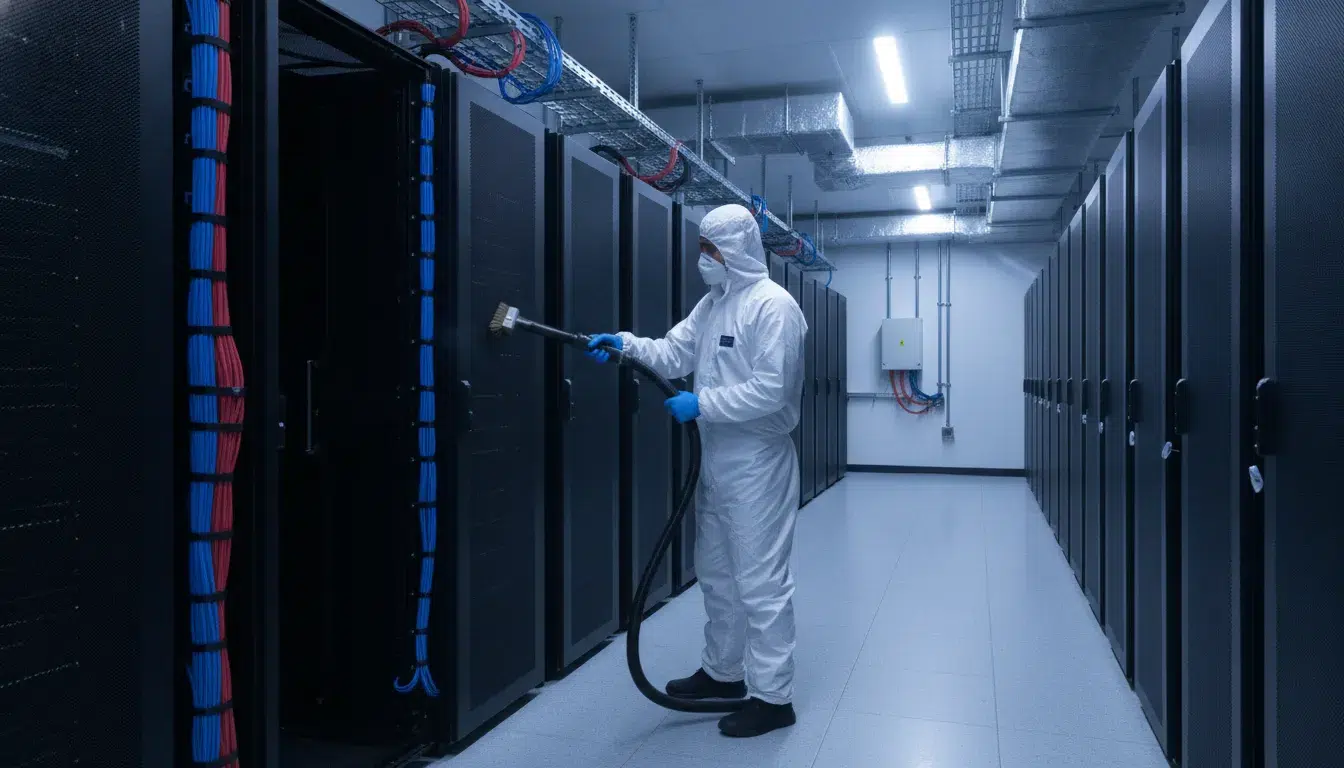
A server room is not quoted like a routine office-cleaning visit. The estimate must account for the environment, the surfaces being serviced, the equipment nearby, and the controls required to protect active infrastructure.
Professional server cleaning cost is determined by the documented scope, room layout, access requirements, cleaning protocols, schedule, and reporting expectations. Because critical-environment needs vary, a responsible proposal follows a walkthrough and needs assessment rather than a generic rate card.
Discuss your server-room cleaning requirements with Foreman Pro Cleaning.
For facility and IT teams, the most useful question is not whether one quote has the lowest headline figure. It is whether each proposal describes the same work, assumptions, controls, and deliverables. That starts with knowing what a complete quote should document.
What Should a Professional Server Cleaning Cost Quote Include?
A professional server cleaning cost quote should function as a scope-and-conditions document, not a generic rate card. A meaningful proposal explains what will be cleaned, how the work will be performed, what conditions the plan assumes, and which activities require coordination or approval. Because critical-environment pricing is customized to facility-specific requirements, there is no standardized rate card that can accurately represent every server room or data center.
The first stage should be a consultation and facility walkthrough. The provider should review the room layout, approximate square footage, access requirements, environment type, service frequency, compliance expectations, and any specialized equipment or protocols that apply. Layout complexity matters because a compact communications room, a raised-floor white space, and a larger data-center environment can involve very different work areas and controls. These factors should be documented rather than hidden behind a single generalized rate.
A needs assessment should then translate the walkthrough into a custom cleaning plan. The quote should identify the areas under consideration, such as server and communications rooms, raised-floor surfaces, sub-floor plenums, rack and cabinet exteriors, accessible cable-management areas, or cooling-system surfaces. The raised-floor surface and the plenum below it should be treated as related but distinct work areas. A proposal should also distinguish components technicians may clean directly from components that require IT, facilities, or manufacturer approval.
The written Scope of Work is the core of the quote. It should specify inclusions and exclusions, cleaning methods, equipment, sequence, inspection expectations, reporting, and any assumptions about access or site readiness. For example, a proposal may describe HEPA vacuuming in a sub-floor plenum, non-abrasive microfiber work around rack and cabinet surfaces, or static-safe procedures where applicable. It should not imply that interior equipment cleaning, cable movement, or work near sensitive components is included unless the responsible parties have approved that activity.
Conditions belong in the document as well. Access protocols, security requirements, maintenance windows, change-control procedures, airflow considerations, certifications, and scheduling constraints can affect how the work is planned. Foreman Pro Cleaning builds critical-environment plans around facility staff, IT teams, security requirements, and vendor guidance. Its stated process moves from assessment and custom-program development to precision cleaning, inspection, reporting, and program assessment. Reviewing a data center deep-cleaning planning guide can help teams prepare the information needed for that conversation.
Unsupported dollar amounts do not belong in an educational cost discussion or a preliminary quote comparison. An accurate figure requires the provider to understand the actual environment, scope, frequency, protocols, and operating conditions first. A proposal that clearly records those variables gives IT and facilities decision-makers a more useful basis for comparison than a low headline rate with unclear exclusions.
How Do Room, Rack, and Equipment Scope Change the Estimate?
A facility walkthrough should separate the areas being cleaned, the components that can be accessed directly, and the work that requires IT, facilities, or manufacturer approval. That distinction is central to a defensible estimate. Square footage matters, but it does not describe whether the assignment includes a server room, communications room, raised-floor plenum, rack exteriors, cabinet tops, cooling surfaces, or high work. Foreman Pro’s planning guidance treats these as distinct scope decisions rather than one undifferentiated room total.
For example, the raised-floor surface and the plenum below it are related but separate work areas. The published data-center scope includes sub-floor plenum cleaning, anti-static top-floor care, and cabinet and rack interior cleaning as different services. A proposal should state which floor areas and equipment surfaces are included, how access will be coordinated, and what remains outside the assignment. This is more useful than comparing a single line labeled “server room cleaning.”
| Scope category | What may be included | What the proposal should clarify |
|---|---|---|
| Room and zone boundaries | White space, network or server rooms, staging and storage areas, transition points, and electrical or mechanical support areas | Which rooms and transition points are included, where protocols change, and which zones are excluded |
| Floor and plenum | Raised-floor surface care, anti-static floor care, pedestal or stringer areas, and sub-floor plenum HEPA vacuuming | Whether the top floor, under-floor plenum, or both are covered, plus access and panel-handling assumptions |
| Racks and cabinets | Rack exteriors, cabinet tops, cable-management areas, and approved interior surfaces | Whether interior cleaning is authorized, which cabinets are accessible, and what requires IT or manufacturer approval |
| Cooling and facility equipment | Accessible surfaces on HVAC or CRAC units, vents, returns, and other facility equipment | Which units and surfaces are in scope, how access is provided, and whether the work is cleaning or a separate maintenance responsibility |
| High work | Ceilings, venting, cable racks, and other elevated surfaces | Exact locations, access equipment requirements, and whether high work is included or excluded |
Each row should be marked explicitly as included, excluded, or subject to approval. Foreman Pro’s published process describes a detailed evaluation before raised-floor work, including careful removal of movable objects. Its planning guide also recommends documenting zone boundaries so technicians understand where clean-zone protocols, airflow, or personnel controls change. Those details can affect labor planning, equipment selection, sequencing, and coordination even when two facilities have similar floor areas.
Equipment scope also requires precise methods. Foreman Pro describes HEPA-filter vacuums and non-abrasive microfiber cloths for rack and cabinet cleaning, and HEPA vacuuming for the sub-floor plenum. The estimate should identify the applicable protocol and the surfaces it covers, rather than implying that every visible component will be handled the same way. A clear professional data center cleaning plan connects room boundaries to rack, floor, cooling, and high-work responsibilities, giving facilities and IT teams a comparable basis for reviewing proposals.
Why Do Contamination Conditions and Cleaning Protocols Matter?
A server room can appear orderly while still containing contamination that matters to electrical and cooling systems. Particles smaller than 10 micrometers may be difficult to notice, yet they can reach areas where damage is possible. Research on data-center environments also reports that particulate can settle on electrical-component surfaces and may include salts and metallic particles. Some salts are neutral, while others may become corrosive depending on humidity conditions. The NSF-hosted study explains these particulate and humidity-related risks in greater detail.
That is why a quote should account for contamination conditions, not just visible floor area. The relevant questions include where particulate may collect, whether raised-floor plenums or rack exteriors are in scope. How close work occurs to active equipment, and what the facility’s access and approval protocols require. A condition assessment helps separate routine surface care from precision work that needs a more controlled method.
How can cleaning methods protect sensitive surfaces?
Equipment-adjacent cleaning requires methods selected for the environment and the material being treated. Foreman Pro’s published scope includes HEPA-filter vacuum systems for particulate removal and non-abrasive microfiber cloths for rack and cabinet surfaces. HEPA vacuuming may also be specified for sub-floor plenums, where accumulated particulate can affect airflow and create a pathway toward equipment ingestion. These methods address different surfaces and should not be treated as interchangeable with general facility cleaning.
Static control is another protocol consideration. Depending on the assessed scope, a plan may call for ESD or static-safe methods, anti-static products, and careful selection of tools and materials. The purpose is not to assume that every room has the same risk profile. It is to align the work method with the equipment, surface, environmental conditions, and facility requirements documented during planning.
What should a protocol-driven proposal clarify?
A useful proposal identifies the areas included, the surfaces that technicians may clean directly, and any components requiring IT, facilities, or manufacturer approval. It should also identify applicable compliance requirements, specialized equipment, inspection steps, and reporting expectations. Foreman Pro describes its critical-environment process as assessment, custom program creation, precision cleaning, inspection, reporting, and program assessment. That structure gives facilities and IT teams a clearer basis for comparing scope rather than comparing an unexplained number.
These details are part of critical-environment cleaning protocols. They can also affect coordination with airflow, change control, and maintenance planning. A protocol may be designed around an approved work window, but no cleaning plan should imply that downtime is automatically guaranteed or unnecessary. The final approach depends on the facility’s operating conditions, equipment guidance, and approvals.
How Do Access, Work Windows, and Frequency Affect Cost?
Access planning can change the labor assumptions behind a professional server cleaning cost quote even when the physical area remains the same. A facility may require security clearances, escort procedures, badging, certifications, equipment approvals, or coordination with an IT and facilities team. These requirements should be identified before the scope is finalized, because they affect who can enter the space. How materials move through it, and how long preparation and closeout may take. Access requirements and needed certifications are recognized quote considerations for critical-environment work.
Work windows require the same level of precision. A cleaning plan may need to align with a maintenance window, change-control process, airflow requirements, or restrictions on activity near active systems. Foreman Pro’s planning guidance recommends accounting for maintenance windows, change control, access protocols, and airflow when organizing the work. That does not mean cleaning should be treated as a guaranteed downtime event. Instead, the written plan should state the approved window, areas available for service, coordination responsibilities, and any work that requires IT, facilities, or manufacturer approval.
For example, a server room may have one window for floor and perimeter work and another for approved rack or cabinet surfaces. Components that technicians may clean directly should be separated from components requiring approval. A team evaluating safe server room cleaning should also confirm how access, equipment protection, and operational controls fit together before work begins.
How do after-hours and weekend schedules change the plan?
After-hours, overnight, and weekend service can be appropriate when facilities want to limit activity during normal operations. However, a non-business-hour window still needs an accountable site contact, access instructions, emergency procedures, and a defined start and stop time. If the window is narrow, the scope may need to be divided into phases rather than treated as one uninterrupted visit. Foreman Pro identifies after-hours, overnight, weekend, maintenance-window, and 24/7 critical-environment scheduling as possible service structures, subject to the facility’s requirements.
Why does one-time work differ from recurring service?
A one-time project often begins with broader discovery, initial condition assessment, and detailed scope definition. Recurring service can use an established program, but its frequency still matters. Monthly, quarterly, or event-driven work may assign different tasks to each visit, such as routine accessible-surface cleaning followed by periodic plenum, high-work, or detailed equipment-area work. Frequency should therefore describe what is performed, where it is performed, and what triggers a change in scope, not simply how often a crew arrives.
Ask for every access assumption, work window, approval requirement, and service frequency to appear in the written Scope of Work. Foreman Pro’s quote process includes a consultation, facility walkthrough, needs assessment, custom cleaning plan, and written specifications. Clear documentation makes proposals easier to compare and reduces the risk that an unstated scheduling or access condition becomes a change in the work plan.
Which Records and Deliverables Should Buyers Request?
A proposal is easier to evaluate when it documents the work rather than presenting a single total without context. Foreman Pro’s quote process includes consultation, a facility walkthrough, a needs assessment, a custom cleaning plan, and a written Scope of Work with specifications. Buyers should expect those records to connect the proposed service to the actual rooms, systems, access conditions, and operating requirements.
What should the written Scope of Work define?
Request a zone-by-zone description of the work. It should identify whether the proposal covers the white space, server or communications rooms, staging areas, transition points, raised-floor surfaces, or the plenum below them. It should also identify the components included, such as rack exteriors, cabinet tops, cable-management areas, and accessible cooling-system surfaces. A clear scope should state the approved cleaning methods and equipment, including where HEPA systems, non-abrasive microfiber, or static-safe procedures apply.
Inclusions and exclusions matter just as much. The document should distinguish areas technicians may clean directly from components that require approval from IT, facilities, or a manufacturer. It should record whether equipment must be powered down, isolated, opened, moved, or left untouched. If environmental sampling or specialized reporting is requested, list it as a defined deliverable rather than assuming it is part of every cleaning visit.
Which coordination records protect the work plan?
Ask the provider to document required approvals, authorized contacts, badge or escort procedures, restricted zones, and the agreed work window. The plan should account for maintenance windows, change control, access protocols, and airflow. These details give facilities and IT teams a shared reference before technicians enter a controlled environment. They also clarify which assumptions could change the scope if site conditions differ from the walkthrough.
What should inspection and reporting include?
A complete program should explain how work is inspected, what findings are recorded, and who receives the report. Foreman Pro describes its critical-environment process as assessment, custom-program creation, precision cleaning, inspection, reporting, and program assessment. Request documentation that identifies completed areas, exceptions, observed conditions, corrective recommendations, and any items deferred for approval. For recurring service, ask when the program will be reviewed and how changes to zones, equipment, access, or operating requirements will be incorporated.
These records make proposals comparable without reducing a critical environment to a generic rate card. They also create a practical change-control trail when the facility evolves.
Request a documented server-room cleaning scope for your facility.
How Can IT and Facilities Teams Compare Proposals Fairly?
A fair comparison starts by making each proposal describe the same work. A lower total may reflect a narrower zone definition, fewer service visits, limited access assumptions, or exclusions that another proposal has included. Because critical-environment cleaning has no standardized rate card, the useful comparison is scope against scope, not one headline number against another. Square footage matters, but so do layout complexity, environment type, compliance requirements, specialized protocols, and access requirements. Evaluate a data center cleaning company using those operational details rather than a generic commercial-cleaning checklist.
Normalize the physical scope
Ask every provider to identify the same zones and surfaces. The proposal should state whether it covers white space, staging or storage areas, network and server rooms, support areas, and transition points. Within a raised-floor environment, require separate language for the floor surface and the under-floor plenum. That distinction prevents a proposal from appearing more comprehensive simply because it uses a broad phrase such as “full facility cleaning.”
Do the same for equipment surfaces. Confirm whether rack and cabinet exteriors, tops, cable-management areas, accessible cooling-system surfaces, CRAC units, and other facility equipment are included. Ask which components may be cleaned directly and which require IT, facilities, or manufacturer approval. Foreman Pro’s data center deep-cleaning planning guidance emphasizes documenting these boundaries before work begins.
Normalize methods, timing, and documentation
A comparable proposal should identify the methods that protect the environment, such as HEPA vacuuming, non-abrasive microfiber use, and static-safe procedures where applicable. It should also state the expected service frequency, work window, access process, security or certification assumptions, and coordination requirements. A proposal that assumes unrestricted daytime access is not equivalent to one designed around a controlled maintenance window, overnight work, or escorted entry.
Finally, compare the deliverables. Look for a written Scope of Work, inspection approach, reporting, identified exclusions, and a change process for conditions discovered after the walkthrough. A well-defined process generally moves from assessment and custom program creation through precision cleaning, inspection, reporting, and program review. Those records help IT and facilities teams confirm what was completed and resolve differences without relying on memory.
Before selecting a provider, place the proposals side by side and mark each item as included, excluded, assumed, or requiring approval. Then ask providers to revise unclear items in writing. This makes the professional server cleaning cost easier to interpret because the comparison reflects the same operational obligations, not merely different labels for different work.
Request a site-specific proposal for your server room or data center.
Frequently Asked Questions: What Should Buyers Know?
Why is there no standard professional server cleaning cost?
Critical-environment cleaning is scoped to the facility rather than selected from a universal rate card. Square footage, layout, environment type, service frequency, access requirements, compliance needs, and specialized protocols can all change the work involved. A walkthrough and needs assessment provide the information required for a site-specific proposal.
What does a server-room cleaning walkthrough cover?
A walkthrough reviews the room layout, equipment and rack areas, raised-floor or plenum conditions. Access controls, airflow considerations, maintenance windows, and the areas the team wants included or excluded. It should also clarify coordination with facilities, IT, security, and equipment vendors before a written scope is prepared. Foreman Pro’s planning guidance identifies access protocols, change control, maintenance windows, and airflow as planning considerations.
How do scope and cleaning frequency affect a proposal?
Scope may include server and communications rooms, rack or cabinet surfaces, raised-floor plenums, floors, high work, or CRAC and HVAC surfaces. A one-time project, recurring program, short-term project, or contract arrangement also creates different planning requirements. The proposal should state the selected areas, methods, frequency, schedule, and any assumptions instead of presenting a generic figure.
What records should we request with a cleaning proposal?
Request a written Scope of Work with specifications, clear inclusions and exclusions. The proposed service frequency, access and scheduling assumptions, inspection or reporting details, and any required coordination responsibilities. These records make proposals easier to compare and give IT and facilities teams a reference for change control and future service reviews.
Can cleaning be scheduled around a maintenance window?
Yes, scheduling can be planned around the facility’s operating requirements, including maintenance windows and approved access periods. Confirm the requested window, escort or credential requirements, change-control process, affected zones, and responsible contacts during the walkthrough. After-hours, overnight, weekend, and other scheduling options should be documented in the proposal when relevant.
What Is the Next Step for Planning Server-Room Cleaning?
A useful proposal starts with the environment, not a generic rate card. Foreman Pro Cleaning can review the areas involved, the access and security requirements. The preferred work window, the cleaning methods, and the records your facility and IT teams need. That information supports a written scope that is easier to evaluate and refine.
Foreman Pro serves commercial and critical environments across Maryland, Washington, D.C., and Virginia, including server rooms, communications rooms, and data-center spaces. A site-specific conversation can clarify whether the immediate need is a one-time deep clean, recurring service, or a phased program.
